
UCPI Daily Report, 5-10 Nov 2025: James Thomson evidence

James Thomson (centre, Barbour jacket, looking at camera) after his spycop career, working as a protection officer for Tony Blair, Dublin, September 2010
INTRODUCTION
Special Demonstration Squad officer HN16 James Thomson ‘James Straven’ was deployed 1997-2002, infiltrating London-based animal rights groups. He deceived several women into long-term intimate relationships.
He gave evidence to the Undercover Policing Inquiry over three days: 5, 6 and 10 November 2025. His evidence was broadcast audio-only in order to protect his privacy.
It is not clear why the Inquiry chose to pander to the desires of this abusive perpetrator and deny the public video access to important evidence, despite Thomson’s relatively recent photo and real name being in the public domain.
The Undercover Policing Inquiry (UCPI) is an independent, judge-led inquiry into undercover policing in England and Wales. Its main focus is the activity of two units who deployed long-term undercover officers into a variety of political groups: the Special Demonstration Squad (SDS, 1968-2008) and the National Public Order Intelligence Unit (NPOIU, 1999-2011). Spycops from these units lived as activists for years at a time, spying on more than 1,000 groups.
This hearing was part of the Inquiry’s ‘Tranche 3 Phase 1’, which is examining the final 15 years of the Special Demonstration Squad, 1993-2008.
Thomson was questioned by Counsel to the Inquiry, David Barr KC. The full transcripts and audio for each day can be found on the Inquiry’s hearing pages for 5 November, 6 November, 10 November.

David Barr KC, Counsel to the Inquiry
As there is no video from the hearings, it is important to report that spectators in the public gallery described Thomson answering many of the initial questions with a smirk or a wry smile. From his body language, he appeared to be enjoying himself, being asked about his time as an undercover officer.
But later on, as the questioning moved on to the many serious matters of his multiple wrongdoings, his demeanour changed, and he became visibly less comfortable. This is the kind of important detail the public misses when the Inquiry refuses to broadcast video of the spycops giving their evidence.
When specific documents are mentioned in this report, we give their Inquiry reference numbers. If the Inquiry has published them, the numbers are hyperlinked.
However, at the time of publication, three months after the hearings, the majority of the 67 documents we cite in this report are still unpublished. It is absurd that the Inquiry thinks it is fulfilling its purpose when it hasn’t got round to publishing the evidence it is citing.
Questioning went back and forth on topics a lot over the three days, so this report has been organised according to themes in the evidence rather than going through it day by day.
This is a long report. Use the links below to jump to a particular topic.
A Known Liar
The major lies told before the hearing began
Misuse of Fake Identities
Stealing Kevin Crossland’s identity long before Thomson was undercover, fraudulent use of documents
Abusive Relationships
Sara, Wendy and Ellie; harassment and manipulation after his deployment ended
Targeting and Deployment
Hunt saboteurs, Shamrock Farm, the growing remit of the NPOIU
Participation in Crime
Public disorder and ‘Operation Lime’ – the gunpowder plot
Foreign Travel
Going abroad with and without authorisation
Intelligence and Tradecraft
Low value reports, racism, sexism, and violation of legal privilege
HN26 ‘Christine Green’
Thomson’s contemporary who left the police to marry a hunt sab
Management Accountability & Post-Deployment Dishonesty
Introduction of RIPA regulations, withdrawal and disciplinary action, claims about mental health
Conclusions
The absence of conscience, remorse and credibility
A Known Liar
At the start of this set of hearings in October 2025, David Barr KC’s opening statement to Tranche 3 gave a summary of what would be heard in the following weeks. He singled out Thomson’s dishonesty:
‘One thing is certain: Mr Thomson has, on his own admission, told many lies to date. He has lied not only to those he mixed with whilst deployed but also to his managers and to the Inquiry. His credibility is very much an issue.’
Now that Thomson was at the Inquiry in person, Barr began by reading Thomson’s witness statement into the evidence. He specified:
‘You have provided a witness statement to the Inquiry, in fact a series of witness statements. I am referring to the last and the longest of those witness statements.’ [UCPI0000035553].
Barr later noted that several of Thomson’s written statements were retractions of lies he had told in previous statements, offering excuses for his mendacious behaviour.
Thomson was questioned about many issues that arose from the evidence of ‘Sara’, ‘Ellie’, ‘Wendy’, ‘L3’, and Liisa Crossland who we heard from in previous hearings.
Barr went on to explore those lies with him in more detail on the last day of questioning. We were shown Thomson’s October 2017 witness statement to the Inquiry [UCPI0000035199]. In it, he asserted that he never had inappropriate relationships with Sara, Ellie or Wendy, and even claimed to have never heard Ellie’s name.
Thomson admitted these were bare-faced lies, and that he deliberately and dishonestly sought to mislead the Inquiry. He claims this was to avoid being exposed as having conducted deceitful sexual relationships and losing his anonymity, and tries to suggest it was only ever intended to be a temporary lie.
We were then shown a statement he made in April 2018 [UCPI0000035223]. In it, Thomson states:
‘This statement is intended to correct parts of the account I submitted to the Inquiry immediately before the closed hearing on 17th October 2017, held to consider my application for anonymity, and as importantly to allow me to apologise to the Inquiry for my comments in particular, and my approach in general.’
Barr asked Thomson why he made that apology:
‘Q. Was it also to try to give the impression to the Inquiry that you were contrite and now coming clean?
A. I was contrite.
Q. And coming clean?
A. I hope so.
Q. Let’s have a look at that.’
In the second statement Thomson admitted he did have relationships with Sara and Ellie, but described the former as ‘a brief sexual relationship over a few weeks’ and the latter as ‘lasting a number of months’. There is no mention that he had sex with Ellie as late as 2015, fifteen years after the relationship began.
Barr pointed out that the apology came after the Inquiry had written to Thomson to inform him that his cover name would be made public. It was only a matter of time before Ellie and Sara would be able to tell the Inquiry about the relationships themselves.
The fact that Thomson has repeatedly told proven lies to the Inquiry in the past clearly framed Barr’s approach to his answers during the hearings, and set the tone for all of the evidence we heard over the three days.
Misuse of Fake Identities
Thomson committed a dizzying list of deceitful, fraudulent and illegal acts while undercover, involving the creation of false identities and the manipulation of ID documents.
Thomson used the official cover name ‘James Straven’. He says that creating an undercover persona by stealing a dead child’s identity was briefly mentioned to him when he was first sounded out for joining the SDS, but he never spoke again to any other SDS officers about how to do it.
The practice was no longer in use when he joined. When he was creating his ‘legend’ he was directly told by his managers HN216 Keith Edmondson and HN10 Bob Lambert not to steal a dead child’s identity.
‘James Straven’ was a fictitious identity, not based on any real individual, and he is not aware of anyone ever researching or testing the ‘James Straven’ legend.
KEVIN CROSSLAND

Kevin Crossland, shortly before he was killed in 1966
Despite this, Thomson did use an alternative (and seemingly unauthorised) identity, ‘Kevin Crossland’, which he stole from a dead child.
The real Kevin Crossland died in a plane crash in Ljubljana, Yugoslavia in 1966, when he was 5 years old. We heard evidence from Liisa Crossland on 4 November about Kevin’s life and the damage Thomson has caused her family.
One extremely striking feature of Thomson’s theft of Kevin Crossland’s identity is that he seemingly obtained the birth certificate in 1991, five years before he joined the SDS. This strongly suggests that he was already corrupt and criminally minded, even before he became an undercover officer.
A copy of Kevin’s birth certificate [MPS-0526867] was made on 9 July 1991. Barr pointed out that it bears a Special Branch reference number, SB/309/476.
Thomson claims he does not know what that number is, but states that he would have made the copy as a fairly junior operative in Special Branch, insisting he doesn’t remember how he came across it, nor how he still had it in his possession when he joined the SDS five years later.
We were then shown Kevin’s death certificate [UCPI0000038350] which records the death occurring in a plane crash in Ljubljana. In his witness statement, Thomson says he knew Kevin had died abroad, but in his oral evidence he claimed this may be the first time he had seen the death certificate and that he couldn’t remember whether he knew that Kevin died in a plane crash.
Thomson says he wants to apologise again to Liisa Crossland and knows how hard it must have been for her to give evidence. However, his apology was significantly undermined by the evidence we then heard about his extensive and apparently criminal misuse of Kevin’s identity.
We were shown an Experian search for electoral roll information [MPS-0722300]. It shows two names registered at James Thomson’s cover address: James Straven and Kevin Crossland. Neither man existed, both were fake identities being used by Thomson.

From 2000-2003, James Straven and Kevin Crossland were on the electoral roll together at Flat 2, 25 Southey Road, London SW9 0PD. Neither of them existed; they were two identities used by spycop James Thomson.
Thomson says he knew it was wrong and illegal to register Crossland’s name on the electoral roll, and that he did this so he could use the Crossland identity if he was ever arrested, to do bail checks.
However, the one time we know he was arrested, he gave the name ‘James Straven’.
We were shown records of both ‘James Straven’ and James Thomson making payments to what appear to be private detective agencies [MPS-0719722] (Thomson claims this is a mistake and he was in fact buying flagstones for his garden).
However, he does not deny that, by the time of his SDS deployment ending in early 2002, he had applied for a driving licence and attempted to open a bank account in the name of Kevin Crossland.
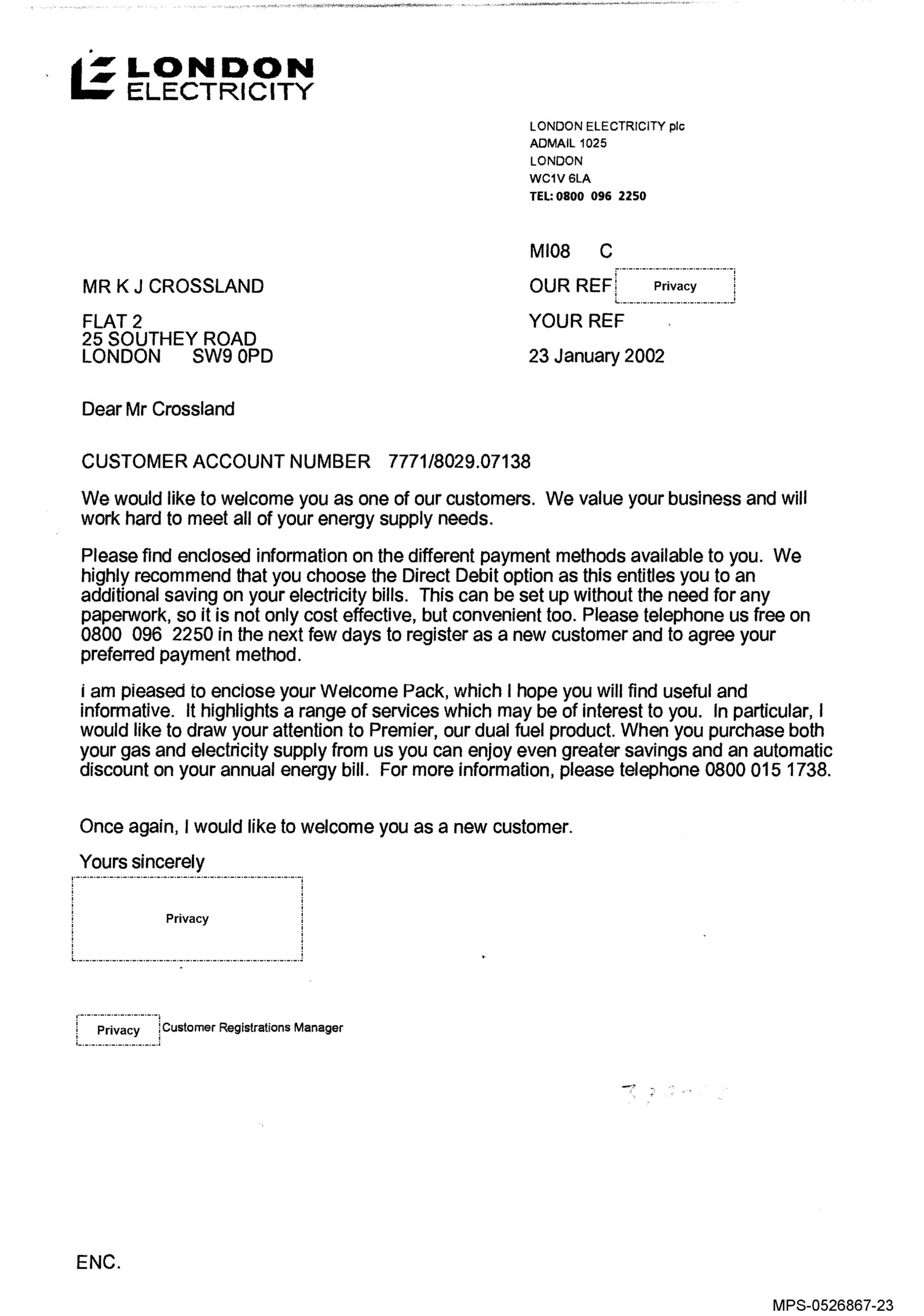
Letter from London Electricity confirming supply in the name of Kevin Crossland, 23 January 2002
We were shown a letter from London Electricity saying Kevin Crossland had been the registered customer at James Thomson’s cover address since 28 January 2001, and a letter from British Telecom about registering a phone line in the name of Kevin Crossland.
Crossland was also the name on council tax bills and water bills for Thomson’s cover address (all these utility documents are in MPS-0526867).
Thomson agrees that he knew at the time that all of this was illegal. It never occurred to him that it was immoral, but he says he realises that now.
Thomson’s theft of the Crossland identity was uncovered by his managers and he was challenged on it in early 2002. A meeting note from 19 March 2002 [MPS-0745388] records Thomson claiming he had stolen Kevin Crossland’s identity for ‘operational safety’. Thomson now says this claim was a lie.
He says he struggled with management generally, and that he cannot rationalise now what his plans were for the Crossland identity.
He admits that he wanted to retain James Straven’s life – the people, the sexual relationships, and the liberated lifestyle – which was completely at odds with the ‘buttoned-down Met Police existence’.
He was expecting to be sacked from the police and was building the Crossland identity as a backup.
FRAUDULENT USE OF DOCUMENTS
In addition to his illegal misuse of Kevin Crossland’s identity, Thomson obtained numerous passports in his ‘James Straven’ identity. He admits to removing pages from them to conceal unauthorised travel from his managers, which we explore in more detail in the section on Foreign Travel.
We were shown a report dated 8 March 2002 [MPS-0719569] which says that Thomson also had four driving licences in his ‘Straven’ identity. He accepts this. They are listed as the original, two replacements he obtained himself, and a fourth he asked the office to get.
The fourth licence is registered to the address of an activist, and an internal SDS debrief document explains the ruse [MPS-0722282]:
‘In conversation with the SDS office it was established that if his address was so remote that public transport was ineffective and he would be unemployable without a vehicle, a court would be disposed, under existing European guidelines, to merely fine him and put points on his (thus far clean) licence.
As a result a new licence was obtained showing JS resident at one of his weary’s addresses in deepest Sussex. This had the added benefit of having the ungodly involved in a small deceit against authority, which further enhanced JS’s legend.
Again the office was aware and seemed to agree it was a frightfully good wheeze. In the event the prosecution, like two before it, failed (more because JS, unlike JT, enjoyed the luck of the devil than because of any strategic thinking).’
From this it is clear that Thomson was prosecuted at least three times for traffic offences in his Straven identity, and supportive SDS management thought that committing fraud to deceive the courts was a ‘frightfully good wheeze’.
Another curious aspect of Thomson’s deployment is that, unlike most of the spycops we have heard about so far, he really did do the ‘cover job’, the employment he told activists that he had.
As James Straven, Thomson was a location finder for film and television. He actually gets credits in several productions, including the 1998 TV drama Coming Home, which starred Joanna Lumley and Peter O’Toole.
Throughout his deployment, Thomson was visiting his cover employment’s office one or two days a week. During filming, he would sometimes spend two full weeks on a set.
He says that he found the cover employment interesting. It included some travel, and he got to meet famous people like O’Toole and Lumley. It also meant he was receiving money over and above his overtime-inflated Metropolitan Police salary.
Thomson says he spent the wages he received from his cover employment in his ‘Straven’ identity. He had multiple credit cards and bank accounts, which he used for anything he would prefer his management not to know about.
The overall picture we are left with is of a deeply deceitful and duplicitous man who had significant criminal tendencies well before he started working for the SDS.
Abusive Relationships
Thomson has now admitted to conducting two deceitful sexual relationships while undercover. He acknowledges that neither of the women he deceived would have consented to have sex with him if they had known his true identity.

Spycop HN16 James Thomson, ‘James Straven’/ ‘Kevin Crossland’
Thomson says he was divorced when he was recruited into the SDS and was in a new ‘off and on’ relationship. He says that managers preferred ‘a stable background’, but that their investigation into the stability of his relationship was limited.
He and his partner went through short-term breakups that he did not report to his managers, although he was expected to do so. He was concerned they would terminate his deployment if they knew his real relationship was on the rocks.
Significantly, Thomson recalls speaking to a number of former undercover officers whilst he was working in the back office, preparing to deploy.
He was mentored by ex-undercover officer HN1 ‘Matt Rayner’. We heard from Liz Fuller in the Inquiry’s Tranche 2 hearings about how she was deceived into abusive sexual relationship by HN1.
Thomson claims HN1 never talked to him about sexual activity during deployments, but did give him advice on how to infiltrate animal rights activism:
‘He described them and their world quite accurately. He described sort of, I would say, the type of people… what was acceptable, what wasn’t.’
He was asked if he spoke to HN2 Andy Coles, who groomed a vulnerable teenager into a sexual relationship while he was undercover, and went on to author the notorious ‘SDS Tradecraft Manual’ [MPS-0527597]). Thomson says he cannot remember talking to Coles, but it is likely that he did.
Barr also asked Thomson about the Tradecraft Manual itself, which offers deeply unpleasant advice to officers about deceiving women into sex, and advocates ‘fleeting and disastrous relationships’.
Thomson says the manual was regularly consulted for meetings with deployed officers. This is in contrast to the claims of other officers who say they never saw it at all. However, Thomson says neither he nor anyone else ever discussed the passage on sexual relationships.
Thomson says he knew his contemporary HN14 Jim Boyling well. Boyling deceived at least three women in his target group into sexual relationships, before going on to have children with one of them. Thomson recalls ‘chatter’ within the SDS about the fact that Boyling’s partner, ‘Rosa’ was trying to find him after his deployment ended and had got hold of a phone number for the SDS office.
Thomson remembers speaking to his manager Bob Lambert about the work. But again, he claims these conversations were never about sex.
‘He was a Detective Inspector, as you said, so sort of more general advice as well. A lot more on the process, about how slow to take it and so on…
Lots of stuff about cover employment, back story. So what bits of legend work and don’t work, what that should look like…
Q. Any advice about how close to get to the activists you were seeking to report on?
A. I think as close as you could.’
Lambert’s earlier period as an undercover officer in the 1980s is one of the most controversial deployments. He gave evidence over seven days in 2024, including about how he deceived four women into sexual relationships, and fathered a child with ‘Jacqui’.
Lambert is expected to return to the Inquiry in 2026 to give evidence about his time as a manager of the SDS, including his oversight of Thomson.
The upshot of all this is that the newly recruited Thomson was introduced to the job by HN1, Coles, Boyling and Lambert, all of them known abusers.
It really brings it home that, by the late 1990s, the SDS resembled a predatory grooming gang, with the worst offenders being promoted and put in charge of initiating new members. It is therefore unsurprising that Thomson’s would become one of the most disturbing deployments to date.
THE RELATIONSHIP WITH SARA
‘Sara’ joined the Croydon hunt saboteurs in 1998. She met Thomson on one of her first hunts, in the autumn of that year. Her evidence is that Thomson asked her out to dinner.
‘Q. You got on well?
A. Yes.
Q. And you called her?
A. Mm-hm.
Q. What caused you to call her?
A. I can’t actually remember calling her. I don’t dispute that’s what happened.
Q. This is calling her to ask her out for dinner?
A. Mm-hm.’
This kind of evasive response is very common from officers like Thomson when they are asked about the details of their abusive behaviour. They don’t deny the facts, but neither do they properly admit them. It is dismissive and offensive. Their identical claims to have no memory of events (without disputing the woman’s account) are made so often and consistently that they lose all credibility.
Asked why he asked Sara out for dinner, Thomson replies:
‘Beyond the obvious attraction, various other things, my own psyche, loneliness, I don’t know… Sexual attraction, certainly…
Q. Can we take it this was done purely for your sexual gratification?
A. No, I think that’s unfair. I think it was a genuine relationship.’
Describing their abusive, deceitful and sexually exploitative behaviour as ‘genuine relationships’ is another offensive SDS trope we have seen time and time again. Like other sexually abusive officers at the Inquiry, Thomson has conceded that he understands that she would never have let him near her if she’d known who he was, and yet is unwilling to admit what that really means.
Thomson claims that he and Sara had a ‘strong connection’, although he also claims not to have known that she wanted the relationship to become long-term. He accepts that he saw Sara about twice a week, and that their relationship was well known within the small social circle they were moving in.
‘Q. You told her that you loved her in 1999, didn’t you?
A. I accept that…
Q. Why did you tell her that you loved her?
A. Because I did.
Q. There was an elephant in the room though, wasn’t there?
A. Certainly.
Q. You were not who you said you were?
A. Correct.
Q. You were a serving police officer?
A. Yes.
Q. On duty?
A. Yes.
Q. She wouldn’t have consented to the relationship or to sex if she had known who you really were, would she?
A. I think not. Sorry, I know not.’
Thomson seemed visibly uncomfortable during questioning about Sara. He gave mostly monosyllabic yes/no answers, not disputing Sara’s account but claiming not to remember or not to know what his thoughts and motivations were at the time.
He says he can’t remember telling Sara that his ex-partner had tricked him into having a child, but agrees that he probably said it because the ages of his children would have meant he had them very young.
This is because Thomson was lying to Sara about his age, claiming to be several years younger than he really was; another trait so common among SDS officers that it was surely training and tradecraft.
REPORTING ON SARA
The first mention of Sara in Thomson’s reporting is from March 1999 [MPS-0001923]. It is an intelligence report about an animal sanctuary that claims Sara works there part time, and Croydon hunt saboteurs are forging close ties with the sanctuary:
‘In the near future the entire sab group will be attending the sanctuary to assist in the construction of a duck pond.’
In addition to the total absurdity of a police intelligence report about a duck pond, Barr pointed out that the report is inaccurate. In fact, the only link between the sab group and the sanctuary was that Wendy and Sara were involved in both. Thomson reported Sara as being employed by the sanctuary, which wasn’t true.
‘Q. That’s not really close ties between the group and the sanctuary, is it? It is more the fact that two animal lovers are both hunt saboteurs and work at an animal sanctuary?
A. No, but it was a link across to the hunt saboteurs.
Q. “Sara” didn’t work there, did she?
A. No.
Q. So this information is wrong… Were you trying to place “Sara” at the sanctuary, making the connection with Croydon hunt saboteurs to justify reporting on “Sara” and spending time at the animal sanctuary?…
Doesn’t the phrase “entire sab group will be attending the sanctuary” overstate the position?…
A. Yes, I would agree with that.’
BREAKING UP WITH SARA, PARTIALLY
Sara’s account of the breakup of her relationship with Thomson was that he disappeared over the Christmas period in 1999. She couldn’t contact him for about two weeks.
He says he assumes he was with his family, and answered all further questions about the breakup with ‘I accept that’ whilst saying he cannot remember.
In fact, Thomson spun Sara a cruel story about experiences of childhood rape and sexual abuse that he used as an excuse to end the sexual relationship. Asked why he did that, he dismissively said:
‘That was in my legend anyway… The abuse and so on.’
Barr noted that there is no written record of any mention of child abuse in James Thomson’s legend.
Despite this, Thomson claims he’s sure it was not something he invented just to tell Sara. He insisted that his managers were fully aware that a history of child sexual abuse made up part of his false identity, and he remembers talking to Detective Sergeant Webb about it.
He says he cannot recall giving any thought to how any of this might affect Sara, and he tries to deny how manipulative it was.
‘Q. If it wasn’t highly manipulative, what was it?
A. I am not disputing that it wasn’t, I just didn’t see it like that. I saw it as a continuation of a genuine friendship.
Q. How could it be a genuine friendship when it was so deceitful from your side?
A. As I said, that was my perspective. I fully accept it can’t have been, and yet I believed it was.
Q. An extremely selfish way to behave?
A. Certainly.’
Thomson alternately claims that he cared about Sara whilst also admitting that he never thought about her feelings or how his behaviour might affect her. By now, he seems a lot less relaxed about the questions.
Thomson remained close to Sara and very shortly after their breakup, in early 2000, he travelled out to Goa, India to meet her there and visit an animal sanctuary. Again, he claims he has no memory of this:
‘I can’t remember it. I don’t dispute it might have happened.
Q. Assuming it happened, unauthorised?
A. I presume so.’
This is just one of many highly controversial trips abroad taken by Thomson which are dealt with below. Sara was also persuaded to join Thomson in France on holiday during what now turns out to have been the extraordinary ‘Operation Lime’ plan to fit up hunt sabs on firearms charges.
Sara moved abroad, and Thomson encouraged her to do so, giving no thought whatsoever to how he was influencing her important life choices. Thomson admits he stayed in contact with Sara by email long after she left the country.
We were also shown his phone’s call logs [MPS-0719722], which show 48 calls to Sara, who is described as the ‘ex-girlfriend of L1’. Thomson accepts Sara had never been L1’s girlfriend.
‘Q. Might it have been that you were deliberately trying to misrepresent events to throw managers off the scent of your own misconduct?
A. Entirely possible.’
Sara then became the focus of additional secret police attention. We were told that management documents exist that talk about ‘protecting’ Thomson from Sara, because she lived close to his ex-wife and children, and so there was a risk of her seeing him in his real life.
Thomson admits that he knew where Sara lived when he started the sexual relationship. He knew this put his deployment at risk and says it was stupidity that led him to put his sexual gratification ahead of basic security.
This is part of another pattern we have seen: entirely innocent people met SDS officers in their undercover roles and were then placed under intensive surveillance, simply because they lived near the officers’ real homes.
People were physically followed in order to establish patterns in their lives. There is evidence that attempts were made to influence where they lived (for example Wendy’s house purchase, examined below).
THE RELATIONSHIP WITH WENDY
The first of Thomson’s intelligence reports to mention Wendy is dated 22 August 1998 and refers to the Old Burstow Hunt’s first cubbing meeting of the 1998-1999 season [MPS-0247867].
Wendy gave live evidence to the Inquiry on 23 October 2025, during which she made clear that she is sure she met Thomson long before the Old Burstow Hunt event.
Thomson accepts that he met her early in his deployment, in 1997, when she was just 17 years old and lived at home with her mother. He became part of her intimate circle of friends, but tries to play their relationship down in his evidence:
‘Q. You became very close friends, didn’t you?
A. We were certainly friends, yes…
Q. To say that you were a close associate would be to understate the position, the reality was you were very close friends?
A. In which case I will accept that.’
In fact, Thomson supported Wendy during her mother’s long illness and death. Thomson says he can’t remember that, although he added:
‘I accept that if I had that opportunity I would have taken it, yes…
Q. You don’t remember the protracted course of somebody dying who is close to one of the people you are mixing with?
A. No.
Q. Why do you think that is?
A. I don’t know.
Q. Is it because you just didn’t care?
A. I hope not.’
Thomson also advised Wendy to split up with her then-boyfriend.
YOU WEREN’T MEANT TO FIND OUT
We were shown an intelligence report where Thomson mentions that breakup, along with the personal lives and sexuality of several members of the Croydon hunt sab group, in flippant and disrespectful terms [MPS-0003413].
Thomson defended the deeply personal nature of the reporting:
‘As I say, I reported anything. They were obviously always intended for the very small audience anyway, and certainly not for the subject to ever read it. So I can only apologise for that.
Q. Was there generally a culture of being disparaging about activists?
A. Yes, I suppose that’s fair.’
Wendy encouraged Sara, and later Ellie, to have relationships with this man who she believed was her good friend. She also recalls a number of instances where Thomson tried to create a sexual frisson in his relationship with her. Thomson denies this but adds ‘there’s lots of things I can’t see myself doing that I have done.’

Spycop HN16 James Thomson
He is asked whether he is trying to claim Wendy posed a physical threat or was a violent activist. Thomson says no, but then claims that ‘she had a temper and she was a committed activist’. His evidence in this section was frankly all over the place.
The most shocking evidence we heard about Thomson’s friendship with Wendy concerned the fact that, after her mother died, she bought a house very close to where Thomson’s ex-wife and children lived. We were shown a management document [MPS-0719701] which refers to ‘attempts to disrupt this purchase having failed’.
Thomson claims not to remember what he and his managers did. He is sure he tried to put her off, though he claims this was limited to telling her there were better areas to live.
However, Wendy recalls significant issues with probate. Her solicitor told her probate sometimes took up to six months, but with her mother’s simple uncontested will it would be much swifter. But it took six months to the day. She nearly lost the home she’d set her heart on.
This all indicates that the SDS actually tried to interfere with the will and the house-buying process.
THE RELATIONSHIP WITH ELLIE
Thomson started a relationship with Ellie very soon after Sara moved abroad.
Ellie wasn’t an animal rights activist, she was a friend of Wendy’s who worked at the same animal sanctuary. Thomson asked Wendy to set them up.
Again, he claims he can’t remember that, but he accepts it. Ellie was 21 at the time. Thomson told her he was 33. In fact he was 37.
‘Q. For a 37-year-old serving police officer undercover to initiate a sexual relationship with a 21-year old woman is an aggravating feature of your deception of her, isn’t it?
A. Yes…
Q. A very conscious deception of “Ellie” as to your real age?
A. Yes, it was all a deception.’
Thomson’s replies became quite petulant and defensive during Barr’s questioning about Ellie.
Asked why he started a sexual relationship with her, Thomson replied:
‘I don’t know that I did start a sexual relationship with “Ellie”. I think I started a relationship that became sexual, which is not quite the same thing.
Q. Why did you start an intimate relationship with “Ellie”?
A. I liked her. I liked her.
Q. So, again, your own sexual gratification?
A. In amongst the other parts of “like”, yes.’
At the time, Ellie had lost her job following sexual harassment by her boss. She was homeless, and unemployed.
‘Q. To take advantage sexually of a woman who was not only vastly younger than you, but also vulnerable, young and naive was a further aggravating feature of your deception of “Ellie”, wasn’t it?
A. I agree that it was. I am not sure I saw her as vulnerable.
Q. Is that because you really weren’t thinking about her feelings at all?
A. Entirely possible.
Q. Thinking entirely about yourself and your own sexual gratification?
A. Yes. I don’t like the word “entirely”, but I won’t dispute it.’
Thomson was Ellie’s first boyfriend and her first love. He accepts that he knew that. She thought it was a committed monogamous relationship, but he was actually in a relationship with someone else. Thomson did not use condoms and he got Ellie to use to use other contraception to avoid pregnancy.
Barr asked Thomson about his use of ‘mirroring’ – reflecting a person’s interests, feelings and personality back at them in order to make them feel a connection – and other manipulation of Ellie, to which Thomson replied:
‘You are reading a lot into it. I don’t think that’s fair.’
Yet all these elements are strikingly similar to how other women had been deceived by earlier SDS officers who were Thomson’s superiors. Identifying a vulnerable, much younger woman, and then grooming her into a relationship is exactly what Bob Lambert had done with Jacqui, and Andy Coles with Jessica. As with the lying about age, it seems too much of a coincidence.
Thomson took Ellie on holiday to Indonesia and Singapore during another of his unauthorised trips abroad, which are examined in more detail below.
BREAKING UP WITH ELLIE, PARTIALLY
Ellie had been with Thomson for about ten months when he told her, in January 2002, that he had to move to the United States because his ex-wife and children were moving there.
That was supposed to be part of a longer exit strategy from his deployment, but Thomson’s managers had, by then, begun to uncover the extent of his extensive fraud and other misconduct, and his deployment was brought to a rapid end.
Thomson had to tell Ellie he was leaving sooner than expected, and he pretended to leave the UK in March 2002. He maintained the sexual relationship right up until he supposedly left. He accepts that there was no real ending of the relationship, because he immediately began to deliberately lay the ground for it to continue.
‘Q. You didn’t want your deployment to end, did you?
A. I didn’t.
Q. And you were a man who ignored your managers when you didn’t like what they had to say, and you were going to stay in touch with “Ellie” despite being withdrawn, weren’t you?
A. Yes.’
HARASSMENT AND MANIPULATION AFTER HIS DEPLOYMENT ENDED
Thomson remained in contact with both Ellie and Wendy for sixteen years after his deployment ended, from 2002 to 2018, by email, phone and meeting up in person. This continued even after the spycops scandal broke and after the Undercover Policing Inquiry had been announced.
We were shown an email to Wendy that he sent on 30 March 2014 [UCPI0000038209]. In it he lies about his life, claiming to be in Canada and returning home to LA (in fact he was still a police officer, living in London). He says he is in an airport sat opposite the Victoria’s Secret store watching rolling adverts of women in lingerie for hours:
‘Let me know if you think that’s sad at all won’t you – even I might get a little jaded by the time I fly’
His regular emails asked about her life and the other activists he had targeted while undercover. He claims that this was ‘just because they were people I knew and had liked.’
Thomson says he doesn’t know if he would have ever ended his contact with Ellie and Wendy if his real identity hadn’t been exposed. He admits that his conduct was extremely harmful and unnecessary.
In her appearance at the Inquiry two weeks before Thomson’s, Ellie gave detailed evidence about the ongoing contact.
Thomson claims not to remember details, but does not dispute anything Ellie has said. He admits he always enjoyed seeing her, and they were ‘like a couple’. He accepts that he prolonged the romantic relationship, picking up where they had left off.

Spycop James Thomson with Ellie at the Raffles Hotel, Singapore. He’d travelled there against the instructions of his managers.
We were then shown some of his emails to her. Barr systematically went through the sexualised comments, including repeated references to sexual frustration, to ‘drooling’ about her ‘in entirely inappropriate ways’, references to a ‘uniform fetish’, and Thomson fantasising about Ellie naked in his office – which is particularly worrying considering where he worked.
We saw an email from October 2011 that is very heavy emotionally and includes him complaining about how sexually frustrated he was, having recently seen her but not had sex.
It is remarkable that he was still sending these emails even after spycop EN12 Mark Kennedy had been uncovered and the scandal of undercover relationships was front page news. Thomson says he didn’t make a connection between himself and these things.
In another email, dated 13 September 2011, Thomson asked Ellie to send photos of herself in lingerie to help with his sexual frustration. Thomson tries to claim he was not being serious, and yet he repeated it in later emails. He claims the persistent requests were not pressurising her, and tries to characterise it as a ‘running joke’.
He often projected their relationship into the future, describing how it will be fun to meet up when Ellie is ‘old and grey’, and he is ‘a ghost’. He admits that he was stringing her along.
Ellie has said that she never got over the relationship with ‘James Straven’, because real men couldn’t measure up to his fabricated persona. He accepts he manipulated her emotions, and affected her ability to have real world relationships.
On 24 June 2015, Thomson met up with Ellie and they did have sex. It is pointed out that this sex with Ellie was soon after the start of the Inquiry. He, incredibly, claims that in his mind he did not connect the two things.
In December 2017, the Inquiry ruled that it would release Thomson’s cover name, ‘James Straven’. In 2018, Thomson finally told Ellie that he was an undercover officer. He didn’t tell her his real name during the call. He didn’t apologise.
He now says he didn’t realise that he hadn’t apologised. He says he never gave Ellie ‘the right sort’ of thought at all, and never once considered her feelings, because his conduct has always been directed by his own self-interest.
This extreme self-centred thinking, not just during deployments but afterwards, is yet another running theme among spycops officers.
Targeting and deployment
INFILTRATING THE HUNT SABS
It is notable that although Thomson was initially deployed into the Brixton hunt saboteurs, most of his infiltration was into the Croydon hunt sabs. He sought to defend that in his evidence by claiming they were more or less one and the same:
‘The organisational end was the Croydon bit by that time. Brixton hunt saboteurs sort of turned up.
Q. Would it be fair then in the light of that answer to say that you deployed into both Brixton and Croydon hunt saboteurs from the outset, or was there a progression from Brixton to Croydon?
A. I can’t remember the exact order, but certainly it was close.’
However, he went on to differentiate between the two groups, claiming that Brixton hunt sabs were more likely to attack the hunters, whereas Croydon would focus on saving the fox.
‘Brixton would sort of kind of turn up for the ruckus and they would tend to go towards hunt supporters and the people running the hunt and the hunt itself…
Insult them, spit at them, try and get people off horses. Try and basically start a confrontation. Just encourage and then join in a fight.’
However, when asked exactly how the sabs would get people off their horses, it became clear that this was more like an act of self-defence against mounted attackers with whips:
‘If they tried to swing a crop, obviously that gave an opportunity to grab that and pull and so on.’
In fact, Thomson accepted that he only ever witnessed minor criminal damage and minor assaults by hunt sabs. Barr says he gets the impression it was more a question of goading by sabs and violence by hunters:
‘Q. Did you see hunt saboteurs throwing the first punch?
A. I am not sure. I can’t remember a specific incidence of that.’
Thomson also said that sabbing got more violent over the course of his deployment. Again, he was asked who would have committed the first violent acts in that escalation:
‘I wouldn’t like to say. I think I am probably biased, because I would say the hunt were more likely to, and I was on the other side.’
We were shown his first report, dated 22 February 1997, about upcoming animal rights protests [MPS-0000168]. He said he doesn’t know if the information in his first report was publicly available or not, but he accepts that at that stage, his infiltration was limited:
‘I would have turned up at a couple of sabs’.
Barr points out that this demonstrates that a very superficial shallow infiltration was all that was needed to get that kind of information.
GOING DEEPER
In May 1997, a file note [MPS-0247080] written by his manager HN10 Bob Lambert, just four months into Thomson’s deployment, recorded that:
‘The activists seem to have been impressed by [Thomson’s] ability to handle himself and face up to violent threats from hunt supporters and the like.’
Thomson agreed that this is probably accurate, although again, he cannot recall a specific incident.
Thomson claims that he doesn’t remember ever being known by the nicknames ‘Posh Sab’ or ‘James Blonde’ whilst he was deployed.
He claims he ‘would have noticed’. All the civilian witnesses he spied on insist that they remember calling him these names to his face.
The May 1997 file note also describes:
‘On Monday, 5 May he received his first in-depth grilling from his new associates. He appears to have handled this well.’
Asked about this, Thomson says:
‘It was a back room in a pub in south London. And just lots and lots of questions… My interest, vegetarianism, veganism, a little bit about where I had been, why I hadn’t been on sabs before.
That sort of thing…Q. As to the demeanour, were these threatening questions or were they just gentle inquisition?
A. I felt slightly under pressure, as far as I can recall. I didn’t feel physically at risk. I wasn’t looking at the windows or anything that I can remember…
Q. If you had not satisfied your questioners, what do you think would have happened?… Was your feeling that you would have been under any physical threat?
A. Yes. They were naturally violent, or some of them, to be fair. Some of them were naturally violent…
Q. Might that have been a subjective fear rather than one with an objective basis?
A. Absolutely.’
One spycop after another infiltrated hunt sabs and described them as seriously violent. Under examination, none of the officers can cite any instances, but vividly describe serious violence from hunters and supporters. HN2 Andy Coles even wrote in the SDS Tradecraft Manual [MPS-0527597]:
‘I know that in the future I will have nothing but contempt for fox hunters and in particular their terriermen.’
Despite all this, the SDS did not infiltrate hunts, and even now they insist that sabs were a deserving target for spying. This proves that the SDS wasn’t focused on the risk of violence and disorder, but rather on threats to established social hierarchies.
ACTUAL DANGER AND VIOLENCE
We were then shown an SDS memo dated 8 August 1997 [MPS-0247206] which records that Thomson was in fact hospitalised in his cover identity on 10 July 1997, with a fractured collar bone and jaw.
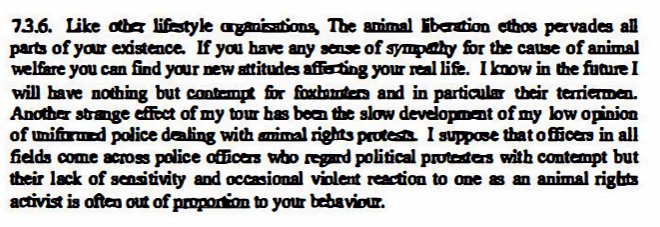
Spycop HN2 Andy Coles describing his ‘contempt for terriermen’ in the SDS Tradecraft Manual
But it was not the hunt sabs who caused those injuries: he was attacked by hunt supporters on a Countryside Alliance march.
Asked about the incident, he says his managers were sympathetic. However, Thomson himself cannot remember how it happened as he was concussed and suffered amnesia.
This was not the only instance where Thomson was injured. A file note dated 21 November 1998 [MPS-0001577] records serious injuries to Thomson’s jaw, back and legs after being attacked by hunt supporters with golf clubs when sabotaging a hunt in Kent.
Thomson claims he cannot remember who else was there when he was attacked. The file states that the attack left Thomson:
‘in cheerful mood and upbeat about his increased credibility.’
A further injury report was filed on 18 November 1999 [MPS-0002618], when Thomson slipped a disc, which made it harder for him to participate in sabbing. He said it slowed him down.
Despite the SDS’s own files showing overwhelming evidence of violence coming predominantly from the hunters, we were shown an intelligence report from 4 August 1997 [MPS-0000483] in which Thomson claims southern England hunt sab groups had ‘hard reputations’.
Questioned about it, he admits that numerically there would almost invariably been far more hunt supporters than sabs. He further admits that it was common for sabs to be unfairly arrested by police:
‘I don’t know what powers they were using. You would be sort of stuck somewhere and quite likely released once the hunt had finished or gone.’
The report claimed that saboteurs were being asked to wear similar black clothing to make identification and post-hunt arrests more difficult. However, Thomson said he was never asked to help identify sabs from photographs, even if there had been incidents of violence, stating:
‘I was there for intelligence, not evidence.’
We were then shown a series of Thomson’s reports from the 1998-1999 hunt season. One report from 23 March 1998 [MPS-0000959] describes the hunt supporters coming off ‘second best’ to the sabs and being attacked while they hid with the police.
Barr was obviously quite struck by this report:
‘Wouldn’t that have been quite a striking and memorable incident.. one which certainly, as depicted here, is violence perpetrated by hunt saboteurs that goes well beyond lawful self-defence?’
Thomson seemed unimpressed, and claims to have no memory of the incident. Despite this, he denies any possibility that he might have exaggerated his report:
‘If I have reported it, then it happened.’
Given the fantastical nature of such a lot of SDS reporting (including the staggering claims made by Thomson about Operation Lime) this statement is meaningless in terms of establishing historical accuracy. Nonetheless, it offers an interesting insight into the SDS mindset and the way they approached intelligence: if we reported it, then it happened (and not the other way around).
MORE NON-SPECIFIC ALLEGATIONS OF VIOLENCE
Another report, which is undated but which the Inquiry has placed within this period, refers to Croydon hunt sabs supposedly planning an attack on a local fascist [MPS-0001541]. Barr points out this is an unusual report:
‘It is not about animal rights, is it? It’s about an alleged plot by the Croydon hunt saboteurs physically to attack a man for his far, or perceived far, right political views…
Did that actually happen?… Why would the Croydon hunt saboteurs, an animal rights group, plan an attack on a fascist?’
Thomson is characteristically vague in his responses, claiming that sabs were very anarchic and that:
‘The right wing were the enemy… across sabbing and animal rights generally.’
He claims he cannot remember whether anything came of the supposed plan. He accepts that if a man had been attacked he would have reported it, but then immediately adds more vague allegations of the same kind:
‘I mean attacks in that area did happen, especially after drink. But they tended to be spontaneous ones.’
The justification for Thomson’s spying on the hunt sabs seems tenuous at best. By then, hunting was on the way to being made illegal, and we saw notes from a strategy meeting dated 2 January 2000 [MPS-0003394]:
‘Sabbing will remain an important area, particularly as the ground is prepared for the anti-hunt bill to be presented in Parliament.’
Barr then showed us a document claiming that Thomson had close contact with activists from the Animal Liberation Front (ALF). The ALF was one of the SDS’s main bogeymen at the time, regarded as the most extreme tier of animal rights activism.
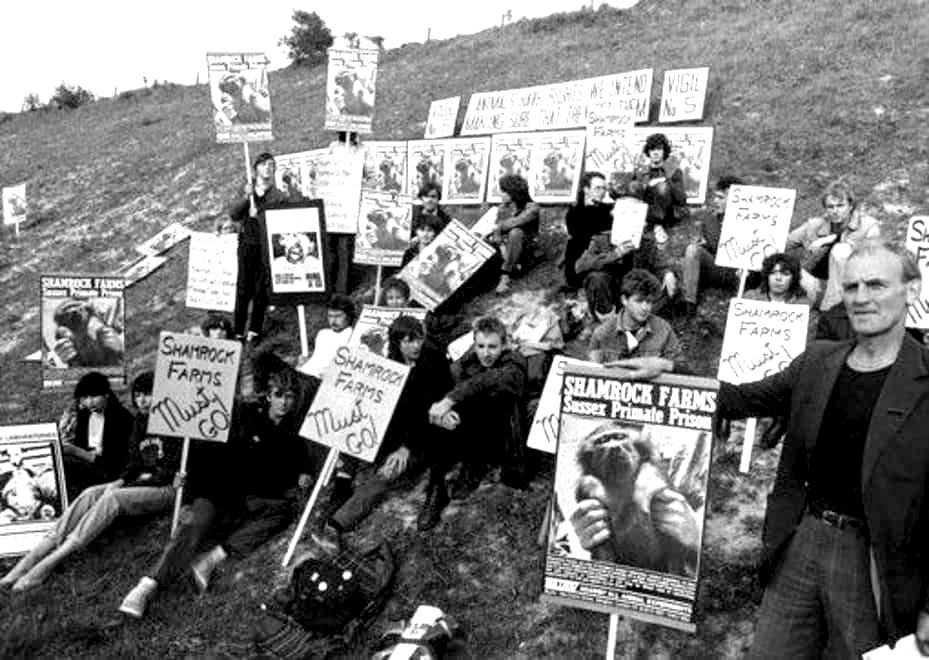
Protest at Shamrock Farm monkey breeding facility
The document is a file note dated 22 May 2000 [MPS-0003403], signed by HN58, the Detective Chief Inspector in charge of the SDS 1997-2001. It refers to Thomson ‘having forged close links with active ALF types.’
However, there is no real evidence to suggest Thomson ever had any links to the ALF, only to the Croydon hunt sabs.
It appears to be another example of the spycops exaggerating their work to the managers, then the managers exaggerating further, an effect repeated as the information went up the chain of intelligence to the higher echelons of the police and Home Office.
Indeed, not only were there no reports from Thomson about the ALF but also, Barr pointed out, the Inquiry actually has very little reporting from Thomson at all in this period.
Asked how much sabbing he actually did in the 2000-2001 and 2001-2002 hunting seasons, Thomson replies:
‘A. I don’t think there was any drop off particularly…
Q. There is reporting about the injury suffered by L4 and responses to that which we will be coming to in due course. But we do not see, as we have done to date, a stream of reporting about hunt sabotage.’
It appears, from the evidence, that Thomson’s decreased reporting about sabbing events may have been due to the changing relationship between the SDS and a new spycop unit, the NPOIU, which we will look at in more detail below.
SHAMROCK FARM
We saw significant reporting by Thomson throughout 1999 about the campaign against Shamrock Farm monkey breeders, Europe’s largest supplier of primates for vivisection.
Thomson reported on large, public and ‘fairly orderly’ demonstrations near the farm, describing them as ‘fairly well, if not heavily, policed.’
His reports also mention ‘home visits’, with activists protesting at the homes of people who owned Shamrock Farm, informing their neighbours of who they lived near. Thomson said he attended a lot of them.
It was put to him that, at the time, home visits could have been legal, but he disputed that fact:
‘The objective was to frighten the people there, or their associates, to make them in turn stop doing what they were doing, or drop the links they had to whichever company it was, depending on the association.
Q. What is the basis for your saying that the intention was to frighten, as opposed to make a point and disagree with what that person was doing by way of legitimate process?
A. I suppose that’s how I remember it.’
In fact, there was no law preventing these kinds of protests until the Criminal Justice & Police Act 2001, something which Thomson, as a serving policing officer working in the animal rights field, really ought to have been aware of.
Thomson’s claim that the aim of the visits was ‘intimidation’ is further undermined by the fact that, despite saying he had attended many of them, he could only recall one instance of criminal damage (a broken window) and one instance where there was an altercation with a neighbour of the targeted house.
It was clear from the documents we saw that, although Thomson was taking part in the actions, he didn’t actually report much specific or pre-emptive intelligence about these protests at all.
Shamrock Farm closed down in 2000. Barr commented:
‘Whether or not that was because of the campaigning may be a separate question… there was some suggestion it may have been because of financial improprieties at Shamrock Farm, but there is another report… [MPS-0003412] dated 25 May 2000.
It says a person, whose name we are protecting, “has discovered, through an employee of the firm, that the arson on [privacy]’s garage was the final ‘straw’ that led to the closure of the premises”.’
It says a lot about the questionable quality of the SDS intelligence we have seen over the past five years of this Inquiry that Barr’s next question was:
‘Do you know whether or not that in fact occurred?’
Thomson can’t remember, and there are no intelligence reports about such an incident. So, Thomson was deep undercover, spying on the Shamrock Farm campaign, but is unable to provide any useful information at all about an arson attack that he alleges got the place closed down. It’s simply not believable.
THE GROWING REMIT OF THE NPOIU
We saw a file note about targeting strategy which recorded a meeting between Thomson and Lambert dated 30 January 1998 [MPS-0247069].
It explores an out-of-London tasking, specifically going down to Hastings, which it describes as ‘an emerging centre of ALF activity’.
Thomson was asked whether there was there any boundary drawn between the Metropolitan Police district and out-of-area activities:
‘Not that I can ever remember, no.
Q. Was a matter of geography ever raised by your managers with you?
A. No… When you say “matter of geography”, I think at the very end of my deployment that was raised, but not at this point.’
Thomson was not specific about what he meant by saying it was raised at the end of his deployment. However, it seems it may well be to do with the formation of a new undercover policing unit.
The National Public Order Intelligence Unit (NPOIU) was established in 1999, using undercover officers in the same way as the SDS, and targeting the same sort of activities. But unlike the SDS, who, as a Met unit, were restricted to London, the NPOIU had a national remit.
There was a sizeable degree of crossover between the two units. It’s established that SDS Tradecraft Manual author HN2 Andy Coles trained the early NPOIU recruits, and there’s a mysterious gap in HN10 Bob Lambert’s CV at exactly that time.
A file note dated 22 May 2000 [MPS-0003403] reviewing Thomson’s operation states:
‘In view of NPOIU’s ever-expanding remit it is becoming increasingly difficult for SDS to operate effectively outside London on anything other than an occasional basis.’
Most, if not all, fox hunts would have taken place outside of the Metropolitan Police district, and Thomson’s decreased participation in and reporting on hunt sabbing from 2000-2002 may well have been related to that as much as his slipped disc.
Thomson claims not to know about this:
‘I was aware of them. But clearly there is something else going on in terms of who is responsible for what there that I wasn’t really cognisant of.
Q. Was there a feeling, that you were aware of, of the SDS’s work being encroached upon by the National Public Order Intelligence Unit?
A. Not that I can ever remember feeling…
Q. Did you have any direct contact with the National Public Order Intelligence Unit?
A. No.’
SDS AND NPOIU CROSSOVER
There are a number of SDS reports made on NPOIU forms. For example, in November 2025, during the Inquiry’s questioning of trade unionist Frank Smith, we saw that SDS spycop HN104 Carlo Soracci ‘Carlo Neri’ had filed a report on 29 January 2002 on NPOIU forms [MPS-0007725].
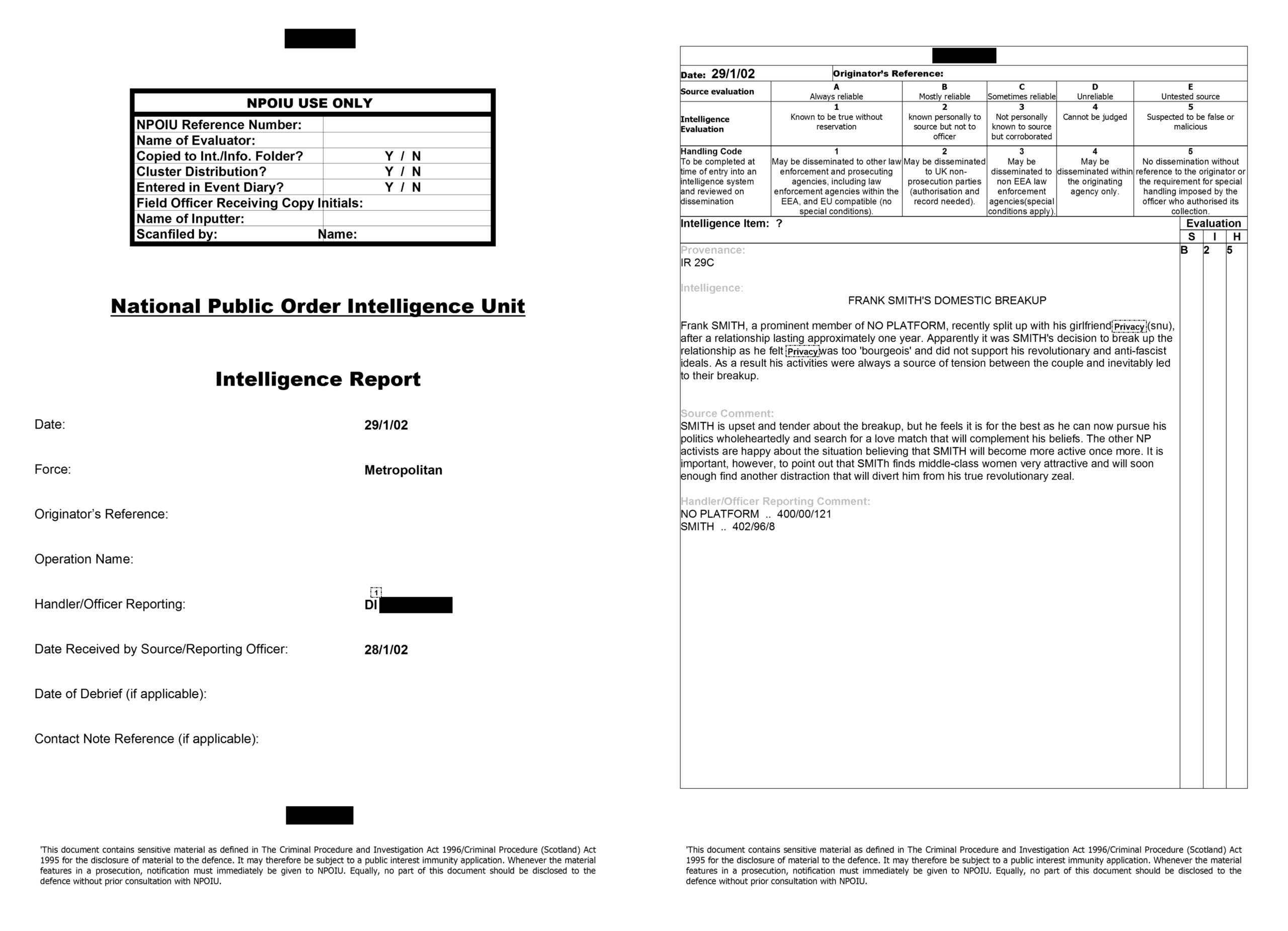
Report filed by SDS officer Carlo Soracchi on NPOIU forms, 29 January 2002
It’s unclear whether this was actually the NPOIU also spying on Smith, or whether Soracchi was using their forms for some reason.
Either way, it shows a significant degree of overlap between the two units.
Thomson was also asked about the earlier relationship between the SDS and the Animal Rights National Index (ARNI, which was later subsumed into the NPOIU), specifically whether ARNI was a customer for SDS intelligence. Yet again he was vague and said it didn’t really come up.
However, the impact of that relationship was certainly greater than Thomson is letting on.
Because of the changing remits and the growing role of the NPOIU, SDS manager HN58 suggested that Thomson should begin looking at a withdrawal strategy in May 2000, with early 2001 as a finish date for his deployment (this may be what Thomson meant by the matter of geography coming up at the end).
‘Q. You are recorded as expressing some disappointment at that, and the reasons are then set out.
Is it right that you were disappointed at the prospect of ending your deployment in early 2001?A. Yes, I am sure it was.
Q. Is that something you felt really pretty strongly about?
A. I suspect so, yes.
Q. Would it be fair to say that your cooperation with this plan was rather begrudging?
A. Yes, I imagine so.’
Thomson’s resistance to the plan to shut down his operation in early 2001, and his desperation to find an excuse to continue, form the backdrop for what subsequently became Operation Lime: his trip to France with a bizarre plot alleging hunt sabs were buying a gun.
Participation in Crime
Asked about participation in crime, Thomson says his manager HN10 Bob Lambert spoke to him about this:
‘We certainly discussed the reporting of it, how that was managed, advance information. We discussed some sort of bits on spontaneous violence and how you deal with them…
Q. Did you discuss the gravity of offence that you might become involved in?
A. Certainly as a relative thing, i.e. you’re there to prevent and mitigate harm. So that’s what you do. In terms of is there an absolute limit, no, I think that was always part of the context.
Q. Were you told that you needed to get advance authority to participate in crime?
A. I was certainly aware of that where possible, yes.
Q. And where not possible?
A. Then you prevent harm, report later.’
Thomson described the process for getting authority to participate in crime:
‘I think I would always have expected it starts with a conversation with the person who is handling you and then they will then decide what sort of level authority it might need.’
Barr pointed out that there is no evidence of a paper trail or any prior authority for any of the crimes Thomson was involved in, with the exception of Operation Lime, which we look at below.
Thomson claimed that he and Lambert did not discuss any specific examples, but that these conversations about participation in crime made up a significant part of the conversations he had with Lambert.
‘I think we discussed scenarios, rather than examples…
What would you do if the group you’re with see someone and decide to attack them, for example. What would you do if they suddenly decide they are going to commit an arson, et cetera.’
This is obviously significant as Lambert himself is accused of having organised and participated in arson attacks against Debenhams department stores. Sadly, Thomson was silent on exactly what Lambert said he should do if his group decided to commit arson.
Barr also asked whether the Home Office guidelines on participation in crime [MPS-0727104] formed the basis for Thomson’s discussions with Detective Inspector Lambert, to which Thomson replied ‘I am sure they were. I am sure they were,’ before admitting:
‘I am not that familiar with them, I can’t remember ever actually looking at that at the time.’
The guidelines expressly forbid misleading courts, though Thomson not only did this but had his managers’ blessing too.
PUBLIC DISORDER
The evidence is that Thomson participated in crime on multiple occasions. We were shown an intelligence report from 12 April 1997 [MPS-0000303] about the March For Social Justice, which Thomson attended with the hunt sab groups he had infiltrated.
The report describes some serious public disorder, and Barr asked him about that:
‘Q. Were you anywhere near that public disorder?
A. I assume so.
Q. What do you recall of it?
A. I can’t recall anything specific. There were a lot of these at that time. Not necessarily labelled March For Social Justice, but serious public disorder in central London…
Q. Were any of the people who you were attending this demonstration with violent?
A. Yes.
Q. On this occasion?
A. I don’t know about this occasion.
Q. Are you able to help us with whether any of them broke the law on this occasion?
A. No, not specifically this occasion. I couldn’t say that.’
These kinds of generalised allegations of serious criminality, violence or disorder without being able to offer any specifics is typical of SDS evidence, and came up very frequently during Thomson’s oral evidence.
While Thomson didn’t know if he was disorderly or not on the March For Social Justice, he says he was active in disorder in ‘these sorts of events’:
‘Q. As a matter of generality, how disorderly were you at this sort of event?
A. I was certainly active… obviously I had been the other side of the shields sort of thing, so I knew that you could go and kick a shield for as long as you like and it didn’t do any harm. So that sort of thing, I would certainly have done that. Yeah, I suppose I just worked within those sort of limits.
Q. In order to demonstrate your activist credentials, how forward were you in this activity?
A. I would have been in and amongst.
Q. Would you be the first to kick the shield?
A. No, I don’t think I would ever have been the first.
Q. Amongst the first?
A. Amongst the first is probably fair.’
We were then shown a file note written by Lambert from 6 May 1997 [MPS-0247080], about the March For Social Justice and a protest at Consort Beagles in Ross on Wye, a breeder of dogs for vivisection, where Thomson was injured by riot police.
In it, Lambert refers to the Consort Beagles protest as ‘an ALF demo’.
As we saw with SDS manager HN58’s reference to Thomson having close contact with the Animal Liberation Front, this seems to be another instance of management exaggerating Thomson’s activity, upgrading him from hunt sab to a group viewed as more dangerous.
Asked about the difference between an animal rights demo and an ALF demo, Thomson replies:
‘I don’t know that there is one. I suspect ALF is a bit of a shorthand.’
This confirms what we saw in evidence in the Inquiry’s Tranche 2 hearings, that the SDS used the term ‘ALF’ as a catch-all, leading to sloppy and inaccurate reporting that sought to justify spying on everyone and anyone with an interest in animal rights.
HUNT SAB ‘MASS HIT’
Thomson was also questioned about an incident on 13 December 1997, about a ‘mass hit’ against a hunt.
A ‘mass hit’ was when one hunt sab group called for others from further afield to come and join them. They often happened after an incident of extreme violence by hunters, as a way of showing that sabs would not be easily cowed, and to discourage hunters from violence in future because it only made sabbing increase.
A report [MPS-0000736] described hunters’ cars being damaged and a fight with hunt supporters. Thomson accepts that he was there but he can’t recall much, nor give any real reason why he was there:
‘My mental image is actually the windows. That’s why I think I was there, I have got a mental image of the breaking of windows, car windows. And after that I sort of am in it and wouldn’t be able to sort of look up…
Q. When you say words to the effect you had your head down after the first window was smashed or words to that effect, was that because you were participating in this affray?
A. I was there.
Q. Were you participating in any of the violence against property?
A. Not that I can remember, no. I don’t believe so…
Q. At an event like this, what did you see your role as being?
A. To the extent I had a role, a useful role at all by that stage, just mitigate harm to the extent I could…
Q. You have seen the report. It is a long report, but it doesn’t identify any individuals, does it?
A. Mm-hm. No, it doesn’t.
Q. Can you recall whether or not you did intervene to mitigate the criminality that was ongoing?
A. I can’t.’
ARRESTING THE SPYCOP
Thomson was arrested on 29 August 1998, for obstructing police, as part of a sit-down protest on the A1 near Huntingdon Life Sciences vivisection facility. He was bailed but ultimately not required to return.

Protest agasint Huntingdon Life Sciences vivisection laboratories
Minutes from an SDS strategy meeting from 27 January 2000 [MPS-0003394] refer to the Mayday 2000 protests organised by Reclaim the Streets, which Thomson attended.
He claims that members of the group he was with took part in physical violence that day, fighting with the police in Whitehall. But, yet again, he can’t make an allegation of any specific violent act.
He claims he reported it at the time, but there is no sign of that report.
Thomson admits that he provided night vision equipment to the sabs, and that his intention was that it would be used for illegal activity.
‘Q. So you were facilitating crime?
A. I accept that.’
He defended providing the equipment, claiming doing so would improve his credibility with the group. In fact, the sabs mostly used it for wildlife watching at night.
Thomson also admits to committing criminal damage by destroying badger traps on a regular basis. He says his SDS managers were aware of this and content for him to do it.
However, the most extreme instance of Thomson’s managers allowing him to participate in crime is the story of ‘Operation Lime’.
OPERATION LIME – THE GUNPOWDER PLOT
Operation Lime is an astonishingly complicated police plot which eventually involved Thomson travelling in his cover identity to Turkey, Indonesia, Singapore and twice to France, ostensibly as part of a conspiracy to acquire a firearm, ammunition and (inexplicably) a bag of ‘black powder’.
![Police photograph of the gun found in James Thomson's car, January 2001 [MPS-0004963]](https://campaignopposingpolicesurveillance.com/wp-content/uploads/2025/11/L3-gun-MPS-0004963-scaled.jpg)
Police photograph of the gun found in James Thomson’s car, January 2001 [MPS-0004963]
The beginnings of Operation Lime came shortly after Thomson was told, in May 2000, that his deployment would be brought to an end by early 2001. It was recorded at the time that he was very unhappy about that decision. It seems he came up with the gun plot as a way to extend his deployment.
On 1 September 2000, a member of the Croydon hunt sabs, known in the Inquiry as ‘L4’, who Thomson had befriended during his deployment, was almost killed by a hunt supporter who ran him over with a Land Rover.
Thomson was not there when it happened, however he filed a report that same day [MPS-0003867] which claimed:
‘There has been immediate talk of reprisals, but no definite plan has yet been formulated.’
Barr asked him who was talking of reprisals at that stage:
‘I can’t remember who I spoke to. I think everyone. It was a truly shocking thing… I mean everyone was very, very angry…
Q. But no indication that that anger would translate at that stage into action?
A. No.’
There was a demonstration at the hunt’s kennels the following day, 2 September, and another a few days later on 6 September. Barr went over Thomson’s reports about those events.
‘Q. I am not asking whether it had completely finished the saga, but was your impression that there had been a venting of anger?
A. No, I don’t think so.’
THE FRENCH CONNECTION
We were then shown a report entitled ‘The French Connection’ dated 31 October 2000 [MPS-0004388]. It is about a plot to obtain a firearm and a strategy to disrupt it.
‘Q. Is it right that your managers’ belief that there was a plot to obtain a firearm was the result of your telling them that?
A. I would presume so, yes…
Q. Were you ever told there was any other source?
A. No.’
The sole source of information about this uncorroborated plot was therefore, at all times, the word of Thomson himself.
The ‘French Connection’ report says the objective is:
‘to gain intelligence on the activities of L2 or L3 … leading to their arrest or disruption, without compromising the source and other long-term SDS operations. A requirement for source to give evidence in court will lead to compromise.’
On the same day, 31 October 2000, HN58 the Detective Chief Inspector then in charge of the SDS, sent a minute to the Commander Special Branch recommending disrupting or frustrating of the plot, rather than making arrests. He also requests authority for Thomson to take part in what is described as a ‘dry run’.
The resulting plan was absurdly convoluted. The police decided to allow the supposed purchase of a gun to take place, on foreign soil. The plan described:
‘a possible opportunity to disrupt in France. Having discussed with MT [‘Magenta Triangle’, code name for Thomson], the theft of his vehicle with ordnance inside could be engineered. This would take the ordnance away from the conspirators and severely disrupt any future plans.
The problem with this scheme is that Roger Pearce probably could not authorise it, particularly as the substantive ‘offences’ are taking place in France.
However, MT feels confident he that he could engineer a position whereby his vehicle could be “stolen”.’
The police plan for Operation Lime included the following steps:
‘MT + Companion depart for France
MT picks up ordnance and secretes in car
MT books into hotel or goes to restaurant
Vehicle gets stolen and ordnance removed’
There are further steps to the plan, but they have been redacted. The Inquiry has not said why.
A PLOT WITHOUT PLOTTERS
The detail of the police’s plan is quite striking. Firstly, because the document suggests that it is Thomson himself who is acquiring the ‘ordnance’, the activists seem to play little or no role. Secondly, because the document asserts that the activists have not actually planned anything:
‘Nothing has been planned so far; the intelligence has come from a number of conversations between interested parties.’
Barr asked Thomson to clarify:
‘In the period between 1 September 2000, when L4 was run over, and 31 October when this document is generated, what conversations had been held between which interested parties?’
Thomson pointed to L2, L3 and himself, but hedged his bets about whether anyone else was involved.
‘Q. Just the three of you?
A. I can’t say that exclusively.
Q. Well, who else?
A. I don’t know…
Q. It is quite a big deal, conspiring to either shoot or murder somebody, isn’t it?
A. Of course.
Q. And one would be pretty careful about who one entered into a conspiracy with to do that?
A. Certainly.
Q. Is it really the case that you are not sure who was party to the conspiracy at this stage?
A. I only know the people I was talking to.’
It was very noticeable that Barr wanted concrete details about who, where and how the plot came into being, while Thomson seemed to be intentionally vague.
A NEW CONSPIRATOR
It seemed that Thomson was making up this gun plot as he went along, and there were audible laughs from the public gallery as he failed to answer any of Barr’s direct questions.
He eventually, begrudgingly, named four people: L1, L2, L3, and a fourth person who had not been previously mentioned at all. They have now been ciphered as L6.
Like L3, L6 had no part in this Inquiry until Thomson suddenly named him in his evidence. L6 has since made a written witness statement (we don’t have a reference number for this and it seems to be another document that the Inquiry hasn’t published yet).
Barr drew Thomson’s attention to the fact that in 2001 the authority to travel abroad [MPS-0006714] recorded only two people being part of this supposed conspiracy:
‘Q. Why has two in a document generated in 2001 become four in your evidence before the Inquiry today?
A. I think it’s a larger number. I do not think that’s accurate.’
Barr asked Thomson about the nature of the conversations he had with L1, L2, L3 and L6, but he was unable to give any specific examples of what was said.
Barr also dug deep into why Thomson thought this supposed murder plot was real:
‘Q. These are people you have described as being involved in essentially minor criminality to advance the cause of animal liberation… Murder is an entirely different ball game… What made you think that any of these four people was capable of that?
A. Because what you describe as minor, they had an ability, a desire, to visit real harm on people and to take satisfaction from it…
Q. Can you give the Inquiry an example of L1 inflicting physical harm on another human being and taking satisfaction from doing that?
A. On a specific day, date, time, place, no…
Q What’s the most specific recollection you have that would support the assertion that you have just made?
A. Home visits, I think…
Q. How many times did you witness L1 being violent in this way?
A. I don’t know.
Q. Why don’t we have any reporting of that?
A. I don’t know.’
Barr asked similar questions about all four of the activists Thomson had named, trying to establish why he believed them to be violent. Thomson was completely unable to cite any real incidents.
He answered all Barr’s questions about specifics with a nebulous refusal to be pinned to any certainty: ‘I can’t remember’; ‘if there was it would have been reported’ and even ‘sorry, I have forgotten the question’. He was visibly uncomfortable by this point.
Barr pointed out there are no (or at least, no surviving) intelligence reports at all about the conversations leading up to this incident. All we have are the management notes.
‘Q. Was there any discussion with your managers about whether or not this should be written up?
A. Not that I can remember.’
This is problematic for Thomson because, while we have internal SDS records that show him telling his managers that this plan existed and them building this incredibly tortuous operation around it, there is no contemporary record at all of any of these supposed conversations taking place between the activists, and no first-hand accounts at all of the meetings and conversations they are supposed to have had.
The only meetings about this plan on record are those held by the police. This fits with the activists’ version of events, as they say it simply didn’t happen, there were no such discussions, and the first they have heard of this plot was very recently, when it was described in the Opening Statements to this Inquiry.
ALWAYS FRANCE FROM THE START
Many aspects of this supposed plot clearly trouble Barr. He asks about when France was first mentioned as the destination for the arms deal. Thomson replied that it was later on, ‘after this report, when things began to firm up’.
However, that makes no sense. Although the 31 October note specifically states that nothing has been planned yet, the title of the document is ‘the French Connection’, and it mentions the possibility of jurisdictional problems in France.
Another internal note from just a week later, dated 6 November [MPS-0004441], seeks authorisation for Thomson to travel to Istanbul. We look at that trip in more detail in the section on foreign travel. Importantly, the note also states:
‘There is a plan to obtain black powder and a gun from France through a French animal rights activist.’
Thomson eventually concedes that France must indeed have come up earlier.

L3 in France on the trip with James Thomson, January 2001
Another document [MPS-0009484] records a meeting on 10 November 2000 between Thomson and two of his managers, Bernie Greaney and Noel Warr, which took place at Thomson’s home.
Thomson says that kind of informal meeting at home was not unusual. It was common SDS practice, and he doesn’t seem to think it posed any kind of security risk. This particular meeting was about events on 9 November – the so-called ‘dry run’ to Calais.
True to form, Thomson says he cannot really remember anything about the trip. He took a long time to answer many of the questions, but he did eventually admit that he travelled to Calais with L1 and L1’s girlfriend.
Thomson claims the purpose of the trip was to see what security was like at the port, and that they were in fact stopped and searched whilst going through customs. His answers were unconvincing, using hedging phrases like ‘I presume I was’ to imply that he has no reliable memory of this at all.
The meeting’s notes record that Thomson told his managers he would actively reassure L1 and his girlfriend that, despite the stop and search, the plan to secure a firearm from France was still sound.
He says that he did do that, which is completely ludicrous for someone whose supposed mission was to prevent the acquisition, as Barr pointed out:
‘You are a serving undercover police officer trying to encourage L1, L2 and L3 to continue with a plot to obtain an illegal firearm with the intent to kill or seriously harm another human being…
In terms of participation in crime, isn’t seeking to reassure your fellow conspirators to continue with the plot at a moment of uncertainty the wrong thing to do?’
Thomson answers that he doesn’t really know now why he did it, but he is nonetheless somehow sure that it was the right thing to do, and that he was always in control of the situation.
He denies L3’s suggestion that the first trip to France was just a ‘booze cruise’ to buy cheap alcohol.
Moving on to the second trip to France, the note of the meeting with Greaney and Warr records:
‘MT has obtained a vegan guidebook for France and has identified a couple of restaurants and hotels in the Marseille area which he will try and use, and which can be researched by us on the recce.’
From this it is clear that Thomson was telling his handlers the destination for the plot was Marseille as early as 10 November. Barr points out that buying the guide book also suggests Thomson was really running the show:
‘You were not only in the driving seat of the vehicle but also in the driving seat of decisions as to where you stopped and where you ate?’
Thomson accepts this, but claims it was L2 who told him Marseille was where they could meet a man to buy a gun. However, he cannot provide any details, and he asks Barr if there is a report about it he could see in order to jog his memory. Barr pointedly says there isn’t:
‘Q. As we discussed yesterday, there is a remarkable dearth of intelligence reports.
A. Mm-hm.’
Like Lambert answering the Inquiry’s questions about his involvement in placing timed incendiary devices in Debenhams’ shops, Thomson is in full ‘I can’t remember’ mode about this plot.
‘Q. When you came back from the day trip to France, did you speak to anyone?…
A. Not that I can remember…
Q. You must have talked to somebody about reassuring the group over the next few days… Wouldn’t there have been a meeting to discuss whether the plot was viable?
A. There may well have been.
Q. Well, you were there. Was there?
A. I can’t remember anything that specific. I would have reported it at the time.’
Thomson also can’t remember who paid for the Channel crossing, the accommodation or the food on the trip, nor where the supposed £700 came from for buying the gun, or even whether they knew the price in advance.
‘Q. Is it right that L3 was not a man who could have afforded this trip on his own?
A. I would suspect so…
Q. And that from a financial point of view, your paying for the accommodation and the transport enabled him to go on the trip?
A. Yes, I suppose that’s true.’
So far, despite answering ‘I can’t remember’ to most of the questions, Thomson has admitted to encouraging the plot and ensuring it went ahead, planning the trip, where they would stay and where they would eat, paying for the travel and accommodation, and possibly even paying for the gun itself.
Had this plot been real, he would certainly have been playing far more than a minor role.
RECONNAISSANCE IN MARSEILLE, NOT BORDEAUX
Finally, six days after the Calais trip, from 14-16 November 2000, Thomson and his managers travelled to Marseille on a recce.
Barr read from a document which notes:
‘“MT’s vegan restaurant guide was well received, however, and he is confident that he will be able to steer his entourage towards the sites agreed during the recce.”
The phrase “the sites agreed during the recce”, suggests that during the reconnaissance, you and your managers made decisions about where you wanted the stops and the meals to take place.’
So, what about Bordeaux, which he had told his superiors would be the first stop before going to buy the gun in Marseille?
‘Q. Did you go to Bordeaux on the recce?
A. No.
Q. Why didn’t you go to Bordeaux on the recce?
A. Because it wasn’t where the operational bit was happening.’
This question about Bordeaux is important. Thomson told his managers the plan was to go to Bordeaux and then on to Marseille, some 400 miles away. He claims it was changed at the very last minute, too late for him to let anyone know.
They instead went to Marseille first and Bordeaux later. Yet he had somehow previously arranged for his then-girlfriend, ‘Sara‘, to fly out and meet them in Bordeaux at the correct time.
Barr points out that if the plan really had been to meet her in Bordeaux and then travel down to Marseille together, and then back from Marseille to Calais, then he was planning to have her travelling with them when they bought the gun.
‘Q. So, as I am understanding your evidence, you were planning to have L3 and “Sara” in your car with an unlawful firearm?
A. Yes…
Q. I think it is common ground that L3 likes wine and that Bordeaux is obviously a wine lover’s paradise?
A. Yes.
Q. And so on a trip to France to take the opportunity to visit Bordeaux in good company is an attractive one?
A. Certainly.
Q. But if one is in the business of purchasing an unlawful firearm with the intention to kill or seriously injure another human being, then a digression to Bordeaux and bringing along non-conspirators in the vehicle would be a surprising thing to want to do, isn’t it?
A. I don’t think so particularly. No.
Q. One would have to be remarkably relaxed about the operation of obtaining an illegal firearm to be planning it in these rather casual terms…
Is it your evidence that L3 had any previous experience in unlawfully obtaining firearms?
A. I have no idea…
Q. Did it strike you as odd that L3 was seeking to add this diversion and add these passengers to a serious criminal endeavour?
A. No.’
It obviously is odd, but Thomson stuck to his guns (so to speak).
‘Q. On the face of the report in front of us, you have had a conversation with L3, who has suggested a diversion to Bordeaux. There is absolutely no mention here of the availability of the supplier of the firearm…
If you were in fact going to pick up a firearm, one would have thought a central question to the itinerary and the timing is when that weapon was going to be available to you… an itinerary would need to revolve around when the weapon would be available?
A. Presumably.
Q. Yet there is no mention of that in this note or in any intelligence reporting?
A. I am sure there is. I mean not in this note, but I am sure there is reporting on that.’
There is none to be found in any of the material the Inquiry has seen.
THE REAL TRIP – STRAIGHT TO MARSEILLE
The actual trip took place in January 2001 and a memo [MPS-0005257] records the movements of Detective Sergeants Warr and Greaney who travelled to Marseille and rented a gîte in the Avignon area on 6 January. It also details the movements of Thomson and L3 who, the report states, travelled from Dover to Calais on 8 January, and then ‘drove towards Bordeaux’.
However, Thomson admits in his evidence that that is not what they actually did. Barr read aloud from the document:
‘During the course of this journey MT had contacted Detective Sergeant Greaney and indicated that he was OK but due to security was unable to say where he was located.’
Detective Chief Inspector HN58 travelled to Bordeaux on 9 January, completely pointlessly, as it turns out, because Thomson was not there. Thomson and L3 had driven straight to Marseille.
HN58 arrived in Bordeaux at 4:30pm but had to leave again at 5:30pm and hot foot it to Marseille, arriving at 11:30pm, long after the alleged arms deal had already taken place.
Thomson tries to say that, despite having a mobile phone, there was no way he could communicate a change of plan to his managers because it was so last minute, claiming:
‘I told them what I could, when I could…
Q. There was, in truth, no reason whatsoever, was there, why you could not have told your managers on Monday, 8 January that you were in fact heading straight to the South of France?
A. I can only disagree with that. I think there was a reason…
Q. Was it because you were trying to make it as difficult as possible for your managers to follow what you were doing whilst you were in Marseille…
You could have told Greaney by phone, by text message or voice message, on both the 8th and the 9th that the plan had changed and you were going to Marseille?
A. I accept that’s your opinion.
Q. It’s not my opinion. It’s a fact, isn’t it?’
Barr was uncompromising on this point, reminding Thomson that he didn’t tell his managers anything until he absolutely had to, which was at 5.07pm on 9 January, when the gun was in the vehicle, ready for them to fake the ‘theft’.
The Inquiry’s Chair, Sir John Mitting, was also troubled by this. Mitting brought Thomson back to the question at the end of the three days of hearings, asking him to confirm that the plan was always to travel to Bordeaux first, and when that plan changed.
Thomson tries to claim that it was altered at the very last minute, but Mitting astutely pointed out that the nature of the French motorway network means that they would have had to make a choice about their route – heading to the east or the west of the country – in Calais, a full two days before arriving in Marseille.
Thomson looks utterly ridiculous as he fails to explain why he didn’t inform his managers. He claims he ‘doesn’t have a memory’ but then shifts to suggesting that in fact he tried to tell them, but HN58 had misunderstood a coded message and gone to the wrong place.
‘BUYING THE GUN’
Finally, Barr asks Thomson about the actual purchase of the gun.
Thomson asks if he can have the document in front of him whilst answering questions about what he did in Marseille, but Barr doesn’t want him sticking to the script and tells him he must use his memory. That doesn’t bode well, as Thomson has not remembered much about any of this so far. So much so that Barr points out:
‘Q. Disrupting a plot to procure a firearm with which to murder or seriously injury another human being is quite a significant event, isn’t it?
A. It’s fairly significant, yes.
Q. Can you help us with why your recollection of events is so hazy for such an important matter?
A. It’s 25 years later and an awful lot of other things have happened.’
When it came to the actual purchase, Thomson does claim to remember a meeting in a cafe in Marseille, somewhere near the main station.
‘We go in, we are recognised straight away. We are there for sort of two minutes, which is a sort of: “Are you?”
“Yes, we are.”
“Do you have this, do you have that?”
“Do we do it here?”
“No, we don’t.”
I felt uncomfortable with it. Certainly in the cafe and around it. We get back in the cars…There’s a brief discussion about exchanging there, which includes handing money over. I don’t feel comfortable with that. We say we will go somewhere else.
We get in the cars, we move away… There was certainly a bag. I don’t know if we looked in it.’
Despite saying that the reconnaissance trip to Marseille with managers had been to agree locations for the purchase, Thomson says that on the day they just drove at random and he told them to stop the car, also at random, near a housing block, where they exchanged money for the bag containing the gun, bullets and black powder.
‘Q. You randomly drive away from a cafe that you had not been to before and you just find somewhere to stop in Marseille?
A. Essentially, yes…
Q. Then what happened?
A. Just exchanged money. Got the bag, in a bag, looked in it…
Q. What did you see inside the bag?
A. The shape of a firearm.
Q. You said a moment ago that there was a bag within a bag?…
A. This is when the inner bag comes out and it is looking in the inner bag, which is just a plastic bag.
Q. Did you see any ammunition in the bag?
A. I can’t remember it particularly, but I only caught a glance… At that point I couldn’t tell you, it was bags of something.
Q. As I am understanding it you are describing a very cursory check?
A. Mine was fairly cursory, certainly…
Q. Then what happens?
A. Money changes hands. The seller gets out of the car. Walks away, we drive away.’
Barr pressed him on whether they did anything more than just look in the bag.
‘Q. Did you at any time do anything further to check whether or not this was a real weapon?’
Thomson is adamant that they did not. They just handed over £700 for some stuff in bags inside a plastic bag inside another bag. Then they hid it in the Land Rover and went to get food. A totally ordinary arms deal.
‘STEALING THE CAR’
At 5.07pm, Thomson informed his managers that the car was ready for collection. The next morning, he went out and checked that the vehicle had gone, then went back to the hotel and told L3 it had been stolen.
![Police photo of he unspecified black powder found in spycops James Thomson's car, January 2001 [MPS-0004959]](https://campaignopposingpolicesurveillance.com/wp-content/uploads/2025/11/L3-powder-MPS-0004959-scaled.jpg)
Police photo of he unspecified black powder found in spycops James Thomson’s car, January 2001 [MPS-0004959]
They reported the theft to the French police and hired a car to continue their holiday in Bordeaux. He claims all of this was discussed with L3. However, L3 says he woke up and Thomson was gone, leaving a note saying that the car had been stolen and he had gone to report it to the police.
Thomson accepts that it is possible he left a note but he doesn’t remember it, and admits he went to the French police station alone to report it.
Thomson also took charge of hiring the new vehicle, which he organised through his cover employers (though he did it in L3’s name). He claims to have no memory of how this happened nor where they collected the car.
We were shown police photographs of what was found inside the ‘stolen’ vehicle by Thomson’s managers. Black powder inside two plastic bags, a gun, and some bullets that were stuffed inside a torch.
Thomson says he can’t remember taking any precautions in handling the firearm or the bullets. It appears that, apart from taking the photographs we are seeing, no other tests or investigation were carried out on the gun by Thomson’s managers. What was ultimately done with all of it has been redacted in the files.
There are obvious questions to be asked about what on earth the French police were doing while all this was going on. However, the Inquiry appears not to have addressed that at all, at least as far as we can see.
SO WHERE DID THE GUN COME FROM?
Barr also asked Thomson about his own access to firearms. This is particularly relevant because in his Opening Statement to the Inquiry on 13 October 2025, Barr noted:
‘There has been no independent corroboration of the plot. Suspicions can only have been heightened by a disclosure made to HN36 Detective Chief Inspector Michael Dell by an undercover officer who has full anonymity in this Inquiry, to the effect that Detective Sergeant Thomson had been in possession of a firearm, given to him as a gift, while he was on protection duties.
Detective Sergeant Thomson was alleged to have sought permission to keep it as a gratuity but to have been refused. It was further alleged that he did not return the gun but instead took it to France and stored it in a deposit box.’
Thomson denies ever receiving any firearms. However, as an explanation for how a gun came to be found in Thomson’s car, this is far more credible than the convoluted story he told during the course of Operation Lime.
He was also asked if he had access to ‘black powder’. He mentions having ‘crow scarers’ that could have contained black powder, but claims he never took them apart.
Black powder is mentioned alongside the gun in even the earliest reports about the supposed plot, and it proved to be a significant bone of contention, since nobody seems to have any idea what it was for.
‘Q. When was there first mention of black powder?
A. I can’t remember.
Q. Why was there mention of black powder?
A. Again, I don’t know. I am not sure what you would do with it.
Q. Did you ever get an answer to that question?
A. No, I don’t think so.
Q. Did you ever ask?
A. I must have done…
Q. What was the answer?
A. I don’t think I ever got an answer.’
Mitting was clearly troubled by this. He intervened at the end of the three days of evidence to ask Thomson a number of questions about Operation Lime, including some detailed questions about the black powder:
‘I am trying to think of any remotely sensible reason why someone in the underworld in Marseille would supply powder of a kind which could be obtained without difficulty in England, or France for that matter, together with a lethal weapon and bullets?’
Thomson simply repeated that he doesn’t know what it was going to be used for, ignoring the substance of the question: why an item easily available over the counter was being supplied at all. It’s a bit like going to an arms dealer and asking for a gun, some bullets and a kilo of carrots.
WHO THOUGHT OF IT?
Quite how Thomson came up with the gun plot can only be a matter for speculation. However, it’s notable that his manager, who he speaks of as being supportive, was Bob Lambert.
![Police photograph of the bullets found in James Thomson's car, January 2001 [MPS-0004969]](https://campaignopposingpolicesurveillance.com/wp-content/uploads/2026/02/L3-ammo-MPS-0004969-scaled.jpg)
Police photograph of the bullets found in James Thomson’s car, January 2001 [MPS-0004969]
The Debenhams plan worked. Two men received substantial custodial sentences and Lambert got away with it. It’s not beyond the bounds of possibility that Thomson was emulating the strategy, perhaps even with Lambert’s input and support.
In the aftermath of Thomson’s trip to France, a document dated 8 February 2001, headed ‘Operation Lime’ [MPS-0005282] reports about the operation.
It claims:
‘In the immediate aftermath of the incident and in the ensuing months there have been a number of revenge attacks against members/associates of the hunt.
All members and supporters of the hunt concerned are now considered to be at risk, although the driver of the vehicle would be a particularly attractive target.’
Barr asked Thomson for details of these attacks, but, yet again, he was unable to cite a single incident:
‘There was a constant drum beat of that in and around sabs and at other times as well.
Q. You say “drum beat of that”. If “that” is revenge attacks, what I am asking is not whether there was tension, but whether there were, to your knowledge, actual attacks?
A. Outside of demonstrations and sabs, I can’t remember any…
Q. We have no reporting in this period of any such attacks… Can you help us with where the author of this document, who was Detective Chief Inspector HN58, obtained the impression that there had been a number of revenge attacks?
A. I presume he was reading the reporting that was coming in.
Q. That’s an assumption on your part?…
A. I can’t remember with HN58 particularly. I think it was a constant theme when I was talking to my handler.
Q. How could it be a constant theme if you hadn’t personally witnessed any?
A. Because they are happening, there was a lot of violence. It was part of that.’
Thomson clearly kept this idea of revenge attacks, and the potential for ‘extreme violence’, alive in order to prolong his deployment.
A report of a meeting between Thomson and his SDS managers [MPS-0719571] dated 12 October 2001 (more than nine months after Operation Lime) records legal advice given to L4, the sab who’d been run over, about seeking redress for his injuries through the courts. It says that ‘L2 and L3 favoured causing L5 [the driver who ran over L4] at least the most severe harm’.
‘Q. Essentially here you are communicating to your managers that despite the fact that advice is being taken on pursuing legal redress, there is another plot afoot and you need to be out there on the ground ready to deal with it…
A. Yes, I think it’s too strong to say “another plot’s afoot”, but essentially that’s correct.
Q. But by this stage you are clearly pushing for your deployment to continue, aren’t you?
A. I believe so, yes.’
It is important to stress that it is not that Thomson has forgotten about all the violent revenge attacks that happened: no such revenge attacks ever took place.
Foreign Travel
It is hardly surprising that Thomson wanted to prolong his deployment. He was having a whale of a time.

Spycop James Thomson ‘James Straven’ in a bar in Amsterdam, 1998
Apart from the sexual relationships, and claiming all that SDS overtime, he was also getting paid for his ‘cover employment’ as a film and TV location scout, and he was travelling all over the world.
We heard evidence about trips to France, Turkey, the Netherlands, India, Indonesia, Singapore and the USA as part of his deployment.
Some of these were authorised, but it is also clear that Thomson did a significant amount of unauthorised foreign travel in his cover identity.
The full extent is unclear, as by the time his deployment ended he held several passports in his cover name and he had removed pages from a number of them in order to conceal entry and exit stamps from his handlers.
We have evidence of the following trips:
Leiden and Amsterdam, The Netherlands, 1998 & 2000
In addition attending the Animal Rights gathering in Leiden with HN26 ‘Christine Green’ in 1998 (we cover his links with HN26 in more detail below). Thomson admits he travelled to Amsterdam at least once in his cover identity.
We saw a document written by HN58 [MPS-0748499] requesting authorisation for Thomson to travel to Amsterdam with L2, L3 and L4 in 2001 but he cannot remember whether he went on that occasion or at a different time.
Goa, India, 1999 & 2000
Thomson went to Goa twice, once on an authorised trip, from 21 January to 4 February 1999, and once more with Sara in January 2000. There is no reporting from the first trip. Thomson claims there should be but accepts that there was no criminal activity while they were there and cannot remember what he would have reported.
He argues that the trip was justified because ‘a large part of it was credibility and burnishing animal rights credibility’. He claims to have no memory at all of the second, unauthorised trip, but adds ‘I don’t dispute it might have happened’.
Istanbul, Turkey, 2000
Thomson’s manager, HN53, granted authority for Thomson travel to Istanbul with L4 from 20-27 November 2000 [MPS-0527650], as part of the elaborate preparations for Operation Lime.
The authorisation, using Thomson’s code name of Magenta Triangle, refers to the:
‘probable intelligence dividend to be gained from L4 about the longer-term intentions … More particularly, however, the cementing of the relationship between Magenta Triangle and the most high-profile animal rights ‘martyr’ will greatly enhance his credibility.’
It is quite offensive that they refer to L4 as a martyr. He was the victim of attempted murder and suffered life-changing injuries as a result of that very serious assault.
The police should have been trying to prosecute the perpetrator; instead they were spying on L4 and interfering with his support network. Thomson was a serving police officer, posing as L4’s friend at a very vulnerable time.
‘Q. Given the gravity of the injuries, he presumably was not yet fully recovered?
A. Oh, he certainly was not fully recovered, no.
Q. What did L4 tell you of intelligence value whilst you were in Turkey?
A. I can’t remember particularly. I would have reported it at the time…
Q. There is no reporting of the trip to Istanbul, why is that?
A. I don’t know. There would have been.’
Calais, Marseille and Bordeaux, France 2000 & 2001
Thomson made at least two trips to France in his cover identity, the second of which allegedly involved meeting a member of the Marseille underworld to buy a gun. We look at these trips in detail in the section on Operation Lime above.
Indonesia & Singapore, 2001
We were shown an ‘authority to travel abroad’, dated 10 September 2001 [MPS-0006714], which illustrates that Thomson further used his claims about a murder plot to justify travel to South East Asia. L4 was in Jakarta at the time.
The document talks about the attack on L4, and states:
‘The dropping of charges by the Crown Prosecution Service following the imprisonment for unrelated offences of the main prosecution witness, has incensed activists and caused two of their number to express a desire to kill L4’s assailant.
Magenta Triangle [Thomson’s code name], a close field associate of L4 has agreed to travel to Djakarta to seek his views. He will obviously wish to report to the activists that L4 does not countenance violence against his assailant.’
Again, Barr asked for specific details about what plans existed to kill the assailant L5, what actual conversations took place? Where did they happen? Anything?
Thomson cannot remember any details at all.
‘Q. Was a reason why you were very keen to go because it would be a nice holiday to an exotic part of the world paid for by the taxpayer?
A. I can’t dispute that might have entered into my thinking, but I can’t remember it as such…
Q. Why did you ask “Ellie” to go with you?… Because you were in a sexual relationship with her at the time? And this would have been a very enjoyable holiday for the two of you to go on as a couple?
A. Indeed.’
Like the previous year’s trip to Turkey, Thomson went to Indonesia to visit L4 and support him during a difficult time. As prosecutors had just dropped all charges against L5, L4’s friends were worried about his state of mind.
‘Q. What was L4’s state of mind after the prosecution against L5 failed… Was he in a bad place mentally?
A. I think that’s probably fair. He had been a very physical bloke and was much diminished, essentially.
Q. You did go out to see him, didn’t you… Did you give any consideration to whether it was appropriate for an undercover officer to go and provide support to a man who was in a bad way mentally, as opposed to one of his genuine friends?
A. No, I think I regarded myself as a genuine friend.
Q. But you weren’t, were you?
A. I was an undercover police officer.’
DEFYING ORDERS
In fact, the authority to travel to Indonesia was quickly withdrawn, because of the 9/11 Al-Qaeda attacks in New York, which happened the next day.

Spycop HN16 James Thomson in Singapore
Thomson’s managers took the view that tensions in the region presented too much of a risk, but Thomson disobeyed their orders and went anyway.
There are significant questions about who paid for his travel. The evidence from the activists is that the trip was funded by L4’s girlfriend who was very worried about L4 and wanted someone to go out there to support him.
Thomson denies this, and Barr points out that SDS records [MPS-0006850] show that he bought a ticket which he supposedly cancelled in exchange for a ‘partial refund’, and that he claimed the remaining cost back on expenses.
Thomson says does not recall whether he did cancel the ticket. He certainly did travel to Indonesia somehow, and he admits he paid for Ellie’s travel and accommodation as well, although where the money came from remains a big question.
Thomson’s answers only muddied the waters further:
‘Q. Who paid for your tickets ultimately?
A. I did.
Q. With what funds?
A. My own.
Q. When you say your own, could you be specific, please?
A. No, I don’t think I could. It would be my money from somewhere.
Q. From your real life personal accounts in your real name?
A. Possibly.
Q. Possibly?
A. I might have moved money from there, or taken money from a hole in the wall or whatever it was. It could easily have come from there or several places. I don’t know.
Q. What other places might it have come from?
A. The “James Straven” account.’
We were shown photographs of Thomson with Ellie in Singapore on holiday [UCPI0000038286, UCPI0000038287].
‘Q. Did you go and see L4?
A. Yes, we were staying with L4.
Q. What did you speak to L4 about?
A. Everything…
Q. Can you be a little bit more specific by what you mean when you say “everything”?
A. We were staying with him, so we had lots of conversations. Including his health, how he was feeling and how he was feeling about the case in the UK…
I remember him being sort of cynically resigned. Much less engaged about it than I thought he would be. Just tired, really.
Q. No desire to murder anybody?
A. No.
Q. But you didn’t report that, because you weren’t supposed to be there?
A. Because I wasn’t supposed to be there, mm-hm.’
Barr also pointed out that Thomson selfishly took Ellie to Indonesia even though his managers had assessed it was too dangerous to go, without any regard for the risk he might be exposing her to.
THE BEGINNING OF THE END
It appears that this unauthorised trip to Indonesia and Singapore on his false passport was the catalyst that led to Thomson’s many transgressions beginning to unravel.
He says he ‘threw a wobbly’, lost his temper and self-control, and threw his passport in his manager’s face. He can’t remember why, just says it was ‘all coming on top’, and his management were expressing a loss of confidence in him.
We were shown a file note written by SDS manager HN53 [MPS-0719783]. It is dated 28 February 2002.
‘MT pulled me aside after today’s meeting (re his withdrawal) to say that he had a problem with his passport.
Somewhat shamefacedly, he told me that he had removed two pages from the document in the immediate aftermath of the Indonesia denouement in an effort to avoid detection. The pages related to his entry and exit visa stamps for that trip…
Clearly it would be operationally improper to countenance MT’s next trip to the USA with a defective passport, particularly in view of his place of birth (Muscat).
The fact that he chose to risk using it on last week’s trip to Los Angeles (and got away with it) must be borne in mind.’
USA, 2001 & 2002
Thomson admits that he did travel to Los Angeles on his defective passport, on an authorised 10-day trip to prepare for his exfiltration, which included telling activists he was moving to the USA.
However, we were shown a file note written by Detective Inspector HN53 [MPS-0719722] dealing with what he describes as an unauthorised USA trip:
‘As detailed in a separate file note, Detective Sergeant Thomson’s second “Straven” passport showed that he had entered the USA on 4 February 2001. This was an unauthorised visit which has yet to be explained.’
Thomson continues to deny this trip ever happened, despite the entry stamp and a number of credit card transactions in Hollywood on 6, 8 and 11 February 2001.
DECEPTION AROUND FOREIGN TRAVEL
Thomson accepts that he ripped pages out of one of his ‘James Straven’ passports to hide the fact that he had been on unauthorised trips. It is clear from the evidence that this wasn’t just the two pages with the stamps from Indonesia.
He mentioned Jakarta and Amsterdam, but then says that he cannot say these were all his unauthorised trips. He may have gone to France too. He ‘can’t remember’ and wants to leave it open.
Barr asks if it is really the truth that he can’t remember what he was trying to hide from his managers. Clearly, when you’re on foreign holidays as often as Thomson, it gets hard to remember which trip is which. Nevertheless, it seems likely he is lying, and hedging his bets in case more evidence comes to light.
Thomson was also issued a second passport in his cover identity of James Straven, after reporting his first passport as stolen to his managers. It hadn’t been stolen, so he had two passports. He says he knew this was illegal. He says he presumes he did it so he could travel without authorisation.
Possessing multiple passports and removing pages from them is just one example of Thomson’s fraudulent behaviour which we examine in more detail above.
Intelligence and Tradecraft
Thomson says that by the time he joined the SDS, reports were computerised. Handlers would meet with field officers and hand-write reports, then the staff in the back office would type them up.
In his witness statement, Thomson described his own practice of reporting:
‘My personal practice of how I provided my intelligence developed quite early on in my deployment.
I would write notes either as bullet points for discussion or as things I felt should be reported and needed to remember, for example car registration numbers.
I would write this on a computer and save on to a floppy disk which I would then put in an envelope with a doctor’s name on it to disguise it, and carry it to the twice-weekly meeting.
The handler would then put the disk in a computer at the office and go through the items with me.
The handler would pull out details and discuss this with me which helped me provide more information and make notes of this discussion.’
Asked if this was common practice, Thomson accepts that it was not:
‘I actually had a computer. A lot wouldn’t have done. It was very early days for them at the time. It was just something that worked for me. I was more comfortable with that than bits of paper.’
His witness statement also refers to the process of sanitising the intelligence:
‘My understanding was that the handler would subsequently assess what was relevant and worthy of reporting.
They would then compile a formal intelligence report that obscured the original source so far as possible, by adding in more general information from sources I would not have known about.’
It is notable that he prefaces this description with ‘my understanding was…’ and ends it by saying he would not have known about the other sources.
Barr pressed him on this and he accepted that it was speculation on his part. Understanding this process of sanitising the intelligence reports is very important in order to be able to interpret the documentary evidence.
Police witnesses are generally very cagey about how intelligence reports were produced, who was responsible for the intelligence they contained, where they were circulated, and who would have seen them.
Asked about the twice-weekly meetings at the safe house, he explained that they took place in small groups and a larger plenary session. He said that security problems, participation in crime, and larger demonstrations would be brought up at these plenary sessions, and that some officers were more detailed than others.
He claimed HN43 Peter Francis would speak a lot at these meetings, chronologically going through every aspect of his deployment. He says that SDS officers would also get together for occasional social events.
That pattern changed over time. Towards the end of his deployment those collective debriefings became less common, leaving only meetings with handlers:
‘The plenary everyone together disappeared, as did the sort of everyone on a three-line whip get together for social events once or twice a year.
The field stuff remained and they became a sort of individual element as well. So there was much more just you dealing with your particular operation.’
Over the course of the three days of his evidence, we saw a number of reports (which were dealt with by Barr in more or less chronological order). These touched on the now familiar themes of SDS reporting: sexism, racism, reporting that violated legal professional privilege, unprofessional language, and reporting that served no useful purpose.
LOW VALUE REPORTING
It was noted several times during questioning that contemporary records show that Thomson produced very little intelligence at all, especially towards the end of his deployment. Barr also sought to establish how useful the reports he did produce had been.
Thomson said he would be asked to identify suspects from photographs after demonstrations, but can’t remember if he was ever successful at doing so.
‘Q. Can I reasonably infer from that answer that so far as identifying offenders in the midst of public order is concerned, your deployment was of limited value?
A. It’s not for me to judge that.’
Barr highlighted another example of the limited value of Thomson’s reporting, a report from 15 December 1997 about an affray in a car park [MPS-0000736]:
‘Q. In short, despite the fact that you had produced some very specific intelligence about this event, it didn’t prevent a nasty episode of criminal damage and physical violence, did it?
A. No.’
In fact, Thomson himself took part in the fight in the car park, which is dealt with in the section on participation in crime above.
UNPROFESSIONAL LANGUAGE
As Barr went through Thomson’s reporting, he highlighted the language used. Thomson accepted that the tone of a report dated 26 May 2000 [MPS-0003413] was flippant and disrespectful and that reporting on an activist’s sexuality had no relevance to policing.
Thomson said he never addressed his mind to the tone and language of his reporting:
‘They were obviously always intended for the very small audience anyway, and certainly not for the subject to ever read it. So I can only apologise for that bit.
Q. Can I take it from that answer that the nature of the audience influenced how you wrote?
A. Yes, I guess so.
Q. Was there generally a culture of being disparaging about activists?
A. Yes, I suppose that’s fair.’
In another report, [MPS-0247867] Thomson describes a stand-off with ‘local scum’.
‘Q. Am I right to understand that the people you are referring to as the “local scum” are people who were supporting the hunt?
A. Yes, that is how they were known.
Q. That’s not a very professional way to refer to people, is it?
A. No, I agree. It shouldn’t have gone into a report.
Q. Were you by this stage becoming aligned to the world view of your target group?
A. Yes.’
This report is dated August 1998, suggesting there was evidence in Thomson’s reporting that he might have been becoming supportive of his targets a full four years before his deployment was brought to an end.
Then again, anybody seeing how hunt sabs were treated by hunters and uniformed police would have sympathy. Thomson was far from the first spycop to feel this way.
Thomson insists that he cannot recall any reaction from managers to this or any of the other unprofessional language found in his reporting.
SEXISM
An intelligence report of 27 October 1997 [MPS-0000614], written by Thomson about a woman hunt sab, records her as ‘surname unknown’, but described her as ‘a part time concubine’ of another activist, about whom there are no further details.
Thomson admitted he had no good reason to write that, and falls back on another ex-SDS trope:
‘This was the 1990s. The idioms and social norms were different.’
Like other spycops, Thomson was given to describing women as ‘girls’.
Another report of Thomson’s from 9 February 1998 [MPS-0000843] about Croydon hunt sabs animal rights activity states:
‘Ms SNU (17 years) recently commenced a career in the modelling field specialising in tasteful poses for gentlemen’s magazines.’
Asked why he reported that about someone whose surname he seemingly didn’t even know, and who was a child at the time, he replied frankly:
‘That probably is prurient… and sexist.’
Asked the purpose of recording such things in intelligence reports, he reiterated what we have now heard from many former SDS officers; that all information is good because it may somehow prove relevant to public order or anti-subversion policing:
‘I didn’t really think about, nor should I have thought about, the purposes for it. Because it may have meant something to someone else, down the line. And it may have been useful to someone else down the line.’
RACISM
Asked about racism in the SDS, Thomson says he received no training on the issue. He had no understanding of subconscious racism or indirect racism, and says that the topic ‘wasn’t important’ in the SDS.
Nevertheless, like other officers we have seen on the witness stand, he ludicrously claims that while he remembers overt racism from his time in uniform, he cannot recall any in Special Branch.
He was not aware that Detective Chief Inspector Bob Potter behaved in a racist manner, and he didn’t witness any overt racism from HN86 (he also says he didn’t have many dealings with HN86).
He claims not to remember anything about the SDS targeting the Stephen Lawrence family justice campaign, and Barr was clearly quite sceptical about this:
‘You essentially make a witness statement which is helpful to the SDS in relation to those allegations… in which you are continuing to portray the SDS as a unit with a moral compass… when you knew that so far as your own conduct is concerned, there had been no moral compass, and when, by that stage, considerable evidence had come out of great concern relating to the unit?…
How could you be sure of the truth of the evidence you gave in those circumstances?’
Thomson’s answers were vague, referring to a general feeling in the unit, things that were ‘broadly discussed in the plenary sessions,’ and echoing the view that the Lawrence campaign was ‘anti-police’.
‘Anything that was racially sensitive could easily become a big issue. So there were other things that happened and continued to happen. Which then flare up into anti-police and anti-authority-type, depending on who else comes along with them. I think that was generally true of that period.
Q. And bad for the reputation of the MPS?
A. Almost always.’
Like all the ex-officers discussing this issue, he completely misses the point that all these justice campaigns were asking the police to properly do their job.
LEGAL PROFESSIONAL PRIVILEGE
Thomson’s reports repeatedly breached legal professional privilege, the principle that conversations between lawyers and clients should be confidential.
A report dated 27 October 1997 [MPS-0000615] records that an activist has postponed his holiday:
‘This follows the advice of his optimistic but ungifted solicitor who believes [the activist] will be acquitted at court when he stands trial for assaulting a BTP [British Transport Police] officer.’
Another report dated 11 May 1999 [MPS-0002072] states:
‘[Privacy] is holding meetings with solicitors to discuss taking action against Sussex Constabulary following his arrest in Brighton on 24 April at the Shamrock Farm march. [Privacy] is collating video, photographic and medical evidence to support his case.’
Like other spycops have done, Thomson justified this reporting on privileged legal advice and a possible civil litigation simply by saying that he reported all the information he came across, and that he never received any criticism from management for that. He admits that he did know about the concept of legal professional privilege, but in the SDS context he ignored it.
He was shown the SDS Code of Practice [MPS-0526760], which refers to journalistic and legal professional privilege. The Code also says that, whether or not it engages those privileges, trespass to property will only be authorised in accordance with part 111 of the Police Act 1997 (which came into force in February 1999).
James Thomson says he has no memory of ever having seen the Code of Practice, nor of any instructions about the circumstances in which he could lawfully enter someone’s home, although his deployment straddled the Act coming into force. He does not remember any change to the procedure on trespass.
SLOPPY TRADECRAFT
The quality of James Thomson’s tradecraft merited a line of questioning all to itself. We were shown a document summarising management inquiries into his behaviour, dated 5 July 2002, shortly after his deployment ended. It was produced by SDS manager HN53 [MPS-0719722].
The report shows how Thomson mixed his cover and real identities, with sections entitled ‘Contamination of Thomson/“Straven” banking facilities’ and ‘Contaminated calls’.
Barr pointed out that his tradecraft was ‘very sloppy’ and asked whether this was because the people he was mixing with posed no physical threat.
Thomson denied this, insisting that he was in danger (demonstrating that exaggerated sense of personal threat we have seen in so many ex-SDS officers) and suggesting that he was just being reckless:
‘I am not sure I still cared.’
The document includes a log of Thomson’s phone calls for that year. We see from the analysis that he spent a lot more time on the phone with Ellie and Wendy than he did with any of his supposed targets.
‘Q. As well as being evidence which made your managers suspicious about your contact with women, undercover, this gives us some indication, doesn’t it, of how you were spending your time.
You were concentrating more on “Ellie” and “Wendy” than L3 and L4?…
Was that because the reality was you were far more interested in living the life that you have described as liking, than you were in policing animal rights activism?
A. No, I think that’s taking it too far. But I certainly did.
Q. This is at a time when there is extremely little reporting coming from you?’
Thomson disputes the allegation that he was hardly producing any reports by the end of his deployment. However, a contemporary document from July records him having submitted only 21 reports in two and half years.
For comparison, two other undercover officers delivered 222 and 170 reports respectively in the same period. Thomson claims the report is lying.
Thomson was also asked how much time he spent with his wife and children, and in his real life, whilst he was deployed. He was vague in his answer but it appeared to have been less and less towards the end. He claims he did spend time in his real life, but he spent it alone. He took a part time course with the Open University, which took about six years.
HN26 ‘Christine Green’
HN26 ‘Christine Green’ is a controversial officer who will not be giving evidence as she is living outside the UK, so the Inquiry has no legal power to compel her to attend.
Her deployment was 1994-1999, slightly earlier than Thomson’s but with 2-3 years overlap. She too was spying on hunt sabs.
Timeline of undercover police officers in animal rights groups, 1983-2010. (Created by the Undercover Research Group, 2019)
Her name came up a number of times during Thomson’s evidence. It is clear from her reporting that she and Thomson both attended a European animal rights gathering in the Netherlands from 9-16 April 1998, at Eurodusnie, a squatted school in Leiden.
Thomson accepts that he, ‘Green’ and Thomas Frampton would all have stayed in the squat, however he claims to have had no knowledge that Frampton and Green were in an intimate relationship.
‘They would have been in their group, which is a separate sabbing group altogether, and I don’t think I knew them in the field at all.’
Thomson recalls that he and Green would have come across each other on several other occasions during his deployment.
‘Q. Did you ever see any sign at any point during your deployment that Thomas Frampton and HN26 were or might have been in a sexually intimate relationship…
A. I can’t help you on that issue. We kept very separate, for obvious reasons.’
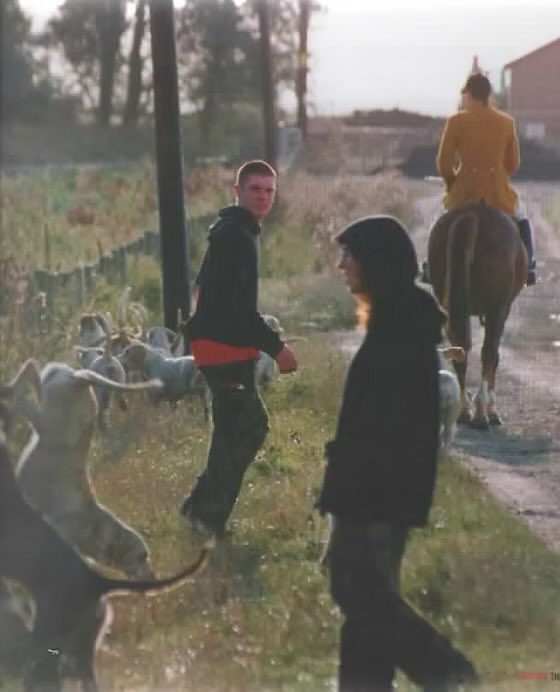
Spycop HN26 Christine Green (with hood up) hunt sabbing
Green left her husband and the police, confessed her real identity to Frampton and moved in with him. As far as we know, they are still together and living in Sweden.
Documents show she was relatively close with Thomson. One dated 26 September 2000 [MPS-0746307] records that Green was planning to leave the UK and live abroad, and that she ‘wanted as little contact as possible with the SDS office in particular and the Met in general’.
It says she told an officer (ciphered as TN0021) that she wanted to distance herself from the organisation and ‘put the whole thing behind her’. A handwritten note on the document says ‘need to speak to JT.’
A few weeks later, a file note from November 2000 [MPS-0009494] expresses SDS concerns that Green had left the country and they had lost touch with her, but says that she was still in contact with Thomson.
Thomson claims he cannot remember any of the conversations from that time. It is clear that Thomson and Green are still in touch with each other two decades later.
Management Accountability & Post-Deployment Dishonesty
As was standard protocol for SDS undercovers, Thomson was required to phone the SDS office twice a day, which he says he did when he could. He says he would mostly tell his managers where he was sleeping, although he claims he didn’t tell them when he was sleeping with Sara or Ellie, as he knew it was wrong.
Thomson also met Assistant Commissioner David Veness during his time undercover, when Veness visited the unit on 3 July 1998.
David Veness, Metropolitan Police Assistant Commissioner for Specialist Operations, 1994-2005
Documents reveal this was a 90-minute planned visit with chats between the ‘Assistant Commissioner Specialist Operations’ and groups of approximately three members of the SDS, each for 15 to 20 minutes.
Thomson said he does remember the event and that the feedback they got was a general ‘he’s very pleased’.
Thomson says only general information was given, regarding things that would be of interest to broader policing such as larger demonstrations in London.
When asked whether sexual relationships between undercover police officers and members of the public was touched upon, even in jest, he is categorical that it would not have been mentioned. He concedes that it’s because it would have been a confession of wrongdoing.
THE INTRODUCTION OF RIPA
The SDS code of conduct was introduced in January 2000 [MPS-0018359]. It contains a section about ‘collateral intrusion’, the incidental spying on people because they’re close to the real targets. The code makes loose claims that measures will be taken to avoid such intrusion.
Thomson says he hasn’t seen it and doesn’t remember even hearing the concept of ‘collateral intrusion’ back then. He points out that it would have been a near impossible task to avoid it, and he doesn’t recall it ever even being talked about. There was no change in operations when this code of conduct was introduced.
Other matters raised in the SDS code of conduct include the stipulation that authorisations should last no longer than three months before being reviewed.
Again, Thomson says this never happened. We were shown authorisation and review documents for Thomson and a number of other officers, seemingly identical wihtout consideration for what the officers were actually doing.
‘Q. It looks as if the cut and paste function has been mastered, doesn’t it?
A. It does look like they had found that on the computer by then.’
The final authorisation for Thomson’s deployment ran from 2 October 2001 to 1 October 2002 [MPS-0526929]. It was compiled by HN36 Detective Chief Inspector Michael Dell and signed by HN85 Commander Roger Pearce.
Under the heading ‘Consideration has been given to any adverse impact on community confidence that may result from the use or conduct of a source, or information obtained from that source,’ it states:
‘The positive effects of the use or conduct of the source in this arena, and the information emanating therefrom, are likely to far outweigh the negligible negative impact on the few supporters of extremist animal rights activity within the community.’
The next heading is: ‘Details of who will be affected, including collateral intrusion’. The response is:
‘Anarchists and animal rights activists who are involved in public disorder, criminal damage and serious assaults. Only information regarding those involved in such activity will be sought and actioned.’
It is evident from the reporting we have seen that information was routinely recorded about people who were not involved in any such activity, and that the negative impacts of these deployments was by no means negligible nor was it limited to a few supporters of ‘extremist animal rights activity’.
‘Q. In order to make the judgement that the positive effects of the information would far outweigh the negligible negative impacts on the few supporters of extremist animal rights activity, are you able to assist us any further as to what evidential basis Detective Chief Inspector Dell had to come to that conclusion?
A. I would presume he’s basing it on the reporting thus far in the deployment.’
Thomson is clear that his managers never discussed any of these questions with him.
MAKING SPYCOPS LAWFUL
Reviewing authorities every three months and limiting collateral intrusion were just some of the checks and balances that became statutory obligations on 25 September 2000, when the Regulation of Investigatory Powers Act (RIPA) came into force, right in the middle of Thomson’s deployment.
The aim of RIPA was to make undercover deployments lawful under the Human Rights Act 1998.
‘Q. Can you recall any discussion or any practical effects of the implementation of that Act of Parliament?
A. No.
Q. Would it be fair to say within the SDS everything continued just as it had always?
A. I think probably yes, but while there was no specific guidance, whether the way management managed might have changed.
Q. Save that some paperwork was generated?
A. Perhaps. Yeah, I don’t know.’
Barr’s questions on this point were very dry, however the implications are huge: if nothing changed after the introduction of RIPA, collateral intrusion was completely disregarded, and authorities were filled out using copy-and-paste, then SDS deployments were unlawful under human rights law.
WITHDRAWAL & DISCIPLINARY ACTION
Thomson was told in May 2000 that his deployment would be wound up in January 2001. He subsequently created the Operation Lime murder plot (dealt with in detail above). As a result of Operation Lime, Thomson’s deployment was extended for a further year. It looks a lot like he invented the plot as a way to continue his cushy life.
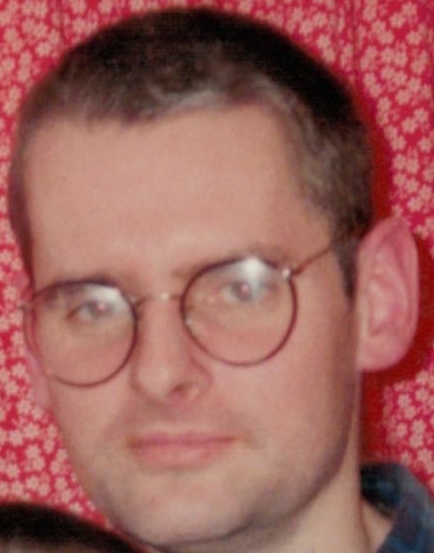
Spycop HN1 ‘Matt Rayner’ while undercover, February 1994. He deceived a woman into a relationship and stole the identity of a dead child. He was later mentor to James Thomson.
We were shown an exfiltration plan proposed by Thomson himself in October 2001. It suggested a very long and drawn out process that would have taken a very long time. He says that this was because he would have done anything to prolong his deployment. He admits that he was very begrudging about any plan to withdraw him.
Thomson told Ellie he would be moving to the USA in January 2002 and his actual exfiltration took place in March 2002, by which time he was under investigation by his managers.
Thomson claims not to remember much about his withdrawal. However, it was clearly a period of significant conflict with his managers that continued after his deployment was over.
A file note from 22 March 2002 [MPS-0719665] records that SDS manager Bob Lambert contacted fellow manager HN53 to say he’d received a call from Thomson, asking for a meeting.
Thomson says he can’t remember what he was thinking, but he thought Lambert would be an ‘understanding ear’. He tells Barr that Lambert already knew about his relationships and didn’t seem shocked or fazed by it.
Tellingly, Thomson says that if Lambert had handled his exfiltration, it would have been far more understanding and less of a disciplinary matter.
However, knowledge of Thomson’s behaviour was not limited to Lambert. Another document from 27 May 2002 records a meeting between Thomson’s mentor HN1 ‘Matt Rayner’ and SDS manager HN53:
‘[Thomson] also told him [HN1] that he believed that most of the current suspicions about his operation stemmed from SDS management disapproval of field officers becoming involved in romantic relationships during the course of their operation.’
Thomson agreed with this:
‘I thought it was sort of hypocritical and sort of retrospective.’
By this stage he claims he wasn’t talking to his managers. In fact, it looks like Thomson tried to put pressure on them in the context of what he felt was a disciplinary process. This included him threatening to leave the force.
Barr points out that in fact he never was subjected to the Met’s formal disciplinary process. As with other errant spycops before him, he was immune to disciplinary or criminal charges because, above all, the SDS prized its secrecy and couldn’t risk a disgruntled officer letting the public know the unit existed.
This reason was stated explicitly in the record of an interview on 18 September 2002, with Detective Chief Superintendent Black and Detective Superintendent McLachlan [MPS-0722289]:
‘I have told him that he has come very close to central discipline and criminal investigations and that, if it were not for the secret nature of the operation and the need to protect his colleagues, he would be long gone.’
It is a shocking admission. Fraud, violation of citizens, lying in court and other crime, all committed with impunity, thus allowing those who follow to do the same and more. It is the very opposite of the stated purpose of policing.
SACKED AS A SPYCOP BUT STILL WELCOME
The final cancellation of the authorisation for Thomson’s deployment was signed off in July 2002 [MPS-0526929]. It states that it was made clear to him that he was no longer a ‘source’ and had no authority to continue to contact his targets (an instruction he completely ignored).
Despite his betrayal of his managers, his unit, his role and his oath, Thomson was not expelled from the police force, nor did he choose to leave.
He wrote a remarkable debrief [MPS-0722282] which included an apology for his behaviour. Barr points out that, just like now, he was apologising for:
‘only what had been discovered and was capable of being proved against you.’
Thomson agrees with that assessment.
At the interview with Black and McLachlan, Thomson was asked outright whether he had sexual relationships with Sara and Ellie, and he said that he admitted then that he did. He claims the question of whether he was still in touch with them never came up.
Finally, we were shown a record of a meeting in 2012 between Thomson and Commander Peter Spindler, the Met’s Director of Professional Standards [UCPI0000035555].
The document states that the purpose of the meeting is to ‘manage potential risk’ to the Met. It appears to be a damage limitation exercise by the police, after the breaking of the spycops scandal.
Commander Spindler was clearly very supportive, reassuring Thomson that this was not a reinvestigation:
‘PS explains that he does not wish JT to finish his career thinking he is under a cloud. The purpose of this process is to protect the officer and the organisation.
Describes that both BS and the Deputy Assistant Commissioner hold JT in high regard and value his commitment and dedication to his role – and is hopeful that in a few months time there will be a clearer picture of the SDS review and that we can respond positively to media interest…
PS explains that the main thrust of the review is to protect the ‘troops’ whilst examining SDS management.
Moves on to say that he wants to instil in JT that he still enjoys the full confidence of the organisation but that is not to say in the future as the review unfolds he may be called to question.’
In fact, Thomson and other SDS officers were later investigated by a large internal police inquiry, Operation Herne.
We were shown Thomson’s statement to Herne [MPS-0721959], in which he describes the ‘moral compass’ of the SDS. Barr’s questions about this were understandably incredulous.
Thomson insists, despite overwhelming evidence to the contrary, that the unit as a whole did have a moral compass and held the moral high ground.
He does concede that his own behaviour was immoral and that he has deliberately and dishonestly misled both Operation Herne and the Inquiry on numerous occasions.
THOMSON’S CLAIMS ABOUT MENTAL HEALTH
In both his witness statement and his oral evidence Thomson has sought to claim he suffers from mental illness, including dissociative identity disorder, in order to explain his behaviour:
‘I appreciate there is a dichotomy here, how I was living two different lives, basically…
I need to be specific and I am trying to explain a state of mind which I alluded to…
I think those reasons are important and relevant… to your understanding and certainly to any lessons learnt.’
Barr pointedly challenged him about this:
‘Q. [Are you alluding] to an assertion that you suffered from dissociative identity disorder? Were you ever formally diagnosed with that psychiatric condition?
A. That came from a meeting with a psychiatrist some years after my deployment and one meeting.
It was something he suggested.Q. “Suggested” is precisely the word you use in your witness statement… That falls some way short of “diagnosed”, doesn’t it?’
Barr went on to point out that Thomson was assessed by psychiatrists on a number of occasions while he was serving.
‘Q. You have said that you were seen by the Chief Medical Officer for the MPS [Metropolitan Police Service] and then by a specialist who dealt with special forces issues?… Neither prevented you continuing to serve in the Metropolitan Police Service?
A. No.
Q. Part of the assessment for developed vetting includes your mental health, doesn’t it?
A. Mm-hm, yes…
Q. Presumably there was no medical issue to stop you continuing to serve not only in the Metropolitan Police Service but in Metropolitan Police Special Branch at a very high level of security clearance?… The reason you were downgraded was because of your conduct, wasn’t it?
A. Yes.’
Barr further pointed out that Thomson’s attempts to imply that he was mentally ill pose some significant issues in relation to his claims about Operation Lime:
‘Q. You were acting as a police officer doing very dangerous work preventing a probable murder…but if the contrary account is true, then it is consciously spun deception for self-serving purposes to impress your bosses, pay for a holiday and to remain undercover?
A. Yes.
Q. All very calculated?
A. Indeed.’
There is some indication that there were concerns about Thomson’s mental health at the time that his deployment was ending. We were shown a file note of his expense claims from early 2002 [MPS-0719684] which recorded:
‘He said that yesterday, after his interview with Detective Chief Superintendent Black and me, he had, “spent two hours at Beachy Head” and now acknowledged the need to see our consultant psychiatrist… “I need to see Mary Piper”.
We agreed that he would keep the appointment to see her on 27 March and that he did not wish to accept my offer of arranging an immediate meeting.’
However, the document also records that Thomson claimed £19.98 in petrol expenses for his quasi-suicidal trip to Beachy Head, and subsequently refused to attend the meeting with the psychiatrist until the internal investigation was over.
Thomson insists that he was genuinely distressed and not simply trying to portray himself as a man in distress so that management would exonerate him of his wrongdoing.
Nevertheless, a document from April 2005 [MPS-0748497], several years after his SDS undercover deployment, records Thomson being furious and ‘considering his legal position’ because his manager HN53 had raised the topic of him being suicidal as a concern about his suitability to be restored to firearms status.
Thomson accepts this might have been a legitimate concern, but says:
‘I think it should have been earlier. It was the timing that so annoyed me.’
Essentially, he only thinks his mental health is relevant when he is trying to avoid being held accountable for wrongdoing.
In any case, despite his claims to have suffered (and to still be suffering) from dissociative identity disorder and other mental illness, Thomson was successfully vetted for firearms duty and security clearance several times after his deployment ended, and remained in the Metropolitan Police Service until 2014.
Either he is lying about it, or the police are worryingly lax about who they allow to carry guns.
Conclusions
Open questioning ended at lunchtime on 10 December, and was followed by a short ‘closed’ hearing where Thomson was questioned by the Inquiry in secret, to protect people’s privacy.
Only his own legal team, the team representing the women he deceived into sexual relationships, and the lawyers for the Metropolitan Police were allowed to be present.
Thomson’s deployment, and his evidence, is among the most gobsmacking this Inquiry has examined. He has admitted to a staggeringly varied array of misconduct, seemingly without remorse:
‘Q. Most people who accept that something is wrong will, at some point, stop… You don’t appear to have done that… Why not?
A. I have no good answer for that.
Q. Save for a complete lack of morality?
A. I would accept that.’
The Inquiry has seen evidence of ill intentions going back years before he even joined the SDS – such as acquiring the birth certificate of a dead child in order to steal their identity – and continuing long after his deployment ended, as he maintained contact with women he deceived for over two decades, even after the SDS had been exposed.
It is clear that Thomson has discussed the Inquiry with other ex-SDS officers. When he told Ellie he was an undercover officer he also told her that many ex-spycops were leaving the UK in order to avoid being questioned by the Inquiry.
He wrote down all the officers he has discussed the Inquiry with since it was announced. We were not told the full extent of the list, but we do know that Lambert, Boyling and HN26 ‘Christine Green’ were all on it.
The Inquiry’s Chair, Sir John Mitting, ended the three days of questioning with a warning for Thomson:
‘I am going to have to think very hard about whether what you have told me about what occurred in Marseille is true, or whether what L3 has told me about what occurred in Marseille and on the way to Marseille is true. And about what objectively occurred and was recorded and verified at the time.
Is there anything other than your own assertion which could persuade me of the account that you have given is correct, and not that which has been given by L3 and which corresponds with the contemporaneous documents?’
Thomson seemingly did answer that question, but his words have been tantalisingly redacted from the transcripts. We will have to wait for Mitting to publish his interim report on the SDS, which is expected around mid 2027.
However, Mitting’s scepticism about Thomson’s evidence is clear from his closing questions. Most noticeably, he did not thank James Thomson for his time.