
UCPI Daily Report, 13 Oct 2025: Opening Statements from Inquiry & Police
Tranche 3, Phase 1, Day 1
13 October 2025

Sir John Mitting opening the Undercover Policing Inquiry’s Tranche 3 Phase 1 hearings, 13 october 2025
INTRODUCTION
The Undercover Policing Inquiry kicked off ‘Tranche 3’, examining the final 15 years of the Special Demonstration Squad 1993-2008, on Monday 13 October 2025.
This is quite a long report, use the links to jumpt to specific speakers:
• David Barr KC – Counsel to the Inquiry (the Inquiry’s main lawyer who’ll question witnesses)
• Peter Skelton KC – Commissioner of Police for the Metropolis (the Metropolitan Police as an institution)
• Neil Sheldon KC – Home Office (government ministry in charge of police and the Inquiry)
• Oliver Sanders KC – Designated Officers (the majority of undercover officers invovled)
Additionally there was a dramatic end to the day:
The Inquiry’s Chair, Sir John Mitting, opened the hearing, saying that T3 will continue until the end of July next year.
Tranche 3 has been divided into 3 ‘phases’. Phases 1 and 2 will consist of evidence from undercover officers (UCOs) and civilian witnesses.
Phase 3 (currently scheduled to take place in June-July 2026) will examine evidence of the unit’s management – hearing not just from the SDS (Special Demonstration Squad, later called the Special Duties Squad) managers, but from those higher up the senior chain of command, those with oversight of the spycops’ operations. We hope to finally hear from the Home Office, who despite setting up the SDS and directly funding it, have been notably silent in this Inquiry to date.
The dates are:
• Tranche 3 Phase 1 hearings, SDS officers and relevant civilians 1993-2008 part 1: 13 October 2025 – approx 18 December 2025
• Tranche 3 Phase 2 hearings, SDS officers and relevant civilians 1993-2008 part 2: 2 February 2026 – approx 26 March 2026
• Tranche 3 Phase 3 hearings, SDS managers: 15 June 2026 – approx 30 July 2026
We believe there will also be ‘closed’ (secret – not open to the public, or to those spied upon) hearings taking place in 2026. Everyone involved in Tranche 3 will then be invited to make Closing Statements in early 2027.
Mitting is due to produce a report, detailing his findings about the SDS, before he retires later in 2027. A new Chair will then be found to oversee the remainder of the Inquiry.
It is important to note that this week’s Opening Statements refer only to what is being called ‘Tranche 3, Phase 1’ (T3P1). Despite having delayed the start of the tranche by eight months, supposedly in order to ensure everyone would have a chance to review the evidence before it began, the Inquiry has yet again failed to get the Hearing Bundle of documents ready on time.
Around 300 people and organisations heavily involved in the spycops scandal have been designated as Core Participants by the Inquiry (mostly people who were spied on). They have so far only received the witness statements and evidence in relation to the six officers that will be examined in this first set of hearings.
Of those six, only HN16 James Thomson ‘James Straven’ / Kevin Crossland’, HN15 Mark Jenner ‘Mark Cassidy’, and HN43 Peter Francis ‘Peter Black/ Daley/ Johnson’ will give evidence in person.
In relation to the others, Barr told us that HN81 ‘David Hagan’:
‘cannot give oral evidence for health reasons, but he has provided the Inquiry with a detailed witness statement.’
HN26 ‘Christine Green’ is understood to be:
‘outside the jurisdiction. She is legally represented but has declined to provide a witness statement’.
This is understood to mean that the Inquiry does not have the power to compel witnesses to give evidence if they live outside England and Wales.
HN123:
‘is unrepresented and ceased responding to the Inquiry’s correspondence some time ago. Despite significant efforts by the Inquiry to find him since then, we have been unable to do so. He has not provided the Inquiry with a witness statement but he did make a witness statement for the purposes of civil litigation against the Commissioner in 2003’.
We note that HN123 is not the only T3 officer to have gone AWOL in this way and we will be questioning the Inquiry’s apparent intention to continue giving those officers anonymity, despite their obvious bad faith.
Evidence relating to the remaining 19 officers from T3 is yet to be released to Core Participants. ‘Phase 2’ (T3P2) hearings are expected to start in February 2026 and continue until at least the end of March.
In his statement, Barr gave a relatively long rundown of the legal, political and administrative changes that affected the SDS during the T3 period (which runs from 1993 until the SDS was disbanded in early 2008) and of the evidence the Inquiry will be hearing.
In the afternoon we heard from lawyers representing the Home Office, Metropolitan Police Service (MPS) and some of the officers (undercovers and their managers). They each gave fairly short statements, effectively blaming each other for the scandal of what they are now calling ‘a dysfunctional unit’.
Before reading the reports of their statements below, we encourage you to remember that throughout the history of the SDS they were all saying how brilliant it was, and commendations were being handed down from on high to SDS officers like confetti.
The Inquiry’s page for the day has video of the hearing, a transcript, and many of the documents referred to.
Live evidence (questioning witnesses in person) starts on Friday 17 October.
David Barr KC (Counsel to the Inquiry)

David Barr KC
Barr’s written Opening Statement has been published on the Inquiry’s website.
There are over 100 pages of Annexes, including a list of all 15 ‘open’ undercover officers (UCOs), and 10 ‘closed’ UCOs (whose real and cover names are being kept anonymous).
Barr began by highlighting some important changes that took place during the T3 era, 1993-2008, and key themes of these T3P1 hearings.
With the end of the Cold War, there was a diminishing interest in ‘subversion’ on the part of the Security Service (aka MI5).
It decided to stop identifying rank and file members of groups considered ‘subversive’ in October 1992.
However, Barr noted an increased threat of terrorism in the UK during the T3 period, citing a number of major terrorist attacks:
‘9 September 2001, or “9/11”, when Al-Qaeda terrorists attacked the United States occasioning very serious loss of life, including 67 British citizens’; and ‘the appalling “7/7” attacks, in 2005, which claimed the lives of 52 innocent people as well as those of the suicide bombers’.
It is hard to comprehend the relevance of these attacks to the work of the SDS.
On Barr’s account, it came when:
‘in a case of mistaken identity, police shot dead Jean Charles De Menezes, at Stockwell underground station, wrongly believing an innocent man to be another suicide bomber’
The SDS proceeded to spy on the family of this innocent victim, and their Justice4Jean campaign.
Barr also mentioned spying on campaigns against the Second Gulf War (including ‘what is generally accepted to have been the largest political demonstration in Britain of all time’ in February 2003). Barr explained that the Inquiry will be examining whether reporting on the Stop the War Coalition, Disarm DSEI and other anti-war, or anti-arms trade campaigners, was justified.
Barr also mentioned the 2006 Lebanon War and ‘long-running problems in the Levant’, as background to spycop HN18 Rob Hastings ‘Rob Harrison’ spying on the International Solidarity Movement, a Palestinian solidarity group. We note that this is the first time this officer’s real identity has been mentioned in public.
Other movements spied on in this period included the climate movement, especially Camp for Climate Action. This will be examined in detail in Tranche 4, which will examine the second spycop unit, the National Public Order Intelligence Unit, which deployed EN12 Mark Kennedy ‘Mark Stone’.
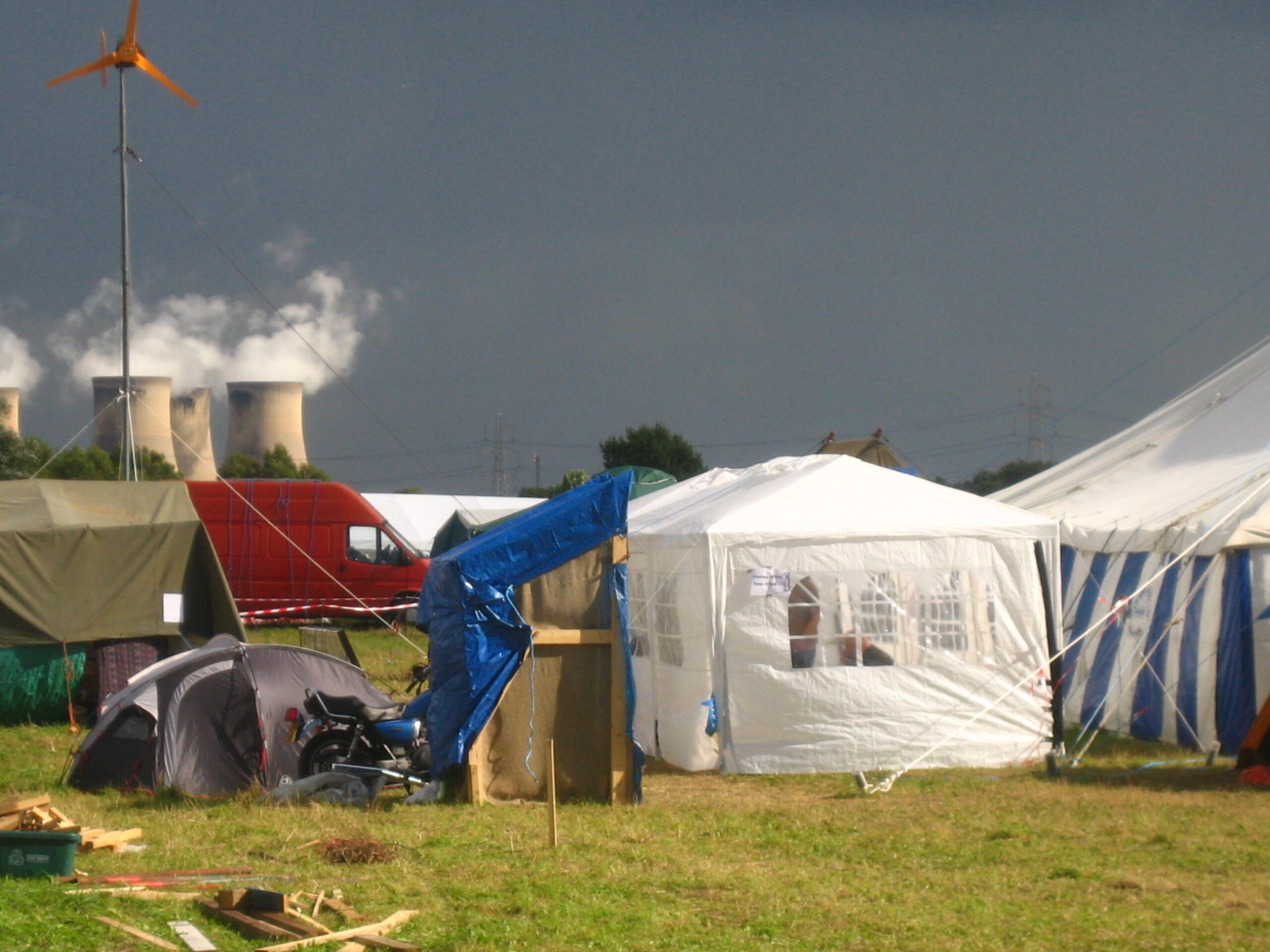
Camp for Climate Action at Drax coal-fired power station, Yorkshire, 2006. Spycops from both major units were involved.
But we now know that these events were also attended and reported on by SDS officers. We were told that HN66/EN327 ‘Dave Jones’ was targeted against the 2006 Camp for Climate Action held close to the Drax power station in North Yorkshire.
Both HN118 ‘Simon Wellings’ and HN18 Rob Hastings ‘Rob Harrison’ appear to have attended the 2007 Camp for Climate Action at Heathrow Airport.
Barr described extensive reporting on other environmental groups, and non-violent direct action against genetically modified crops, road building and the proliferation of motor vehicles generally, with groups such as Earth First! and Reclaim the Streets being specifically targeted by the SDS.
However, none of these deployments will be looked at in detail until ‘Phase 2’ hearings beginning in February 2026, and the bundle of documents and evidence about these officers has not yet been disclosed to us.
Animal rights activism continued to be targeted by the SDS throughout the T3 era. A footnote to Barr’s statement notes that spycops HN26 ‘Christine Green’, HN14 Jim Boyling ‘Jim Sutton’, HN16 James Thomson ‘James Straven’ / ‘Kevin Crossland’, and HN60 ‘Dave Evans’ were all targeted in the animal rights field, Green and Thomson exclusively so.
Barr explained that ‘a wide range of animal rights activism was infiltrated’ including hunt sabs.
He notes that a:
‘landmark event was the Hunting Act 2004 which, subject to certain exemptions, rendered unlawful hunting wild mammals with dogs. It came into force on February 2005.’
IRELAND
Barr’s list of key events in the period included the 1992
‘transfer of lead responsibility for Irish Republican terrorism on the mainland from the Metropolitan Police Special Branch, or MPSB, to the Security Service’
He also cited the radical changes to ‘both the political and policing landscape’ brought about by the signing of the Good Friday Agreement in April 1998.
Nevertheless, he went on to describe SDS activity in the 1990s (notably that of HN15 Mark Jenner – see below) which suggests the unit still considered this part of its remit.
RACIST POLICING
This will be a primary focus of the evidence we are going to hear in these ‘Phase 1’ hearings. Barr noted that there was considerable racist violence within the Metropolitan Police District in the early 1990s, particularly in South East London, which prompted large anti-racist protests, for example the two that took place in Welling in 1993.
He highlighted the fact that:
‘Racism within the MPS [Metropolitan Police Service] was also an issue. Numerous racial justice campaigns arose often from deaths in custody, miscarriages of justice or failures to bring the perpetrators of racist attacks to justice.’
After the murder of Black teenager Stephen Lawrence in 1993 and the racist police investigation, a public inquiry was announced in July 1997 and reported in February 1999. It famously found that:
‘the Metropolitan Police Service was institutionally racist.’
Barr continued:
‘We have been investigating SDS reporting on Black justice campaigns and attitudes to race within the unit from the outset of the Inquiry. There have been many examples in Tranches 1 and 2 of racist content within SDS reporting. We have found much reporting on those campaigning for racial justice.
There were deployments into far-left wing groups campaigning for racial justice, such as that of HN106 “Barry Tompkins” in Tranche 1… HN88 [‘Timothy Spence’], in Tranche 2, [deployed to Stoke Newington and Hackney], where he reported on racial justice campaigners and those seeking to hold the police to account.’
We have already heard a great deal of harrowing evidence about the racism at the core of the police, and how it related to the SDS operation, from a host of witnesses: John Burke-Monerville, Sharon Grant OBE, Diane Abbott MP, Richard Adams, and Stafford Scott. (Scott has provided an additional witness statement for this Tranche, which will be published in due course).
This provides important contextual background about the attitudes and practices found within the SDS and amongst the ‘consumers’ of the intelligence it gathered.
Barr made it clear that the issue of race will be particularly prominent in T3P1:
‘There is a great deal of SDS reporting on a large number of racial justice campaigns during this era’.
Much of it came from the deployments of HN43 Peter Francis, HN81 ‘David Hagan’, and HN15 Mark Jenner.
A large number of civilians affected by SDS reporting on racial justice campaigns or race related issues have provided witness statements, including:
• Baroness Doreen Lawrence OBE
• Dr Neville Lawrence OBE
• Duwayne Brooks OBE
• Bernard Renwick
• Lee Lawrence
• ‘MSS’ (family of Michael Menson)
• ‘MWS’(family of Michael Menson)
• Myrna Simpson
• Patricia Armani Da Silva
• Sukhdev Reel
• Tish Reel
• Winston Silcott
Barr noted:
‘The traumas experienced by each of these people are clearly set out in their deeply moving, at times harrowing, evidence. So too are their complaints about the police, many of which have already been held to be justified.’
Others who advised or closely supported those at the heart of such campaigns and were themselves reported on or directly targeted have also made statements, including:
• Michael Mansfield KC
• Suresh Grover of The Monitoring Group;
• Asad Rehman of Newham Monitoring Project
• Marc Wadsworth of the Anti-Racist Alliance
• Mark Metcalf and ‘Alison’ of the Colin Roach Centre
• Dr Graham Smith of the Hackney Community Defence Association
• Hannah Sell and Lois Austin of Youth Against Racism in Europe
• Alex Owolade, Karen Doyle, Antonia Bright and ‘Lewis’ of the Movement for Justice
The Inquiry intends to look for evidence of conscious and subconscious racism in the SDS deployments, and examine the way that Black justice campaigns were reported on. Was this a case of what is termed ‘collateral intrusion’ when mainly spying on someone else, or were they deliberately targeted by Special Branch? What was this reporting used for?
BLACKLISTING
It is well established by police and their satellite bodies that Special Branch officers routinely, illegally, supplied personal details of people to an illegal employment blacklisting organisation, The Consulting Association. Thousands of people were denied work merely for entirely lawful trade union and workplace activity.
Barr informed us that:
‘The Consulting Association continued to be involved in blacklisting throughout the Tranche 3 era. We will continue, as we have to date, to look for evidence of any links between SDS intelligence and those blacklisted’.
However we note that blacklisted union activist, COPS campaigner and Secretary of the Blacklist Support Group, Dave Smith, has not been called to give oral evidence, despite his expertise and unique understanding of the blacklisting scandal.
Smith has applied for a Judicial Review of the unreasonable and irrational decision by Sir John Mitting not to call him at these hearings, saying:
‘The inquiry’s intention to restrict the evidence of blacklisted workers, means they are relying only on police accounts. It is against natural justice and the public interest and it makes the inquiry look like an establishment cover-up’.
KEY LEGAL DEVELOPMENTS
T3 saw some very significant legal changes, most notably the enactment of the Human Rights Act 1998 (HRA) on 2 October 2000. From then onwards, unjustified interference with private life through undercover policing, and inhuman or degrading treatment at the hands of undercover officers, both constituted Human Rights breaches enforceable in the UK domestic courts.
The Regulation of Investigatory Powers Act 2000 (referred to as ‘RIPA’) introduced a statutory regime with specific regulations for all deployments of undercover police officers, supposedly to ensure that these complied with the requirements of the HRA.
It introduced new systems for the authorisation, review, record keeping and oversight of undercover deployments which Barr noted:
‘should have focused minds on the justification for deploying SDS UCOs, including proportionality, as well as the need to manage and limit collateral intrusion.’
Barr made it clear that this Inquiry is prohibited from ruling on civil or criminal liability, but
that its terms of reference allow it to establish the extent to which managers considered and followed the laws which were designed to prevent problems of precisely the kind which beset the SDS.
In addition to the HRA and RIPA, other relevant legal changes that took place in the T3 period included the Criminal Procedure and Investigations Act 1996, the Police (Conduct) Regulations 1997/30, the Data Protection Act 1998, the Greater London Authority Act 1999, the Race Relations (Amendment) Act 2000 and the Police (Conduct) Regulations 2004/645, the Management of Health and Safety at Work Regulations 1999, and the Police (Health and Safety) Regulations 1999.
Barr pointed out that these last two are relevant to:
‘the extent to which the MPS sought to protect its officers, and those affected by their actions, from avoidable psychiatric harm’.
He also observed that the Inquiry will examine:
‘a great deal of evidence in this tranche about the harm done not only to members of the public but also undercover officers as a result of SDS operations’.
ORGANISATION OF THE SPECIAL DEMONSTRATION SQUAD
The Inquiry has now published a timeline and explanatory note for Tranche 3. This sets out the dates different officers served in the unit and some of the organisational changes that took place.
Barr described how in 1992, Special Branch’s ‘C’ and ‘E’ Squads merged into ‘CE Squad’ which commanded the SDS until approximately January 1995. Command was then transferred to ‘S’ Squad.
He also mentioned the 2006 merger of the Met’s Special Branch (‘SO12’) and Anti-Terrorist Branch (‘SO13’) into Counter Terrorism Command (‘SO15’).
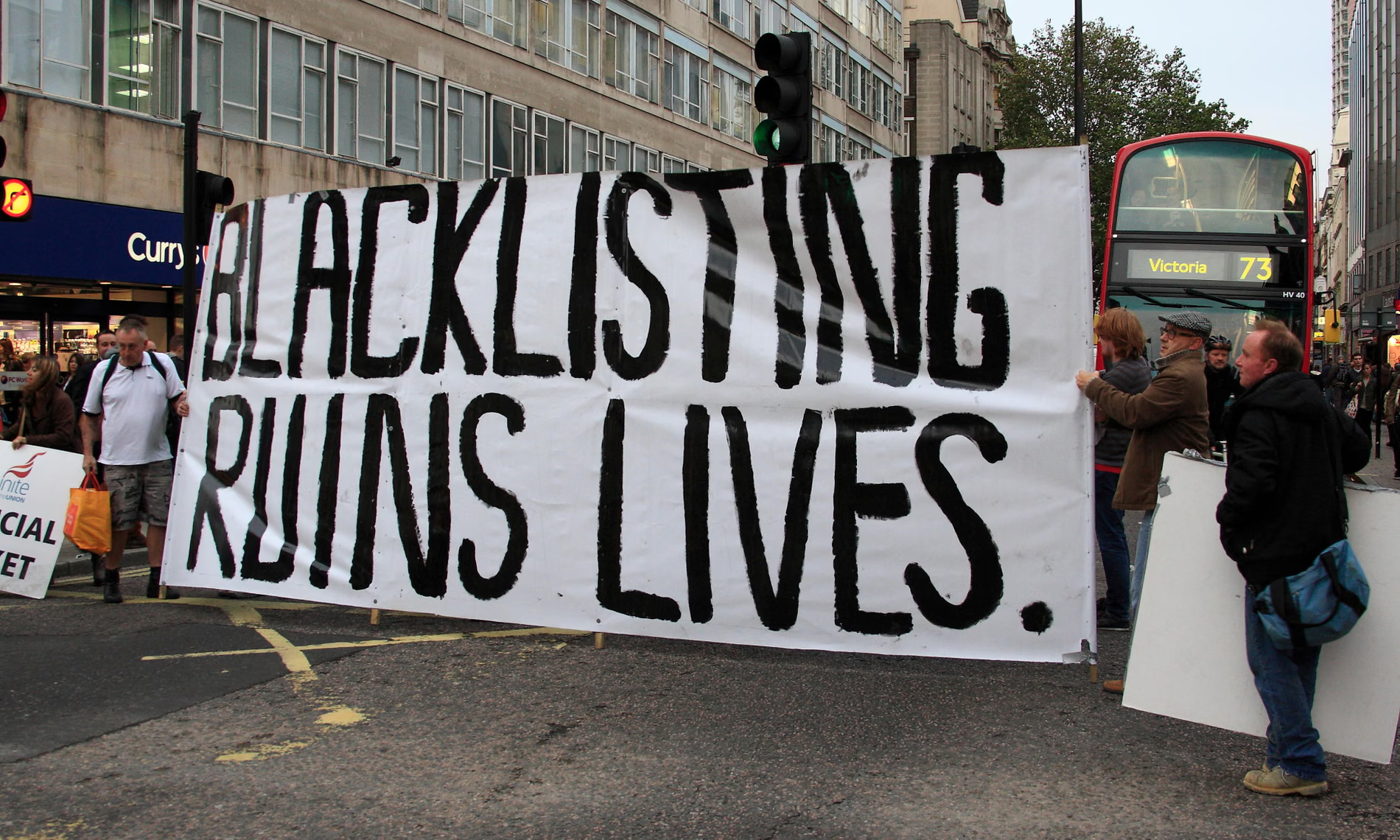
Members of Unite the Union protest in London against employment blacklisting. Spycops illegally assisted the blacklist.
In 1997 or 1998, the meaning of the SDS acronym also changed, from ‘Special Demonstration Squad’ to ‘Special Duties Section’.
The SDS itself was headed by a Detective Chief Inspector (DCI), supported by a Detective Inspector (DI) and two or three Sergeants.
A civilian administrator was added in 1995, and a Detective Constable joined the back office team in 2003. Nominally, the SDS was supposed to have 12 undercover officers deployed at any one time, but in practice there were often fewer than that.
Many aspects of the SDS operation appear to have remained largely the same in the T3 era. They continued to recruit officers exclusively from within Special Branch. Training continued to be informal, in the back office and on the job.
The deeply problematic SDS Tradecraft Manual appears to have been in use throughout this period. The unit continued to conduct twice weekly meetings at safe houses, and undercover officers continued to use cover accommodation, cover employment, cover documents and cover vehicles.
Other practices changed. The back office was moved to covert premises in 1997 or 1998 and
undercover officers were given (frankly ludicrous and disturbing) code names.
The SDS computerised its administration in 1995 and the Inquiry has worked from electronic documents in this Tranche. (Full details of their methodology and sources can be found in the Tranche 3 Disclosure Note).
In Tranche 2, examining the SDS 1983-1992, we heard how the selection process was changed after the ‘Scutt affair’. T3 saw further changes, with the introduction of psychometric testing (according to the SDS Annual Report of 1993-94).
The practice of peer mentoring continued, but was not without its problems. There is evidence that when HN86 was in charge of the unit, he sought to improve the support available for UCOs, with psychological support apparently on offer from around 2001 onwards. However, the extent to which his reforms were actually put into practice and maintained is in doubt.
By 2005, the unit’s recruitment process seems to have included:
‘an informal meeting, an interview, psychometric testing, a psychological interview, a structured interview, a home visit and then final selection.’
The selection process, according to Barr:
‘sought, amongst other things, to assess moral and ethical boundaries… Dilemmas on themes of “racial violence”, “racial issues” and “sex, drugs and rock ’n’ roll”, amongst others, appear to have been used’…
The titles alone seem to confirm that these were areas which either were, or should have been, of concern for management’.
However, despite all the legal and organisational changes, much of the behaviour of the SDS remained the same. There is considerable evidence that sexual relationships were still known about and talked about within the unit during T3.
Keeping the unit’s existence and methods secret continued to be a ‘paramount consideration’, and this influenced the way that misconduct of all kinds was dealt with, or not, and the unit’s attitude to the civil and criminal justice systems.
Barr outlined key questions for the Inquiry, a list which bears quoting in full:
‘who took targeting decisions, what decisions were made, why, how, whether they were justified, whether they were kept under review and, if they were justified initially, whether they remained so?’
He went on to say:
‘We will be taking a particular interest in how targeting was dealt with once the provisions of RIPA came into force. What difference did formal statutory processes make? To what extent did they achieve the aims which the legislation intended and, where they fell short, why?
It is self-evident that the introduction of RIPA did not act as a panacea for problems of the kind that we have been investigating. But understanding why that was the case may be very important to recommendations for the future of undercover policing. Especially if the answer is cultural, involving ingrained attitudes, behaviours and practices’.
DECEASED CHILDREN’S IDENTITIES
The SDS officially stopped stealing the identities of dead children early in T3, and HN43 Peter Francis was the last of the ‘open’ UCOs to base his cover identity on a dead child.
However, the Inquiry has learnt that HN16 James Thomson made supposedly unauthorised use of the identity ‘Kevin Crossland’. Barr explained:
‘Kevin Crossland lost his life, aged 5, in an aeroplane crash in the early hours of 1 September 1966. His mother and sister also perished in the crash but his father, David, survived albeit with serious injuries.’
The Inquiry will consider evidence of family members and will hear oral evidence from Liisa Crossland, about the impact of Thomson’s conduct and concerns about the management of the SDS.
Thomson will be questioned about how and why he used Kevin’s identity, seemingly for his own ends. Barr noted:
‘By the time the issue came to the attention of SDS managers, DS Thomson had registered Kevin to vote, obtained a mobile phone in his name and obtained a driving licence in this name.’
SDS ANNUAL REPORTS
The SDS produced annual reports until at least 1996-97. These reports were published in T2. Three further documents have now been published, including what appears to have been some discarded text from the 1995-96 report, a signed copy of the 1996-97 report with associated minute sheet, and either an incomplete draft, or part of a report, for 1997-98.
Barr noted that no complete report for 1997-98 nor any subsequent SDS annual reports have been found amongst surviving SDS records.
We can see from the minute sheet accompanying the 1996-97 report that it was definitely seen by a number of senior officers, including the then Commissioner, Sir Paul Condon, and the then Assistant Commissioner (Special Operations), Sir David Veness.
Dated 14 October 1997 is a comment from Condon:
‘Please convey my appreciation to all concerned for another year of outstanding courage and professionalism’.
This fact should be coupled with spycops describing Condon visiting their safe house to personally congratulate them. It shows that when, in the early days of the spycops scandal and the Met were in denial mode, Condon was lying when he said he’d never even heard of the SDS.
The incomplete 1997-98 report evidences a wish, on behalf of SDS management, to trumpet to their superiors about the work of HN81 ‘David Hagan’, his infiltration of the Movement for Justice and reporting on the group’s alleged actions in relation to the Stephen Lawrence Inquiry.
Questions need to be asked about the senior chain of Met command’s knowledge and involvement with the SDS, and the Inquiry will be investigating this at hearings in summer 2026.
THE DEMISE OF THE SDS
The SDS was shut down at the very start of 2008. The Inquiry will examine the events around the unit’s demise in detail at the T3P3 hearings in summer 2026.
According to Barr, in these T3P1 hearings, they will start exploring the apparent ‘clash of cultures’ that occurred towards the end:
‘It manifested itself in considerable tensions between managers with backgrounds outside Special Branch and UCOs recruited from within Special Branch. The former sought to effect significant changes to the way in which the SDS was run. They were met with considerable resistance to their efforts.’
The Inquiry has just published an explosive report for the SDS [MPS-0722622] which was written by Detective Sergeant HN273 in 2009, following the closure of the unit, at the behest of DCI Flood.
Barr describes it as:
‘a significant early critique of the SDS operation. Amongst other things it recognised the considerable legacy of risk which the unit was leaving behind. For example, because of the way in which courts had not been properly informed of SDS activity.
An important question is why more was not done at that time to act upon the recognition that there were likely to have been miscarriages of justice and deceitful sexual relationships’.
HOW EVIDENCE WILL BE ‘ADDUCED’
Barr addressed the Inquiry’s evidence process for this Tranche. He made a point of insisting that the Inquiry’s approach ‘will remain the same as it was in Tranche 2’, claiming that the vast majority of evidence was only ‘adduced’ in writing, rather than being heard orally.
This was something of a dog whistle on Barr’s part, as there is significant controversy over the fact that the Inquiry does not intend to call many non-police non-State witnesses in this Tranche, even where there are significant disagreements.
He specifically defended those decisions, telling the Chair:
‘Not every dispute of fact arising on the face of the written evidence will need to be resolved in order for you, Sir, to discharge the terms of reference. For this reason, it is not necessary to call some witnesses even though their evidence conflicts with that of other witnesses. Nor is it necessary to question every witness who is giving oral evidence about every dispute.’
He also explained that non-police non-State witnesses would continue to give evidence first, before the officers that spied on them.
This means that a large number of these witnesses will be expected to give evidence in ‘Phase 1’, about officers whose witness statements have not been disclosed and whose oral evidence will not be heard until next year.
(A full list of the non-State witnesses can be found at Annex E to the written version of Barr’s Opening Statement and the Inquiry has uploaded a provisional schedule of the T3P1 hearings).
Barr then made a very important point, reminding the Chair that:
‘the boundaries between our tranches and the phases within them are entirely administrative boundaries used by the Inquiry to organise the conduct of our necessarily complex and lengthy investigation. The ground truth was a continuum and there is considerable overlap between tranches and phases in places.
For example, some members of the public were reported on by both SDS and NPOIU UCOs during the period that both units co-existed. Some were affected by both Tranche 3 Phase 1 and Tranche 3 Phase 2 UCOs.’
One such example is that of the civilian witnesses who will be called to appear in these hearings but can also provide important evidence about HN104 Carlo Soracchi ‘Carlo Neri’, who won’t appear until ‘Phase 2’.
This understated comment was a significant moment: the Inquiry has behaved quite ridiculously when it comes to Soracchi, and although his real name has been public knowledge for years, this was the first time anyone from the Inquiry has publicly said it.
Finally, Barr summarised the police witnesses who will be giving evidence in ‘Phase 1’, and about whom others will give evidence, in the coming weeks:
1. HN143 Dennis ‘Ben’ Gunn
Gunn is actually a senior manager from T2 who is giving evidence out of turn, early next week because ‘it is expedient to do so now rather than wait until next summer’s senior management
hearing.’ Gunn served as Commander (Operations) in the Met’s Special Branch (MPSB) between approximately February 1988 and November 1991.
2. HN587 Peter Phelan
Barr noted that the Inquiry plans to call another senior manager ‘at some point during the Phase 1 hearing’. Peter Phelan was supposed to give evidence on Thursday 16 October but he cancelled unexpectedly. He served as Commander (Operations) in MPSB from the late summer of 1983 until December 1987 and thereafter as Deputy Assistant Commissioner (Security) from January 1988 until December 1991.
3. HN16 James Thomson, ‘James Straven’/ ‘Kevin Crossland’
Detective Sergeant James Thomson was deployed from February 1997 until March 2002 under the fictional cover name ‘James Straven’. He infiltrated the animal rights movement, specifically targeting the Brixton Hunt Saboteurs and the Croydon Hunt Saboteurs, and Barr added that:
‘He also appears to have mixed with at least some people who were believed to be committing offences under the banner of the ALF.’
Barr noted that Thomson’s deployment into Brixton Hunt Sabs was short lived. The reason he cites: ‘it was felt they were too unpredictable to be a source of reliable advance intelligence.’
It is worth noting that this seems improbable. It is far more likely that Thomson just failed to win the trust of the group, one which evidence from T2 suggests the SDS were extremely interested in.
Barr notes that Thomson claims to have ‘assessed the Croydon Hunt Saboteurs to be more organised and consistently led’.
Thomson’s reporting for the first three years of his deployment is described as: ‘a mixture of intrusive personal reporting of the kind with which we are now familiar but also reports about activities which, on their face, appear to have some policing value’. Thomson’s managers
were seemingly pleased with his performance.
However, Barr states:
‘In fact, all was not well. There are very many troubling aspects of DS Thomson’s deployment and conduct. Despite investigation by his immediate managers towards the end of his deployment, investigation by [police internal spycops investigation] Operation Herne and our work to date it is still not entirely clear where the truth lies…
One thing is certain: Mr Thomson has, on his own admission, told many lies to date. He has lied not only to those he mixed with whilst deployed but also to his managers and to the Inquiry. His credibility is very much an issue.’
HN16 JAMES THOMSON ABUSING WOMEN
Thomson’s misdeeds include deceiving several women into sexual relationships (something which he no longer denies).
‘Sara’ joined the Croydon Hunt Saboteurs, soon after meeting the man she knew as ‘James Straven’, in the autumn of 1998. She liked him. A relationship developed and became sexual. He told her that he loved her at the Glastonbury festival in 1999.
She felt a strong connection to him and would have married him had he asked. Over Christmas 1999 she could not contact him. She challenged him and he came to see her with a letter in which he claimed to have experienced sexual abuse when at school, asking her not to tell anyone about this. She is now very angry with the way in which she was manipulated.
Barr stated:
‘I shall not attempt, in this brief opening, to do justice to “Sara’s” evidence about the impact of DS Thomson’s deceit. But her counsel, Ms Kilroy KC, will be speaking on her behalf tomorrow.’
Sara will be the first T3P1 witness to give evidence, doing so on Friday 17 October.
‘Ellie’ was not an activist but was and is an animal lover. She volunteered and later worked at a local animal hospital. Her relationship with the man she knew as ‘James Straven’ began in early 2001.

Spycop HN16 James Thomson, ‘James Straven’/ ‘Kevin Crossland’
He had asked her close friend, who we are calling ‘Wendy’, to set them up. Ellie was 21 years old at the time and vulnerable. He said he was 33. He was in fact 37. ‘James Straven’ was Ellie’s first real love and first serious boyfriend.
They went on holiday together to Indonesia and Singapore. Around the start of 2002, Ellie recalls ‘Straven’ telling her that he was going to move to the United States because his ex-wife and children were moving there. About a month later he told her he would be moving sooner than he thought. This was all part of Thomson’s exfiltration plan from his deployment.
For an extraordinary sixteen years after Thomson’s deployment ended, he kept in touch with ‘Ellie’ and met up with her periodically. ‘Ellie’ has provided exhibits to the Inquiry, including some of the loving and emotional communications that passed between them over the years. In one, Thomson asked for photographs of her in lingerie.
In June 2015, thirteen years after his deployment ended, after this Inquiry was announced and just a month before its formal opening, ‘Ellie’ had sex with the man she still knew as ‘James Straven’.
Eventually, in April 2018, after Thomson knew that he was going to lose his anonymity in the Inquiry, he told Ellie he had been an undercover police officer. By this stage, Barr noted:
‘We may need to explore in more detail what was said in this conversation. Amongst other things, “Ellie” states that Mr Thomson told her that a lot of former UCOs were leaving the country until the Inquiry had blown over.’
Such prolonged contact, over so many years, had a significant impact on ‘Ellie’. She was never able to move on and get over him, and the discovery that ‘Straven’ was an undercover police officer has had a profound impact upon her.

Spycop James Thomson ‘James Straven’ in a bar in Amsterdam, 1998
Ellie will be giving evidence on 23 October and 3 November.
‘Wendy’ was deceived into a long-term friendship by ‘Straven’ which lasted for over twenty years. from 1997 until she discovered the truth about who he was in 2018.
She volunteered and then worked at the same animal hospital as ‘Ellie’. She was an animal rights activist, who became a hunt saboteur in 1997, aged 17.
‘Straven’ supported her in 2000 and 2001 when her mother was dying, at a time when her mental health was very poor. She recounts how Thomson encouraged her to continue hunt sabbing at this time and facilitated her doing so.
‘Sara’ and ‘Ellie’ were close friends and Wendy is now troubled by the role she played in encouraging Thomson’s sexual relationships with them both. Thomson’s deception has had a significant impact upon her which she articulates in her witness statement.
One particularly disturbing aspect of his interference in her life is a passage in an internal SDS document about her which reads:
‘Recently moved into an address… which she has bought since the death of her mother, attempts to disrupt this purchase having failed. It is impossible to predict how long she will remain here’.
Why on earth did the spycops want to stymie her buying a house? Barr agreed in his statement that ‘this passage calls for an explanation.’

From 2000-2003, James Straven and Kevin Crossland were on the electoral roll together at Flat 2, 25 Southey Road, London SW9 0PD. Neither of them existed; they were two identities used by spycop James Thomson.
SDS managers first developed serious concerns about Thomson in 2001, when he told them he would travel to France on annual leave (from 26 September to 5 October 2001). They discovered he had in fact deliberately disobeyed instructions and gone to Indonesia with ‘Ellie’.
Barr explained that from then on, more and more problems with Thomson’s conduct emerged.
He had multiple credit cards and bank accounts in his ‘James Straven’ identity, and more than one passport, some with pages removed, apparently to conceal unauthorised travel.
He had multiple driving licences at various addresses, and managers believed he must have broken the law to obtain some of them.
‘Perhaps most troubling of all, DS Thomson was found to be developing another false and unauthorised persona. It was based on a deceased child’s identity: that of Kevin Crossland…
There was, and is, considerable suspicion about the financial propriety of DS Thomson’s conduct during his deployment.’
Barr then recounted an especially serious incident in Thomson’s deployment which will be examined in detail by the Inquiry.
As part of his supposed infiltration of the Animal Liberation Front, Thomson reported on a plot to travel to France to obtain a firearm and black powder from an animal rights activist. This supposed plot was allowed to go ahead in order to be disrupted by the police.
Barr explained:
‘DS Thomson appears to have driven to Marseille in his cover Land Rover Discovery with an activist known as ‘L3’. He seems to have left the vehicle where it could be, and was, recovered by [SDS manager] HN58 who made it appear like a theft.
A semi-automatic large calibre handgun was found in the vehicle, together with ammunition and black powder. DS Thomson hired a car and drove to Bordeaux where “Sara” recalls meeting him.’
However, SDS managers became suspicious that the plot might in fact have been a self-
aggrandising tale designed to prolong Thomson’s deployment. There has been no independent corroboration of the plot, and it appears that another UCO – who has full anonymity in this Inquiry – told his manager HN36 Michael Dell that Thomson was in possession of a firearm, given to him as a gift while on protective duties.
Thomson allegedly sought permission to keep the gun as a gratuity, and when that was refused, did not return it but instead took it to France and stored it in a ‘deposit box’.
Barr bluntly asks:
‘Was there a genuine plot which DS Thomson’s intelligence and actions thwarted, or was it all a deception on his part?’
SDS managers noted that the volume of Thomson’s reporting was much lower than might have been expected, and on analysis it proved to be of little value, so what was he doing? During his deployment, he was spending time with ‘Ellie’ and ‘Wendy’ and found the time to study for numerous qualifications from the Open University.
Barr told us that the SDS managers suspected that Thomson was overly ‘engrossed’ in his unusual cover employment. HN36 Michael Dell even commented in a File Note that Thomson’s activities in the film industry were almost the only topic of conversation at field officers’ meetings.
Barr displayed a screenshot from the British Film Institute’s website for the 1998 television drama, ‘Coming Home’, noting:
‘It is certainly an extraordinary feature of this deployment that the cover name of an SDS UCO features in the credits for a wartime period drama.’
The evidence is that managers knew about Thomson’s relationships. His phone records revealed a suspiciously large number of calls to ‘Sara’, ‘Ellie’ and ‘Wendy’.
In his witness statement, Thomson claims that when he was interviewed by Detective Chief Superintendent Black, he admitted to having a relationship with ‘Sara’.
Barr noted that:
‘it appears that an opportunity might have been missed to prevent, or reduce, the protracted deceptions of both “Ellie” and “Wendy” which continued until 2018. In the result, “Sara”, “Ellie”, “Wendy” and the Crosslands did not find out what DS Thomson had done until this inquiry’s processes brought his conduct to light.’
Barr made it clear that the Inquiry has a lot of questions about how the case of Thomson was handled by SDS management. According to him:
‘Both SDS and more senior MPSB managers faced a by now familiar quandary. Should they discipline Thomson or might that risk leading to a chain of events that would compromise the operational security of the SDS?’
Thomson doesn’t seem to have faced any formal disciplinary process, just some ‘stern words from DCS Colin Black’. His undercover deployment was ended, his security vetting reduced and his firearms authorisation revoked, but these last two were reinstated a few years later, and Thomson continued working as a police officer until his retirement in June 2014, upon completion of 30 years’ service.
It is striking to see that managers being interviewed in 2012 (i.e. after concerns about the SDS had become public) are recorded as saying that they have ‘every faith in JT who has shown unquestionable integrity over the last decade’, thanking him ‘for his dedication, commitment and value over the last 11 years through some extremely stressful operations that have been performed in an exemplary way throughout’ and adding that they do not wish DS Thomson to finish his career ‘thinking he is under a cloud’.
Barr concluded his account with the comment:
‘As to why DS Thomson behaved as he did, we understand him to be conveying in his witness statement that he lost his sense of identity and effectively became James Straven. He suggests that he was suffering from Dissociative Identity Disorder.
You may need to decide, Sir, whether Mr Thomson lost his grip on who he really was or whether his conduct, over the course of many years, has in fact been motivated throughout by amoral self-interest.’
HN43 PETER FRANCIS ‘PETER JOHNSON / BLACK / DALEY’
Peter Francis joined the SDS in January 1993 and was deployed between September 1993 and September 1997. He stole the identity of a dead child, Peter David Johnson. Barr noted that there are some questions about how this was done.
He also used other names,‘Pete Black’ and ‘Pete Daley’, but without any false documentation to support them. He secured cover employment at a special needs school in West London, which allowed him to have school holidays with his real family.
Of his early deployment Barr notes that:
‘whilst in the back office, preparing to deploy, he regularly drove the then head of the SDS, HN86, to and from work. Doing so enabled him to get to know HN86 well and led to conversations about the unit.’
Francis’ evidence says HN86 was thoroughly and overtly racist. In particular, Francis says he was instructed by HN86 to seek out intelligence that could be used to undermine, discredit and destroy
Black family justice campaigns, particularly that of Stephen Lawrence.
HN86 denies these allegations, and the Inquiry intends to look at them very closely indeed.
Barr notes:
‘On the one hand there is evidence of overt racism, in the chain of command, relating to HN593 Detective Chief Supt. Robert Potter and HN86.
There is also evidence of racist content in SDS reporting, considerable emphasis on Black justice campaigns, evidence of critical police comments to the media in other cases, following the deaths of Black people as a result of the use of force by police, and broader findings about racism within the MPS, not least the findings of the Stephen Lawrence Inquiry itself…
On the other hand, none of Mr Francis’ SDS contemporaries corroborate his account of a tasking to undermine the Lawrences. Nor is there any written SDS record of any such tasking.’
Barr also noted that several other witnesses question Francis’ credibility.
Francis’ account states that when he was working in the SDS back office, HN86 gave him a list of names of people visiting the Lawrence family home in the wake of Stephen’s murder, and asked him to find out if any of them had particular political affiliations and were known to the SDS.
Family Liaison Officers (FLOs) who visited the Lawrences’ home in the aftermath of the murder did make a list of visitors to the house, and the FLOs are being asked to provide further evidence.
Barr insists that:
‘Our exploration of the evidence in Tranche 3 will not be narrowly confined to whether or not events occurred precisely as described by Mr Francis. The Inquiry is seeking to establish the full truth about what happened in relation not only to the Lawrence family and Stephen Lawrence Campaign, but also Duwayne Brooks and other family justice campaigns.
We will be exploring whether relevant SDS deployments were tainted by either conscious or subconscious racism, taking into account all relevant contextual evidence.’
Francis’ first targets included the Kingsway Anti-Fascist Group (KAFG) and ‘Lewis’, a member of that group who is due to give evidence on 12 November. Barr notes that: ‘There are significant disputes of fact between members of KAFG and Mr Francis’ for the Inquiry to investigate.
Very early in his deployment, Francis attended a demonstration at the British National Party’s headquarters in Welling, held on 16 October 1993.Through his infiltration of KAFG, he made contacts within both Youth Against Racism in Europe (YRE) and Militant Labour (ML, called the Socialist Party since December 1996).
Francis held a number of official roles within YRE and Militant, some of which he discussed with managers. However, yet again, Barr notes that:
‘There are considerable differences between Mr Francis’ accounts and the accounts of those he mixed with from YRE and ML. There are also conflicts between Mr Francis’ evidence and that of his managers and fellow UCOs’.
Francis was also involved in anti-racist activism, reporting widely on a number of single issue and racial justice campaigns, including the Winston Silcott Defence Campaign, the Brian Douglas Campaign and the Wayne Douglas Campaign.
Francis reported on trade unionists, whom he believed fell into the ‘subversives’ category. Examples include:
• Frank Smith (trade unionist and member of the Militant Away Team)
• Alex Owolade (member of UNISON, as well as the Revolutionary Internationalist League, and then Movement for Justice (MFJ)
• Tony Gard (member of the National Union of Teachers as well as the MFJ)
• Matt Wrack (member of the Fire Brigades Union)
Francis claims that his intelligence was of interest both to Special Branch and to the Security Service, and was likely disseminated to the Branch’s building trade contacts, and potentially used for ‘blacklisting’ purposes.
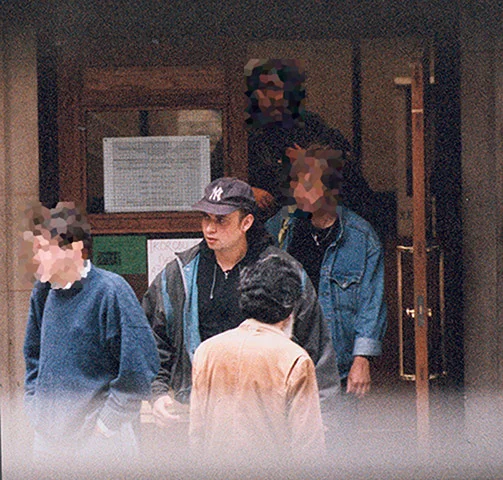
Peter Francis in a Special Branch surveillance photo of an activist event at Conway Hall, London, in the mid 1990s
Similarly, he reported on Militant members getting involved in unions and associated campaigns, such as the National Union for Teachers’ Campaign Against Vouchers in Education.
By November 1996, the Security Service was no longer required information on such ‘subversive groups’. In any event, it was decided to end Francis’ deployment in 1997. An exfiltration strategy was put in motion in December 1996, and became a long and convoluted process.
Francis finally withdrew from the field in September 1997, using the pretence of a sick mother, who then died. This prompted sympathy cards and offers of support from his targets.
He asserts that his deployment in fact ended due to the actions of his then wife who raised concerns about his mental health with his manager, HN10 Bob Lambert.
Francis says he argued forcefully for the Macpherson Inquiry into Stephen Lawrence’s murder to be informed of his involvement, but his superiors were against this.
He feels he was failed by SDS management. He was medically retired from the Met in 2001 and then brought a civil claim for damages against them, which was settled out of court.
Francis says managers Lambert and HN67 ‘Alan Bond’ advised him always to use condoms when having sex undercover. He describes two occasions when the Squad travelled to Amsterdam where many of the officers, he implies, enjoyed all the city had to offer.
He says he had a number of sexual encounters during his deployment (some of which he referred to in the civil claim he brought in 2003, which management would have seen). Barr elaborates:
‘He portrays a unit in which such conduct was well known and accepted as part of the job. He states that managers HN86 and HN67 told him that the SDS went “where MI5 feared to go”, the inference being that MI5 agents could not engage in sexual activity but SDS officers could’.
Barr also noted:
‘All three of the open former UCOs being called to give oral evidence in Phase 1 sexually deceived women. Three of the five who we will be hearing from in Phase 2 are also known to have done so.’
Despite raising doubts about Francis’ credibility as a witness, Barr acknowledged that he is a whistleblower:
‘He made a very significant contribution to the series of events which led to the establishment of this inquiry.’
HN81 ‘DAVID HAGAN’
HN81 ‘David Hagan’ joined the SDS in January 1996 and was deployed on undercover operations in June of that year. He used the cover name ‘David Steven Hagan’ and was assigned the codename ‘Windmill Tilter’.
He infiltrated the Socialist Workers Party (SWP) in Hammersmith and later Fulham. He has provided the Inquiry with a lengthy witness statement but is not attending to give oral evidence due to complex post-traumatic stress disorder.
Barr describes his operation as:
‘a relatively fruitless exercise as far as public order intelligence was concerned. The SWP was not engaging in what is euphemistically described in police documents as “street activity”.’
HN81 sought redirection, which took him South of the Thames to Brixton. There he refocused his attention on Class War, an anarchist political organisation that had been involved in the Poll Tax riots of 1990.
His involvement with this group led him to Movement Against the Monarchy (or ‘MA’M’). He was not specifically tasked to infiltrate Class War or ‘MA’M’. His managers had directed him to go to Brixton, outlining his general targeting strategy as a “roving public order brief” with a broad discretion as to direction.’
Barr questions why he was sent with such a wide brief to ‘a racially diverse part of London’ and notes that ‘he found little by way of serious public order to report on’.
Within a year of his deployment starting, HN81 sought to infiltrate the Movement for Justice (MFJ), a group involved in a number of campaigns focussed on issues of racism and immigration. These included the police’s use of stop and search powers, CS spray, and deaths in custody (all of which disproportionately affected young Black men), often supporting family justice campaigns.
Issues of race became a feature of HN81’s reporting, and he remained a member of MFJ until his deployment ended in the summer of 2021.
Barr explained:
‘The extent to which members of MFJ, including ‘David Hagan’, were, or were not, involved in the Stephen Lawrence Campaign, the Stephen Lawrence Public Support Group (or with the Lawrence family or other supportive groups) is a matter that will need our close attention. A significant number of the documents relating to HN81’s deployment refer to the Stephen Lawrence Campaign and, indeed, the Stephen Lawrence Inquiry.
HN81 was present at Hannibal House, above the Elephant and Castle shopping centre, on a number of occasions when that inquiry was sitting there. Not least on the day that the five murder suspects attended. He accepts being involved in the public disorder surrounding that event.’
The Stephen Lawrence family campaign always advocated for order and calm. Yet on that day, 29 June 1998, Hagan describes shouting and aggressive posturing, and admits to joining in with the pushing and shoving that began when the suspects emerged from the building.
We were shown a long and compelling extract from ‘The Murder that Changed a Nation’, a BBC documentary showing scenes of the community’s protests as well as the police’s behaviour that day.
Barr cited the feelings of Stephen’s father, Dr Neville Lawrence, who finds it:
‘particularly troubling that an officer who sought to justify surveillance on the grounds of public disorder actively contributed to it’.
He also noted the observation of Baroness Doreen Lawrence, Stephen’s mother:
‘HN81’s presence at campaign meetings and events was purposeful and his involvement suggests more than incidental involvement; the effects of his actions amounted to surveillance and intrusion into their family and the campaign for justice.’
Barr revealed that:
‘There is written evidence that the SDS, through HN81 and his manager DI Robert Lambert, fed directly into the MPS Stephen Lawrence Review Team (or SLRT). They provided oral briefings to A/DI Richard Walton around August 1998 at a time when the Commissioner’s legal team were preparing his submission to the Macpherson Inquiry. There was a meeting at which A/DI Walton, DI Lambert and HN86 were present which was held in DI Lambert’s back garden.
It is our understanding that [Chair of the Lawrence inquiry] Sir William Macpherson was not made aware of such channels of intelligence…
Who knew what about HN81’s operation must also be established. There is evidence suggesting that it went to the top of the MPS, eliciting praise from Commissioner Sir Paul Condon at the height of the Macpherson Inquiry…
In a summary of HN81’s withdrawal strategy, HN129 DS Noel Warr notes (I quote), “[Windmill Tilter] is quite candid in admitting that he was largely responsible for their adoption of the Stephen Lawrence case, and the rest, as they say, is history”.’
It is important to note that that this kind of interference in legal processes is by no means an isolated incident, and Barr specifically stated that:
‘The legal and ethical basis for the MPS resorting to undercover intelligence in the context of legal affairs is a wider topic that this inquiry will investigate’.
Through MFJ, Hagan also came into contact with the family of Lakhvinder ‘Ricky’ Reel, who died after a racist attack in Kingston-Upon-Thames. The police insisted it was an accident and the family started a campaign for justice:
‘His mother, Sukhdev Reel, has stated that she was horrified to learn that HN81 had been reporting on their personal lives, and had driven her home following a meeting one evening.’
HN81’s deployment ended in 2001. He believes that his service as an undercover officer has had an enduring effect on his mental health and that of his family.
HN15 MARK JENNER ‘MARK CASSIDY’
Mark Jenner was deployed between February 1995 and April 2000. He first infiltrated the Colin Roach Centre (CRC) and the Hackney Community Defence Association (HCDA). He then targeted Anti-Fascist Action and Red Action.
From late 1995 onwards, Jenner was reporting on Republican Forum and Republican Sinn Féin, and SDS records from 1997 show that he was ordered to focus on London-based Irish Republican activists. His targeting specifically included two named individuals, Mark Metcalf of the CRC and Norman Blair. The former he got very close to, but not the latter.
Barr explained that the Inquiry will investigate whether there was any justification for spying on the CRC and HCDA:
‘There are serious differences between the portrayal of the CRC and HCDA by the SDS and the descriptions provided by these witnesses.’
However it is agreed that the CRC campaigned against racism and the HCDA was involved in police accountability work, including cases with a racial dimension.
Barr further noted:
‘There is also an issue as to how DC Jenner conducted himself, including whether he was violent in his undercover identity and, if so, whether his use of violence was appropriate or authorised?’
Witnesses Mark Metcalf, ‘Alison’, Steve Hedley, Dr Graham Smith, and Jenner’s now ex-wife (known as ‘S’) will all give evidence about his deployment.
Barr noted that Jenner was arrested on suspicion of obstruction of the highway at a counter demonstration against the National Front in Dover on 28 February 1998. He showed news footage of that event, commenting that it:
‘gives a flavour of the kind of public disorder in which DC Jenner found himself during the course of his deployment. He is wearing a black bomber jacket, black woollen hat and gloves and can be seen prominently at the end of the piece, apparently mouthing “come on” to opposing demonstrators.’
Barr also noted that Jenner assumed a number of positions of responsibility during his deployment and that a cause of considerable concern is
‘the extremely prolonged sexual and emotional deception that DC Jenner practised on “Alison”.’
Jenner began a sexual relationship with ‘Alison’ very early in his deployment, and soon moved into her flat. The relationship lasted almost five years and they cohabitated for more than four years.
Jenner became very deeply involved in her life, attending family weddings, birthdays and religious celebrations and holidays in the United Kingdom, Greece, Israel, Vietnam and the Netherlands.
Barr noted:
‘A particularly cruel feature of DC Jenner’s deception of “Alison” is that she wanted to start a family. The man she knew as “Mark Cassidy” told her he wanted to have children with her, but “just not yet”. Her written evidence explains that she persuaded him to go to couples counselling for between 12 to 18 months in an attempt to resolve that impasse.’
Jenner implemented his exfiltration plan after Christmas 1999, by feigning depression and paranoia.
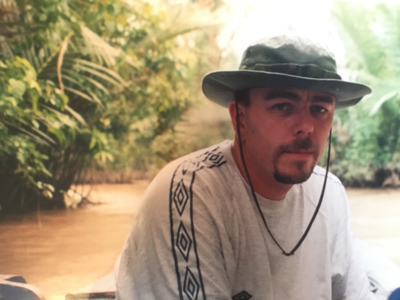
Mark Jenner in Vietnam with Alison. Jenner is understood to have been in couples counselling with Alison & his wife at the same time, with both thinking they were his only partner
On 15 March 2000, he abruptly moved out of the flat, returning for two periods over the following weeks, before finally disappearing for good on 11 April 2000, leaving a note explaining he had left to travel to Germany. ‘Alison’ was utterly devastated by his sudden departure.
She made extensive efforts to locate him, but these yielded nothing.
She learned through an unofficial search that Mark Cassidy’s passport was recorded as stored in ‘CE’. Further enquiries with a private detective led her to believe that Mark had been living under a false identity.
Eventually, a meeting with Helen Steel and a discussion surrounding her own experience with HN5 John Dines ‘John Barker’ convinced Alison that Mark Cassidy had been a Special Branch officer.
She didn’t receive any confirmation of this until 2011 (and the Met continued to ‘Neither Confirm Nor Deny’ his identity for years after that).
Barr said:
‘An extraordinary and valuable element of the evidence that we have is video footage
of DC Jenner during the course of the relationship. It was filmed by “Alison”…. It vividly depicts the deception in ways that words cannot.’
We will also hear from ‘S’, Jenner’s wife at that time, who Barr recognises as a ‘female victim of his deployment’.
Her evidence describes the sacrifices made by her family during and after the deployment, including being forced to move house, and the other impacts of Jenner’s behaviour. She is critical of SDS management, asserting that there was a lack of oversight, information, and support.
Barr lists a number of issues the Inquiry will wish to investigate in relation to Jenner’s deployment, including management knowledge of the sexual relationship and the extent to which the chain of command was aware of the nature of his target groups.
He cites a memo written by HN127 Tiddy dated 10 October 2000, which was circulated at the time to all of the unit’s managers (i.e. DCI HN53, DI HN58, DS HN52 Greaney and DS Warr):
‘Partnerships in the left-wing field are by and large confined to the parties that they are members of. For example, there are a large number of cohabiting partners/relationships within the SWP and SP and anyone who enjoys single status over a certain period may invite unwanted suspicion.
The most difficult of this type of enquiry is generally instigated from an attached female who may be taking soundings on behalf of one of her friends. The female antennae is a difficult creature to subdue and whereas, as a rule, they applaud monogamy they do possess the ability to unearth doubts about perceived relationships.
There have been recent operations e.g. Touchy Subject [Jenner] and Psycho Dream [Boyling] where, due to the lifestyle employed by the operatives their bona fides were considered unimpeachable.
This is patently not the case in every operation and consideration should now be given to providing additional operational support to field officers.’
This strongly suggests managers knew about the long-term intimate relationships these officers were having and knew exactly how they were spending their time. Beyond that, it indicates that managers saw such long-term relationships positively as a way to reinforce a deployment.
HN26 ‘CHRISTINE GREEN’
HN26 ‘Christine Green’ spied on animal rights activists from November 1994 to November 1999. She was based in South and West London, but also operated outside the city. She reported principally on London Animal Action, South London Animal Action, Brixton Hunt Sabs and what Barr describes as ‘persons involved in actions which fell under the ALF [Animal Liberation Front] banner’.
He commented that:
‘Her reporting covers a great variety of activism in the cause of animal rights, some of it lawful and some of it decidedly unlawful’.
However, it wasn’t clear whether he meant the activism or the reporting was unlawful, because he went on to say that:
‘Amongst reporting on individuals of a kind that was usual for the SDS is a report on a planned meeting to discuss making civil claims against the Commissioner. It is yet another example of reporting on civil litigation, or the potential for it’.
Barr made reference to a watershed in her reporting, around the spring of 1998. Following complaints from managers that she wasn’t producing good enough intelligence, there seems to have been a sudden increase in reporting on Animal Liberation Front (ALF) type activity, focussed on a man named Thomas Frampton, who was widely known as ‘Joe Tex’ or ‘Joe Tax’. An SDS File Note described him as ‘the leader of a London based ALF cell’.
In fact, Green became intimately involved with Mr Frampton and eventually resigned from the police to be his permanent partner.
There is some dispute about when that intimate relationship began, but in Tranche 2 hearings, Paul Gravett and ‘Walter’ gave evidence to the effect that it began during her deployment, and this might explain the sudden change in her intelligence product.
Barr commented:
‘Far fewer women than men served as undercover police officers in the SDS. But HN26’s case illustrates clearly that the risk of undercover police officers becoming involved in sexual relationships with those they mix with undercover is not confined to men.’
It is, however, striking that, far from the cruel and degrading ways in which male officers behaved towards the women they deceived, Green seemingly told Frampton the truth about her identity, and ultimately left her husband for him. They were understood to still be together when the facts became public in 2018.
Barr highlighted a key question of particular concern to the Inquiry: Green’s involvement in the high-profile animal liberation action which resulted in up to 6000 mink being released into the wild from Crow Hill Farm in Ringwood, Hampshire on the night of 8 August 1998:
‘She was authorised by her SDS managers to participate. The focus of our investigation, when managers are questioned next summer, will concern the circumstances in which she was so authorised, the level of that authority, and why local police were not informed either before or afterwards when the crime was being investigated.’
HN123
Barr told us HN123 infiltrated the Socialist Workers Party (SWP) and the Anti-Nazi League in the mid-1990s, adding the cryptic comment ‘He later targeted another group which was involved in violence.’
Barr highlighted three aspects of HN123’s written evidence that are of particular significance:
1. He has stated that he reported on the Stephen Lawrence Campaign whilst he was infiltrating the Anti-Nazi League.
2. His partner wrote a letter of complaint to Assistant Commissioner David Veness in August 2002, in which she referred to officers boasting about undercover activity, including their sexual relationships and the extra-marital affairs. She recalled AC Veness himself referring to the SDS as a ‘cowboy outfit’. Her main concern was the failure of the SDS to protect the welfare of its officers and the stable family relationships they relied on.
This was an attempt to bring the issue of sexual misconduct to the attention of a very senior officer: ACSO Veness was second only to Lord Stevens in the SDS’ chain of command at that time. Mr Veness will have an opportunity to respond next summer when the Inquiry’s attention turns to the unit’s management.
3. HN123 joined in with Peter Francis in bringing a claim for damages for personal injury to his mental health against the Met’s Commissioner. This was settled out of court.
CONCLUSION
Barr ended by saying that the Inquiry ‘continues to be a Herculean task’, and thanked all the people who have worked to prepare for these hearings, often to tight deadlines. He also said how ‘daunting and stressful’ the prospect of giving evidence will be for many, and advertised the fact that the Inquiry now has a Vulnerable Witness Policy, encouraging people to read it and seek the support it offers.
Peter Skelton KC (on behalf of the Commissioner of Police for the Metropolis)

Peter Skelton KC
Skelton spoke for only thirty minutes, representing the Metropolitan Police as an institution.
His statement was basically a long list of the mistakes the police had made, peppered with negative superlatives and apologies, suggesting that the MPS no longer have the will to defend the indefensible.
He acknowledged from the outset that there was serious wrongdoing by ‘some UCOs’, and specified that it was ‘not only in hindsight but by the standards at the time.’
He then listed seven specific failings:
1. Managers should not have allowed reporting on family justice and police accountability campaigns
He stressed that these groups presented no risk of crime and no risk of disorder, and families like the Lawrences tended to actively discourage such behaviour.
He referred to senior officers having ‘legitimate concerns’ about a lack of trust in the police and some public disorder resulting from this, but accepted that the use of undercovers was not justified. The police’s time and resources would have been better spent on community engagement and relationship repair, and responding more effectively to racist violence.
He denied that the SDS gathered information about the Lawrences with a view to smearing the family, as alleged by whistleblower officer Peter Francis.
He expects managers and more senior officers to be questioned about exactly what they knew about such reporting, and what they authorised, or failed to question, acknowledging that there was a ‘collective failure to exercise ethical judgement’, and also a failure on the part of the most senior officers to get rid of an unhealthy ‘us against them’ culture within the Met.
APOLOGY 1
He delivered an apology at this point to ‘the family of Stephen Lawrence, Duwayne Brookes OBE the family of Ricky Reel and the other individuals, families and family members who were the subject of this improper reporting during the T3 period’.
2. Sexual relationships were wrong
APOLOGY 2
Skelton began by citing the Met’s apology made in 2015, describing these relationships as ‘a gross violation of privacy and human rights. They were abusive, deceitful, manipulative and wrong’, adding that they were a serious failing ‘by the standards of any time.’
He stressed that who knew what about these sexual relationships will be a matter for Phase 3, but admitted that they were ‘facilitated by poor management’ and that there is considerable evidence that managers within the SDS and Special Branch either knew, or should have known, of at least some of them.
He pointed out that the attitude of managers towards sexual relationships was exemplified by the ‘inadequate, misguided, sexist and offensive’ guidance in the SDS’s Tradecraft manual.
He described its focus as ‘self-serving’, and ’predicated on the false premise’ that rather than the undercovers, it would be their civilian targets and ‘associates’ who would want and initiate these relationships. UCOs were allowed and encouraged ‘to abrogate responsibility for their own predatory actions’.
He went on to say:
‘senior police officers in the MPS and other police services would now be expected to recognise sexual misconduct as an abuse of power and to understand the significant effects that it has on the people who are manipulated and deceived.’
This is not due to some sudden developoemnt of conscience within the Met, but the reaction to the investigative and campaigning efforts of women who were deceived into sexual relationships by officers from both spycops units.
Skelton ended by saying:
‘It is a matter of deep regret that such recognition and understanding was not part of the prevailing culture within the MPS during the 1990s and 2000s. Therefore, no consideration was given at that time – as it would now be today – to contacting the individual women to inform them that they had been deceived’.
We note that if that is the case, it was a very long time coming, as women deceived into relationships in the 1990s and 2000s were still finding out about it as late as 2017 for ‘Jessica’, 2018 for ‘Ellie’, and 2019 for ‘Maya’.
3. Participation in Crime
Managers failed to ensure that any participation of SDS officers in criminal activities was fully compliant with Home Office guidelines (Home Office Circular No. 35/1986 ‘Consolidated Circular to the Police on Crime and Kindred Matters’), specifically citing the Crow Hill mink farm incident and multiple examples of officers misleading the courts.
The Home Office had already issued unequivocal instructions in 1969, a year after the SDS was founded, saying that if the use of any kind of informant might lead to a court being misled, they should be exposed or withdrawn. No spycops should ever have gone to court without the court’s full knowledge.
4. Failure to discipline UCOs for misconduct
He referred to a ‘general failure on the part of the SDS’s management to impose discipline on UCOs’:
‘Officers who behaved unprofessionally or dishonestly were not subject to misconduct proceedings and there was no proper recognition that their lack of professionalism and integrity created security risks which made them unsuitable for further sensitive work within Special Branch or elsewhere in the MPS.
This led to a culture in which misconduct was tolerated wrongly in order to protect the continuation of the secret work of the unit… the handling of Detective Sergeant Thomson’s misconduct exemplifies this failure.’
5. Deceased Children
Skelton described the move from using dead children to fictional identities as ‘prompted by computerisation not ethical concerns’ and repeated the apologies made in T2, extending them to the Crossland family and other families affected in T3:
APOLOGY 3
‘The MPS accepts that the managers of the SDS failed to recognise the hurt, distress, and anger that the use of deceased children’s identities would cause the families of the children, and the public concern that would result if the practice had been revealed.
It apologises unreservedly to the families for this. It also wishes to acknowledge that their distress will have been compounded by the revelation that some SDS officers behaved indefensibly while using their children’s names’.
He went on to say that there was ‘no justification whatsoever’ for DS Thomson’s misuse of Kevin Crossland’s identity.
6. Welfare of UCOs
Skelton described how the T3 period saw an increasing awareness, both within Special Branch and in the wider intelligence community, of the unique stresses and risks to mental health that could be caused by undercover work.
He noted that the ‘operational security of the unit’ was too often prioritised over the welfare of the UCOs, with professional psychological support not being made compulsory until 2001.
The ‘psychological effects of living in a false identity and, for some, the direct experience of physical violence or the chronic fear of being exposed and physically attacked’ went unrecognised. The Met now acknowledges that some SDS officers suffered ‘significant psychological harm as a result of their work’.
One of those officers, Peter Francis, was mentioned by name at this point, in a way that seemed a rather nasty back-handed attack on his credibility and mental health.
7. Spouses, partners and families of UCOs
Finally, the MPS added to the long list of grovelling apologies they have been forced to issue in the course of this Inquiry, this time to the UCOs’ partners and families.
Skelton noted that SDS deployments led to particular stresses on the undercovers. They spent a lot of time living in their false identities, for years on end, most of them only intermittently returning home to their families and their ‘real’ lives. Security risks and fear of exposure meant that some UCOs and their families had to undergo the upheaval of relocating their homes and lives.
The failure of the unit’s managers to ‘provide sufficient support and psychological welfare’, and their failure to prevent sexual misconduct (and therefore sexual infidelity) from taking place contributed to the harm done to UCOs’ families.
Skelton noted that ‘S’, the former wife of Mark Jenner, will be giving evidence and stated:
APOLOGY 4
‘The MPS wishes to apologise unreservedly to them, and to all the partners and former partners of SDS UCOs, for its failure to better protect them from the effects of the SDS’s work and the misconduct of its officers’
Conclusions
After all of that, Skelton added the police’s standard mitigating point:
‘Undercover policing is an extremely valuable means of gathering intelligence for the purposes of protecting national security, preventing serious crime, preserving public order, and other important policing purposes.’
He acknowledged that it is ‘exceptionally invasive’, and there was a risk of officers abusing their power, saying that ‘high standards of conduct, ethics and governance’ were needed for any undercover operations.
He insisted that ‘some of the SDS’s targeting was justifiable’ and some of the intelligence they gathered was ‘valuable’, but offered no examples, and admitted that some of those they spied on should never have been the subject of undercover reporting.
His closing comments were damning:
‘In short, the SDS became a dysfunctional undercover unit. The human toll of the SDS’s dysfunction has been severe and wide-ranging: misuse of deceased people’s identities, wrongful intrusion into individuals’ private and political lives, grievous sexual exploitation, damaged relationships, broken families, and widespread anger, distress and psychological harm – including to some of the officers themselves.
The MPS recognises how important it is to understand the damage that the SDS has caused, to hear directly from the people who have been affected, and for the Inquiry to hold those responsible to account.’
Neil Sheldon KC (Home Office)

Neil Sheldon KC
The Home Office has submitted a written Opening Statement.
Neil Sheldon KC spoke on behalf of the Secretary of State of the Home Department (the Home Secretary), in her capacity as a Core Participant (rather than as the sponsor and funder of the Inquiry).
These are the first submissions to be made by the current Home Secretary, Shabana Mahmood – the ninth person to hold the office since the Inquiry began – so he took the opportunity to say on her behalf that she is appalled by these ‘historical allegations’, and that it is vital that this Inquiry uncovers the truth and lessons are learnt for the future.
However, Sheldon then defended the use of undercover operations as a tool for tackling crime. He did stress that there ‘never can be any excuse or justification for the type of conduct at the heart of the Inquiry’, noting that it irreparably damaged lives, and that it must be subjected to ‘unsparing public scrutiny’. Nevertheless there was an obvious attempt to distance the SDS from any other policing operations.
NOTHING TO DO WITH US, HONEST
The rest of the statement was an exercise in distancing the Home Office from any responsibility for what happened.
Sheldon said ‘direct involvement of the Home Office in this T3P1 is limited’, pointing out that the Inquiry has not yet requested any witness evidence from the Home Office in any Tranche, as though this were somehow evidence of their innocence, rather than a serious oversight on the part of the Inquiry.
Core Participants have pressed for the Home Office to be required to provide a witness statement and respond candidly to questions about their role.
We would also remind the Home Secretary that her Government has just introduced a Bill to Parliament (the ‘Hillsborough Law’) which would make attempts by the Home Office to cover up their role in the spycops scandal a criminal offence.
Sheldon admitted that the Home Office was ‘a recipient of indirect SDS intelligence’, but repeatedly claimed that there was no ‘cogent evidence’ that they had anything to do with the SDS’s tasking.
He said that only one State witness claimed otherwise in either of the earlier Tranches, and cast doubt upon the credibility of that particular former officer (HN78 Trevor Morris ‘Anthony Lewis’ gave evidence to the effect that the Home Secretary deemed the SWP to be a ‘subversive organisation’).
He made a plea that the Inquiry should ‘rigorously’ test any such allegations in this Tranche, and that people should take care not to lump all branches of ‘the Government’ together, or refer to ‘the Home Office’ when they actually mean another branch of the State or the Security Service.
He went on to assert that the Home Office have not seen any evidence to suggest that anyone there had any knowledge of UCO misconduct, specifically their involvement in criminality, theft of dead children’s identities, sexual misconduct, or actions which may have led to miscarriages of justice.
He stressed that:
‘it is important that everyone keeps in mind what the evidence does, and perhaps more importantly, does not demonstrate in this regard.’
This is very reminiscent of the police defence in the Investigatory Powers Tribunal proceedings Wilson v MPS, where the MPS insisted on admitting only to what could be demonstrated by the written evidence, and declined to ask any of their employees who were present at the time what they did or did not know.
The Home Office set up the SDS, and documents at the time show that they were terrified of the embarrassment it would cause the Home Secretary if its existence were ever made public. The Home Office directly funded the SDS for 20 years, renewing funding annually after reviewing its activity over the year.
After the spycops scandal broke, a search of all Home Office archives failed to find a single document about the SDS. The Undercover Plolicing Inquiry is exactly the kind of thing the Home Office must have had in mind when they ensured there was no paper trail leading to them.
REGULATORY REFORMS
Sheldon then moved on to mention the ‘radical reform’ that took place in the T3period, a reference to the fundamental change in the way that undercover policing operations were supposed to be authorised and regulated, with new statutory standards and requirements being introduced.
For example, according to the Regulation of Investigatory Powers Act 2000 (RIPA), deployments could only be authorised if three requirements were met: necessity, proportionality and oversight.
There was also the Police Act 1997, and new Police (Conduct) Regulations which came into force in 1999. These brought in new regulations that the police were supposed to follow, and an improved complaints procedure.
Included was a new Code of Conduct for all police officers to follow at all times
‘It is of paramount importance that the public has faith in the honesty and integrity of police officers. Officers should therefore be open and truthful in their dealings; avoid being improperly beholden to any person or institution; and discharge their duties with integrity…
Whether on or off duty, police officers should not behave in a way which is likely to bring discredit upon the police service’.
The ‘CHIS Code’ (or to give it its full name, the ‘Covert Human Intelligence Sources: Code of Practice 2002’) provided guidance on all aspects of undercover operations. It aimed to ensure that such policing was done in a way that complied with RIPA, other relevant legislation and human rights. It outlined the procedures that should be followed by authorising officers, and those handling intelligence from undercover sources, including a duty to consider the risk of collateral intrusion.
Finally, he quoted at length from the 2004 ‘Home Office Guidelines on the Work of a Special Branch in Great Britain’. In short, Special Branch staff were expected to comply with all of the new legislation that had been introduced, including the Human Rights Act 1998 (which came into force in October 2000). They were reminded that, just like every other branch of the police service, they were also: ‘subject to the provisions contained within the Data Protection Act 1998 and, more recently, the Freedom of Information Act 2000’.
At no point did Sheldon acknowledge that the SDS simply ignored all of this ‘radical reform’ and didn’t bother to comply with the new legislative ‘landscape’.
The other spycops unit, the NPOIU, was established during the T3 period, and it is clear from what we already know about their operations that the same forms of malpractice continued in it. Both units saw themselves as beyond the law.
Sheldon went to some pains to state that none of these reforms were the result of legislators or anyone at the Home Office becoming aware of misconduct or malpractice on the part of any police officers.
IN CONCLUSION
Sheldon finished by saying that the Home Secretary supports the Inquiry’s aims and is committed to her department ‘continuing to cooperate fully with its investigations’. She awaits its findings and recommendations with interest, including the ‘interim report’ which Mitting has promised to deliver in 2027, before he finally retires. Sheldon then took the opportunity to acknowledge, on behalf of Mahmood, Mitting’s ‘many years of hard work’ as Chair of this Inquiry.
Mitting thanked him for his ‘kind words’.
Oliver Sanders KC (Designated Officers)
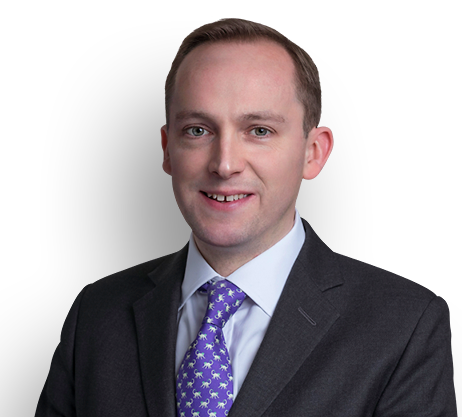
Oliver Sanders KC
Sanders represents the ‘designated lawyer officers’, 114 mostly ex- (though some current) spycops.
They are predominantly from the Special Demonstration Squad, but some from the later National Public Order Intelligence Unit, and they include both undercover and back room staff. Some of them became managers later. In total, it’s around 60% of all SDS staff (around 70% of those still alive).
None of his clients are due to give evidence in this Phase of hearings (Jenner, Francis and Thomson have all chosen to be represented by other lawyers).
HN81 is a client of Sanders, but he will not give oral evidence. Neither does he represent managers Gunn and Phelan (who are T2 witnesses giving evidence out of turn),
Sanders therefore only wanted to raise a few ‘short matters’ today; his written Opening Statement goes into more detail.
THE SUCCESSES OF THE SDS
He pointed out that there are more ‘closed’ officers (who won’t be known to the public), and therefore more ‘closed’ (secret) hearings in Tranche 3 than any of the previous tranches. He claimed that during this era, the SDS ‘did some of its most challenging and valuable work’, basically suggesting that although we will hear lots of damning evidence, we won’t hear about a lot of the background and how successful the SDS really was.
He alluded to the unit’s managers having a lot ‘on their plate’, which we (the public, who are excluded from the ‘closed’ hearings) can never fully understand, and claimed that they made lots of improvements to the way the unit was run and started to ‘modernise’ it before RIPA was enacted, with a whole list of innovations being introduced at this time.
These included:
‘psychometric testing for new recruits; psychiatric or psychological support for undercover officers and former undercover officers; the introduction of a mentoring scheme; the introduction of performance indicators and customer feedback surveys; the introduction of designated cover officers for specific undercover officers; and changes to the way in which undercover identities were made.’
Like Sheldon, he glossed over the fact that none of these ‘reforms’ prevented officer misconduct or mismanagement or had any discernable impact on the toxic culture of the SDS.
THE PROBLEMS OF HN43 PETER FRANCIS
Sanders dedicated a significant chunk of time to discussing, or rather, seeking to undermine, the evidence of Peter Francis, whilst claiming to make ‘no comment on his sincerity or motivations’.
He advised Mitting to be ‘cautious’ about accepting the claims made by Francis, saying that many of them are uncorroborated, and at one point referring to his evidence as ‘a mixture of fact, fiction and fantasy’.
Peter Francis graduating from police training, May 1986. He is presented with his award by Assistant Commissioner Hugh Annesley
In particular, he highlighted Francis’ claim that there were ‘high-level concerns’ within the SDS and Special Branch, about the ‘risk of “race riots”’, and/or of public disorder connected in some way to Black family justice groups, including the Lawrence family.
Sanders claimed that this could not possibly have been the case, because there’s no written evidence of these concerns in any of the surviving reports and records that the Inquiry has been able to unearth.
As he well knows, the SDS avoided written records on some sensitive subject, as well as destroying a lot of its paper archives when it was closed down, and the wider Met is known to have deliberately shredded many more shortly after this Inquiry was announced.
Similarly, Sanders dismissed three other claims made by Francis.
The first: that the SDS was keen to find out who visited the Lawrences’ home in the immediate aftermath of Stephen’s murder, again pointing to a lack of any proof of this. Yet in his statement earlier in the day, Counsel to the Inquiry David Barr KC pointed out the existence of evidence that police ‘Family Liaison Officers’ did in fact make lists of such visitors.
Secondly: Francis has also claimed that there was an attempt to ‘smear’ the Lawrences and their campaign. Sanders attempted to suggest that this would have been ‘an extraordinary and unprecedented tasking’, completely inconsistent with what the SDS did. He claimed that this would entailed ‘an extraordinary degree of bad faith’.

Duwayne Brooks: persecuted by police
It is doubtful that any of the Non-State core participants had any difficulty in believing that this was indeed something that the SDS were capable of doing, and not ‘extraordinary’ at all. Sanders is underestimating the documented extent of the bad faith with which the institutionally racist and institutionally corrupt Met approached Black families like the Lawrences at the time.
Stephen Lawrence’s friend Duwayne Brooks, the main witness to the murder, was persecuted by the Met for years. He was prosecuted on charges so trumped up that the judge threw it out without Brooks saying a word, designating it an abuise of process.
Then the Met did it again. There is no other person known to have ever had two cases thrown out as abuse of process. So yes, the Met undoubtedly did have an extraordinary degree of bad faith towards those invovled in the Lawrence campaign.
Francis has also stated that he believes that intelligence gathered by the SDS around the time of Stephen’s murder was retained and passed on to other officers (specifically Richard Walton) years later, at the time of the 1998 Macpherson Inquiry into Stephen Lawrence’s murder. Sanders flatly states that this is ‘not true’ but offers no reasons for this opinion, and claims there are inconsistencies in what Francis has said about this over the years.
It is well established that SDS manager HN10 Bob Lambert brokered a meeting between his officer HN81 ‘Dave Hagan’ and Richard Walton, a senior officer crafting the Met’s defensive response to the Macpherson inquiry. Lambert would not have done that unless HN81 ‘Dave Hagan’ was the best officer to report on the Lawrences.
HN81 ‘DAVID HAGAN’

Special Demonstration Squad officer HN81 ‘David Hagan’
He finished his submissions with a rebuttal on behalf of one of his clients, HN81 ‘David Hagan’.
Since the Ellison Review of the Stephen Lawrence case came out in 2014, he has been referred to as ‘a spy in the Lawrence family camp’ and, according to Sanders, this has had ‘a devastating and unfair impact on him’.
Hagan denies ever meeting or speaking to the Lawrences, and says the organisation he infiltrated – the Revolutionary Internationalist League, and what he called its ‘front’ Movement For Justice – was not close to the Lawrence family, who shunned most political parties.
We note that this unrepentant and self-pitying statement completely ignores the fact that Hagan admitted that he did meet, speak to and even drive Sukhdev Reel, the mother of murdered Asian teenager Ricky Reel, to her home, a fact that has caused that family significant distress.
The Inquiry’s decision to delay seeking evidence from Hagan for over 10 years, by which time he was apparently too ‘ill’ to provide it, is one that will not be easily forgiven by many core participants.
HN86 refusing to testify
After Sanders had reached the end of what he wanted to say, the Chair, Sir John Mitting, intervened with an unexpected bit of drama.
He explained that he had made a Restriction Order in July 2018 granting anonymity over both the real and cover names of HN86.
He read at length from the anonymity application received from the ‘Designated Lawyers’ at the time, which stressed that it was in the public interest to grant HN86’s request, as this would enable him to participate as fully as possible in the Inquiry, by mitigating any risks to his health and welfare. The inference was that he was willing to co-operate and give evidence, provided his identity was protected.
Mitting stressed that the Inquiry is willing to take whatever measures are needed for HN86 to give his evidence, for example he could do so remotely. He is keen to find out what HN86 has to say, especially about some of the evidence provided by Peter Francis.
HN86 was deployed undercover as well as serving as an SDS manager. However it seems that he has now declared that he has no intention of giving any oral evidence. There are no medical grounds for this refusal. He just doesn’t want to.
Mitting then dropped the news that he had decided to serve notice under Section 21 of the 2005 Inquiries Act, to compel HN86 to give evidence, and notified him of this via his lawyers. HN86’s lawyers are now seeking to challenge that decision with a Judicial Review.
Mitting pointed out that HN86’s decision to bring legal proceedings will mean three different groups will need to reflect on the situation, and what happens next:
1. The Mayor’s Office for Policing and Crime will have to consider whether they should allow public money to be used to fund these proceedings, which are not designed to enable the Inquiry to continue its purpose but on the contrary, will make it more difficult.
2. If HN86 cannot be persuaded to provide oral evidence, then Mitting and his team will have to reconsider his anonymity, and maybe revoke the Restriction Order on his name that was granted in 2018.
3. The ‘Designated Lawyers’ themselves may have to reflect on whether it would be proper of them to bring proceedings ‘that aim to frustrate the purpose indicated in their application’ for that Restriction Order.
Sanders responded to the Chair’s unusually public airing of this kind of grievance by pointing out that this is actually the third such judicial review the firm has brought against the Inquiry’s decisions on the public dime, and he sees no reason why the taxpayer shouldn’t pay him to do this one too.
Dave Smith with his blacklist file
The unfairness of this is particularly stark, as Non-State core participant) Dave Smith, the country’s leading expert on employment blacklisting, is also currently seeking to bring a judicial review. In contrast to HN86, Smith is going to court in order to be able to give – rather than withhold – vital evidence to the Inquiry, and is having to pay for this out of his own pocket.
Sanders noted that HN86 is getting older (unlklike the rest of us?) and ‘doesn’t feel able to give evidence’.
According to him, the judicial review questions whether or not this Inquiry actually has any legal power to compel someone like HN86, who lives overseas, to return to the UK and give oral evidence, or even just to give it remotely.
Sanders described this question as ‘a live issue’ and ‘arguable’, adding that he ‘appreciates it is a disappointment for you and the Inquiry and others’, and almost shrugging his shoulders as he says ‘all I can do is advise him and take his instructions and represent him’.
He continues:
‘It is our position that the Inquiry has no power to compel overseas witnesses, and there is no point us trying to litigate it now’.
We can agree that the issue is an important one, as it raises questions about why this power was not used to compel HN5 John Dines to give evidence in T2 and whether it could be used to compel HN26 ‘Christine Green’ to give evidence in T3. The Inquiry had started the day by saying that Green will simply be left alone because she is ‘outside the jurisdiction’.
It was also striking that Mitting chose to air this conversation in public, and although he was very polite about it and couched it all in careful legalese, the overall impression we got was that he really is quite cross.
Peter Skelton KC was invited to comment about this development on behalf of the Commissioner, but he protested that he could not say anything at the stage about the Met’s position as he had not had time to take any instructions from them. Mitting asked that Skelton let the Inquiry know when he has received such instructions.