UCPI Daily Report, 17 Nov 2025: Frank Smith evidence
Tranche 3 Phase 1, Day 14
17 November 2025

Blacklisted workers and their supporters outside the Royal Courts of Justice. Spycops reported on trade union activity and assisted with illegal employment blacklists.
INTRODUCTION
On the afternoon of Monday 17 November 2025, the Undercover Policing Inquiry heard evidence from Frank Smith.
Smith is a lifelong trade unionist and antifascist. His union activity got him blacklisted by an illegal employment organisation which Special Branch officers illegally supplied with personal details of trade unionists and other activists.
Smith has been given a high level of anonymity at the Inquiry. The public were excluded from the hearing, and he gave evidence with his face unseen and his voice modulated. The evidence was not given a video or audio broadcast, and no recording will be published. The only public record is a transcript published via the Inquiry’s page for the day.
The Undercover Policing Inquiry (UCPI) is an independent, judge-led inquiry into undercover policing in England and Wales. Its main focus is the activity of two units who deployed long-term undercover officers into a variety of political groups: the Special Demonstration Squad (SDS, 1968-2008) and the National Public Order Intelligence Unit (NPOIU, 1999-2011). Spycops from these units lived as activists for years at a time, spying on more than 1,000 groups.
Smith’s questioning is part of the Inquiry’s Tranche 3, examining the final 15 years of the Special Demonstration Squad, 1993-2008.
Smith has given the Inquiry a relatively short written witness statement [UCPI0000038182].
He was questioned for the Inquiry by Aphra Bruce-Jones.
BACKGROUND
Smith joined the Labour Party Young Socialists at the age of 15. In the late 1980s, dissatisfied with the Labour Party’s rightward drift, he quit and joined Militant Labour (now called the Socialist Party).
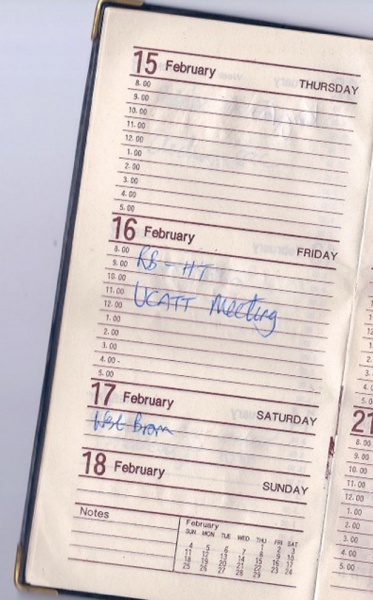
Page from undercover officer Mark Jenner’s 1996 diary, showing his attendance at a UCATT meeting
When he was 16, Smith had joined the construction workers’ union UCATT (now part of Unite). He said that unionisation was essential at the time just to secure the basic facilities workers should expect, such as a canteen, toilets, and an organised bonus system.
Smith went on to have several formal roles in the union as a shop steward, safety officer, and branch secretary.
Safety was poor in the construction industry at the time. Three workers a week were killed in London alone, and employers’ liability was merely a civil offence.
A UCATT campaign succeeded in getting the law changed so that bosses of negligent companies became criminally responsible for deaths and injuries on site.
The campaign had involved working with MPs, getting articles in the press, and picketing sites known to have unsafe practices. Smith says that sometimes pickets were physically attacked by subcontractors.
Spycop HN43 Peter Francis ‘Peter Black’ / ‘Peter Daley’ / ‘Peter Johnson’, who infiltrated left wing groups in the mid 1990s, says in his witness statement [UCPI0000036012]:
‘Frank Smith was often upsetting the building trade on behalf of his union. He certainly was not a passive worker. I understood that intelligence I reported about Frank Smith agitating within the construction unions would go onto his Special Branch file.’
Smith derides such ‘Special Branch language’, and translates it. Francis is actually describing reasonable, lawful work to get decent standards of health and safety for workers, yet talking as if it’s all a subversive threat to the state.
THE AWAY TEAM
From around the late 1990s, Smith was active in No Platform, a group opposed to allowing fascists to spread their message. He explains that, at the time, anti-racist activities were being attacked by the British National Party and neo-Nazi group Combat 18, and there was a need for self-defence.
A secret report by spycop HN104 Carlo Soracchi ‘Carlo Neri’ [MPS-0031153] describes No Platform in some detail:
‘No Platform was formed in March/April 2000 in London by a group of disenchanted Anti-Fascist Action members and the Socialist Party ‘away team’, a militant stewarding group…
Initially the group was formed in London by Dan Gillman and Frank Smith of the Socialist Party “away team”.’
Soracchi said that the group was intended to bring people together from a range of political affiliations. It was prompted by a concern that the far-right’s move away from street presence to electoral politics was only temporary, and so the capacity for effective direct confrontation needed to be maintained.
Smith says that No Platform wasn’t a formal group, there was no membership structure, it was more of a common cause with different people coming to different events.
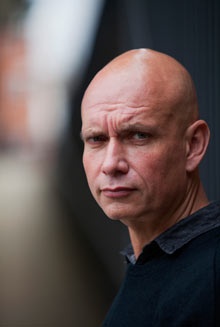
Whistleblower spycop HN43 Peter Francis: his spying on Smith contributed to illegal employment blacklisting
Similarly, he says that the term ‘away team’ was a loose term, humorously used, for stewards who ensure that anti-fascist and left wing marches and events passed off safely. It wasn’t a set group, the people in the role varied from one event to another. It was largely people from a trade union background, mixed gender but mostly men.
Bruce-Jones showed a clip from a World in Action documentary, ‘Violence With Violence’, broadcast on 15 November 1993. It describes the ‘away team’ as a clandestine violent organisation of 25 people within Youth Against Racism in Europe. Smith dismisses the claim outright.
The documentary then shows the British National Party (BNP) presence in Brick Lane, a multicultural area of East London with a large Bangladeshi community, on 19 September 1993. The BNP was faced by a counter-demonstration on the far side of the road.
Smith explains that it was a few days after the BNP had achieved a shock council election victory in East London. This had come after an increase in racist violence on the streets.
Antifascists made a concerted effort to oppose the planned BNP presence in the area. Smith was there on the day, stewarding the antifascist counter-protest, ready to defend it from fascist attack.
Bruce-Jones then showed a further part of the documentary where people from the counter-protest crossed the road and confronted the fascists. This is alleged to be the work of the away team.
Smith says that on that day the away team stewards were all white men, and the footage shows a lot of women and Asian people going to the fascists. He gets the Inquiry to take the video slowly, and points out that in the bit where a fascist is being kicked, the people responsible are two Bangladeshi women.
Smith explains that the stewards had received a report of a load of Combat 18 activists up the road, so they’d gone to see and found it was true. The stewards were attacked with bottles and bricks but, being burly construction workers, they weren’t cowed and managed to see the fascists off.
As they returned to the main protest, the police saw these big white men with short hair and ushered them to the fascists’ side of the road. Approaching the fascists, Smith gave warning:
‘I shouted to them, “Oi, come on then”, to let them know who we were, and to make them run. Which most of them did. And those who didn’t run were battered by the local community, as you see in the footage.’
Smith says that three people were arrested on the day. Two were discharged and one was given a bind over. The police and courts clearly didn’t think it was serious.
This same footage was shown when Dan Gillman and Lois Austin were at the Inquiry. If a minute of people chasing fascists down the road is the worst thing they can find, then even if this had been some wholly premeditated master plan it still wouldn’t warrant long-term undercover spying.
The Inquiry treated the documentary as if it were credible, even impartial. Yet its tales of the away team as a secret unit hidden within a respectable group, yearning for street violence, is at odds with all the evidence, including the footage itself. The only thing it tallies with is the spycops’ descriptions – which suggests that Special Branch was the journalists’ source.
Smith is asked whether he was a member of Anti-Fascist Action. He, once again, tries to get the Inquiry to see beyond its model of activism being formed of regimented organisations with formal membership. He explains that much of it was loose affiliations based on previous experience at similar events.
SELF-DEFENCE
He says that his stewarding role included self-defence if the group was attacked, describing it as the stewards’ duty to those present. The majority of events passed off without incident, precisely because they had been well stewarded.
The self-defence wasn’t just against overtly fascist groups. At the huge October 1993 protest against the BNP in Welling, South London, they were attacked by police.
Smith describes the events in his written witness statement:
‘At the Welling demonstration a section of the road was blocked by riot police, who then began attacking activists. As chief steward, my role was to direct those at the front of the march to link arms in order to protect others and discourage the police from charging through the crowd.
Our actions were always focused on keeping people safe, we never initiated violence or disorder.’
The tactic worked. The police withdrew, and the protesters negotiated for the march to leave the area. Smith says this reactive, defensive approach was what kept people safe. Despite the spycops’ depiction of the stewards as ruthless terrifying street fighters, there were no pitched battles with fascists. The only times he got hurt, it was by riot police.
THE SPYCOPS
Smith was asked about the Special Demonstration Squad officers who had reported on him.
He doesn’t remember seeing HN43 Peter Francis during the undercover deployment in the 1990s.
Regarding HN15 Mark Jenner ‘Mark Cassidy’, who was deployed 1995-2000, Smith describes him as being on the fringes of antifascist activity. Smith remembers meeting him through construction workers, as Jenner’s cover story was that he was a carpenter.
‘I actually offered to get him a job! He didn’t want it. I now know why. He wasn’t a real carpenter.’
Smith knew HN104 Carlo Soracchi best, as Soracchi had befriended some of his close friends, though Smith wasn’t actually close with him.
Soracchi’s cover story was that he was a locksmith. He told many of the activists he spied on, including Smith, that their locks were inadequate and that he’d fit them free upgrades. The activists accepted, meaning that Soracchi then had keys to all their homes.
It wasn’t Soracchi’s only unethical intrusion into Smith’s life:
‘I had been arrested by the police. I was suing them for a wrongful arrest. So Carlo was always interested in how my case was going. You know, so obviously I would tell him. He was always saying, “You should settle, you know, don’t let it drag on”.’
This is by no means an isolated incident. We have seen a number of instances of SDS officers reporting on or interfering in civil lawsuits, involving either the police or private companies.
It’s also worth pointing out that, despite all the spycop reports alleging Smith to be a violent street-fighting thug who was well known to police, that wrongful arrest is the only time he has ever been arrested.
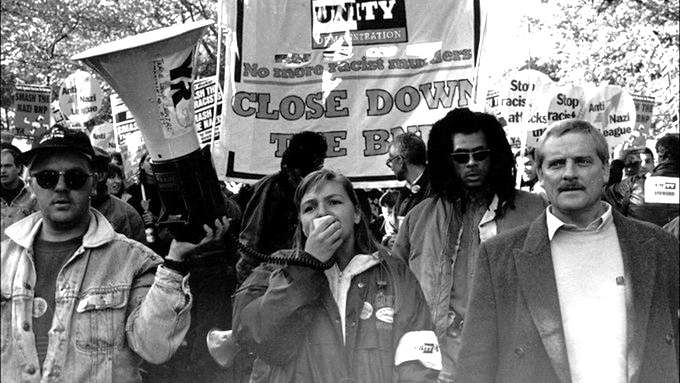
Lois Austin, Smith’s contemporary in Militant Labour, leading the chants on a ‘Close Down the BNP’ protest, 1993
Bruce-Jones showed an SDS report on the Militant Labour national conference 1994 [MPS-0745874], attributed to Peter Francis. It lists Smith among the attendees and describes a resolution being put to the conference for the formal creation of the away team. Smith says it didn’t happen. He is certain he would remember it if it had.
This tallies with what Lois Austin said when asked about this report. It appears to be a spycop fiction invented to make the spied-upon group seem more dangerous, in order to impress the SDS’s managers.
Another report by Francis, dated 18 November 1994 [UCPI0000034521], describes 25 antifascists gathering to oppose the racist National Front laying a wreath at the Cenotaph during the Remembrance Day march in London. Francis describes ‘a skirmish’ when the fascists were ‘set upon’. He said several National Front members and two of the away team were arrested, and Frank Smith broke his ankle.
Smith says it’s more exaggeration and lies. He was there, but none of the stewards were arrested. His ankle injury hadn’t happened yet, it was a workplace accident that occurred on a later date.
In July 1995, a Special Demonstration Squad report was made [MPS-0245257] with a lot of personal details about Smith. It once again portrayed him as a keen and rugged street fighter:
‘It is guaranteed that Frank Smith will be in the forefront of any violence or disorder in which the away team is involved.
Smith lives at the above address with his current girlfriend and fellow Militant Labour activist, Lisa Teuscher.’
Smith is affronted at the inclusion of many personal details that have no policing value. He’s even more annoyed at the talk of the away team as if it’s some kind of established violent street gang.
A year later, on 1 May 1996, an updated personal profile was made [MPS-0246230]:
‘Frank Smith has been reappointed as the chief steward in charge of security at all Militant Labour youth events for the coming year.’
Smith says there was no such official position. He was chief steward at some events, but not at others.
The report continued:
‘He’s an active member of his local Militant Labour branch in Camden and he agitates within the construction unions on behalf of the party on matters related to the building trade, especially health and safety issues.’
Beyond the false image of regimentation, Smith also takes issue with the terminology; ‘agitate’ implies making trouble for its own sake, rather than being someone who, as the report itself says, is trying to ensure that the workplace is safe.
JENNER’S CARICATURE

Spycop Mark Jenner undercover
Bruce-Jones then went through a series of five reports about Smith made by Mark Jenner, all of which portray Smith as a volatile and violent person.
The first of these reports was submitted on 8 June 1998 [MPS-0001123]. It says that an individual involved in Anti-Fascist Action (AFA) has been approached by other members, including Smith, who want to break away and form a rival organisation.
Smith says it’s complete rubbish. He was never even in AFA. It also appears to be yet another example of spycops inventing stories of division and power struggles between groups which, in real life, are actually working towards the same ends.
A few months later, on 5 November 1998, Jenner filed another report [MPS-0001506] about someone from AFA approaching Smith and members of Workers Power.
‘Thus far little is known of this alliance other than its informality and its willingness to get involved in small one-off hits. They are not capable of mounting a serious split from AFA and are content with brawling around events that would normally attract the ANL [Anti-Nazi League].’
Smith entirely dismisses this report too, saying ‘it’s nonsense’. In phrasing such as ‘content with brawling’ we see yet more of that spycop use of language; a supercilious tone with implications of the subjects being people who just want some recreational violence.
The third report was dated 2 February 1999 [MPS-0001736]. In it, Jenner describes a split in London AFA. He says a couple of members are:
‘forming a closer working relationship with the recently revamped Socialist Party away team led by Frank Smith… [and are] trying to lure other south London Anti-Fascist Action members over to their side with promises of good information and direct action…
Together with Frank Smith’s team, they are capable of being an irritant at demonstrations.’
Smith is blunt: ‘this document is a lie’.
He goes through it point by point, saying that he was not an ‘irritant at demonstrations’, and was not known to incite or engage in violence at any time while stewarding.
The spycops’ characterisation of the steward’s role is completely wrong. This is evidenced by the fact that the majority of events went off entirely peaceably, and there are no spycop reports specifying any instances of the kind of violence that the dreaded away team are supposedly so keen to engage in.
The fourth report is from six weeks later, 17 March 1999 [MPS-0001900]. Jenner cooks up a spicy story:
‘The Socialist Party’s anti-fascist group, known as the ‘away team’, are re-emerging on the anti-fascist scene following years of inactivity following the Welling riot.
This group numbers only about a dozen people, with one of the leading members being Frank Smith. In the last 12 months, the away team are believed to be responsible for attacks on members of extreme right-wing groups in Walthamstow, London Bridge, after the Bloody Sunday demo, and in Bromley following a council by-election.
They will continue to concentrate on picking off individual right wingers, particularly politically active British National Party members.’
Once again, Smith denies that anything described ever happened. Bruce-Jones checks that he really means all of it:
Q: You say everything within this that names you is inaccurate?
A: Well, yes.
Q: Is there anything that could be accurate?
A: They got my name right.
Finally, Bruce-Jones brought out another Jenner report from the same week [MPS-0001983]. Jenner, himself also a member of UCATT in his undercover identity, accurately records Smith’s trade union activity and employment status.
He then goes on to say Smith has carried out a number of attacks on far-right activists in recent months:
‘Although short in stature, Smith is extremely violent and short tempered.’
As with getting his name right, Smith agrees that he is diminutive, but rejects the rest of the characterisation:
‘I don’t recognise that. Basically the whole tone of it is trying to make out I am someone I am not.’
Jenner’s report then gives Smith’s home address and phone number. This is something that makes him wonder:
‘During that time, when I was leading the joint site committee, I would regularly get phoned up with death threats. So maybe it was him.’
Asked why he thinks Jenner’s reports consistently describe him as such a volatile, criminal character, Smith replies:
‘He can’t write, like, “nothing happened, they are all, like, nice people, Frank’s very popular, nothing to report here”. He can’t write that because he would be out of a job. So he’s got to, like, make it sound like things happen.’
SEARCHLIGHT
Bruce-Jones asks about Searchlight, the antifascist magazine that reported on what far-right organisations were doing. Smith says he was on nodding terms with a couple of the people from it. He corrects Bruce-Jones for calling Searchlight a group. Once again, he has to explain that not everything with a name is a formal organisation with membership lists.
On 3 August 2000, Carlo Soracchi filed a report [MPS-0003753]:
‘Frank Smith, a member of the Socialist Party away team, currently receives information on extreme right wingers from Gerry Gable, the editor of Searchlight, and Smith has occasionally used this information in order to carry out serious assaults on right-wing activists.
A recent example of this was the unreported assault on two members of the British National Party whilst they were canvassing in the Slade Green council election.’
Smith rejects it all. He says he’s never even met Gerry Gable, did not receive information from him, and did not assault BNP canvassers. It’s notable that on this rare occasion when a spycop describes a specific instance of violence, it’s an ‘unreported assault’ so there’s no other documentation to verify that it ever happened.
Undercover officer Carlo Soracchi
Smith says that he and other antifascists were in Slade Green though, as they’d leaflet and canvas in areas where the BNP were likely to get a significant share of the vote.
Another Soracchi report, dated 21 March 2002 [MPS-0008373], gives a list of dates on which it says No Platform intend to hunt down BNP canvassers in Slade Green and Barking. It says that if information isn’t forthcoming from Searchlight then Smith would make direct contact.
Smith says it’s all fiction too, Soracchi inventing activity to justify his job.
Later that year, on 29 August 2002, Soracchi submitted a further report [MPS-0009985] saying Smith has become No Platform’s key point of contact with Searchlight. Smith dismisses this as ‘nonsense, absolute nonsense’.
With a proven record of safe, effective stewarding, Smith and his friends would sometimes train others, or be asked to steward events. Stop the War Coalition asked them to help out with the front of the massive London demonstration against the Iraq War on 15 February 2003.
Six weeks beforehand, Soracchi reported a version of the plan [MPS-0077368]. He said that Dan Gillman ‘and his cohort’ were asked to steward the front of the march:
‘Gillman advised his Socialist Party/No Platform cohort that it was very likely that a confrontation would take place between the stewards and any militant Muslim groups who attempt to hijack the front of the demonstration, as happened in the previous anti-war demo…
Gillman and Frank Smith will be the principal stewards on the day and Smith is already looking forward to having another confrontation with Muslim extremists, after he was butted in a dispute at the last anti-war demo.’
Smith says this is yet another embellishment, a spycop inventing conflict and division where none exists. He says there was no headbutt, nor any attempt to ‘hijack the front’ by anyone. He also objects to the characterisation of Muslim groups on the march as confrontational and violent. It was, he points out, a peace protest.
PERSONAL RELATIONSHIPS
Smith’s relationship with his partner Lisa Teuscher is repeatedly mentioned in spycop reports. It’s first mentioned on 21 June 1995 [MPS-0245210], in a report which has a range of personal details about her.
Nearly seven years later, on 29 January 2002, there’s a report titled ‘Frank Smith’s Domestic Breakup’ [MPS-0007725]. It’s notable that this is not on an SDS form but is on a form from the other main spycop unit, the National Public Order Intelligence Unit. It’s unclear whether this is actually the other unit also spying on Smith, or whether Soracchi was using their forms for some reason. Either way, it shows a significant degree of overlap between the units.
The report describes the separation in quite some detail, all of which Smith rejects as untrue. He is utterly disgusted, both at the intrusion and the falsehoods.
It claimed they’d been together for a year, and that he broke it off because he found her too bourgeois and unsupportive of his political activity. In case this isn’t patronising enough, the report concludes:
‘It is important, however, to point out that Smith finds middle-class women very attractive and will soon enough find another distraction that will divert him from his true revolutionary zeal.’
It didn’t end there. At the end of the year, on 2 December 2002, Soracchi reported [MPS-0077370]:
‘Frank Smith of No Platform and the Socialist Party is in love once again. He has fallen for an American female from San Francisco and is seriously contemplating relocating to the United States…
Frank is known to have a liking for American women and the country itself, (interesting considering he is a Trotskyist revolutionary supposedly).’
Soracchi details the couple’s time together and their future plans. Smith is affronted at the invasion of privacy involved. It contains nothing that could be considered of policing value, it’s purely gossip and personal information. Smith also takes issue with the use of ‘a liking for American women’, saying that this sneering allegation of superficiality is a slur.
Soracchi made a number of reports about this relationship. One of them, dated 20 July 2003 [MPS-0022072], contains personal details of several other activists. He says that one is being tested for prostate cancer and the man concerned has only told his partner and Soracchi.
It’s a stark illustration of how spycops inveigled themselves into the very core of people’s lives and then betrayed their trust. Even if the ‘friend’ being confided in was an undercover police officer, it should be reasonable to expect that very personal information like this would be kept private.
In the report, Soracchi also says Smith’s relationship is going well, despite her parents having a very different political disposition. The report says they want to be together but aren’t sure about the upheaval:
‘He has decided that he is far too old to contemplate relocating to the USA. Their long-term relationship and future fairytale happiness hinge on her decision.’
Smith is outraged. He never knew Soracchi well and is certain that they never discussed his relationships. The reference to his partner’s family stands out, and he wonders if they were being spied on too. And, again, he is disgusted not only by the content but also the tone of the reporting.
BLACKLISTING
Smith is one of thousands of people who were on the illegal construction industry blacklist run by a company called the Consulting Association.

Blacklisted workers outside the High Court
Most major construction firms supplied the blacklist with information on undesirable workers; those who were elected as union representatives, raised concerns about safety on site, submitted complaints to an employment tribunal, or took part in a protest.
Household names like Balfour Beatty, Laing O’Rourke, Costain, Skanska, Kier, AMEC and AMEY were all actively involved.
When a company was taking on new workers, they checked to see if the Consulting Association had a file. If so, the person was refused work.
The Consulting Association was raided by the Information Commissioner’s Office in 2009. They seized files on 3,213 people. Details in the files included not only names, addresses and National Insurance numbers, but photos, phone numbers, car registrations, and information about the subject’s medical history and family members.
To give an idea of scale, a blacklisting name-check cost £2.20. The 2009 Consulting Association invoices for Sir Robert McAlpine alone, when the company was building the Olympic Stadium, totalled £28,000. This wasn’t a few managers chatting after work, it was industrial-scale, systematic blacklisting of union activists.
The blacklist also included people who had never worked in construction, but were noted for being seen on anti-racist or environmental protests. How did they end up on the blacklist?
In 2012 David Clancy, the Information Commissioners Office investigations manager, said:
‘There is information on the Consulting Association files that I believe could only be supplied by the police or the security services.’
The Independent Police Complaints Commission later confirmed that every constabulary’s Special Branch routinely passed information to the blacklist.
In 2018, the Met finally admitted that their Special Branch had done so, and that it was a crime that could have led to officers being prosecuted (although none have been). This wasn’t police officers upholding the law, this was police officers breaking the law to maximise corporate profit.
Frank Smith was one of the blacklisted construction workers. Having seen his file, he knows that there is information in it that can only have come from the spycops. There are distinctive phrases that appear in both spycops’ reports and the file, incidents are logged that are nothing to do with construction work, and there is a note saying he is ‘under “constant watch” (officially) and seen as politically dangerous’.
In his written witness statement to the Inquiry [UCPI0000036012], spycop Peter Francis says he thinks his reporting contributed to Smith’s blacklist file. Francis is a little bit sorry about that:
‘I did not report that Frank Smith was an agitator so that he would be blacklisted. I reported on information about Frank because in my view he fitted the bill for subversion and he posed a public order threat as he was violent at the time and an organiser.’
Francis became a whistleblower on the SDS in 2010, giving a huge amount of shocking information to the media. Without him, it is very unlikely that there would be an Undercover Policing Inquiry.
Smith has since met him:
‘We had a big meeting at the House of Commons for the Blacklist Support Group. Pete Francis approached me and said “I apologise for everything I did to you”, and my reply was: “You owe me no apology. What you have done settles the score, you know”.’
But back in the 1990s, Smith went from being sought after for the calibre of his work and earning excellent money, to being unable to get steady work, or even any work at all unless he used a fake name.
It went on and on, and the stress of it directly led to the demise of his relationship with Lisa Teuscher. It wasn’t just himself that he was unable to support. Without employment, he could no longer be a shop steward.
‘I lost my ability to represent and support others in the workplace. What started with those reports ended up costing me not just a job, but also my voice and place in the movement.’
Spycops supplying information to the construction blacklist is a major scandal worthy of its own public inquiry. As Smith shows, people who had done nothing wrong were victimised, and their lives were ruined.
However, the Undercover Policing Inquiry has barely touched this topic. If, as it seems on course to do, the Inquiry ignores the blacklisting scandal in its final report then it will have failed.