
UCPI Daily Report, 23 Oct 2025: ‘Wendy’ evidence
Tranche 3 Phase 1, Day 6
23 October 2025

Spycop James Thomson (centre, Barbour jacket, looking at camera) working as a protection officer for Tony Blair, Dublin, September 2010. This was eight years after his Special Demonstration Squad deployment ended, yet he was mainatining intimate relationships with women he’d deceived while undercover.
INTRODUCTION
On Thursday 23 October 2025 the Undercover Policing Inquiry took evidence from ‘Wendy’. She was deceived into a long-term intimate friendship with Special Demonstration Squad officer HN16 James Thomson ‘James Straven’, which he continued long after his deployment ended in 2002.
We had previously heard evidence from ‘Ellie’, a friend of Wendy’s, who Thomson had deceived into a long-term sexual relationship.
The Undercover Policing Inquiry (UCPI) is an independent, judge-led inquiry into undercover policing in England and Wales. Its main focus is the activity of two units who deployed long-term undercover officers into a variety of political groups: the Special Demonstration Squad (SDS, 1968-2008) and the National Public Order Intelligence Unit (NPOIU, 1999-2011). Spycops from these units lived as activists for years at a time, spying on more than 1,000 groups.
Wendy has provided the Inquiry with a 30-page written witness statement [UCPI0000038208]. The Inquiry’s page for the day has audio and a transcript of the live session.
Wendy was questioned by Don Ramble, Junior Counsel to the Inquiry, who began his questioning by asking her about her interest in animal rights and her involvement with Croydon Hunt Saboteurs.
ANIMAL LOVER
Wendy described growing up an animal lover, and being profoundly impacted by an animal rights stall when she was 14 years old. She discovered how she was inadvertently harming animals through her way of life, went vegetarian and started attending protests against a nearby vivisection lab.
She attended her first hunt at 16 years old and started going out regularly with the Croydon Hunt Saboteurs when she was 17.
Ramble asked her about membership of the group, and Wendy pointed out the voluntary nature of hunt sabs:
‘I think it’s important to note it’s not – even though there is the Hunt Saboteurs Association, it’s not like we sign up to a membership and have to, you know, commit to weekly meetings or anything like that.
So you might go out one week and there was four people and then you might go out the next week and there would be 20 people. I would say there was a core group of around ten people who would be there if they could.’
Wendy was the youngest person in that core group, most of whom were young men. She was usually the only woman from Croydon out in the field. They would socialise together:
‘After a hunt you really needed to decompress, so people would tend to go to the pub as a group, and just sit and have a chat and bring everything back down.’
Wendy would go out pretty much every weekend during the hunting season, and she described the experience of taking direct action that had an immediate and obvious effect: saving the life of an animal. In the off-season she would do a fundraising stall and attend protests.
FRIENDSHIP WITH THOMSON
James Thomson was deployed 1997-2002, using the name ‘James Straven’. He infiltrated hunt saboteurs and other animal rights campaigns in South London. Wendy was 17 years old when she first met him. She was still in school doing A Levels and living at home with her mother.
‘I do remember being in the back of a van and having a conversation with him quite early on when I was going out and realising that, for want of a better term, he was quite posh. And at the time, you wouldn’t believe it now, but at the time I was quite posh.
And I think we kind of went, oh, okay, we are both going to get a bit of ribbing for being the middle class sabs or, as he liked to refer to himself, “upper middle class”.’
Ramble asked if people were suspicious of Thomson, who quickly earned himself the nickname ‘James Blond’. Wendy explained that you had to be slightly suspicious of everyone:
‘We knew that there were phone taps at the time. Both because you would hear clicking when you picked up the line, but also because if you shared false information you would see the end result being that police would turn up at the false place instead of where you were actually going…
I do remember an experience where somebody who was actually an undercover journalist came out and next week there’s a story in the papers. So, again, it’s not so much that you treated everybody like a spy, but you treat everybody at arm’s length initially.’
She explained that there was something about Thomson that wasn’t quite right:
‘But then after a certain amount of time, when he starts being close friends and he starts dating, of course you go, “Well, he’s just a bit off, he’s just a bit of an oddball and that’s just him”.’
He claimed to come from a posh Scottish family, and would smirk when he spoke about himself, in a self-deprecating and ironic, but nonetheless boastful way. Wendy knew him to be a vegetarian, but others said they thought he was vegan.
He claimed to be a filming locations producer, and he was always willing to talk about his ‘work’. He would name drop people he said he was working with, such as Joanna Lumley, Peter O’Toole, Keira Knightley, Gillian Taylforth (who he supposedly got fired for mocking) and other celebrities.
There is a lot of truth to this as he actually gets on-screen credits in several productions, including the 1998 TV drama Coming Home, which starred Lumley, Knightley and O’Toole.
Ramble made clear that the Inquiry was concerned about how Thomson could have found the time to work in the film industry as a locations assistant while also being an undercover police officer.
Wendy explained that he would be away for work for about three weeks at a time every couple of months.
‘But also bear in mind, you know, we weren’t full-time animal activists. We were going out when the hunt went out. We might meet up during the week. But pretty much the week was his and then he was just with us on the weekends, maybe the odd evening.
So he had all the time in the world to do whatever he wanted to do, I suppose, and whatever he was getting extra money for.’
Thomson also told Wendy that he had three children with an ex, and seeing the kids was often a reason he gave for not coming to hunt meets.
WENDY’S FRIENDSHIP WITH THOMSON
Thomson became closer to Wendy in the second half of 2000. At that time, her relationship with her then-partner came to an end, and her mother found out her cancer had returned.
‘He made a lot more effort to see me on my own… I don’t have a lot of memories of James and I seeing each other on our own while I was in a relationship. But after that relationship ended, we spent time together alone…
He was one of the people that I spoke to after I found out [my mother] was terminally ill. And obviously I was very distressed about that.’
Thomson seemed to be very supportive at that difficult time. During her mother’s illness he made an effort to take her places. He met her mother, who really liked him.
‘She said to me after: “Why don’t you want to go out with him? He seems lovely. You wouldn’t want him because he’s a nice one.” And I said, “I just don’t see him like that mum”…
She’d never really kind of been vocal about me being with somebody or not being with somebody… and I said to her, why are you suddenly trying to make me date people? And she said, “Well, because I don’t want you to be alone after I am gone. I don’t like the idea of that. I’d really like to see you with someone”.
And obviously now I hate the fact that she thought he was a nice guy who I could potentially be with after she was dead’.’
Wendy goes on to describe Thomson taking her out for dinner with friends as her mother’s health declined:
He also took her sabbing:
‘Obviously around the time of my mother being severely ill and dying, things get very foggy… But one of my very clear memories was he actually took me out sabbing when she was in a coma in the last days…
I was told when they stopped life support that she would be gone in a couple of days, and she lasted ten days after that. So it was a very difficult time.
And I remember him saying: “I will come and pick you up. You don’t have to talk to anyone else while you’re out there, you don’t have to talk to me. We’ll go out, we’ll go sabbing and I will drop you back and let’s just – you know, you can’t just be at the hospital all the time”.’
Thomson was one of Wendy’s primary sources of support during her mother’s illness, and she was grateful to him at the time. Now she says:
‘I think he saw an opportunity when I was vulnerable and perhaps, you know I was single, I was vulnerable. I needed someone.’
She points out that he deliberately chose to intrude on her most personal moments, saying:
‘If you had any shred of human decency and empathy there are times when you could very easily use your children or your job as a locations producer to say, “I am so sorry, I can’t be there for that”, and let somebody who is genuinely close to that person step in and support them. And he instead took those times as an opportunity for himself.’
Wendy believes Thomson targeted her for a sexual relationship. She gave examples of incidents where he made sexualised comments when she was in her late teens and early 20s.
The Special Demonstration Squad officers have a history of homing in on vulnerable young women and grooming them into sexual relationships. Thomson’s boss, HN10 Bob Lambert, had done it himself when he was undercover in the 1980s with ‘Jacqui’. Thomson went on to do the same with Ellie. This was part of the spycops’ tradecraft. They were a state-sponsored grooming gang.
Ramble then read from what Thomson says about Wendy in his witness statement [UCPI0000035553] where he clearly seeks to minimise the relationship:
‘I would describe her as a close associate in that I came to know her well through [privacy] and her animal rights activities… I wouldn’t describe her as a close personal friend.’
We are told that Thomson repeats the phrase ‘close associate’ several times to describe his relationship with Wendy, to which she replied:
‘I was a pretty close associate for 21 years. That’s a long time to not be a personal close friend of somebody.’
Thomson’s phone call logs for 2001-2 [MPS-0719641] reveal a great many text messages and calls to Wendy’s personal mobile phone. He has sought to downplay this by claiming he was simply leaving messages for Ellie.
However, Wendy says that never happened. The vast majority of these were text messages for her; some were longer conversations with her. She pointed out that Ellie had her own phone (and his logs show multiple calls to that number as well).
‘It’s the most bizarre excuse he could have thought of, to be honest. If we were messaging regularly or speaking regularly on a certain day, it was probably because we had plans.
I can’t obviously tell you what those plans were, but we weren’t either of us the kind of person to just send a message going, “Hope you have a great day, buddy”, so if there was lots of back and forth we would be planning something. It would be a dinner or we would be catching up with other people, or, you know, whatever it may be.’
RELATIONSHIPS
Asked about Thomson’s relationships, Wendy explained:
‘I in no way want to suggest that when I felt James was trying to get with me and then instead went with “Ellie” it’s because “Ellie” was a second choice or he’d have rather been with me than “Sara”.
He didn’t care who he was with. He wasn’t interested in any of us as more than perhaps a momentary enjoyable moment while he was getting to have sex and get paid for it.’
Wendy pointed out that there were no single women in the Croydon Hunt Sab group until Sara joined, and he more or less immediately initiated a relationship with her. Then, when Wendy became single, he tried to start a relationship with her, and when that didn’t work out, he targeted her close friend Ellie (who was outside the group).
Wendy struggles with the fact that she encouraged both Sara and Ellie to have relationships with her friend ‘James Straven’.
Asked about the relationship with Sara, Wendy says Thomson never talked about Sara with her, which was odd. Thomson ended that relationship by giving Sara a letter claiming he couldn’t have a sexual relationship due to severe sexual abuse when he was a child.
Wendy didn’t know about the details of the letter Thomson gave to Sara. However, she remembers how Sara was after that conversation:
‘She seemed a little bit smaller, if you know what I mean. She just shrunk a little bit. Probably a little bit less bubbly. Yes, like she wouldn’t talk about it a great deal. I realise now [it was] out of respect for what he claimed had happened to him. But she just seemed a little bit smaller in person.’
Wendy met Ellie in 1999, when they were both working at the wildlife hospital. They ended up living in the same house, one owned by a relative of their boss, and working on a rota together.
In early 2001, Thomson asked Wendy how old Ellie was (21, the same age as Wendy herself) and asked her if she thought Ellie would be interested in a relationship with “an oldie like me”. Thomson told Ellie he was 33. He later said he’d got his age wrong and he was 36. He was in fact 37 when he first deceived Ellie into a relationship.
She recalls that he had probably only met Ellie once, and not even spoken to her, before this conversation. She says now:
‘Not only did I directly set her up with him, she wouldn’t have met him any other way. He wouldn’t have targeted her if she wasn’t my friend. And essentially I destroyed my friend’s trust in men and ability to date. So I struggle quite hard with that.’
ACTIVISM
Next, Wendy is asked about Thomson’s involvement in animal rights activism.

Spycop James Thomson ‘James Straven’ in a bar in Amsterdam, 1998
She says he regularly came along to hunt sabs, but didn’t do anything to stop the fox being killed. He didn’t even carry citronella with him (sabs would spray this essential oil on the ground once a fox had broken cover to mask the fox’s scent and enable it to escape the hounds).
Asked about the frequency of violence, Wendy explained that this depended on the hunt involved – some were known to be more violent than others.
The sabs would try to avoid such confrontations whenever they could, by running away. Their priority was to prevent the fox being killed, which they couldn’t do if they were arrested or stuck in a fight.
The Inquiry has spent a long time asking witnesses about violence at hunts. The police – far beyond the spycops – have portrayed sabs as keen instigators of violence, rather than its victims.
This comes despite many officers who infiltrated sabs, including Thomson, describing violence from the hunters, often with collusion of uniformed police.
Wendy has a clear memory of Thomson being present at two occasions when the sabs were violently attacked by hunters or supporters. On one of these, the hunters charged down a hill at them on horseback:
‘We turned around to exit the field and the police shut the gate. When we tried to climb over the gate, they pushed us back into the field at which point the men on horses started striking us with their whips. And I remember being hit on the head with a brass-ended whip which – excuse my French – bloody hurts.’
In another incident, two vehicle loads of hunt supporters, armed with golf clubs and bats, chased the sabs, then viciously attacked them:
‘I was struck with a golf club and I don’t know if I was momentarily knocked out, but I was on the ground and I was being kicked in the face by a man who was also on the ground and our legs were kind of tangled up and I was trying to kick at him, and he kicked me in the face and ended up leaving an imprint on my face.’
Thomson described this incident in his reporting. In his written witness statement he notes:
‘I have been referred to the file note at MPS-0001577, which refers to me sustaining bruising to my jaw, upper and lower back and legs during hunt saboteur activity on 21 November 1998. I remember this incident because I was attacked during a hunt sab and struck with a golf club.’
Wendy says the only times she saw Thomson involved in any physical altercation:
‘He was defending himself the same as we were. I believe the reason for that is that had he started violence out sabbing, it would have stood out like a sore thumb’.
REPORTING ABOUT WENDY
Wendy was then shown a number of reports by ‘Magenta Triangle’ (Thomson’s code name). One, from 20 July 1998 [MPS-0001211], is about the Annual General Meeting of the Hunt Saboteurs Association.
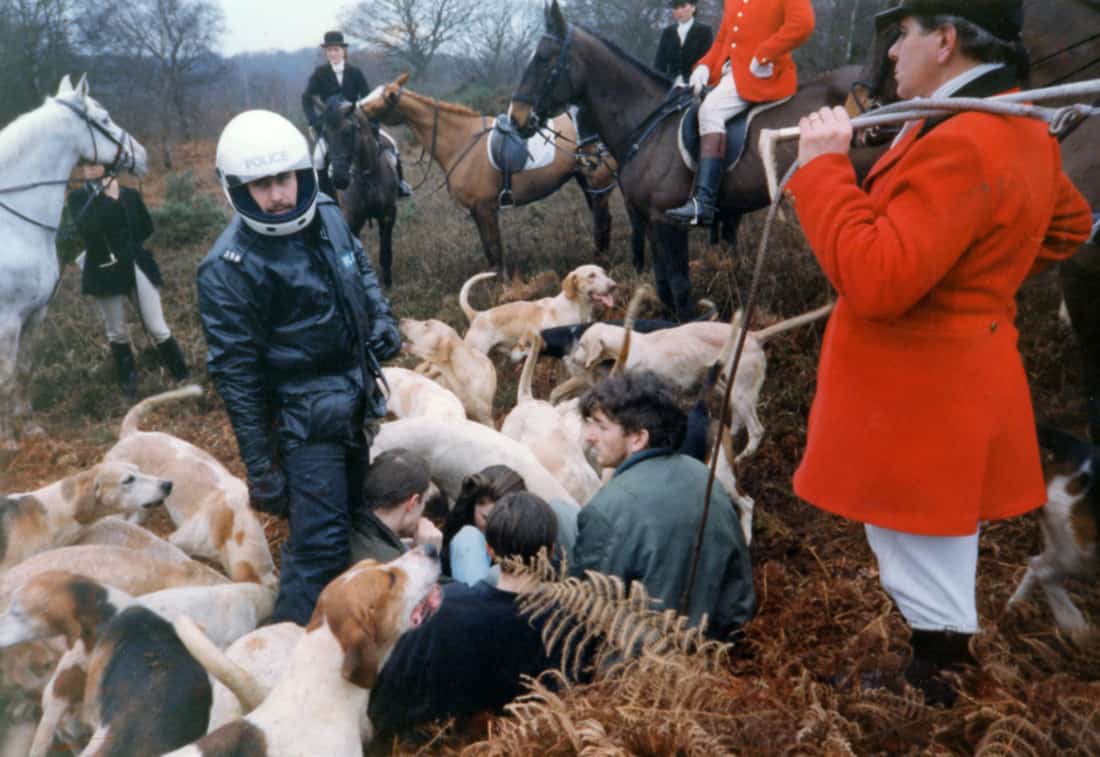
Saboteurs from the New Forest and Winchester protect a fox that’s gone to earth to escape the hounds
It mentions the Croydon sabs, saying that they will travel to Kent to support the sabs there in the coming season. Wendy explains that sometimes it was good to have ‘strength in numbers’ when a group was attacked by the Hunt.
Wendy is listed as attending this AGM. So is a sab known at the Inquiry as ‘L4’, who would later be almost killed by hunters and featured in Thomson’s spying. Wendy says that she and L4 were close friends.
She notes that Thomson seems to have deliberately inserted himself into L4’s life after he suffered serious injuries, similar to the way he inveigled himself more firmly into Wendy’s life when she was single and her mother was dying.
We hear about another report of Thomson’s, dated 24 August 1998, [MPS-0247867] which describes an Old Burstow Hunt cubbing meet that was attended by Wendy, L4, L1 & L2.
She confirms that L1 and L2 were also good friends of hers, as was L2’s brother, L3. Standing together, ‘back-to-back’, defending each other against hunt violence, made them all a close-knit group. However, she points out that she knew Thomson better than most of the other people in the group, having met him first.
Ramble reads a single-paragraph report from 29 March 1999 [MPS-0001923], in full. It claims that the Croydon sabs ‘are forging close ties’ with the animal sanctuary where she and Ellie worked. It specifically mentions plans to construct a duck pond. Wendy pointed out that, despite only being five lines long, the report has a number of inaccuracies, and went on to say:
‘I think it reflects fairly badly on any claims that they are making that they were there to intercept illegal activity or threats to the public or processes.
Because, you know, he was literally in his reports telling them that the activity we were undertaking was building a duck pond. It’s not really a threat to public security.’
A further report by Thomson, about a meeting of ‘Surrey Fighting for Animals’ on 5 August 1999, [MPS-0002323] talks about ‘activists’ and ‘fluffies’. Wendy points out how derogatory this report is, and how bitter Thomson sounds. She also notes that he invented division where none really existed.
She said Thomson himself would have attended ‘home visits’ against vivisectors, which were legal at the time. She explains that as the purpose was to make sure that people who ‘tortured animals for a living’ weren’t able to hide what they did from their neighbours, there would be some yelling, but no criminal damage or other criminal offences committed.
The report goes on to state:
‘Robin Webb then gave his speech, which was excellent but largely wasted on those present. Webb was then subjected to an hour of the most moronic questioning he may ever have had to face and it is unlikely he will darken the Surrey Fighting for Animals doorstep again.’
‘Everything he says is just creative theatre,’ Wendy says. It appears this was just a way for Thomson to make jokes at the activists’ expense, for his colleagues to laugh at.
She adds:
‘This isn’t reporting on criminal activity, proposed criminal activity, anything of value whatsoever.
It’s basically just trying to find ways to belittle, feel superior and make jokes. There doesn’t seem to be any relevance to it. That’s what confuses me the most, is all the money, time and effort that’s gone into these undercover officers’ deployments, there didn’t seem to be any reason for it.’
Thomson reported on 21 February 2000 [MPS-0003033] about who was living with Wendy and her boyfriend at this time. In another report, dated 26 April 2000, [MPS-0003413] he detailed that Wendy had now split up with her boyfriend.
She is scathing about the petty details of activists’ personal relationships being put into such reports, saying it’s:
‘obvious that they didn’t have anything of quality to report. What else did he have to talk about other than who was sleeping with who and who was living with who?’
She says the first report didn’t bother her so much – it just ‘highlighted what utter rubbish the whole thing was’ – but she felt more angry and hurt when she saw the second one:
‘I spoke to him quite a bit during the time that my relationship was breaking down and after it had broken down, and he was very supportive of me leaving the relationship. And yet it’s just another anecdote for him to put down, because he doesn’t have anything else to talk about.’
OPERATION LIME
L4 was deliberately run over by a hunt supporter in September 2000. Fortunately he was not killed, but he did sustain serious life-changing injuries. Wendy was not present, but heard about it the same day, as did Thomson.
Emotions were very high, especially as the driver of the vehicle, known in the Inquiry as ‘L5’, would turn up to hunts afterwards and taunt the sabs by making steering wheel motions with his hands. He was charged with grievous bodily harm with intent to kill. However, the trial collapsed.
Q. After that trial, was there any talk about ‘well, we will take the law into our own hands, we will get revenge or reprisals after that’, that you witnessed?
A. The only talk I heard and was part of after that trial collapsed was, “Oh my God, what’s going to happen with L4? This is going to kill him. How do we support him, what can we do?”
However, in his written statement, Thomson described a plot to obtain a gun and ammunition from France in order to seek revenge for what had happened to L4.
Thomson claimed to be part of this plot, stating that he had foiled it by arranging for the gun to be left in his vehicle, which was then ‘stolen’ by his SDS handler. This was ‘Operation Lime’.
Ramble asked Wendy what she thought when she read Thomson’s version of events. She responded:
‘I would say I was as close, if not closer, to L4 than James was and there was certainly never anything discussed or mentioned or even hinted with me, and the same from L1, L2 and L3. Never anything…
The second I read it, my jaw hit the floor. And I knew straight away it was utter crap…
I can remember thinking how ridiculous the entire thing was, that I couldn’t believe that at the time the rest of the police bought into it. Because, putting aside entirely my knowledge personally of the other individuals involved, and my 100 per cent knowledge in my heart that they would never have been part of something like that, it was the dumbest plot I could have conceived.
If you are an animal rights activist supposedly involved in such extremist activity that you are going to murder someone, why would you drive to France to buy a gun from a stranger to drive it back through customs to the UK?’
Wendy was not on the trip to France but she heard about it at the time. As far as she knew, the only things ‘Sara’, Thomson and L3 did on this trip were to drink wine and have a nice time.
L3 is also being questioned by the Inquiry about this. He is a late addition to the Inquiry, having gone years without realising what happened, and how close he’d come to being framed by Thomson for a fictional gun plot that could have ended in a long jail term and a ruined life.
POST DEPLOYMENT
When their deployment was ending spycops usually told the people they spied on that they were moving a long way away, often to another country. Thomson did this, saying his ex was moving to the USA with his children, and so he was going to move there too in order to be a good parent.

Spycop HN16 James Thomson
Wendy remembers Thomson’s departure as a sad occasion for them all, and recalls how upset Ellie was. She says he wasn’t happy either; he wanted to be near his kids, but didn’t want to leave his comrades or the UK.
He stayed in contact with Wendy long after his deployment ended. After she moved to Australia, he would normally meet up with her when she came back to the UK every 18 months or so, although she notes that he carefully avoided meeting other former targets.
He kept in touch by email and the odd phone call for many years, well after the spycops scandal was public and the Undercover Policing Inquiry was set up. Wendy has shared the emails with the Inquiry [UCPI0000038209].
The tone is one of lots of love, kisses and plans to meet up at various stages over the years. He even met her then partner. We’re shown an email from Thomson to Wendy, dated 24 November 2006, in which he asked her to send a photo – which she did. She hastens to make it clear that this was not a request for a sexual photo (which is something he did with Ellie).
He asked her for L4’s address, ostensibly so he could visit. She gave it to him, and now wonders what he did with it. She knows that he never contacted L4 at the time.
‘It haunts me. I cannot begin to imagine why he wanted that address. His deployment had ended, yet he was still working for the Metropolitan Police.
To me, it just reaffirms my belief that he was staying in touch with me because I remained useful on getting information. I do not accept that that information was not to be passed to the police. There is absolutely no reason why he would have required L4’s address, and in fact I confirmed, at the time, I remember confirming with L4 whether he had gone there, and he had not.’
Another email, sent to Wendy on 14 September 2009, asks her to tell Ellie that ‘she still owes’ him an email, adding ‘where are the photos?’.
She explains that at the time she just assumed that this was something Ellie had promised him in a conversation. Having heard Ellie’s evidence now, about the number of times Thomson harassed her for explicit photos, she now characterises this as:
‘sexual harassment by a dirty old man who wanted to get his jollies off with looking at photos of a younger woman he had tricked into a sexual relationship… I found it absolutely repulsive’.
INTERFERENCE WITH HER MOTHER’S WILL
After her mother died, Wendy started looking to buy a house with her inheritance.
‘I knew the contents of my mother’s will. I knew the executor of her will, which was her best friend, and obviously I knew the solicitor and the solicitor said: “Look, it’s an easy will, it’s not contested, it should just take a few weeks. So if you want to start looking at houses now, you should be able to do that.”
He said: “Technically, probate can take up to six months but that’s only for really complicated scenarios, usually where there’s multiple challenges, so you should be okay to start looking”. It took six months to the day.’
Wendy nearly lost out on buying the house she had set her heart on, back in 2001.
‘It felt like something positive could happen in regards to I had found a home that I actually wanted to be in, that was suitable, that was close to everything I needed to be close to. And I had made an offer and it was a new build from a small building firm…
As probate took longer and longer and we didn’t have any answers as to why, the builders started saying, “We can’t hold this property for you, we have multiple other buyers we could be selling this to”… I was going to lose the property.’
A highly detailed Special Demonstration Squad document on the plan for the ending of Thomson’s deployment [MPS-0719701] includes the following peculiar and disturbing comment:
‘Wendy recently moved into an address in [address redacted] which she has bought following the death of her mother, attempts to disrupt this purchase having failed. It is impossible to predict how long she might remain here.’
Wendy described her reaction on reading that report:
‘It was one of those heart-stopping moments… I started thinking back to that time and how odd it was, how long the process had taken for probate and how I kept going to the solicitor and asking what was happening, and he said he had no idea. There were no updates.
He was chasing my mother’s best friend, who was the executor of the will, who was also an estate agent, and had started showing me other properties and trying to persuade me to buy another property.
So I am thinking, was she in on it somehow? Was my solicitor in on it somehow? Did they contact the probate office and interfere with probate and just tell them to put it at the bottom of the pile? How deep did this go and how far up was it approved? Who approved this?’
In his written witness statement Thomson simply says he has no memory of the plan to disrupt Wendy buying a house. She does not believe him, nor does she believe management did not know.
DISCIPLINARY INVESTIGATION
Towards the end of Thomson’s deployment one of his managers, HN53, produced a report on various problems [MPS-0719722]. It describes how Thomson fabricated intelligence and was dishonest with his managers. Investigations revealed financial irregularities, identity theft and other possible criminal activity. This led to his deployment being terminated.
His security status was downgraded and had to re-apply for his firearm licence. However, he was not disciplined, let alone faced with criminal charges, and was allowed to remain in the police until 2014.
He was also given his firearm back and returned to active protection duties just two years after his deployment ended – highly unusual for an officer who had an unblemished history – let alone one as murky as James’.
Wendy says she is disgusted that despite his lies, sexual relationships and criminal activities being known, the police took no action against him.
‘They decided that the important thing was not to make the Metropolitan Police look bad. And they acknowledge in their internal documents that the risk of taking any other form of action, be it even just more formal discipline against James Thomson, might make them look bad. And that was what they based their decision to take no action upon.’
IMPACT
Finding out that Thomson was an undercover officer has affected Wendy’s memories of her mother, devastated the life of her best friend, and utterly ruined her trust in other people. Wendy was extremely forthright about her feelings about this:
‘This is not just the disgusting pathetic things that James has done while he’s playing spy. It is showing the absolute corruption of the entire system. Not even just the Metropolitan Police, but whoever had knowledge of these actions. It’s mind blowing.’
Asked if there are any other points she wishes to make, Wendy flagged several items.
Firstly, she dismissed Thomson’s ‘ridiculous claims’ about suffering from dissociation disorder, pointing out that this can be easily disproved. For example, he falsely claimed in reports that Sara was dating another activist (L1) in order to cover his own inappropriate relationship with her, showing he knew he was doing something wrong.
She also pointed out that despite the concerns raised by HN53, and the supposed policy that SDS undercovers were not supposed to take up protection duties within 10 years of their deployment ending, Thomson was given back his firearms licence, and put to work in close protection, after just two years.
New photographic evidence has now emerged of him engaged in close protection work with Tony Blair in 2010. She asks what would have happened if someone at that anti-war event had recognised Thomson.
She also referred to a letter that she’s seen, sent to Thomson in August 1996, before he joined the spycops unit. He is invited to take part in group therapy and advised to ‘keep taking the tablets’. She asked the Inquiry to investigate whether he was known to have mental health problems before he was deployed into her life.
‘The last thing I would like to say is just that I feel there is abundant evidence to show that at every stage, at every level, the Metropolitan Police has encouraged, facilitated and even covered up abuses of human rights.
And in my opinion they are continuing to do so and I sincerely hope, for those of us who have been impacted so severely, that the Inquiry holds both the undercover officers and all levels of management accountable for these actions.’
At the end of her evidence the Inquiry’s Chair, Sir John Mitting, thanked Wendy:
‘for the care and attention that you have given to your evidence and to your not-easy task of giving it orally and publicly. I am very grateful to you. I am very dependent upon those who participated in the events that I am looking into providing their own evidence about it, so that I can make a judgment about where the truth lies and about what really happened.’