
UCPI Daily Report, 14 Nov 2025: Lois Austin evidence
Tranche 3 Phase 1, Day 13
13 November 2025

Lois Austin giving evidence to the Undercover Policing Inquiry, 14 November 2025
Content warning: this report contains descriptions of severe interpersonal violence, killing, and misogynist abuse.
INTRODUCTION
On the morning of Thursday 14 November 2025, the Undercover Policing Inquiry heard evidence from Lois Austin.
Austin is a lifelong socialist and social justice campaigner. She’s a member of the Socialist Party (formerly Militant Labour) and works with us, Campaign Opposing Police Surveillance.
In the early 1990s she was part of Youth Against Racism in Europe and was spied on by several Special Demonstration Squad officers, particularly HN43 Peter Francis ‘Peter Black’/ ‘Peter Daley’ / ‘Peter Johnson’. Hence the Inquiry’s interest in her now.

Sarah Hemingway, Second Junior Counsel to the Inquiry
She is one of a number of activists being called to give evidence to the Undercover Policing Inquiry ahead of Francis’s appearance in the first week of December.
Austin gave powerful, sincere and candid testimony challenging specific falsehoods. She unambiguously explained the politics, process and culture of the campaigns she was involved with.
The Undercover Policing Inquiry (UCPI) is an independent, judge-led inquiry into undercover policing in England and Wales. Its main focus is the activity of two units who deployed long-term undercover officers into a variety of political groups: the Special Demonstration Squad (SDS, 1968-2008) and the National Public Order Intelligence Unit (NPOIU, 1999-2011). Spycops from these units lived as activists for years at a time, spying on more than 1,000 groups.
Austin has given the Inquiry a written witness statement [UCPI0000037774].
She was questioned by Sarah Hemingway, Second Junior Counsel to the Inquiry.
The Inquiry’s page for the day has video and a transcript of the live session.
BACKGROUND
Austin grew up in Welling, South London, as part of a socialist family. She was politically active from the age of 14 or 15 with the local branch of the Labour Party Young Socialists, alongside her younger sister.
The 1984-5 miners’ strike galvanised her political spirit. She was outraged at the police violence and biased media reporting. She was active in many of the prominent campaigns of the day including anti-apartheid, and the Campaign for Nuclear Disarmament. She wasn’t shy about taking on active organising roles and doing media work.
The Thatcher government set up the Youth Training Scheme (YTS), in which young people had to work full-time hours for unemployment benefits. In 1985, Austin organised a school strike in opposition to plans for the YTS to be made compulsory. She made numerous national media appearances talking about it.
She was on the Labour Party Young Socialists’ London regional committee and the Labour Party’s National Executive Committee youth sub-committee.
THE BNP IN WELLING
Austin was asked about the far-right British National Party (BNP), the main racist organisation on the rise in Britain at the time. The BNP moved into a residential street in Welling in 1987, calling their operational base a ‘bookshop’.
They chose Welling due to its history of far-right support. Austin remembers a 1981 National Front march several hundred strong coming down the High Street.
The BNP went into youth clubs, recruiting new members. The area immediately experienced a huge rise in racist attacks, including murders of young Black men. One Asian family in particular was singled out. The police weren’t interested, so the campaigners organised a rota of visitors:
‘We wanted the British National Party to see that this was a family that had support, the whole of the community, black, white and Asian, and we made sure there was people in and out.
Sometimes people had to stay there overnight because we wanted to send a signal that this is a family that is being protected, it is being defended by the community and you need to stay away.’
In response to the BNP’s presence in her neighbourhood, Austin helped to co-ordinate opposition among trade unionists, socialists and other anti-racist community groups to form the Bexley and Greenwich Labour Movement Campaign Against Racism and Fascism.
The group petitioned the council to use planning laws and the Race Relations Act to have the BNP ejected from their ‘book shop’ headquarters. From 1987 to 1993 they lobbied every full meeting of Bexley council, and had sympathetic councillors present motions to the meetings.
Austin recalls how upsetting it was to hear Bexley council, the police, and the press saying the left were just as bad as the BNP. The BNP were trying to create hatred and division whereas they were doing the opposite.
The campaign also did street stalls for outreach, something that was dangerous given the presence of the violent far-right group Combat 18. Austin was singled out. Neo-Nazi Combat 18 activists were asking around in local pubs about ‘that commie slag Lois Austin’, wanting to know where she lived. She ended up on a Combat 18 hit list.
Asked if she accepted the BNP as a legitimate political party with a right to campaign, she was clear and blunt.
‘No. I would not accept that. Because the British National Party were openly fascist. They said that… They said “We are a Nazi party and Hitler was right”.’
Even Combat 18’s name is a Nazi reference – the 1st and 8th letters of the alphabet are Hitler’s initials.
On 8 May 1993, in the aftermath of the murder of Stephen Lawrence, an anti-racist demonstration was held in Welling. As always, the Inquiry was keen to find out about anything that might be construed as violence from the people who were spied on. Austin says some placards were thrown at the BNP office but not much else.
The main disorder was caused by police who waded in with horses and riot gear, attacking people. This was not a one-off, and Austin is emphatic that the Inquiry needs to examine the actions of the police in attacking demonstrations.
ENTER SPYCOPS – THE OCTOBER 1993 DEMO
HN43 Peter Francis was deployed on 27 September 1993, shortly before a large anti-racist protest in Welling on 16 October 1993. He was tasked to infiltrate Youth Against Racism in Europe (YRE), which had been formed in 1992 in response to rising racist attacks across the continent. Austin became one of the UK leaders.

Notice from the Class War newspaper – ‘the Beano of the left’ – saying ‘burn down the BNP’.
Austin rejects the claim in spycop reports that YRE was merely a front for Militant Labour. She says there’s a long history of socialists setting up broad organisations (Eleanor Marx was involved in setting up the GMB!). The biggest contingent on the October 1993 march was unaffiliated local people.
She explains how her specific role on 16 October 1993 was to lead the demonstration with the banner. They found the planned route blocked by riot police with mounted officers behind. They were not being permitted to go past the BNP office, but nor were they given an alternative. They were penned in with no exit, an early example of police ‘kettling’ that increased at protests over the following years.
We are shown a clip from ‘Violence With Violence’, an episode of the ITV political documentary series World in Action which alleges the existence of a secret violent group with YRE. The footage shows police blocking the 16 October march.
Austin says they were affronted at being blocked from marching past the BNP, because it breached their democratic right to protest.
A spycop intelligence report [UCPI0000025694] claims that the night before the demonstration activists were confident of destroying the BNP headquarters during the protest. Austin says this is a wildly fictionalised account of a meeting that just had stewards planning logistics to keep it safe and orderly.
Francis says there was a Class War plan to burn down the BNP bookshop. This seems to amount to little more than a notice in that group’s provocative anarchist publication.
‘I think Class War were probably not even seriously putting that forward. Because I think “Lewis” described yesterday, their magazine being the sort of Beano of the left… “Eat the Rich” and stuff like that. So nobody really took them seriously.’
Austin says she never heard of such a plan at the time and would have been stridently opposed if someone had actually suggested it.
She dismisses the idea as ridiculous on several levels. Not only was it wholly beyond the ways and methods of YRE, but the BNP HQ was a heavily fortified building next door to a residential house and a fire would have put people at risk.
‘And that, quite frankly, is ridiculous. Because the method of Youth Against Racism in Europe, and the Anti-Nazi League as well, actually… was to build a mass political campaign. That is how you defeat fascism.’
Austin describes how she was charged by police and knocked on the floor then saved by YRE stewards:
‘If it weren’t for the Youth Against Racism in Europe stewards, people like Dan Gillman and others who jumped on my back when the police were trying to batter me and they took the blows on their backs, if it hadn’t have been for that, I honestly believe I would have ended up like Julie Waterson who was whacked across the head by a police truncheon.
And I can see her on my left. I am negotiating with the police. Police keep charging us and I can see Julie Waterson in her white jacket covered in blood. I was saying to our stewards, “They have got Julie, they have got Julie, you have to go over there, you have to assist.” That was what was going on. That was the reality of Welling.’
She asks again, why did the police block the exit at Lodge Hill that would have taken everyone away from the BNP and up to the park? Every exit route was blocked. The inescapable conclusion is that it was a police trap so they could attack the crowd.
Austin points out that riot police chased protesters across fields as they were trying to leave the area, beating people up as they were leaving.
THE OCTOBER DEMO IN WELLING – ANALYSIS
The spycop report of the march, apparently by Francis [UCPI0000025694] claims the march was a group of hoodlums bent on violence, prevented by seeing the might of their adversaries:
‘The physical presence and appearance of large numbers of fully equipped riot-police was the single most persuasive deterrent to the ill-intentioned mob on that day. The second major factor was the choice of battleground by the police.’
Austin not only rejects the allegation but also the wider mindset of it being akin to a military conflict. The police are mounting gladiatorial opposition to people exercising their democratic rights, and people shouldn’t be portrayed as violent just because they protest.
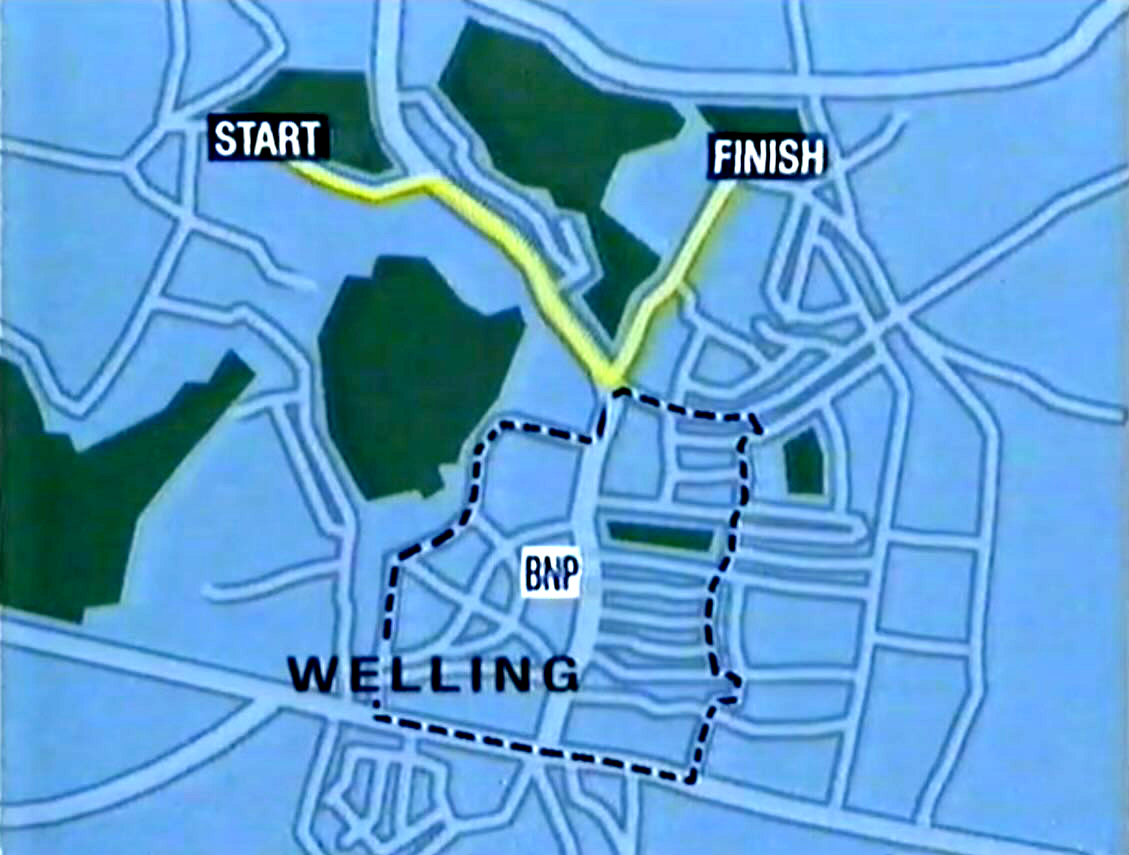
Map of the anti-BNP protest in Welling, 16 October 1993
She says the police intimidation and violence were part of a strategy of scaring people away from protesting, and this is totally unacceptable in a democracy.
Austin also dismissed the World in Action documentary’s characterisation which, while talking about a secret plan for anti-racist violence, only actually shows police attacking protesters and the crowd reacting.
Given how closely the World in Action perspective matches the fictions of the spycops, this suggests that the SDS may have been the source of the programme’s information.
Similarly, the spycops report said ‘stewards were instructed not to carry weapons’, which is a way of admitting they were unarmed but still crowbarring in an implication that they were wanting violence.
‘We didn’t have to say to our stewards “don’t carry weapons” because we didn’t carry weapons… the idea that we were violent, that we were carrying weapons, that we were up for a fight and all of that, it’s just not true.’
The spycops report claims ‘coloured youths of murdered families and a holocaust survivor were being used as stooges’ by YRE activists. Austin is disgusted at this. Again, it characterises activists as inauthentic, having a nefarious desire for violence rather than genuinely holding the moral position that they’re always talking about.
It shows the police find it hard to believe anyone could actually be actively anti-racist, and believe there can be no legitimate opposition to racism.
But more, Austin points out, it shows a racist basis to their thinking:
‘The fact that the police report it in that way shows their racism actually, and their prejudice, that Black families, Black members of the community, have to be led or can be in some way manipulated by activists, socialists, trade unionists. It is absolute rubbish.’
The spycop report talks about how ‘actual fighting was started by 60-100 ‘crusties’’ (members of a scruffy anarcho-political youth subculture of the time) who the stewards were powerless to control. It says they were hunt sabs and anarchists, two favourite bogeymen of the spycops and conservative state. It doesn’t say how they were able to ascertain this.
Austin is asked if it is true, and she flatly rejects it. When people were penned in and shoved by police there were people pushing back, but the overt violence was started by the police.
Though the day was fraught, the sustained campaigning won in the end, which Austin says shows that both the cause and the method were vindicated. They had been lawfully campaigning for the law to be applied and a danger to public order to be removed; things the police should support, yet the police had treated them as the problem.
‘What ultimately happened was that our campaign was successful. The political campaign that we had in the area, the mass pressure from everything that we did, along with other groups, meant that the authorities eventually did set up a planning inquiry…
I wrote the evidence for Youth Against Racism in Europe where I linked issues around planning and detriment to the community to the Race Relations Act and incitement to racial hatred, and I said that the Race Relations Act is relevant to planning law and that is a reason to close it.
And the judge included our submission and that point in his reasoning as to why the British National Party headquarters should be closed down. So our mass political campaign won.’
TARGETED FOR WANTING CHANGE
The intelligence report of the 1994 Militant Labour AGM [MPS-0745874], filled with the characteristic disdain of the spycops, says:
‘A debate of some interest took place on the Sunday afternoon, when the question was raised as to whether Militant Labour should conceal the fact that it is really a revolutionary group, bent on the overthrow of the capitalist state.
Given its relationship with the Labour Party had been severed so unceremoniously, it was perhaps no surprise when it was decided that the message should be shouted from the rooftops in true Trotskyist tradition.
This apart, the weekend offered little to interest a normal person.”
Austin responds with a fundamental truth, that everyone says there is something wrong with society. She is a socialist who wants to transform society, at the time focused on – as the reports show – anti-racism, jobs and housing.
In November 1995 the Security Service (aka MI5) are recorded [UCPI0000027223] as asking the SDS for information on specific members of Militant Labour. Austin says this proves the political policing extended well beyond the SDS, and that MI5 should be being investigated as part of the Inquiry.
‘There is nothing in our paper, in our magazines that doesn’t say what we are, who we are and what we stand for and why we want people to join us. Again, it’s political policing and it’s the state, the Security Services, operating in a biased way…
Why are the Security Services getting involved with Special Branch to infiltrate and subvert organisations which are supposed to be tolerated in a democratic society?’
MILITANT ISN’T VIOLENT
For the Inquiry, Sarah Hemingway once again suggests Youth Against Racism in Europe was part of Militant Labour. Austin explains that while there were Militant Labour members, YRE was a broad organisation 20,000 strong.
From there, Hemingway asks what the term ‘militant’ means, suggesting there is something intrinsically violent about it. Austin gives a comprehensive and eloquent answer:
‘When we use the word militant or militancy in a labour movement context, that is language of the labour movement, and if somebody is raising it to suggest that it means violence or something they don’t really understand the labour movement.
I would describe myself as a working class militant. I work for a campaigning trade union and when an employer says we are going to make job cuts, or we are going to rip up your terms and conditions, or we are going to outsource you to a rotten private company, then we take militant action. We build the union. We organise for ballots for industrial action, we set up strikes and picket lines.
So that’s what it means in the context of the labour movement, and it’s a term that’s always been there.’
Hemingway isn’t really listening and interrupts to ask:
‘Does it mean confrontation? Does it mean violence?’
Austin patiently replies that no, it doesn’t.
Hemingway is certainly having a peculiar day of it. She comes across as disorganised and flustered. She is clearly keen to not overrun and so interrupts Austin’s longer responses, seemingly unaware that she’s just heard the answers to questions she’s about to ask.
NOT VIOLENT ANYWHERE ELSE, EITHER
Hemingway asks Austin if she has ever been violent on a demonstration.
‘I have never been arrested and brought before a court and I do not have a criminal record and I have never been violent. So why do the Metropolitan Police and the secret services have a huge file on me?
It is completely and utterly wrong. It is disgraceful and it is something that should never, ever happen in a so-called or supposedly democratic society.
And I think what goes to the heart of all of this, and again it needs to be said at this Inquiry, is that this is political policing. This is the police, the secret services and British State saying “anybody that criticises the state and what it is doing is a legitimate target”, and that is completely and utterly wrong.’
This underlines Austin’s fundamental theme of the day: the spycops were not about preventing disorder, they were political police units aimed at those whose political beliefs were deemed unacceptable.
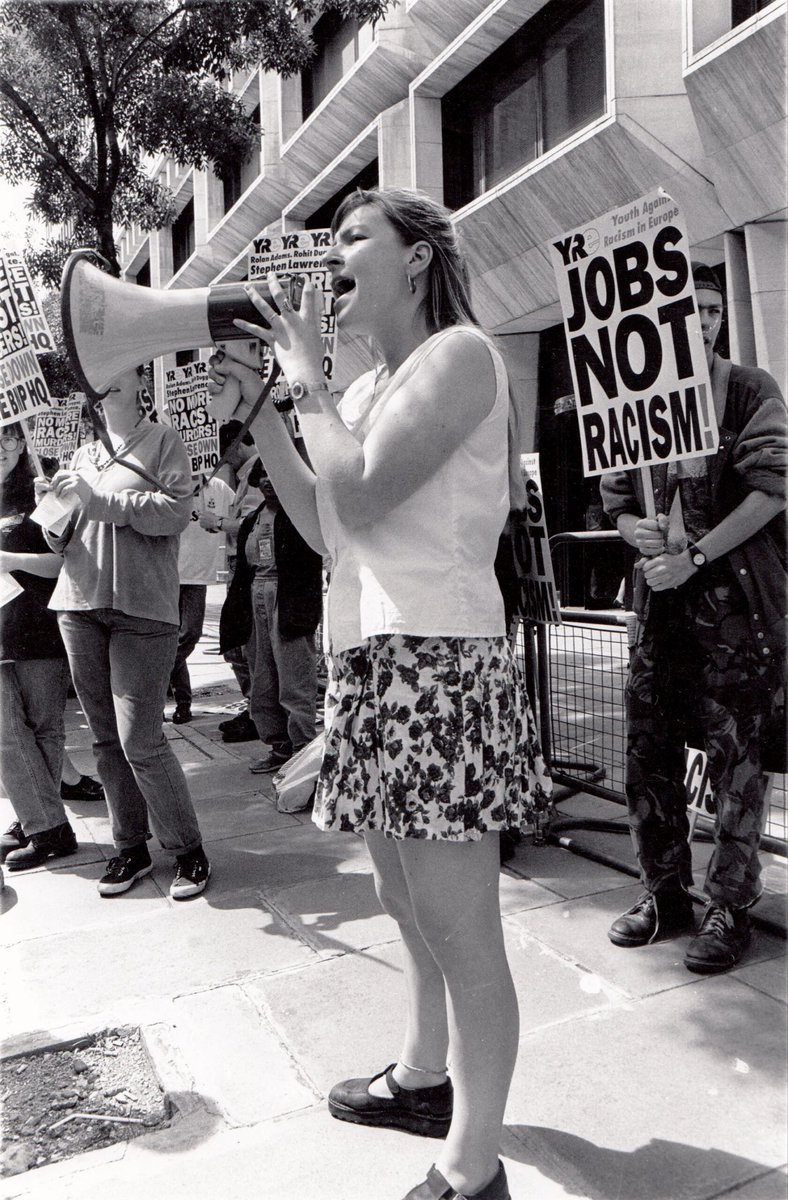
Lois Austin on a YRE lobby of the Home Office, 1993. Pic: Tim Bolwell
Hemingway interrupts again to ask Austin if the Youth Against Racism in Europe logo of a fist smashing a swastika was violent, noting that more recently it’s just a swastika going in a bin. There is laughter from the public gallery, and Austin seems a tad surprised that she has to explain that the fist is symbolic.
A spycop report of 9 November 1993 [UCPI0000033071] talks about an event called ‘Smash the Nazis’ organised by Austin. Hemingway asks if this was a sign that she was violent. Austin once again points out that there is no evidence of them ever attacking anyone. She explains, again, that YRE was a political campaign using petitions, lobbying and marches.
Austin says they would use slogans like ‘smash the BNP’ but this didn’t mean bodily smashing individual BNP members. It certainly wasn’t taken that literally by anyone she ever worked with, and on a practical level such violence would have been counter-productive, discouraging people from joining the campaign.
Hemingway quotes spycop Peter Francis’ witness statement [UCPI0000036012] which says that the YRE used the slogan ‘no platform for fascists’ and that they wanted to ‘hit the BNP’ whenever they could. Might this, then, be proof at last that YRE was violent?
Austin points out that Francis, despite all his embellishments, gives no evidence of any violence ever occurring with YRE.
She has to explain the concept of ‘no platform’ meaning kicking the fascists out of their headquarters, and banning them from using public premises like libraries for meetings. This is not the same as the tooled-up street fights Hemingway seems so keen to imagine.
‘No platform means that we need to use a political campaign, we need to use the community, the mass, as many people as we can, to ensure that they are not platformed. That’s what we mean by that.’
THE AWAY TEAM
Hemingway asks about the ‘away team’, named in the World in Action documentary as YRE’s secret violent core.

March on the BNP headqquaters, Welling, 1992
Austin explains that it was just a loose term for YRE members who stewarded at meetings and marches to try to ensure safety and prevent people from being attacked by fascists or police. It wasn’t a formal organisation, let alone the clandestine street-fighting squad that the spycops and World in Action describe.
Austin explains that they were asking lots of people to come to demonstrations against the BNP, so they had to take stewarding seriously. Protesters had been hospitalised by fascists and police, so they organised well-disciplined stewarding to defend themselves and keep it as safe as possible.
Stewards would ensure people kept to the agreed route, they would spot fascists up ahead and ensure the two sides didn’t meet. They would also put themselves between police batons and marchers, and prevented some terrible injuries from happening.
Asked again if the away team was a secret self-organised group within Militant Labour, Austin has to explain how they organised as a hierarchical party and that sort of thing would not happen. She reiterates it was an open political campaign.
Austin is challenged on saying the away team was never formalised. We are again shown a spycop report about the 1994 Militant Labour conference (the same one that said they were going to declare themselves bent on overthrowing the state) [MPS-0745874] that says there was a motion passed confirming the official formation for the away team.
Austin says there is no evidence any such motion took place. It appears to be yet another spycop fairytale invented to shore up the story of derring-do in the face of danger, created to impress their managers.
Peter Francis says in his witness statement:
‘Part of my deep cover involved convincing my targets that I was interested in the confrontational side against the BNP. We as a group certainly instigated violence with the BNP. I, as part of that group, attacked people. That was the role. The role was agreed with management.’
Austin gives it no credence whatsoever:
‘I don’t think there is any truth in this at all. I am not aware of that at all. We were not involved in pre-emptive attacks. We were involved in lobbies, protests, mass demonstrations, counter protests. If the British National Party were having a protest we would have a counter protest. But we were not involved in pre-emptive attacks.’
Francis also claims that there were ‘dawn raids’ on BNP members by people he spied on, with swastikas painted on houses and dog excrement pushed through letter boxes. However, Francis himself admits he never saw them actually happen. Austin rejects the entire accusation outright too, saying it simply never happened.
BRICK LANE
Austin is asked about an incident where the BNP were on the streets in the notably multicultural Brick Lane on 19 September 1993, three days after the BNP had a councillor elected. She can’t remember if Peter Francis was there.
We are shown another clip from World In Action, shot on the day. There are Anti-Nazi League banners and Austin is visible as part of the static protest behind railings, in a police-approved pen on the opposite side of the road from the fascists.
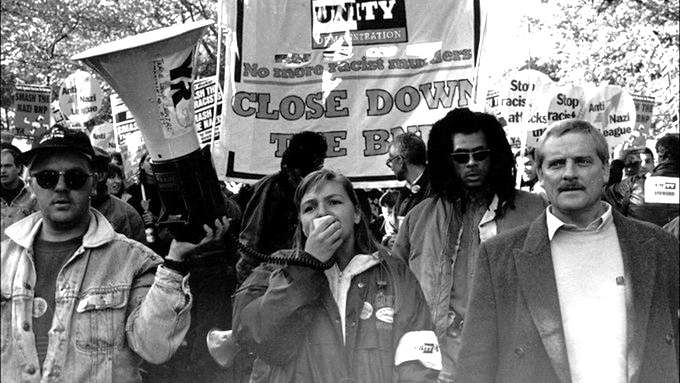
Lois Austin leading the chants on a Close Down the BNP protest
The World in Action voiceover refers to it as the sinister ‘away team under the ANL banner’. A group of anti-fascists were mistaken for fascists by police and guided across to the BNP side of the road, where they chased the fascists away.
Austin accepts that the group who rushed the BNP paper sellers included YRE stewards. She says she had no knowledge of any premeditated plan to rush the BNP. She puts it in proportion, pointing out that worse goes off at West Ham matches on a Saturday, never mind the horrendous racist attacks of the time.
Hemingway brings her back to the point, that this was surely a confrontational attack. Austin doesn’t disagree, but sets it in terms of self-defence. Again, the footage is at odds with the commentary. There is no evidence of a secret violent group in YRE, and chasing fascists down the street is hardly riotous disorder.
Peter Francis claims that the YRE had ‘an appetite for violence’. Austin rejects that entirely. It was a mass organisation made up of trade unionists and teenagers. There was no public disorder at the vast majority of events they were involved in. The spycops can’t see it as anything other than a small, violent group when it was actually neither.
Austin says YRE always had pre-event negotiations with the police. For every single event, including small matters like lobbying of the council, they always got permission.
THE EARL’S COURT ATTACK
The Inquiry then turned to a genuinely horrific incident at Earl’s Court tube station on 15 January 1994.
Neo-Nazi band Blood and Honour were due to play a gig in a pub in Becontree, East London. There was an anti-fascist protest to try to stop the gig. Austin thinks they contacted police about it in advance.
As she was approaching the location, a van of riot police drove alongside at walking pace with its side door open. An officer called out to Austin by name, saying ‘we know all about you’.
‘I was targeted by the police on that day. And my question again for the Inquiry, which needs investigating, is what role did undercover police officers play in trying to create an image that I was a violent person that needed to be contained, which was just not true?
What role did they play in setting all of that up? And what did undercover police officers say to the uniformed police and the riot police on that day that meant that I was targeted?’
Asked how they intended to prevent the gig, Austin explains that they would have liked the antifascists to have has sufficient numbers to prevent the gig, although in the event it was cancelled anyway.
The police surrounded the protesters and told them were not allowed to leave. The spycop report [UCPI0000029708] says the police told the group that the police had laid on a special train to take them to Bow Road where there was a fight going on with fascists, and that Austin ‘rather naively’ accepted the offer.
Austin angrily dismisses this ludicrous fiction:
‘They said, “you can only get out of this area by getting on this train. There is no other way we are going to let you go. You can only get out of this area by getting on this train, and you are going to Victoria and you can disperse from Victoria.” That’s what was said.’
The train went non-stop through 22 stations, and people were very nervous. It was very packed. On arrival at Victoria, the doors weren’t opened. They could see ordinary passengers outside, and several people were banging on the window trying to let people know that they were trapped inside the train.
After a while, the train went on to Earl’s Court. On arrival, the doors opened and there was relief because people believed they were going home. They were very wrong indeed.
There were riot police on all platforms and escalators. It was a trap. Austin remembers an officer seeming to recognise her and grinning.
At the top of the escalators, they found the gates out of the station had been closed and the general public had been cleared out. A great mass of police were hitting people on their heads with batons. A gang of them rushed towards Austin and beat her to the floor. While they were kicking her, they were shouting insults:
‘They were battering me, booting me and kicking me and whacking me with truncheons, and while they were doing it they were calling me a fucking cunt, a fucking slag, calling me the worst misogynistic, sexist abusive names you could possibly imagine.’
The gates were opened, and Austin was among the protesters who managed to run out onto road. They turned round to see the gates being shut and police batoning those still inside.
Shortly after, the gates were opened again and the police charged out. Austin was battered on the top of her head. She was left with a large wound and blood streaming down her face.
She feels she was personally targeted. The signs all points towards it. The earlier intimidation of ‘we know who you are’, the grin on the escalator, the number of officers who made a beeline for her as she got to the top, and the fact that Dan Gillman (who gave evidence to the Inquiry on the same day as Austin) was assigned to her that day as a steward to protect her but was arrested just before she was attacked.
Austin wasn’t doing anything to draw attention to herself at all. She was targeted as organiser of these antifascist protests.
‘Again, that’s political policing. That is outrageous in a democratic society. Why are we not allowed to protest without being in fear of our lives in terms of police brutality?’
Hemingway inevitably asks if the protesters were being violent towards the police. Austin says not at all, and recounts the sickening violence by the police against them. She is impassioned, and visibly upset recalling her trauma from the experience.
There is no doubt that the attack at Earl’s Court was planned well in advance. To have had so many officers ready and kitted out in riot gear, to have a dedicated tube train ready and waiting, to clear the station and close it to the public, all must have taken a great deal of preparation, under instructions from high up.
RISKING KILLING – AGAIN
Austin was one of about 30 people who needed hospital treatment. The nurse who attended to her said ‘why are they hitting you on the head, do they not know they’ll kill somebody doing that?’
Kevin Gately in Red Lion Square, London, 15 June 1974
It was no exaggeration, but a very real and present risk. Metropolitan Police blows to the head have killed many people in the past, including anti-fascist protesters.
Kevin Gately was a 20 year old student protesting against the National Front in Red Lion Square on 15 June 1974. At 6’ 9” tall, his head was well above the level of the crowd when mounted police charged through, batoning anyone they could reach. He died of a brain haemorrhage.
33 year old teacher Blair Peach was killed when police hit him over the head with an unauthorised weapon at an anti-fascist protest in Southall on 24 April 1979.
Barely a year after police attacked Austin and the YRE protesters at Earl’s Court, on 3 May 1995 police stopped Brian Douglas in Clapham. Although walking backwards away from the officers with empty hands, they hit him on the head with one of the Met’s then-new long acrylic batons. He died of a massive brain haemorrhage.
The officer who killed him lied to the inquest, saying he’d merely hit Douglas’s shoulder. Douglas’s loved ones campaigned for justice, for which they were spied on by Peter Francis.
No police officer was ever charged for any of these killings.
In the aftermath of the Earl’s Court attack, the spycop report of 18 January 1994 [UCPI0000029708] mildly describes the violence as nobody’s fault, and praises the police for setting up the situation:
‘There was some confrontation with police at Earl’s Court station, and at least seven members of the group, including Lois AUSTIN, sustained injuries.
The special train ploy to remove this violent group was brilliantly conceived and executed.’
Austin has never been able to trust the police again.
It’s incredible that the Inquiry regards chasing fascists down the street one time as violence while ignoring the premeditated attacks by police.
Imagine if YRE had tooled up with batons and armoured clothing, locked a load of police in an enclosed space and battered their heads, leaving dozens hospitalised. The name of the incident would still be general knowledge all these years later.
The attack did not become legal just because it was committed by police officers. Criminal prosecutions should have followed. But because police were perpetrators it’s just accepted, nobody hears about it. Nobody is held to account and we just move on.
Austin brought a civil claim against the police for it, and received a settlement.
PERPETUAL SPYING
As a person of interest, Austin continued to be subjected to intrusive personal reporting by spycops that had no policing value at all. The fact of being spied on in the past meant you were going to be spied on in future.
A spycops report of 1 October 1996 [MPS-0246670] gives details of Austin moving house. It says she is ‘always moving house’. She points out she was a young woman living alone at the time and a group of men were secretly keeping tabs on where she was living:
‘If I had known about this at the time, I would have been frightened.’
A further spycops report of 26 November 1996 [MPS-0246858] describes Austin attending protests around the country, including an anti-deportation protest in Manchester and a memorial event for Ken Saro-Wiwa, a West African campaigner against Shell’s environmental devastation in the Niger delta.
We’re shown a spycops authorisation for HN104 Carlo Soracchi ‘Carlo Neri’, deployed 2000-2006, [MPS-0069948] which says that the Special Branch ‘Red Desk’ is asking for more information about Lois Austin.
The Inquiry then showed a document from Operation Herne, the police’s internal investigation into spycops [MPS-0721975]. Officer HN73 said that comprehensive reports on people would be commissioned on individuals once they had come to be ‘of interest’, often at the behest of MI5. Austin notes that many of these reports are stamped ‘Box 500’, meaning copies had been given to MI5.
EXIT THE SPYCOP

Brian Douglas, killed by police in 1995. Peter Francis spied on the campaign for justice.
Austin is asked about when spycop officer Peter Francis was nearing the end of his infiltration and money was raised for him by the Hackney branch of Militant Labour, where he had risen to the post of secretary.
As was standard for spycops, he feigned a mental breakdown to provide him with a credible excuse to vanish from everyone’s lives.
And, as was also standard, this lie caused a great deal of worry among the friends he’d spent years cultivating friendships with.
Francis claims in a spycop report that he sold all his furniture at a car boot sale and gave the proceeds to Militant Labour. Austin doesn’t think that’s true. Her recollection is that people visiting his flat noticed how sparse it was, felt sorry for him and had a collection among themselves to give him money.
Hemingway asks Austin if Francis failing to overtly have sex with members of Militant Labour led her to suspect he might be a state agent.
‘That is ridiculous. The idea that I or anybody else in the leadership of Youth Against Racism in Europe and Militant knew about the sex lives and who was having sex with who is ridiculous. I mean we are a very, very working class organisation, full of ordinary people in trade unions and things like that.
I have seen reports about the “wearies” being promiscuous, and all of that. The undercovers have said that, and if you weren’t having lots of sex then your cover would be blown. That’s absolute and utter nonsense.
I would not have even known if he was having sex, or who he was or wasn’t having sex with, and it wouldn’t have interested me in the slightest. It does interest me if he was an undercover officer infiltrating our organisation and deceiving women into intimate sexual relationships. That’s abuse.’
Austin says Francis has done real public service by becoming a whistleblower, and for that she is grateful. But she says we cannot allow his claims that YRE were violent and looking for trouble to go unanswered.
That’s the last question for Austin. She will be back to answer questions about events on May Day 2001 where she was spied on by HN104 Carlo Soracchi and brought another civil claim against the Met. This will be dealt with in the Tranche 3 Phase 2 hearings scheduled to be held February-March 2026.
Austin returned to the Inquiry to give more evidence on 26 February 2026, this time concerning her legal action against the police for maltreatment, and the fact that spycop HN104 Carlo Soracchi was briefing the police’s legal defence team about it.