
UCPI Daily Report, 26 Feb 2026: Lois Austin evidence
Tranche 3 Phase 2, Day 10
26 February 2026

Lois Austin giving evidence to the Undercover Policing Inquiry, 26 February 2026
On Thursday 26 February 2026, Lois Austin returned to the Undercover Policing Inquiry (UCPI). We already heard evidence from Austin on 13 November 2025, about the spying on her and the groups she was involved in (the Socialist Party and Youth Against Racism in Europe) by undercover police officer HN43 Peter Francis ‘Pete Black’.
Austin has since seen further disclosure of evidence about another undercover police officer, HN104 Carlo Soracchi ‘Carlo Neri’, who was deployed from 2000 to 2005, infiltrating socialist and antifascist groups in London. She has therefore produced a second witness statement, and is being called back to give evidence about that.

Spycop Carlo Soracchi
The UCPI is an independent, judge-led inquiry into undercover policing in England and Wales.
Its main focus is the activity of two units who deployed long-term undercover officers into a variety of political groups: the Special Demonstration Squad (SDS, 1968-2008) and the National Public Order Intelligence Unit (NPOIU, 1999-2011).
Spycops from these units lived as activists for years at a time, spying on more than 1,000 groups.
Austin’s evidence was given as part of the UCPI’s ‘Tranche 3 Phase 2’ hearings, examining the final 15 years of the Special Demonstration Squad (1993-2008).
She has produced a written witness statement for the Inquiry [UCPI0000037774] however at time of writing (four months after she gave her evidence) it has not yet been published online.
Austin was questioned by Sarah Hemingway, as First Junior Counsel to the Inquiry.
MAYDAY 2001
Austin began by describing the protest in London on 1 May 2001. The protest was just one of many annual Mayday demonstrations that happen throughout the world every year. Austin explained:
‘The trade unions in London have a regional May Day demonstration every year… I am a trade unionist, I am a socialist, I attend, along with comrades, friends, family.’
On 30 April 2001, the night before the Mayday protest, Soracchi filed a report [MPS-0005795] about antifascist group of No Platform alleging that:
‘Should the opportunity present itself for an attack on property or the police then they will take part.’
Austin explains that this is a wild exaggeration of the kind we see over and over again in SDS reports:
‘It is absolute rubbish and nonsense. What we were doing on that day was about politics. It was a political intervention…
So it’s not reliable. No, it’s not reliable pre-event intelligence’
Around 20-30 Socialist Party members joined the protest, to give out flyers and sell newspapers. They stayed together as the protest went down Regent Street and reached the Nike shop at Oxford Circus.
Austin takes up the story:
‘So we arrived at Oxford Circus probably just before 2.00 pm…
There were lots of police around. Lots of protesters. Very peaceful, carnival atmosphere, people with musical instruments. I was outside Nike Town, I think, giving out leaflets about child labour and the fact that Nike use child labour in the Third World.’
At around 2pm, 6,000 police officers moved in and surrounded the crowd. About 3,000 people, including Austin, were held there, penned in by police, for seven and a half hours.
People were tightly packed, there was no water, food or toilets provided, and there was a level of distress in the crowd. No one was allowed to leave until 9:30pm.
This was the first time the Met used this now-common tactic, known as ‘kettling’. It caused outrage not only among those invovled but among civil rights groups too.
‘Q. You didn’t see any incidents of violence, did you, while you were in that cordon?
A. No, I didn’t. What I saw was people tired, frustrated. People with medical conditions like diabetes, you know, we had a couple of young women with us who were on their period. There were no toilet facilities.’
Spycop Carlo Soracchi, who infiltrate the Socialist Party and associated groups, was also in the crowd that day with Austin and around two dozen other Socialist Party members. He was held inside the kettle along with everyone else.
Austin describes how the police cordon closed in on the crowd, which she felt was both dangerous and reckless.
‘At a certain point they tightened the cordon, and the normal uniformed police officers stepped back and then rows and rows of riot police move in and they tighten and tighten the cordon.
I can remember saying to the police near me at the time, “Why are you tightening the cordon? Why are you doing that? That is dangerous, are you attempting to create a crush? Because people are getting frightened. You are creating a crush”.
As it is, we are already quite tightly packed into Oxford Circus’
Austin had a baby in creche that day, less than one year old. She was breast feeding and needed to get back to collect her child. She explained this to police but they refused to let her leave.
‘I was scared and frightened. I was frightened when they tightened the cordon.
I was upset when they wouldn’t let me leave to collect my daughter and I got really scared when it got dark and we were getting hardly or no announcements from the police about what was going on’
THE OXFORD CIRCUS KETTLING CASE
In 2005 Austin brought a civil claim against the Metropolitan Police over their use of the ‘kettle’ that day.

Police kettling Mayday protesters at Oxford Circus, 1 May 2001 (pic: Brian David Stevens)
She was represented by barrister Kier Starmer, among others, and hers was the first of a potential 150 claims for false imprisonment brought by people unlawfully detained by police at Oxford Circus on 1 May 2001.
We now know that Soracchi was tasked with briefing the legal team representing the Met in that case, giving insider information about the police’s legal opponents..
Documents have emerged in this Inquiry which reveal that Soracchi met with John Beggs, the lead barrister representing the Met, the night before Austin was cross examined.
Soracchi was still deployed in 2005. We were shown an authorisation [MPS-0526804] which stated that his deployment was for the prevention and detection of the crime or public disorder.
Yet this was a civil claim, not to do with crime. Furthermore, it had nothing to do with dosorder, Austin and the others had acted entirely lawfully, it was the Met who didn’t.
Soracchi’s authorisation says that he was tasked with infiltrating antifascist groups No Platform and Antifa. Counsel asks if there was crossover between them and the Socialist Party.
Austin points out that she has given evidence on this before, and that she doesn’t know what else he was doing:
‘I just thought he was an ordinary member of the Socialist Party.’
There is no sign of any SDS reports by Carlo Soracchi about the legal briefing he gave to Beggs, however there are bullet points in an internal SDS document about it, and a later authorisation document for Soracchi (using his code name ‘Craggy Island’) mentions that he was able to provide briefings in a civil case to legal counsel, noting:
‘Undercover officer Craggy Island’s intelligence and assessment for MPS counsel in relation to the recent May Day action was of significant value.’
Evidence of what was said in that briefing can be found in the notes made by officers who interviewed Soracchi in 2013 for Operation Herne, the Met’s investigation in to spycops [MPS-0726931, MPS-0738088].
Two different officers took notes of Soracchi’s description of the meeting with Beggs and record it as follows:
‘Brief description given of Lois and what would wind her up because of the type of person she was.’
And that Soracchi was:
‘asked to brief… in relation to her character. I know she was a South London girl who could easily get wound up.’
At the trial itself, Austin gave evidence for two days, and she says the cross examination was very hostile. She describes how it was evident from Beggs’ tone that he was trying to discredit her as a witness:
‘The questions I was asked at the start of when I gave evidence about Irish people, I was asked: “There were a lot of Irish people in the Socialist Party contingent, wasn’t there? Your partner is Irish, he was active in politics in, I think, Belfast in the 1990s.”
And I remember asking the question to Mr Beggs: “Are you allowed to ask questions about that? Is that not racist? What are you trying to say about Irish people?”
So that makes me think that maybe that’s the information that Carlo had given Mr Beggs, to say, well, Lois is married to an Irishman, she’s got Irish friends. That may be something that’s going to wind her up.’
Beggs has submitted a witness statement about this incident to the Inquiry [UCPI0000039326] in which he claims that he brought up the presence of Irish people at the Mayday 2001 protest for ‘forensic reasons’, however he does not explain what they were.
Soracchi has also given a statement to the inquiry about the briefing he gave to Beggs [UCPI0000035550] but a large section is redacted.
INSIDE INFORMATION
Irrespective of what the briefings and meeting involved, there was a police spy in a group that was involved in legal action against the police. This is exactly the situation that scandalised the nation when it was revealed that police had done this to the family of murdered teenager Stephen Lawrence, an outrage that forced the Home Secretary to set up the Undercover Policing Inquiry.
Beggs has told the Inquiry that he remembers being briefed by Soracchi. He describes being provided with written briefings about Lois by the SDS, and says he didn’t want to rely on them for his cross examination because they were untested.
‘[the briefings] seemed to portray Lois Austin as some kind of wild radical, possibly involved in very serious matters.
I was asked whether I wanted to meet with the undercover officer. I said yes because (as stated) I was sceptical about the written briefings.’
We are told by Counsel that these briefings may have been produced by Soracchi’s managers at the time, HN58 or HN36 Michael Dell. Beggs goes on to conclude that the briefings were unfair and inaccurate, saying:
‘I remember contrasting the hyperbole of the written briefings with the mundanity of his [Soracchi’s] direct oral briefing to me.’
However Austin disputes this:
‘I think this is Mr Beggs trying to cover his tracks… is it lawful or is it misconduct?
If it is not unlawful, is it misconduct for a barrister to meet an undercover informant, or undercover police officer, the night before a trial and -’
Hemingway cuts Austin off:
‘I don’t think that is something we can comment on this morning.’
It is important to remember that Soracchi’s account of the meeting is that he was specifically asked by Beggs to give information about what would ‘wind her up’.
Austin describes her experience in court on the second day:
‘A lot of the cross-examination was about violence, whether I was violent and about violence generally…
Carlo knew that I wasn’t a violent person and Carlo admits it here, says it here, that Lois was not a violent person.
So the Metropolitan Police… have been told by one of their sources that I am not a violent person, why was I cross-examined… so vigorously by Mr Beggs about violence and whether or not I was a violent person?…
Not only did Carlo know that I wasn’t a violent person… he knew that I had a baby…
I can’t imagine that he was in that kettle for seven and a half hours and at no point had spoken to his handlers.’
Again, Counsel interrupts Austin to shut her down, saying that uniformed police wouldn’t have been able to know whether she was lying about having a baby and insisting:
‘We are not going to back and re-litigate and we are not going to look at the reasoning of the judge here.’
This seems unnecessarily hostile, particularly given the questions Counsel went on to ask.
Counsel takes us to Beggs’ second witness statement [UCPI0000039591] in which he says that he believed Austin and other witnesses were going to perjure themselves by denying membership of the Socialist Party.
Counsel then seems to re-ask many of Beggs’ cross examination questions, seeking to establish whether or not witnesses to the Mayday 2001 civil case were secretly members of the Socialist Party, and very much giving the impression that she does actually want to re-litigate the case.
At the trial in 2005, Beggs was working for the police alongside George Thomas KC. He has given a statement to the Undercover Policing Inquiry [UCPI0000039464], saying:
‘Mr Beggs sets out in stark terms the seriousness of the allegation that witnesses disclaiming any personal involvement with the Socialist Party were in fact members of it…
This was not a case of the defendant seeking to take inappropriate advantage of information learned from a secret source about the other side’s legitimate litigation tactics: the information, if true, indicated serious wrongdoing, and possible illegality.
If it was not true, or could not be proved, it would lead nowhere.’
Counsel recognises that it did, in fact, lead nowhere, and Austin points out that was because it was untrue.
Austin laughs at the idea that she would ever hide her membership of the Socialist Party – she was in the party leadership and stood in elections:
‘I mean the world and his dog knows that I was a member of the Socialist Party!’
ACCUSED OF LYING
She confirms that Beggs did ask her repeatedly about the other witnesses and called her a liar for saying she didn’t know them.
‘I was cross-examined on it and I was asked specifically about names of individuals, and whether or not they were Socialist Party members and whether I knew them. At the time I can remember thinking: why is he asking me about these people that I had never heard of?’
Austin is shown the list of 150 claimants-in-waiting for the Mayday 2001 kettling case. She is asked how many were Socialist Party members and she replies that, including her, there were three.
Asked about the list of the ten witnesses that were called by claimants in the civil case, she says none of them were Socialist Party members except her partner, although one was a friend in the Socialist Alliance.
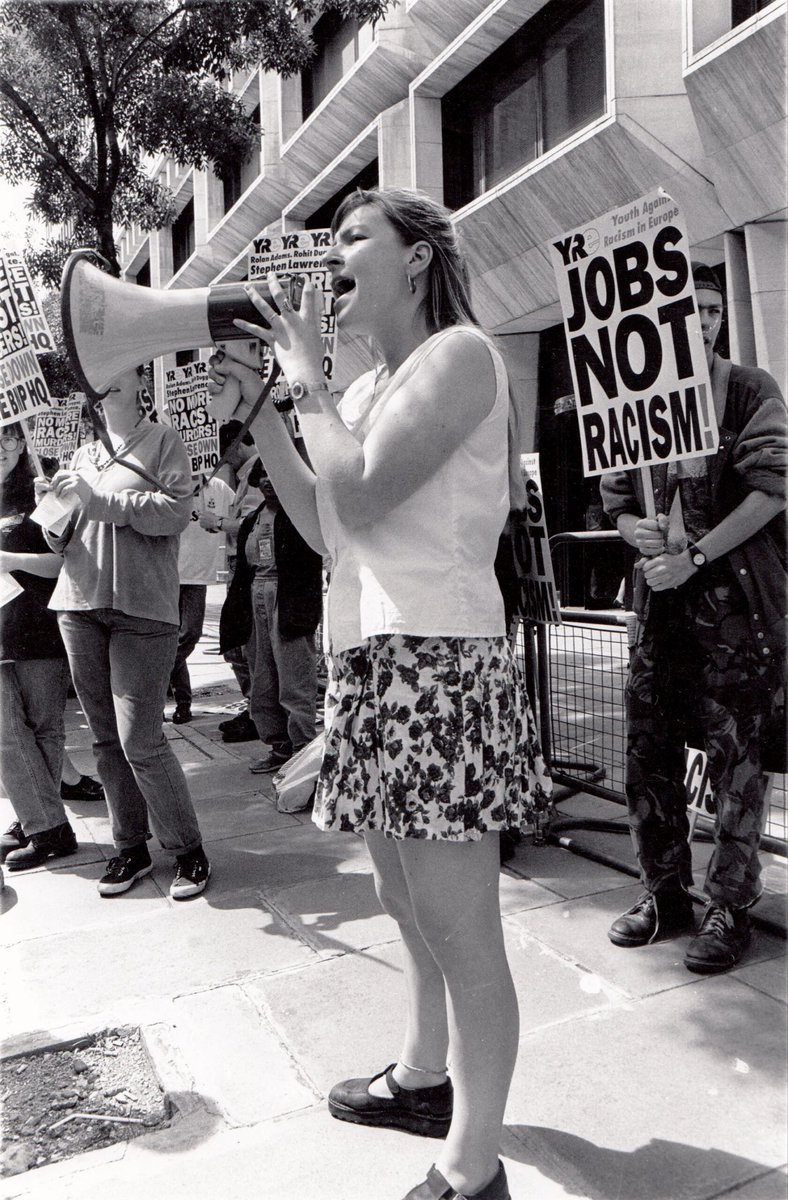
Lois Austin on a Youth Against Racism in europe lobby of the Home Office, 1993. Pic: Tim Bolwell
However, Austin also points out that if the number of Socialist Party members among the witnesses had been twenty rather than two, it would not have made any difference to the legal strategy.
The fact is that the police were using their secret political spies to gain litigation advantage in a civil claim.
Another lawyer who represented the police, whose name is restricted, has made a witness statement saying it was ‘standard practice’ to try and get background information about the other side’s witnesses. They refer to an email from Beggs after the meeting which states that he has acquired some ‘useful general information about the nature of the beast’.
Soracchi claims he did not pass on any information that would be subject to legal professional privilege, i.e. he says he didn’t disclose Austin’s legal strategy. That seems unlikely, and even if it were true, the fact that an undercover officer was briefing the police legal team was never mentioned in disclosure at the time.
Soracchi was not only in a position to know about Austin and what might wind her up. As a member of the Socialist Party at the time who had been there on the day, Soracchi was also contacted as a witness to the 2001 kettling, and invited to be part of Austin’s case.
As Austin says, he had been present in the crowd on the day, and he ought to have had important evidence to give to the court that supported her description of events:
‘Carlo would have been a very good claimant. Because he would have said, “I saw no violence and people were bored and fed up and frustrated and people wanted to go home”.’
Austin makes clear that the Inquiry needs to put it to Soracchi that he knew full well that the things that were said about her during cross-examination were untrue.
While there was a short break in the questioning, Tom Fowler made this video with Donal O’Driscoll of the Undercover Research Group:
DISORDER ORGANISED BY SPYCOPS
During the trial in her civil claim, Austin was cross-examined for hours about violence, including being shown videos of disorder at ‘J18’ protests in June 1999, and Mayday 2000.
She reminds the Inquiry that she wasn’t at either of those events. It is very clear from the evidence heard in this Inquiry, that the SDS officers HN14 Jim Boyling ‘Jim Sutton’ and HN3 ‘Jason Bishop’ played a significant role in organising those events. If there was any crime involved, the spycops had far more to do with it than she did.
That would obviously also have been relevant disclosure to be made in her case, if Beggs wanted to use those events as evidence against her.
‘I feel very upset that I was a young mum, two small children, cross-examined for two days in the most hostile fashion about events that we now know were set up and orchestrated by undercover police officers.
And used as an excuse to contain me for seven, seven and a half, eight hours, in Oxford Circus, no access to the toilet.
I was lactating at the time so I was actually in physical pain and needed to feed my daughter…
[I was told] that I was not credible when I said that there was no violence or I saw no violence, when actually a member of the Metropolitan Police, Carlo Soracchi, who was with me in the containment, also said that he saw no violence. But that was never disclosed to the court.’
Austin further says that she does not accept the claim that police witnesses were not briefed by Soracchi. She points out there were confirmed telephone briefings of witnesses by Beggs after he met with Soracchi, and we are shown another authorisation document which states:
‘The undercover officer Craggy Island has been in a position to provide background briefing to both Metropolitan Police legal advisers and SO12 [Special Branch] senior management in the current May Day 2001 civil case.’
Austin points out that senior management within Special Branch at the time included Detective Chief Inspector Alan Mitchell, who was a police witness during the trial.
It is frankly appalling that a spycops officer was briefing barristers for the Met to help them defend a civil case at all.
Hemingway drew Austin’s attention to the fact that undercover officers were mentioned in Alan Mitchell’s evidence in her case, but Austin explains how that was understood:
‘I would have thought, you know, police that were maybe turning up to the odd meeting in the run-up to the protest…
What I certainly did not consider or think was at all possible in what is supposed to be a democratic society, that undercover officers were deep infiltrators.
That someone like Carlo had actually joined the Socialist Party, was deceiving women either who were members or on the sort of fringes, or friends of members of the Socialist Party into intimate sexual relationships, and that they kept the sort of information on us that they did…
They took leadership positions in the organisations that they infiltrated.’
LOSING THE CASE
The judge ultimately found against Austin in the civil claim. He added that even if he had found in her favour, he would have only awarded nominal compensation of five pounds.
Austin points out that if the judge had been made aware of the role of the SDS in the case, and the intelligence and briefings provided by Soracchi, he may well have taken a different view.
‘I know that you have said we are not talking about the bigger issue about as to whether the containment was lawful or not, but surely knowing what we now know about undercover police officers setting up J18 and the events of May Day 2000, surely we do have to ask the question: was the containment lawful?
Because if Jim Boyling and ‘Jason Bishop’ hadn’t done what they had done, then that was given at the trial as the justification for the seven to eight-hour kettle in Oxford Circus on May Day 2001.’
Austin points out how terrible the ruling was in the civil case.
‘We appealed because the judgment was so bad and so awful… we couldn’t allow the idea that it was completely okay to kettle protesters for hours with no food, no water, no toilet facilities…
Whether or not we thought that we could win an appeal, I think we knew that it was problematic because there had been a big attempt… to criminalise protesters to say that all protesters are violent… but I think we felt that we had no choice.’
We are shown an intelligence report by Soracchi about the civil case [MPS-0043049]which claims that Austin did not give a good ‘performance’ in court and notes that the police were able to discredit her, as well as reporting the intention to appeal.
‘Q. Specifically, how do you feel about that being reported back to the police, given that they were part of the litigation?
A. Well… I mean… I am not a lawyer. But is that allowed?… is it lawful for a police officer?
Q. I can’t answer that question’
Austin is asked how it makes her feel that an undercover officer was used to brief the opposing legal team and that information was not disclosed to her in the civil case:
‘Very upset. Very angry… undercover officers should not be allowed to infiltrate and attempt to subvert democratic organisations like the Socialist Party or trade unions.
The fact that they were all talking about me, gathering evidence on me, I find very, very upsetting…
I have never been arrested. I have never even been cautioned… So the fact that the Metropolitan Police have a huge big file on me, that they are having all sorts of conversations about me that I don’t know about… I think is alarming and it should not happen in a democratic society.
If I have done something wrong, then please, arrest me and bring me before a court and say “We have this big file on Lois Austin, because we think she’s a criminal and we think she’s done all these things that are a breach of the peace or she’s been involved in violent disorder.”
But there is no such evidence and, as I said, I have never been arrested. What’s happened instead is I think I have been the subject of a terrible injustices. I have been beaten, I have been kettled. I have been spied on.
The organisations that I am a member of, which are public organisations, have been infiltrated. And I am very angry and upset about it.’
This was a short hearing, dealing with this one event, and it was over before lunchtime.
The Inquiry’s Chair, Sir John Mitting, thanked Austin for coming back to give evidence for a second time.
After Austin’s questioning ended, Tom Fowler made this video with Austin’s partner Niall Mulholland, and Donal O’Driscoll of the Undercover Research Group: