
UCPI Daily Report, 29 & 30 Jan 2025: HN109 evidence
Tranche 2 Phase 2, Days 43 & 44
29 & 30 January 2025
 INTRODUCTION
HN109 is a former undercover police officer and manager with the Special Demonstration Squad (SDS). He has been granted full anonymity in the Undercover Policing Inquiry, we only have the cipher with which to refer to him.
HN109 gave evidence to the Inquiry on 29 and 30 January 2025 about his role as an SDS manager, a position he held from 1987 to 1990.
Due to the extent of the restriction order covering his identity, his evidence was not broadcast or open to the public. Those who attended the hearings in person were only permitted to hear his voice. Later, transcripts of the hearings were released. In support of this evidence, he had provided a second witness statement which at the time of writing has yet to be released to the public.
He had previously given evidence about his undercover work in the 1970s in the Inquiry’s Tranche 1 (covering the SDS 1968-82). This was done entirely in secret. We have no idea what he said or what his undercover deployment involved.
The Undercover Policing Inquiry (UCPI) is an independent, judge-led inquiry into undercover policing in England and Wales. Its main focus is the activity of two units who deployed long-term undercover officers into a variety of political groups: the Special Demonstration Squad (SDS, 1968-2008) and the National Public Order Intelligence Unit (NPOIU, 1999-2011). Spycops from these units lived as activists for years at a time, spying on more than 1,000 groups.
This hearing was part of the Inquiry’s ‘Tranche 2 Phase 2’, which mainly concentrated on examining the animal rights-focused activities of the SDS from 1983-92. He was questioned by Daisy Monahan, Counsel to the Inquiry.
The Inquiry’s pages for 29 January and 30 January have links to transcripts and many of the documents referred to.
It was two days of questioning, and managers cover a huge range of activity, so this is a long report. You can use the links below to jump to specific sections:
Background
What HN109 did in his police career and SDS roles
Managing the SDS
Recruitment and care of undercovers; theft of dead children’s identities and other tradecraft; visits from senior officers; trusting the spycops
Reporting
Undercovers writing reports with no way to verify; managers’ editing responsibilities; lechery in the reporting; spying on politicians, political parties, trade unions, and police accountability groups; officers contradicting each other; SDS relations with McDonald’s
Safe house meetings
How the spycops compared notes; dominant personalities; sexual and sexist banter; fear of the Inquiry
Debenhams
Spycop Bob Lambert’s involvement in placing timed incendiary devices and visiting his comrades in prison
Arrests, legal professional privilege and violence
Spycops being arrested, breaching lawyer confidentiality, and undermining justice for the wrongfully arrested
Misconduct and sexual relationships
Spycops’ special opportunities for misconduct; the women deceived into relationships by Lambert, Dines and others; HN109’s rollercoaster ride of what he’ll admit, and other officers contradicting his denials
The Scutt affair and the Cabal
The peculiar story of the spycop who fell out with HN109 and disappeared; his discovery; conspiracy with MI5 to ensure the Home Office didn’t find out; the changes to the squad that followed
Background
HN109 became a Detective Inspector for the SDS, its second in command, on 19 October 1987. He served under Chief Inspector HN39 Eric Docker until November 1988 when Docker was replaced by HN51 Martin Gray. Docker had previously been the Detective Inspector for the unit and had just been promoted to the unit head.
HN109 remained at the SDS until 2 April 1990, when he was replaced in turn by HN86. Undercovers who were in the field when he started as a manager were:
- HN10 Robert Lambert ‘Bob Robinson’
- HN95 Stefan Scutt ‘Stefan Wesolowski’
- HN87 ‘John Lipscombe’
- HN5 John Dines ‘John Barker’
He was also present for the deployment of HN25 ‘Kevin Douglas’, HN90 ‘Mark Kerry’, and HN122 ‘Neil Richardson’. He was also there when HN56 ‘Alan Nicholson’ was recruited.
As a result, he was present for events such as the Scutt affair and Dines’ targeting of Helen Steel and their subsequent long-term intimate relationship.
CAREER
HN109 joined the Metropolitan Police in the 1960s and transferred to Special Branch after five years, serving as an SDS undercover in the 1970s. Afterwards he was on various Special Branch squads including C Squad, which gathered intelligence on left-wing groups and was, along with MI5, the main recipient of SDS reports.
Though the reports were sanitised he was able to recognise which ones came from the SDS due to his experience. However, he said that there was no gossip or rumour about the existence of the SDS while he was on C Squad. They received the intelligence, and that was that; they were never questioned.
Some time after his time on the SDS, he moved to the Metropolitan Police’s Public Order Branch (then called TO20, but which previously had been A8 department). This branch was a key recipient of intelligence and threat assessments from C Squad, and because of his time in that squad, he understood how the assessments were created and the extent to which they were reliable or speculative.
HN109 states that SDS intelligence was an important component of those assessments, albeit forming less than 50% of them, but there was no question that it helped form an accurate threat assessment.
The reason SDS intelligence was more valuable than other forms was ‘because it was almost at source, if not at sources’, so easier to assess its quality than, say, a leaflet discovered by a local police commander. HN109 believed SDS intelligence was more reliable than intelligence from other sources.
Managing the SDS
GETTING RECRUITED TO THE SDS AS A MANAGER
According to his recollection, his recruitment to the SDS manager position was done informally – he was approached out of the blue by a senior officer who asked him if he wanted the role, and that they knew he had previously been undercover.
Counsel to the Inquiry pointed out a briefing note [MPS-076287] where Chief Superintendent Raymond Parker, the head of S Squad (under which the SDS sat at that time), was of the opinion that HN109 was:
‘The one man who could properly play the poacher turned gamekeeper role.’
HN109 didn’t recall this comment at the time, but on reflection, he thought it meant that ‘maybe things weren’t right on the SDS’. However, he was definite that this was not an impression he had been given at the time.
Counsel to the Inquiry noted that HN109 was considered a disciplinarian and a stickler for the rules within Special Branch. The former officer did not recall the point ever being raised with him, but conceded that he had an appetite for supervision and sticking to the rules and regulations.
He says he was happy to have been selected, as it may have shown additional confidence in his abilities. However, he says he did not see the SDS as an elite squad. It was rather that someone had recognised he had ‘the awareness and the ability to maintain [the] security’ that surrounded the SDS.
In general, he does not like the word elite being applied to the SDS and stepped away from it when it was brought up at other times.
There was no formal training for his managerial role. He notes that:
‘there was also a degree of similarity from when I was an undercover officer.’
However, his boss Eric Docker was careful to share his knowledge, albeit on an informal basis, and in an ad hoc, piecemeal fashion. He and Docker shared an office at Vincent Square, overheard each other’s phone calls, and discussed matters as they arose. This office was known as ‘the front office’ of the SDS, as opposed to the ‘back office’ where the administration sergeants and undercovers in training spent their time.
He thinks Docker would have given him a rundown on the squad as it was then and the different roles each of the staff had.

HN109’s boss Eric Docker giving evidence at the Undercover Policing Inquiry, 28 January 2025
Docker was also aware that HN109 had previously been undercover, and trusted him to be able to get on with the job because of this experience. As a result, there was an element of the operational side falling to HN109 while Docker took on the more managerial and administrative aspects.
On managing the unit, HN109 said he respected Docker, who had been in HN109’s new position previously.
Therefore he was more careful than usual in making changes to the conduct of the Detective Inspector role in case it was mistaken as a criticism of the senior officer.
However, he felt that Docker appreciated that HN109’s previous experience as an undercover would bring something to the SDS that had been lacking in management terms. The changes he made were introducing promotion classes and checks on cover accommodation, which were supported by Docker.
His primary responsibility was the day-to-day running of the SDS. This involved dealing with the undercovers themselves and the back office sergeants, while Docker dealt with other matters and liaised with senior officers back at New Scotland Yard.
If an undercover was having difficulty with their operation or needed advice, the idea was that they’d turn to HN109. However, there was no strict demarcation of his and Docker’s roles, and sometimes HN109 would also liaise with senior officers and MI5. For a period, he was also the acting head of the unit. As the senior manager, though, the buck stopped with Docker.
The SDS was less formal than other Special Branch squads in that managers would be spoken to in their real names; it had a more collective, chatty aspect compared to the more formal aspects in the rest of Special Branch.
NO PROBLEMS IN THE SDS
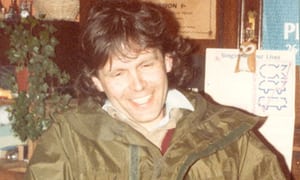
Spycop Bob Lambert deceived women into relationships, committed serious crime, caused miscarriages of justice and stole the identity of a dead child. He was then promoted.
When HN109 joined the SDS, Docker did not raise any areas within the squad that concerned him or problems to be aware of.
HN109 says he was not told that HN10 Bob Lambert, who was still serving at this point, had fathered a child with a woman he spied on. However, he would have expected to have been told about this.
HN109 says he thought Docker was a good colleague, open with him, and wouldn’t have kept such ‘important and crucial information’ from him – HN109 would be disappointed if he had.
It has been acknowledged by Lambert that he had told Docker and HN109’s predecessors that he had fathered a child – known as TBS in the Inquiry – at the time. Lambert’s contemporary HN11 Mike Chitty ‘Mike Blake’ said Lambert bragged about having the child and it was common knowledge in the SDS.
HN109 thought knowing such information was important because it was ‘very relative’ to how an undercover was doing their duty. He also said that all undercovers would have been spoken to about avoiding relationships as it was a breach of regulations:
‘everyone was told that sexual relations while they were working on the SDS was something they should not engage in.’
However, HN109 claims Docker said nothing to him about undercovers engaging in sexual relationships.
RECRUITMENT OF UNDERCOVERS
HN109 agrees with a memo from Docker that Special Branch supervising officers were on the lookout for potential SDS undercovers. The operational secrecy of the SDS meant that a more open recruitment process was not possible, but this spotting of officers was true of Special Branch more generally as well. Often it was based on evaluation of the Annual Quality Review (AQR) reports.
Undercover HN122 ‘Neil Richardson’ and back office sergeant HN29 Dave Carson both reported it was HN109 who recruited them to the unit. HN109, however, does not remember this, and thinks they would have initially been proposed by others since he did not recall knowing them beforehand.
In his statement, HN109 problematised the recruitment process as it meant former undercovers were more likely to propose candidates who conformed to their own self-image:
‘In my view, this approach to recruitment discouraged diversity and potentially introduce issues of patronage and nepotism.’
He does not recall having access to personal files as part of the recruitment process, but they would be privy to more senior officers.
According to his statement, undercovers were recruited because they stood out among a dedicated and talented group of vetted individuals. In cross-examination, he says it was not because they were the best that Special Branch had to offer, but:
‘were good and sufficiently well considered to be recruited into a specialist organisation.’
He agrees that undercovers would have seen being selected for the SDS as a vote of confidence in their abilities, and that they were going into something special (though not ‘elite’).
HN109 said that when undercovers were recruited, managers already had the officer’s target groups for infiltration in mind, which would have been a factor in selection.
HOME VISITS TO UNDERCOVERS
Visits to the home of prospective undercovers were made before they were recruited. A section from a memo written by Docker [MPS-0726998] said the purpose of these home visits was to:
‘view the home surroundings and get a feel of the relationship.’
Asked about this, HN109 said that it was to ascertain if the officer was in a stable, loving relationship and if there was stability in the home generally; a joint mortgage was a good indicator of a settled relationship. HN109 doesn’t recall any specific home visits he did, though HN122 ‘Neil Richardson’ did recall that HN109 and another officer visited his home.
Docker also wrote that:
‘It is essential, in my opinion, that the wife or fiancée understands precisely what effect SDS work will have on her home life, and I need to be assured that the officer concerned has the full backing of his partner in his proposed specialist duties.’
HN109 agreed that Richardson’s recollection of the visit was putting this aspect into practice and that HN109 would have spelled out to him and his wife the strain that would have been put on their marriage.
HN109 agreed that he had appreciated that undercover deployments were difficult for the partners of undercover officers, and it was important to see how the potential undercover’s partner reacted to that information. He also agreed that a negative reaction from a partner would have dissuaded him from recruiting an officer.
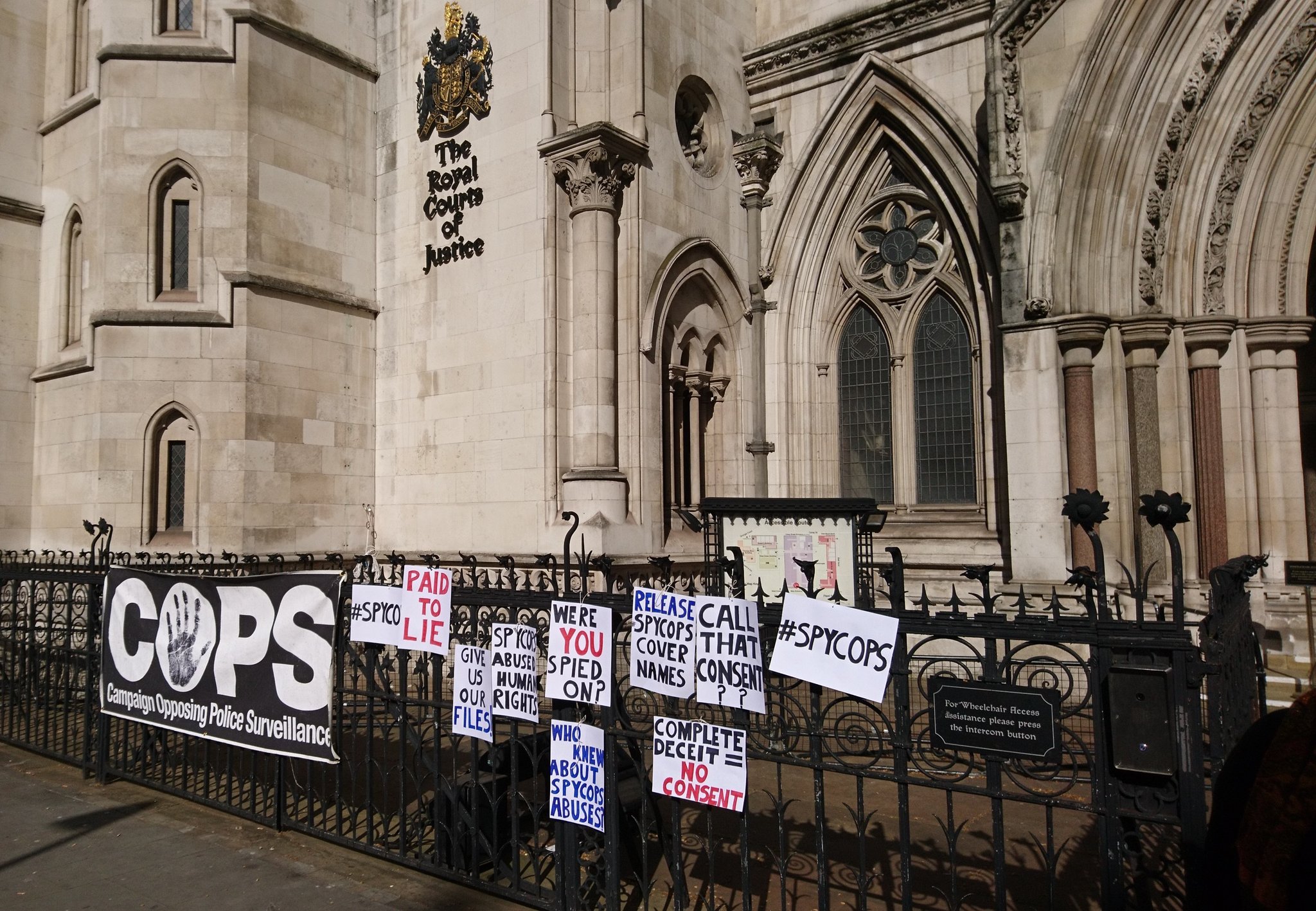
Placards outside the Royal Courts of Justice calling for the truth about spycops
HN109 didn’t recall ever seeing such a negative reaction, but accepted that partners might be on their best behaviour during these visits, so their reaction was not a genuine one.
Docker also wrote that these visits helped establish a liaison between himself and the undercover’s partner, which could be used to clear up ambiguities or difficulties.
HN109 doesn’t recall what support was offered to an undercover officer’s partner and does not recall giving them a number to call in case of issues. Nor does he recall there being any issues caused by a disgruntled partner.
He denied that the purpose of the visits was to stop them getting cross and causing problems for the SDS.
WELFARE OF UNDERCOVERS
HN109 says he did speak to undercovers about their welfare. For him, such stresses would have included the hours they were working, including weekends being disrupted; establishing themselves in their target organisations; and the work they were carrying out.
Living a lie was stressful. They could also not engage with broader police-related social activities. He would have had these discussions with the undercovers who were new to the unit, before any of them entered the field.
He would reassure officers that if there were difficulties, such as threats or risks, they would be looked at. Difficulties would also include stresses in their home life because of arguments about never being at home. HN109 does not recall any undercover coming to confide in him because of issues in their home life.
He encouraged SDS officers to think of themselves as a team, and to see it as a welfare issue where they looked after each other, ensuring that they were thriving, not struggling.
BACK OFFICE SERGEANTS
During HN109’s tenure, these were HN61 Chris Hyde and HN108 Chris Sutcliffe, later succeeded by HN59 John Houchin and HN29 David Carson. They reported to both HN109 and Docker. Their responsibilities included processing the undercovers’ reports and expenses, maintaining a diary of forthcoming events, and also some open-source research. Knowledge of events was a way of keeping track of where an undercover might be.
At that time, most of the undercovers were sergeants, so of the same rank as the back office. HN109 agrees this could have created a sense of parity between back office sergeants and the undercovers.

SDS back office sergeant HN32 Michael Couch giving evidence to the UCPI, 23 January 2025
The back office sergeants did not have a supervisory responsibility for the undercovers, but it was part of their role to be alive to the undercover officer’s welfare. Due to the routine daily phone calls they had more contact with the undercovers, and hence a natural conduit for familiarity, or an easy listening ear.
HN109 agrees with one such back office sergeant, HN32 Michael Couch, that the undercovers would come first to the back office with any worries, and the sergeant would then escalate that to the inspector or chief inspector.
HN109 is asked if undercovers would mention things to the back office sergeants about their undercover work that they wouldn’t say to the manager directly. The example quoted is HN5 John Dines telling the back office he was squatting, which HN109 was not aware of.
HN109 says he would have expected the back office to report that to him if it were significant. He imagined the back office had a sense of responsibility to managers such as himself, but he didn’t explicitly tell the back office to report to him or other managers anything that could be concerning or could cause problems to operational security.
DEAD CHILDREN’S IDENTITIES
HN109 said in his statement to the inquiry that stealing dead children’s identities as the basis of an undercover’s fake persona provided a more secure method than other options. He did not address his mind to whether it was legal and did not seek reassurance from senior managers about its legality.
He guessed that the practice was well known to senior Special Branch management because it had been going on for so long, but couldn’t say specifically that they knew.
He did consider the ethics of this kind of exploitation of tragedy and said he had felt discomfort with it because it was an intrusive way of getting identities. In his statement he said:
‘As there was no expectation that the practice would come to light, only very limited consideration was given to the potential impact on the deceased children’s families.’
He acknowledged the distress of families contacted by the Inquiry but believed:
‘there was sufficient justification for the practice at the time.’
When put to him, HN109 agreed that whether something was right or wrong doesn’t depend on whether or not it became public. And that the police also have a responsibility to comply with moral and ethical mores in private as well as in public.
Beyond that, he’s wrong about the security of the practice. For the first five years of the SDS, officers simply made up names. Since the mid 1990s they have done the same. But for about 20 years after it was made to look suave in the book and film The Day of The Jackal, the SDS stole dead children’s identities, which left them vulnerable to suspicious activists investigating and finding the death certificate. This is exactly what happened, as HN109 knew full well.

Matthew Rayner, who died of leukaemia aged four, and whose identity was stolen by a spycop
In 1976, the fifth officer to steal a dead child’s identity, HN297 Richard Clark ‘Rick Gibson’, had been compromised when presented with his cover identity’s death certificate.
It is raised that there was a programme of action planned around the compromise of Clark, which ought to have caused HN109 to review practices, but he doesn’t think it made him reconsider this one.
HN109 says he is not aware of him or other managers ever considering the risk to the families of dead children of being visited by activists conducting checks on identities. He says that undercovers could opt out of the strategy and that at least one or two officers did so.
Later, he said he would have left it up to an undercover if they stole a dead child’s identity or not, but that the undercover would have needed proof of identity, such as a driving license.
Attention is drawn to HN56 ‘Alan Nicholson’ who joined the back office as a trainee undercover in August 1989, and wrote that HN109 was changing procedures because of issues affecting the unit (likely the Scutt affair), and that Nicholson adopted a fictitious identity, rather than stealing a real one, as a result.
HN109 is unable to shed light on this and disagreed that he was changing procedures. Officers after Nicholson continued to steal dead children’s identities.
Some officers did not just use a dead child’s birth certificate details. They visited the child’s home town to more fully take on their identity.
In his written statement to the Inquiry, HN109 says that undercovers were encouraged to create robust identities which were proof against coincidence, but did not require them to visit the areas referenced in their cover story. However, he says they were justified in undertaking fact-checking and familiarisation visits – and he would have encouraged this.
It was not a specific requirement to check if relatives were still living in the area. HN90 ‘Mark Kerry’ noted that the back office helped out with checks, such as speaking to local special branches to see if the family of the child had come to police notice.
This does not ring any bells with HN109, but he’s not surprised that it might have happened. He does not recall an instance of this but speculates it might have caused a reconsideration of that particular identity.
Asked if he took steps to ensure the investigation of the background of the dead child was only what was necessary in terms of research into their families, he says he does not recall saying anything specifically like that.
HN109 agrees with the Metropolitan Police’s apology regarding the tactic:
‘The Metropolitan Police Service accepts that the managers of the SDS failed to recognise the hurt, distress and anger that the use of DCIs [deceased children’s identities] would cause the families of the children and the public concern that would result if the practice had been revealed…
It also wishes to acknowledge that their distress will have been compounded by the revelation that some SDS officers behaved indefensibly while using their children’s names’
HN109 had not heard that HN5 John Dines had used more than one identity stolen from dead children, and used that second identity, ‘Wayne Cadogan’, when arrested for participation in the 1990 Poll Tax Riot.
HN109 had left the SDS by then but said he ‘was staggered’ when he learned of it. He said he would not have authorised it and would have pursued the issue as the likelihood of any undercover needing a second false identity ‘was minimal’. He cannot think of circumstances under which he’d have permitted it.
Dines said having a second fake identity gave him credibility with the activists he was spying on, and such a tactic was common among them. HN109 disagreed and said he would have liked to know more about that and would have been interested:
‘if the people he was reporting on were going to the extent that he had gone to, to obtain that second ID.’
Undercovers were required to return their cover documents at the end of their deployment.
At the very end of his testimony, HN109’s own barrister, Oliver Sanders KC, asked if he had ever considered the legality of the tactic, to which he replied no, only whether it was ethical. Otherwise, he just continued the practice he had inherited.
COVER EMPLOYMENT
Former manager HN51 Martin Gray said it was preferable to have cover employment which gave officers plausible access to a van. They could then transport activists to demonstrations and overhear conversations.
It’s well established that having a van was so common among spycops that it was effectively standard practice. Activists with reliable vehicles were rare, so it meant the officer would know about any protest where transport was required.

Spycop HN14 Jim Boyling, deployed 1995-2000, with his van
Picking people up and dropping them off gave them the home details of those they spied on. It also made them seem generous and likeable. Several officers chose to drop people off last if they were trying to deceive them into an intimate relationship. This tactic meant they could then stay in the van talking or get invited in.
Additionally, being responsible for the group’s transport gave the spycops something to talk about with activists that didn’t require any political understanding. This last point also applies to them often taking on roles such as treasurer, and DJing.
HN109 clarified that it did not have to be a van, but any vehicle would make them useful; in some cases, a van would make them more useful, but the main thing was having a vehicle. He agreed that a van had the advantage of carrying more people and space for protest items, but also made the point that it might be harder to pick up information in a van than in a smaller vehicle.
COVER ACCOMMODATION
Undercovers were trusted to sort out a place to live for themselves. HN109 wanted to add that they would do so with the assistance of their colleagues. It was expected their colleague would guide them rather than letting the undercover ‘fly solo’.
For HN109, such assistance was a crucial part of the SDS. The need for guidance was so that the accommodation was as self-contained and anonymous as possible, meaning the undercover could come and go freely. They didn’t want the officer’s privacy impeded by cohabiting or living near those who could track their movements.
He did recall that, when he was a new manager, there was close contact between HN25 ‘Kevin Douglas’ and his landlord. It came up almost as an aside, that Douglas had been invited to the christening of the landlord’s child.
This had given rise to two concerns. One was for the officer’s security. The other was HN109’s disappointment that experienced undercovers had not directed Douglas away from forming such a relationship. HN109 expected that such advice would ‘happen almost by osmosis’.
Learning this, HN109 wanted to check out Douglas’s accommodation setup but without being intrusive with other undercovers. There was also the issue of the amount of the unit’s expenses going out on rent, so he also wanted to see rent books more generally. Doing this would give him insight into their cover accommodation situation too.
Douglas says HN109 came round to inspect his accommodation, and the landlord’s family was there. The manager does not recall this, but accepts it’s something he might have done, and that he would have been presented as a colleague from Douglas’s cover employment.
He concluded that Douglas was too close to the landlord’s family and probably said he should move, though he doesn’t recall specifically. Douglas said in his evidence that he was unhappy about the visit, but HN109 does not recall that.
HN109 believes he visited other cover accommodations to avoid singling out Douglas, but not the specifics of which. He notes in his written statement that there must have been a conversation about these visits, as undercover Stefan Scutt complained to Docker about HN109’s proposed checks.
He adds that Scutt was the only officer who made such an adverse comment. However, he accepts, when put to him, that Scutt may have been an unofficial spokesperson for others in this. For HN109, the adverse comment added to a wider concern about Scutt (of which more to come…).
Undercovers thought checks on accommodation were a security risk. HN109 did not agree this was necessarily the case, as it depended on factors such as their cover employment. The undercover would help shape the story for HN109’s visit to minimise risk, and it wouldn’t have been done without Docker’s approval. Later, HN109 notes that all rent books were checked and, as far as he can remember, were fine.
The Inquiry’s questioning did not bring up the issue of HN5 John Dines who was living in a squat, and where the money Dines was given for rent was actually going.
While the Inquiry was focused on the supposed and quite minimal risk to the undercovers, there was no attention paid to the facts that the undercovers were actually resisting their managers conducting oversight, that HN109 would have been well within his rights to do such checks, and even ought to have been doing them as standard.
In many ways, HN109’s evidence around respecting the sensitivity of the undercovers implicitly demonstrates the kid-glove treatment they received and how they were seemingly allowed to do what they wanted as long as they kept writing reports.
It also shows how claims of operational security were used to justify resistance to even the most basic checks by management. And from this, we get further insight into their resistance to the Inquiry process and the excessive demands for anonymity.
HN109 is asked if the situation with HN25’s cover accommodation revealed an issue with the method of expecting undercovers to rely on advice from their colleagues and whether that was adequate oversight. The manager dodges this issue, focusing not on managerial oversight but on that Douglas was let down by the other undercovers, even though the ‘tribal knowledge’ was there.
He does not recall there being advice on how long undercovers should spend at their cover address, but did say it should have been as little as possible as managers would have preferred them to go to their real family homes.
COVER ADDRESS – THE JOHN DINES SQUATTING ISSUE
HN109 was asked about undercovers claiming overtime for spending a night at their cover addresses, but said they couldn’t. He wouldn’t be told formally if an undercover was planning to spend the night at another address while undercover, but it was something he would want to know. Especially, how often it was occurring.
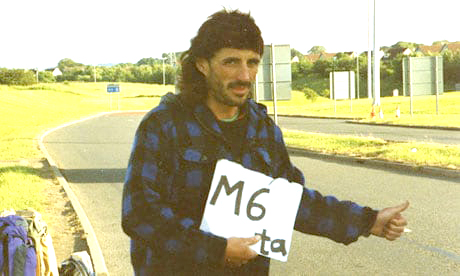
Spycop John Dines whilst undercover as ‘John Barker’
The first point of knowledge about this would probably be the daily phone calls to the back office sergeants. However, HN109 says he didn’t explicitly instruct the sergeants to feed that sort of information back to him.
From September 1988 to March 1990, HN5 John Dines was living in squats while undercover.
N109 says he was aware Dines was squatting but not to that extent. Dines had told managers he had to squat as it was in keeping with his target group, or it was too late at night to return home.
This did not cause HN109 any security concern, or concern that living in proximity to other activists could give rise to sexual activity. What did concern him was Dines’s time away from his real home, but he would have accepted it as part of Dines’ cover provided it was only occasionally.
He presumes that Dines would have maintained his cover accommodation and his rent book would have showed payments for it. HN109 does not recall Dines’ rent book but asserts that all rent books would have been checked and all of them were fine.
Later, towards the end of his evidence, HN109 agrees the main purpose of the twice daily phone calls of the undercovers to the SDS office was to ensure that they were safe. It is pointed out that he didn’t even seek to know nor instruct his back office staff to find out where the undercover spent the night. How then was he ensuring the officers were safe if he didn’t know who they were spending the night with, or where?
HN109 takes a while to understand the point, but accepts it was a blind spot at the time. He says today there’d be electronic solutions for locating an undercover. He says it was something managers had no control over without putting time and effort into following the undercovers, or having some kind of signal when they were at their cover address.
VISITS FROM SENIOR MET OFFICERS
When the spycops scandal broke in 2011, the Metropolitan Police was at pains to say that the SDS was a rogue unit, unknown to rest of the Met. The Inquiry has established that this is a lie. One Commissioner after another visited the SDS at the unit’s safe house to congratulate them on their work.
HN109 has general memories of senior officers meeting the unit, but nothing specific. The SDS team would sit in a circle with the senior officers. Individual undercovers would be asked about their work by the senior officers who had been briefed. Meetings focused on the work itself and the groups targeted. HN109 says it was without much detail and the meetings were ‘fairly short’.
He agreed with Docker that it boosted morale. Which was needed, he says, because the undercovers were doing a difficult job, isolated from their colleagues in the rest of the police, and it showed a recognition of their work. HN109 does not agree with Docker’s assessment that it was a ‘covering one’s arse’ exercise, where if the unit was exposed, Met management could not claim to be completely ignorant of it.
There were more regular visits from the management in Special Branch. The managers of S and C Squads which oversaw the SDS would visit the undercovers almost monthly. These meetings tended to be less formal but it would still be unusual for an undercover to raise an issue at them. Generally, a positive picture of life in the unit was presented but it was also for managers to get a sense of the undercovers and an opportunity to talk to them.
HN109 doesn’t recall there being a visit from a senior manager to boost morale following the Scutt Affair.
TRADECRAFT AND BEHAVIOUR
Though there was no formal training in the SDS, HN109 recalls there being a binder of accumulated information when he joined. However, he says he doesn’t recall looking at it, or even much about it, including what it might have said about sexual relationships.
He wrote up his experiences at the end of his time undercover and thought it would be a thing of good value to do generally, but says he doesn’t recall asking any undercovers to do it when he was a manager. It would have been to ‘add to informal tribal knowledge’.
It was impressed on undercovers when they first arrived at the back office that they were part of a disciplined police force and this was reinforced informally in conversations. If he didn’t think the message had landed, he would have pursued it.
For him it was self-evident that, except for slight exceptions for behaviour in role, policing regulations applied to undercovers – including those around discreditable conduct. Such conduct would include alcohol and drug abuse, sexual relations, assault, abusive language and other crimes.
There would be exceptions in his mind for minor criminality, soft drugs and minor public order offences as needed to maintain a cover.
‘I don’t recall it being spelt out. But I am sure that in general conversation those matters would’ve been fundamental. The officers should and would likely have been aware of them anyway.’
Undercovers were reminded repeatedly to not exercise too much influence on a group, formally or informally (e.g. if they didn’t have a formal position within them, but might do by force of personality). For HN109, the concern around this was not so much to do with a spycop steering a group’s direction:
‘I would’ve been more concerned about the officer becoming over-involved in something that they shouldn’t have done.’
He might have picked up on it in reading reports. He has a recollection of bringing up the issue of being an agent provocateur as something he needed to impress on undercovers, as well as not becoming involved in crime if they could avoid it. He hoped that if there was a likelihood of an undercover being involved in crime then they’d speak to managers first.
Even this seemingly upstanding approach allows the spycops too much latitude. The Home Office directive on the topic [MPS-0727104] was issued in 1969, the year after the SDS was founded. It is clear, emphatic and unequivocal. If the use of any kind of informant might lead to a court being misled, that person should be withdrawn or outed. The SDS just ignored this.
Reporting
HN109 had different levels of trust in undercovers when it came to evaluating their written reports and whether those reports got passed on to the wider Metropolitan Police. He might need to speak to an undercover directly to get a clearer picture about how the intelligence had been obtained and the risks that entailed.
MAKING IT UP
He thought some undercovers might exaggerate information or knowledge; he was asked to write those names down. Later we learned they are HN10 Bob Lambert, HN95 Stefan Scutt and an officer the Inquiry refuses to publicly identify.
In the following day’s evidence, HN109 said that it was not so much that the intelligence was wrong, but it was being elaborated on or there was a degree of theatre to it. On a number of occasions HN109:
‘felt unsure about elements of the information that was coming in.’
He didn’t follow up on this with the officers concerned and cannot say why not, adding:
‘I am now asking myself why not.’
This is at odds with many parts of his evidence where he asserts he would have followed up when something was amiss or missing regarding an undercover’s performance or behaviour. It appears clear that he didn’t think it was a big deal if an officer was exaggerating the information they reported, and it seems that he accepted it as part of the way the SDS functioned.
Counsel challenged HN109 on how he squared his statement that he believed Lambert was providing good, reliable, usable intelligence, with the assertion that he produced exaggerated intelligence. HN109’s response was that the exaggeration was in how he presented the intelligence, as opposed to the intelligence itself. He had no reason to believe the intelligence was wrong.
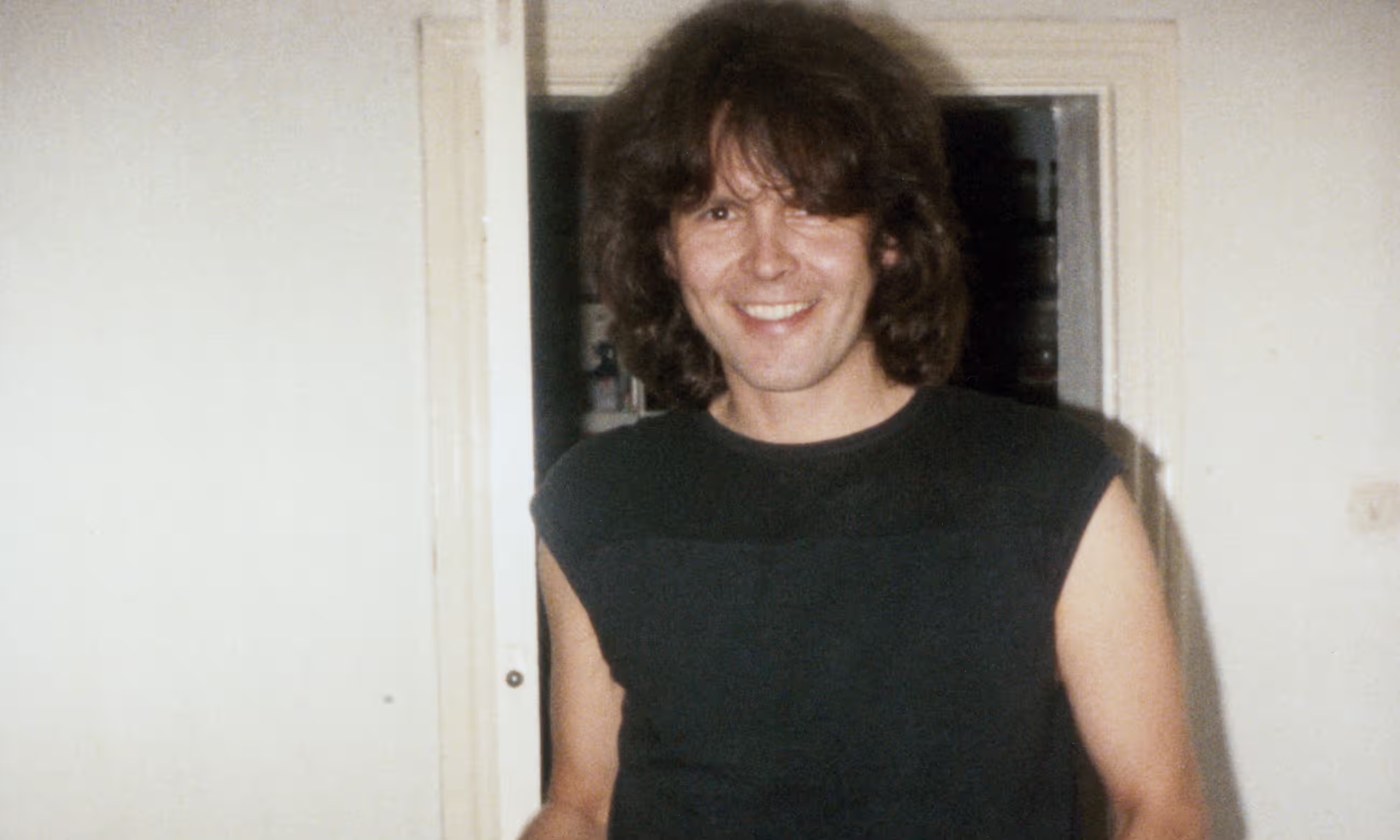
Spycop Bob Lambert whilst undercover, 1987 or 1988
So, despite having rowed to the edge of criticising Lambert’s intelligence over the course of the day, HN109 reversed in order to avoid actually criticising the undercover, despite the obvious facts staring everyone in the face. Not only would criticism be a breach of team loyalty, it would also be criticism of his own management of the unit.
HN25 ‘Kevin Douglas’ said that most of the time undercovers were under pressure to deliver a certain volume and quality of intelligence while deployed. HN109 said that was not the case, as the undercovers could only go as fast as they could. If there was potential disorder somewhere, ‘we would be asking for information and we were asking all of them’. Otherwise, HN109 says they did not apply pressure.
If there was no specific flashpoint event looming, he would expect reports on individuals, organisations and events. There was no particular expectation of a given volume of reports. He also denies HN5 John Dines’ statement that he felt obliged to report intelligence he was aware had little interest or value just to keep their numbers up.
If they noticed a sudden dip in the reporting pattern of an officer they would have talked with the undercover to understand the situation better, but he doesn’t really recall this happening.
HN25 ‘Kevin Douglas’ said he was redeployed from Troops Out Movement to the Irish Freedom Movement in spring 1989, and in dealing with this he came to feel it was not really possible to have a discussion with HN109. For his part, HN109 says that is not a fair comment.
HN109 says that following the Scutt Affair and the examination of the rent books there was an ‘attitude’ towards him, but he understands the undercovers’ point of view:
‘these are good people who are working out there on their own with little communication elsewhere, and I can understand the feeling. So from that perspective I can see that he could make a comment like that.’
MANAGERS EDITING REPORTS
HN109 agrees that the style of reporting from SDS undercovers was close to the Special Branch house style; there was little need to tutor the undercovers on this, albeit there was one who indulged in:
‘over elaboration and flowery language which wasn’t necessary and detracted from the importance of intelligence.’
Any corrections were to do with style rather than substance. Undercovers in training in the back office ‘topping and tailing’ reports would have also become familiar with SDS reporting content and style.
HN109 received undercovers’ draft reports in writing and would sometimes have to review them because they lacked precision or were not convertible into intelligence. He would remove these issues from the draft before it went to be typed. It was purely editorial and he would discuss significant queries with the undercover.
In his written statement to the Inquiry [MPS-0748825], HN109 cites one undercover who he had to frequently edit as they were prone to:
‘overly literary language, judgmental comments and occasional irrelevance.’
It’s unclear if this was the same officer as the one who used ‘flowery language’. As the description fits a significant proportion of spycops reports, it may well not be.
HN109 might combine reports from several undercovers into one where a single event was being discussed, or contrasting views between groups. Sometimes he’d help out the back office with the reports. Overall, only a few ever needed any editorial improvement.
He did not see all the draft reports; many went straight to the back office sergeants. He did see reports once they were typed up, in order to sign them off for distribution. Docker also saw some.
Returning later to the point about judgemental, irrelevant or imprecise language in the handwritten reports, HN109 says he probably would have spoken to the undercover in the first instance. He would have wanted to help the undercovers improve their reporting style ‘every time’. He recalls having to speak to undercovers about this issue.
Counsel then draws his attention to a report [UCPI0000026858] by John Dines in January 1990, on activist Gary Batchelor who had recently admitted himself to a psychiatric hospital. It contains a highly judgemental assessment of Batchelor.
It is signed by HN109’s superior, HN51 Martin Gray, rather than HN109 himself. Counsel asks HN109 to address the appropriateness of the tone. He agrees that there is over-elaboration and a contemptuous tone in places.
He disagrees that it shows a problematic attitude by Dines towards those he is reporting on. Rather, he says it’s unusual, and he is surprised as Dines was precise in his writing. He says that if he’d seen the report at the time he would have pulled Dines up on it.
‘I think I would’ve certainly discussed it with him. And looked at the wording,’
LECHERY IN REPORTING
Following this we were shown a report from June 1988 [MPS-0740559] by HN87 ‘John Lipscombe’ and signed by Docker, on the family life and sexual activity of a 16 year old girl who was an animal rights and anti-apartheid activist.
Firstly, HN109 admits there are no guidelines for reporting on children. In his witness statement, he argued the report was relevant as it highlighted a lack of parental control and her unusual independence and maturity. He says that her animal rights activity makes it legitimate to report even though she’s only 16. The groups she was getting involved in, and that she was trying to establish her own group:
‘would be indications that she could well be getting involved in matters of interest to the police, including disorder.’
He is challenged about the reporting on her sex life and lesbian affairs, which he accepts had no value around subversion or public order. His justification is that they are ‘relevant as far as her character is concerned’. And having a relationship with lesbians would have been unusual at the time.
Pressed on its intelligence value, he expands:
‘well it gives an idea of what her proclivities are, and it may be of interest at a later date. And I think with intelligence, the smallest details are sometimes very important.’
This canard of a justification is one multiple SDS officers have fallen back on, but the Inquiry has yet to tease out an answer on. Not least the question of just what sort of situation would make such information relevant.
He denies it was written for the purposes of titillation, asserting that HN87 ‘John Lipscombe’ wrote accurate reports. HN109 thinks the undercover was reporting a comprehensive picture of ‘this young lady’.
The Inquiry points out that HN87 ‘John Lipscombe’ has admitted to sexual activity while undercover. HN109 says he didn’t know that. The Inquiry says this is a surprising response, given that it was made clear to HN109 when he was given information and asked to make his written statement to the Inquiry (his Rule 9 request).
Asked if such a report ought to have been a red flag about the interest HN78 ‘John Lipscombe’ had in young women, HN109 responds:
‘I would have been more satisfied of that if I’d seen more than one report that indicated that, and I can’t recall that.’
Counsel seemed ready for this, bringing up [MPS-0743663], another report by HN87 ‘John Lipscombe’ and this time signed by HN109, which reports on the attractiveness of a hunt saboteur, including calling her ‘well built’.
HN109 dodges around the obvious implications that Lipscombe is sexually attracted to the subject, but does say ‘the wording doesn’t sound healthy.’ He is unable to say why he did not excise it from the report, limply falling back on ‘norms of the time’, and suggesting that perhaps he hadn’t noticed it.
This undermines his earlier lengthy justification on how he tried to shape the reports. He wants to say he was a good manager, but claims that time and again he didn’t notice deplorable content in his officers’ reports.
It’s pretty clear that he didn’t really care at the time. It seems that sexism and lechery were acceptable and accepted parts of spycops’ behaviour. HN109 had been an SDS undercover in the 1970s and was obviously well aware of the culture of the squad.
Counsel was not finished on this point. We were shown another report [UCPI0000032060], signed off by HN109, which describes a woman as ‘turning to fat’ and as having ‘generally plain unattractive looks.’
HN109 could not say what possible intelligence value this had:
‘It makes me feel uncomfortable looking at it again.’
As before, he would like to think that in hindsight he would excise these statements from the report. The implicit point is that he didn’t.
It is put to him that a woman’s attractiveness was considered an appropriate detail at the time. HN109 pleads that ‘it’s a descriptive’. He accepts it is not a neutral description, but something very subjective.
Counsel notes that Docker said there was probably some sexual banter in the office. HN109 agrees but says he can’t recall specific instances, or whether the attractiveness of women activists was ever the subject of banter.
REPORTING ON THE SWP AND TRADE UNIONS
Attention is drawn to a 1988 report on Socialist Workers Party (SWP) involvement in militant trade union activism [MPS-0740698].

Socialist Workers Party and Militant Labour placards on a march against the poll tax, 1990. Pic: Dave Sinclair
The Inquiry has already established that the SWP was probably the most infiltrated group in the history of the SDS. A significant proportion of officers got involved in their local branches, holding office and actively campaigning.
HN109 says the matters in this particular report don’t sound like subversive activity to him. The report is important, to his mind, because it shows what the SWP would be trying to do with various pressure organisations, their ‘entryism’ trying to turn the organisations extreme. He maintained that though the SWP were not subverting the organisations to their cause, it was still valid.
He can’t recall the SWP actually taking over a campaign, but relied on the fact that they could turn out in numbers. It was this which caused the fear that they could bring disorder to events.
He accepts that the reason for looking at the SWP and their involvement with other organisations was for public order intelligence, and their possible entryism; he disagrees with the positions of other managers that the reason for targeting the SWP was because they tried to hijack campaigns or trade union activity.
He is unable to explain why trade unions have Special Branch Registry Files on them, showing that trade unions were spied on in their own right. His rather weak response was that he could guess that there were individuals within those unions who have been involved in extremism or some form of subversion with the union. He is not able to answer why the unions themselves have a file, not just the individuals.
BLAIR PEACH JUSTICE CAMPAIGN
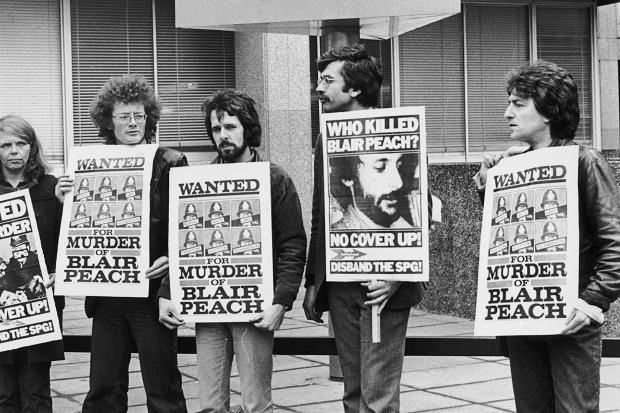
Blair Peach protest
Attention is drawn to a 1988 report from HN25 ‘Kevin Douglas’ [UCPI0000026097] submitting a leaflet on upcoming events to mark the ninth anniversary of Blair Peach being killed by police at an antifascist demonstration.
An internal police report at the time found that Peach had been killed by one of six officers of one of its Special Patrol Group units.
A search of the officers’ lockers found dozens of unauthorised weapons, and a search of one of their homes revealed more weapons and Nazi memorabilia. The report was kept secret for over 30 years before being published in 2010.
In his written statement, HN109 said the leaflet gave two weeks’ notice of the anniversary commemorative event. Given the understandable sensitivities around the anniversary, careful assessment and planning would have been required.
Asked what he meant by ‘understandable sensitivities’ he replies:
‘Blair Peach was killed and there was some suggestion that there was police involvement in that death.’
Counsel to the Inquiry replied ‘more than suggestion I think’ but HN109 failed to acknowledge that point. Instead, he continued:
‘His death attracted a lot of attention from across the left wing. And I think any demonstration in respect of Blair Peach’s death would attract factions which could cause disorder.’
Pressed on the propriety of an undercover officer reporting on a commemoration of a person who was killed by the police, HN109 maintains that it was about the risk of public disorder. He makes this claim despite the fact that there was never any disorder at a Blair Peach commemoration. He accepted that it was fair to say the SDS’ remit to produce intelligence to prevent disorder was paramount, taking precedence over all other considerations.
HACKNEY COMMUNITY DEFENCE ASSOCIATION
HN25 ‘Kevin Douglas’ reported on a 1989 public meeting of the Hackney Community Defence Association with touring Sinn Fein councillors, organised by the Troops Out Movement [UCPI0000023785].
The Inquiry focuses on an address by someone from the Defence Association on police brutality and specifically named officers at Dalston Police Station.
HN25 ‘Kevin Douglas’ calls the speech a tirade and refers to the speaker’s ‘unbounded enmity for the police’. HN109 denies the description is judgemental.
The names of the officers are not given in the report. HN109 says that is not of particular interest as he would not have been able to do anything with them. So if the names are not given nor wanted, there was no intelligence purpose in mentioning that they were named – nor even in being at the meeting at all, given that it was public and lawful.
The Metropolitan Police’s opening statement to Tranche 2 of the Inquiry admitted that reporting on the Hackney Community Defence Association was unnecessary as they did not present any risk of serious public disorder and where not engaged in any criminal or subversive activity.
It admitted that undercovers should not have obtained intelligence on the individuals involved and Special Branch should not have retained the reports, especially since the Home Office had unequivocally criticised this in 1983.
HN109 says he aligns himself with this. But, just as with the sexist reporting, it’s clear that he did not do so at the time and is just trying to make himself appear more reasonable than his own documents show him to be.
KEN LIVINGSTONE

Labour politician Ken Livingstone was spied on by the SDS. He is a core participant tat the Undercover Policing Inquiry
Another report from HN25 ‘Kevin Douglas’ [UCPI0000023802] is on a South London Labour Committee on Ireland public meeting in January 1988, which reports on a speech by Ken Livingstone in support of British withdrawal from Northern Ireland. Livingstone, former leader of the Greater London Council (GLC), was a Labour MP by then.
On being questioned about Livingstone being anti-establishment and having established the GLC Police Committee to monitor the Met police, HN109 denied there being any antipathy within Special Branch towards him.
HN109 says in his written witness statement that Special Branch policy was not to actively report on MPs, but there was no restriction on reporting on their attendance at events.
He justifies the level of detail that the report goes into on what Livingstone said, on the grounds that it was important to Special Branch as it could ‘engender feelings in organisations or individuals that could result in disorder’.
There was no consideration given to its propriety. HN109 says HN25 ‘Kevin Douglas’ simply detailed everything said at the meeting which could be relevant to the work of Special Branch – even though Livingstone had a wider platform already, in Parliament.
HN109’s claim is simply untenable. Numerous MPs were spied on by the SDS, and Jack Straw says his targeting began when he was Home Secretary after he ordered – against the wishes of the Met – a public inquiry into police handling of the racist murder of Stephen Lawrence.
TRESPASS
No consideration was given to the legality of undercovers entering people’s homes. HN109 says he cannot recall if any form of guidance was ever given on this. He tries to justify it by saying that in most cases they would have been invited, ignoring the obvious fact that they were operating under false identities like fraudsters who claim to be reading your gas meter as a pretext for nicking your jewellery.
HN122 ‘Neil Richardson’ said in his written statement and live evidence that he had been invited to do some carpet cleaning at an activist’s home and used the opportunity to collect the names of Revolutionary Communist Party branch members.
He couldn’t remember getting any authorisation but felt sure it happened. He said that because it was gathering intelligence rather than evidence, it was acceptable, and that:
‘Managers did not raise an issue with the way in which this information was obtained.’
HN109 thought at the time it would have been acceptable to him, though now:
‘I would say it was on the threshold for me at the minute, thinking about it.’
It is yet another instance of him showing that he accepted behaviour that he cannot defend.
HELEN STEEL IN TWO PLACES AT ONCE
Counsel to the Inquiry drew HN109’s attention to several reports relating to Helen Steel. She was a London Greenpeace activist, later one of the ‘McLibel Two’.
Bob Lambert had the habit of doing things and then reporting them by saying Steel had done them instead. It gave him things to write about while not appearing to his bosses as an agent provocateur.
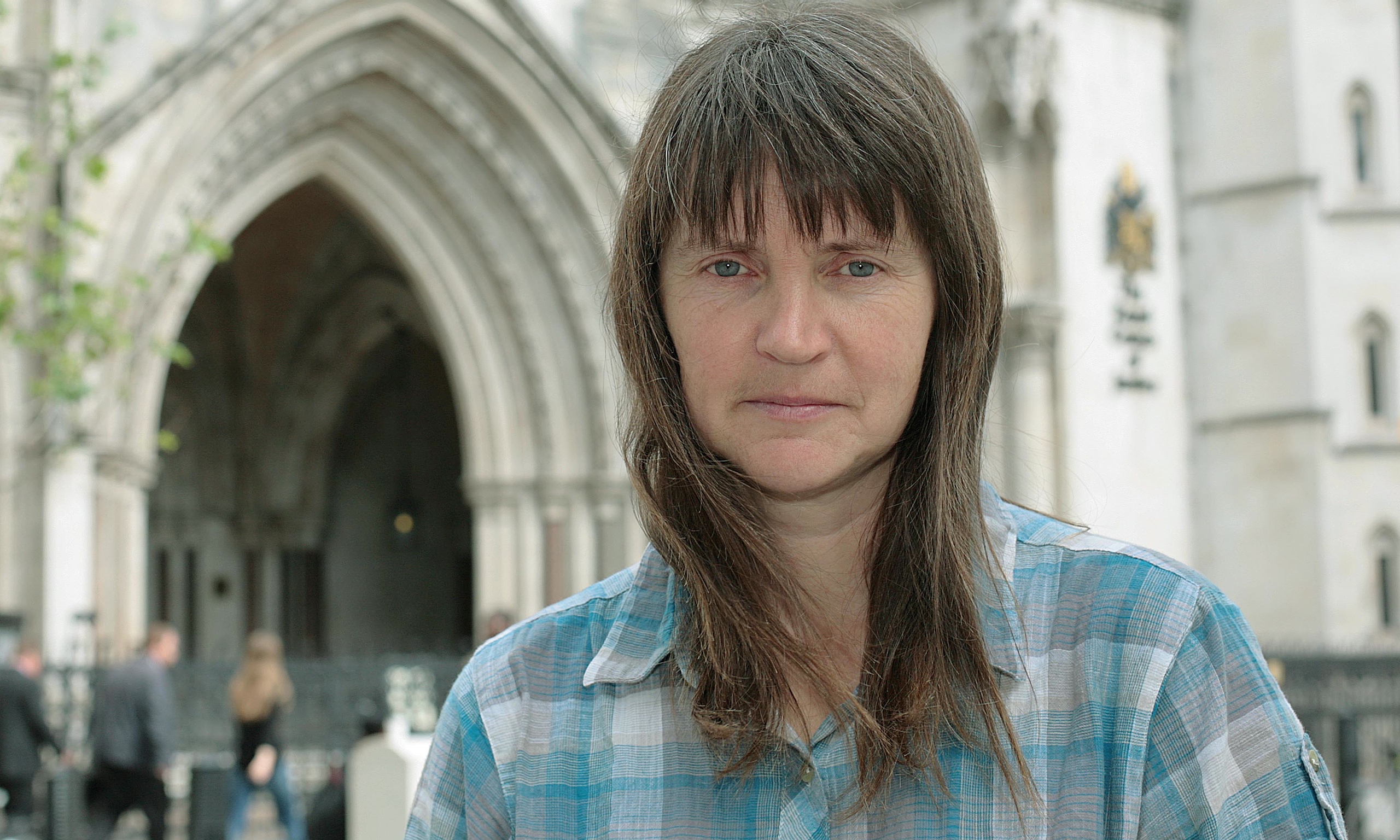
Helen Steel at the Royal Courts of Justice
A report by Lambert dated 9 September 1988 and signed by Docker [MPS-0740518], says Helen Steel was in London on 13 August 1988, waiting to meet a comrade in relation to the ALF Supporters Group.
However, John Dines made a report on 16 August 1988 [MPS-0743632] which says Steel was in North Yorkshire on 11 to 13 August 1988 with hunt saboteurs for an action against a grouse shoot.
A third report, presumably also from Dines, [MPS-0744064] says Steel was at a meeting of the Federation of Animal Rights Group in Leeds, West Yorkshire, on 14 August.
The Inquiry wants to know how Lambert and Dines place her in two locations at once. It’s clear that one officer was not telling the truth.
HN109 embarrasses himself at this point by desperately trying to imply that she could have briefly gone back to London. In the end he has to accept it is vanishingly unlikely.
HN109 also notes that Lambert’s report had a substantial time-lag, some four weeks after the events being described. This was ‘very unusual’, and there would have been mention of it at the time to understand why there was such a delay.
Counsel presses him on this, reminding HN109 that he’d said he would seek where possible to establish whether intelligence was hearsay or something the undercover had witnessed directly, and that he would consult on this if the information was significant.
She pointedly asked HN109 if he would seek to understand or address the veracity of the intelligence. HN109’s underwhelming response:
‘I would like to think I would.’
It was clear by this point, the afternoon of the first of his two days, that HN109 was trying to present the management of the SDS in a more exalted light than it deserved, and that he had no real answer for the catalogue of serious deficiencies that were steadily being listed. In such cases he simply expressed disappointment, or fudged responses like ‘I would like to think I would’.
Counsel continued to pursue the matter, asking whether he would accept that because SDS intelligence was secret and, unlike other intelligence, not subjected to rigorous testing such as happens in court, and because he had faith in his undercovers:
‘that did make it easy for perhaps a less scrupulous officer to gild the lily in terms of their intelligence.’
HN109, hedging things as ever despite his earlier admissions, responds:
‘Potentially yes.’
He did acknowledge that he did not recognise it at the time but can now do so in retrospect.
Counsel then brings up the Special Branch Guidelines [UCPI0000004538], a Home Office document setting out the role and duties of all Special Branches which was issued in 1984 following concern about Special Branch’s impingement on civil liberties.
HN109 was aware of this while in C Squad. Particularly, paragraph 17 which stresses the importance of ensuring:
‘information recorded on an individual is authenticated and does not give a false or misleading impression. Care should be taken to ensure that only necessary and relevant information is recorded and retained.’
Counsel asks HN109 if SDS management failed to comply with this. He waffles, saying he agrees with the guidelines, but:
‘I’m thinking about how we could then have gained, if you like, information of evidential value that would show that these statements were correct or otherwise.’
He ends up accepting Counsel’s proposition that the guidelines were the standard to which intelligence was recorded, but there was a systemic problem with the SDS’s intelligence gathering in that it was difficult to meet that guideline due to the very nature of the operation.
While this might seem a dry point, it is one of the key exchanges in HN109’s evidence. By building on the clearly nonsensical Lambert report on Helen Steel being in London, Counsel drew out that there was no way to check the intelligence of the undercovers, and the degree to which everything was purely taken on faith was the norm – even when the managers felt there was an issue about reliability such as the one HN109 admitted about Lambert.
There was stylistic oversight up to a point, but next to nothing about the actual content. This line of questioning clearly exposes the degree to which the SDS intelligence gathering system was open to abuse. The spycops could report whatever they wanted, their bosses had no way to check it, and their targets would never know (at least, not until now).
MCDONALD’S
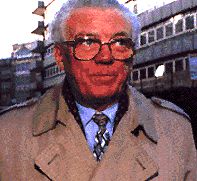
Sid Nicholson, McDonald’s head of security, had a two-way exchange of information with Special Branch
McDonald’s was the subject of protests by London Greenpeace. Their leaflet ‘What’s Wrong With McDonald’s?’, which was co-written by spycop Bob Lambert, led to a prosecution for libel.
The feted McLibel trial turned out to be the longest court case in English history. Helen Steel and Dave Morris were the defendants.
The McLibel trial heard from Sid Nicholson, Vice President of McDonald’s UK and the company’s Head of Security. He had been a police officer for 31 years, starting in apartheid South Africa and retiring as a Chief Superintendent of the Met.
He said that his entire department was made up of ex-police officers which made it easy to establish a casual, two-way, illegal exchange of personal details about London Greenpeace activists.
He specifically told the court that Special Branch officers initiated contact with McDonald’s on occasion:
‘They telephoned me to ask me if I was aware that there was going to be a demonstration outside of our offices and then they indicated that they were interested in the organisation [London Greenpeace] and did I have a perch they could use, and a perch is police parlance for an observation post. I told them I was interested and… [allowed them to] make use of any facilities they wished.’
But when HN109 is asked if he had any knowledge of liaison between McDonald’s security and Special Branch or the SDS, he says absolutely not. Furthermore, he says he would have taken action to report it, if he had such knowledge.
It would have been ‘wholly inappropriate’ for anyone at the SDS to contact a private organisation and an issue for senior managers if information did need to be passed on and they disguised the fact that it came from the SDS.
Given that the facts about McDonald’s exchange of information with the police were established in court 30 years ago, it’s ridiculous that HN109 can claim such ignorance.
Spycop John Dines, who deceived Helen Steel into a long-term intimate relationship, told her on two occasions that he thought they were being followed, possibly by someone linked to McDonald’s. HN109 claims Dines never told him this.
Safe house meetings
The SDS management held twice-weekly meetings with all undercover officers at their safe house. There was no formal agenda, but they followed a routine.
Firstly, they dealt with admin, expenses and any forms that needed filling out, along with communication of police notices. This was followed by an informal round-robin where undercovers fed back what they had been doing. This helped the managers to get to know the undercovers and stay abreast of what they were up to, as well as keep an eye out for their welfare.
DOMINANT PERSONALITIES
In his written statement, HN109 noted:
‘certain key personalities dictated the tone… There was a degree to which they dominated proceedings.’
This group included HN10 Bob Lambert and HN5 John Dines. Counsel specifically excluded discussion of a third officer among these dominant personalities to focus on only on this pair.
HN109 says they were of strong character:
‘I think they were seen by some colleagues as individuals who could portray feelings or senses that were on the squad and would be happy to allow them to take the lead – which they did.’
They were self-appointed informal spokespeople for the undercovers:
‘I don’t think they were altogether representing the views or the health of the SDS.’
Asked about Lambert’s ‘strong character’, HN109 explained:
‘Bob was – he’s tall, and he was positive in what he said, how he said it, and was fairly unafraid to be frank, and I think having gained the reputation that he had in his work, I think some of the others looked up to him.’
He clarified that neither he nor his superior Eric Docker personally looked up to Lambert, though he felt that Docker’s successor, HN51 Martin Gray, might have done, as he had a willingness to engage more with Lambert. He believes Gray and Lambert had more one-to-one meetings than were being held with the other undercovers.
As for Dines, HN109 says he was quiet and serious, but appeared enthusiastic in what he did and how he did it. He was also happy to represent himself and others, but be balanced in what he said. He was a man of few words. All this combined to give the impression of someone who was confident. HN109 thinks other undercovers looked up to Dines both because of his work and his demeanour of calm assertiveness.
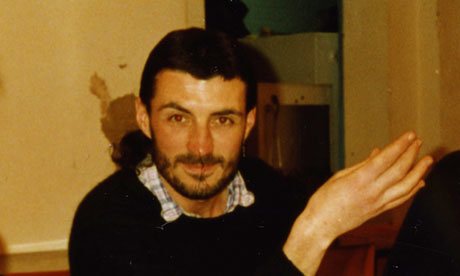
Spycop HN5 John Dines ‘John Barker’ while undercover
Asked if they ‘strutted about’, he says they did; Dines to a lesser extent, but they didn’t brag. He says Stefan Scutt was another like this. Their manner made it hard for other officers to relax because it brought an element of domination and there was an arrogance in it.
HN109 said Dines and Lambert held themselves out as setting the standard to which other undercovers should aspire. They did this not only by their attitude but also the information they were getting, which was something other undercovers would have aspired to.
Pressed on how this was conveyed, HN109 says it was through their written work that HN109 got the impression that others saw in them elements of excellence and good practice. This cannot have been the case. Undercovers wouldn’t have seen the written work of others. There is presumably something else that HN109 is not willing to go into regarding Dines and Lambert, around how they presented their achievements.
HN25 ‘Kevin Douglas’ said he thought Dines was a ‘gong-hunter’. HN109 says this is more applicable to Lambert. He says Dines and Lambert were not competitive with one other but were close.
Later, in light of the Scutt affair, HN109 will privately label this group, including Lambert and Dines, ‘the cabal’. He said they had an air of superiority and authority to the point that he feared:
‘it could get to tails wagging dogs… so an over-influence that would undermine management.’
THE REST OF THE SPYCOPS
Though HN109 skirted around issues with Lambert and Dines, he was more open about HN95 Stefan Scutt, who he said peacocked around and was a braggart.
Asked how this manifested, HN109 replies that Scutt was boastful about what he was doing and how he was doing it. Scutt engaged in self-promotion about his undercover work:
‘he took on a mantle of authority and seniority that was wholly unjustified, and also of excellence that was unjustified’.
He adds that in the round-robins, Scutt came across as quiet and unforthcoming, supporting the assertion of HN25 ‘Kevin Douglas’ that Scutt was very reticent. He notes that Scutt could be uncooperative, but that was not as evident as other characteristics.
HN25 ‘Kevin Douglas’ had also said the undercovers were siloed at the meetings and even regarded each other as a threat. HN109 is surprised to hear this. This is not necessarily contradictory, but perhaps indicative of how little control HN109 really had over the underlying dynamics, or that he was ill-equipped as a manager despite being a stickler for the rules.
HN109 says there was not a competitive atmosphere as the undercovers were not in the same groups or branches, so there was really nothing to compete on. Both he and Docker would have been against encouraging competition.
Asked about sexual activity, HN109 says the undercovers did not brag about it, and he claims it was never mentioned that Lambert had a child with a woman he spied on.
HN109 says there would have been a few one-to-one meetings with the undercovers, when they wanted to discuss specific elements of work and possible directions, or felt an issue was not right to discuss in front of the group as a whole. These meetings tended to be about operational matters rather than personal ones.
In a squad review at the time, ‘Special Demonstration Squad: Viability’, published in August 1988, unit manager Eric Docker wrote that:
‘great care is taken to establish a relaxed and convivial atmosphere where all aspects of squad work may be discussed.’
HN109 is asked how the managers sought to do that. He replies it was by having all the undercovers together in one place. The great care would come from observing what they were like, what and how they were doing at work, but also potentially socially as well.
For HN109, it was all about observing and taking in what they were doing, putting the bits together and seeing if they were OK.
‘The care I don’t think necessarily involved action to be taken.’
As with so many of HN109’s answers, he is not actually addressing the point. There is an illusion of doing something, but looked at squarely he is claiming that he, as a manager, was not actually doing anything other than convening the twice weekly meetings.
Asked if it was an opportunity to let their hair down a bit, he says yes and adds there was a lot of laughing and jokes.
SOCIALISING
HN109 doesn’t recall alcohol being consumed in the safe houses except occasionally when there might be a celebration or a longer period of time at the meetings. Alcohol was not routine in private unless it was a social event or a leaving lunch. After the meetings they would go to the pub.
An MI5 memo from 1985 [UCPI0000036109] describes their meetings with SDS managers and warns colleagues to ‘be prepared to drink lots of beer’ because of the SDS mangers’ macho drinking culture. But HN109 rejects this:
‘I think this says more about the writer than it does of the activity.’
In his written statement to the Inquiry, HN109 says that undercovers would sometimes stay over at the safe house when they’d drunk so much that they were unsafe to drive.

MI5 note warning its staff about the drinking culture of the SDS, 1985
Questioned about this, he’s at pains to downplay it as being a very rare occurrence.
Great store was set by undercovers being sociable with each other and having good social skills. This was because it is an important characteristic for a group that was otherwise isolated from other work colleagues, and vital for their wellbeing. It was important that they could talk about ordinary stuff among their colleagues.
It is clear that HN109 did go to the pub with the undercovers. When there were problems with officer HN95 ‘Stefan Scutt’, a report by Chief Superintendent Tony Evans (S Squad line manager for SDS) [MPS-0740925] noted that Scutt:
‘did not drink and did not socialise with them, or his supervising officers, outside of the office.
In his view this was one factor which distanced him from Detective Inspector [HN109] who appeared to enjoy the thrust and parry of lively verbal exchanges; this, however, was not his style and underlined the difference in temperament between them.’
HN109 doesn’t know what is meant by this, but says he enjoyed having discussions and that these allowed them to communicate with others – and allowed managers to see how:
‘they were managing themselves in a social atmosphere, removing them or trying to remove them as much as possible from their work in what’s pretty intense and sometimes awfully intense.’
He found it noticeable that Stefan Scutt avoided such socialising, though he denied taking a dim view of this. He says drinking alcohol was not a crucial element for the social aspect, and that he’s sure other undercovers didn’t drink at social occasions. Going further, he says he wouldn’t have allowed alcohol to be the sole purpose of engagement with the squad.
However, he says because Scutt was so reticent and reserved and didn’t participate, this made it harder for HN109 to get an insight into him.
SEXUAL BANTER AND IMPLAUSIBLE DENIAL
Counsel returned to the issue of the laughter and joking. HN109 doesn’t recall if there were jokes about sexual matters. If there were, this wasn’t a significant feature, but probably reflected the social atmosphere, and was nothing that would raise suspicions with managers.
In 2016, HN109 was interviewed by Operation Sparkler, a police investigation in relation to Bob Lambert’s role in placing incendiary devices in Debenhams shops while undercover in an Animal Liberation Front cell [MPS-0737160].
In the interview, HN109 said he was unaware of undercovers deceiving women into sexual relationships, but there had been jokes about high standards of intelligence to be gained from ‘horizontal politics’. The other standing joke was that Helen Steel, who Dines had deceived into a relationship, was not very attractive.
HN109 now says the ‘horizontal politics’ line was from when he was undercover in the 1970s and he never heard it when he was a manager at the SDS.
There’s no such excuse available for the derogatory comments about the attractiveness of Steel, who wasn’t spied on until the 1980s. Faced with the report of his own words from 2016, he flounders:
‘I have no recall of that. Clearly I must have said it. And looking at it, it makes me feel uncomfortable.’
Given how often he expresses discomfort during his evidence, one gets a sense that there is a lot for him to feel uncomfortable about now he’s forced to face up to the reality of how he managed the unit and what happened on his watch. All the more so, given that he was someone who portrayed himself as focused on the unit abiding by regulations. Either a lot slipped by him or he was willing to let a lot more go than he’d like us to believe, little of which stands the test of time.
It’s a pattern we’ve seen repeated over and over at the Inquiry. Confronted with the clear evidence of what the SDS did, denials are impossible. This leaves managers having to admit either to being corrupt or to being incompetent, so they opt for the latter and say they didn’t know about anything contentious. HN109 is no exception, and immediately give us more of it.
Counsel did not let him off the issue of the ‘standing joke’ about Helen Steel, stating that it’s not even a joke, but simply a nasty comment. HN109 has to accept it’s not a joke.
He says that he thinks he was repeating to Operation Sparkler what he had been told or heard from others. He then rows back entirely:
‘I certainly can’t recall it as being a standing joke. That would sort of indicate that it was something that came up on a fairly regular basis. I don’t recall anything like that.’
He also says he can’t remember who might have ever said it. Asked about how he would have responded on hearing such a remark he says he would have felt uncomfortable, but not reprimanded the officer:
‘maybe because it would be the sort of thing that would’ve been spoken about in [the] open and forgotten. I’m not sure.’
HN109 desperately hedges himself. But the implication is clear that this sort of banter went on and the managers either turned blind eye to it or simply didn’t recognise it as cruel. He then goes on to make it worse for himself.
Counsel continued to press, making the point that even with everything he’s just said, he thought the issue of comments about Steel’s appearance was significant enough to raise with a police officer from Operation Sparkler. He’s forced to concede that he must have thought it was of significance in 2016, even though he claims he can’t remember it at all now.
Asked if such comments on perceived sexual attractiveness at the safe house or in the pub are a red flag, he responds that ‘it’s not healthy’ and admits it’s demeaning.
However, despite his 2016 citing of the ‘standing joke’ and his admission that he wouldn’t have done anything about such comments, he refuses to concede that this meant there was a problem with the SDS:
‘Because I don’t think discussion like that, demeaning discussion, took place, either on males or females. It wasn’t, you know, there was no significance, it didn’t happen a lot, it wasn’t something in the culture of the group.’
He is asked by his own barrister about Operation Sparkler reporting that he’d told them:
‘there had been jokes made about high standards of intelligence being gained from “horizontal politics”.’
Having U-turned and run away on the unattractiveness comment, he does a similar move here, with an equally low level of plausibility.
‘”horizontal politics” in my Operation Sparkler interview was not a reference to relationships between undercover officers and activists but rather to the interactions between activists themselves.
There were frequent correlations between the internal dynamics of a group or branch and the sexual relationships that formed and broke down between its members.’
He claims to have only ever heard the phrase used once or twice, by one undercover.
He also asserted that he never heard any racist language used in the SDS offices or safe houses. Asked specifically about HN86/HN1361, a manager who succeeded him and who it has been suggested was racist, HN109 unsurprisingly says he can’t remember the officer ever doing anything like that.
One spycop after another has told the Inquiry that there was no verbal racism or sexism in the squad. They’re asking us to believe that they’re so decent that they wouldn’t think it or say it, yet somehow they put it in official written reports that managers were happy with. They are insulting our intelligence and lying under oath.
GUILTY CONSCIENCE
Counsel stayed on the topic of HN109’s Operation Sparkler interview. When first approached for an interview he told them he was willing to be questioned but wanted to know if anything would go to the Undercover Policing Inquiry. He was told that if anything of relevance to the Inquiry came to notice, the investigation team would have a duty to inform overarching police investigation Operation Herne and the Inquiry.
Asked if, at the time of the Sparkler interview, he thought engaging with the Inquiry was optional, he says he thought it was, and that the meeting with Sparkler was very informal.
He was concerned about where the information would go, but he wasn’t saying he didn’t want to engage with the Inquiry. He says he had nothing to hide when he met with officers from Sparkler, and it wasn’t because he had let his guard down with them.
On the second day of HN109’s evidence there was an announcement from the Chair, Sir John Mitting, that there had been a private hearing where HN109 explained his caution about engaging with Operation Herne and the Inquiry. Mitting said he already knew the reasons and was fine with them. We, however, are not told what they are.
Debenhams
In July 1987, SDS officer HN10 Bob Lambert was undercover in an Animal Liberation Front cell that placed timed incendiary devices in branches of Debenhams department stores that sold fur. They were set to go off in the dead of night, creating just enough smoke to trigger the sprinkler system and drench the stock.
Three shops were targeted simultaneously. Andrew Clarke and Geoff Sheppard were arrested and convicted for two of them. Both they, and numerous other people who knew Lambert at the time, say Lambert planted the third incendiary device, in the Harrow shop. There is no other credible explanation for the planting of the Harrow device.
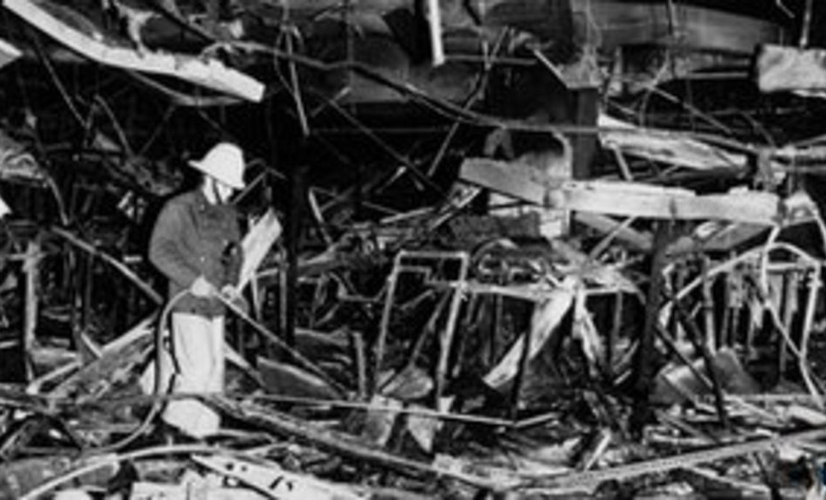
Firefighter in the wreckage of Debenhams Luton store after an incendiary device was placed by Bob Lambert’s Animal Liberation Front cell, July 1987
Lambert denies it, and several of his contemporaries at the Inquiry have had convenient amnesia on the issue. Lambert’s involvement was kept secret from the court. This means that the defence did not have access to all evidence in the case. Therefore the convictions of Clarke and Sheppard were a miscarriage of justice.
HN109 joined the SDS six weeks after the arrest of Sheppard and Clarke. Though not gone into in detail in HN109’s testimony, this event was the basis for questioning on a number of topics.
HN109’s understanding of the root of Lambert’s success was that the undercover had become close to the people involved.
He agreed that morale in the unit was good as a result of the success of Lambert’s role in that operation. He also agrees with the Assistant Commissioner’s assessment that the arrests were a rare tangible result for the SDS. Additionally, he agrees with Counsel to the Inquiry’s proposition that it was so celebrated because it had actually led to a criminal prosecution.
However, the secrecy of the SDS, even with Special Branch, meant that HN109 didn’t believe there was a significant focus or an ability to contribute to the prosecution of crime. The Debenhams case was the exception in this.
They couldn’t get involved in prosecutions as it would potentially expose the undercovers, and hence compromise the secrecy of the squad. As a result, he speculated that the intelligence from Lambert about Sheppard and Clarke would have all been dealt with through C Squad to protect the SDS.
When it was put to him that protecting Lambert’s identity was more important than ensuring the defendants’ right to a fair trial, he did not give a clear answer. Furthermore, he says he could not recall any discussion about whether or not disclosing the undercover’s role might have impacted the fairness of Sheppard and Clarke’s trial, which took place during his tenure as manager.
HN109 accepts that Lambert would have been well regarded because of the Debenhams ‘triumph’. However, the nature of his target meant that Lambert would have developed specific characteristics to get close to them. This would not have been generally applicable to other deployments. Especially as the SDS was focused on gathering intelligence on public disorder, not combatting crime.
LEGAL PROFESSIONAL PRIVILEGE
Numerous spycops were involved in arrests and court cases. This didn’t just mean misleading courts and creating miscarriages of justice. It also meant they were party to the defendants’ discussions with lawyers. This is a gross breach of the principle of ‘legal professional privilege’, that lawyers must be able to speak to clients in confidence.
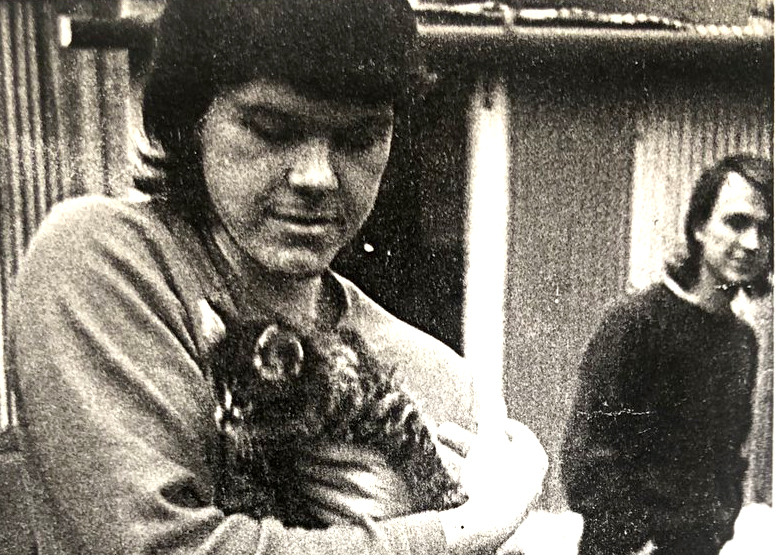
Geoff Sheppard (left) with friends Paul Gravett and a cat, 1980s
A 1987 report by Lambert on Sheppard and Clarke as they prepared their defence case in prison is raised, particularly a conversation between Clarke and his solicitor [MPS-0740050].
HN109 accepted this report contained information from a legal representative and says it is concerning ‘in hindsight’. Asked why he wasn’t bothered at the time, he limply suggests that perhaps he thought it would have been told to Lambert by someone else, not the solicitor themselves.
CLARKE IN PRISON
In February 1988, Lambert submitted a report [MPS-0744784] detailing Andrew Clarke supposedly being assaulted in prison for interfering with the genitals of a Black cell mate.
HN109 is questioned on why the ethnicity of the cell mate is important to report, and he says it’s a description of where Clarke was and what he was dealing with, and it gave an impression of what he was inclined to do, which might not have been something known previously.
Helen Steel, who was close to Clarke at the time, said she thinks this report was a fiction. HN109 maintains it was relevant information worth disseminating as – the line we’ve heard from so many spycops defending sharing information without any justification – it was something that might have been useful in some way in the future.
The report also discusses Sheppard and Clarke’s legal strategy for their upcoming trial and their different approaches. Despite the breach of legal professional privilege, HN109 is not troubled by this as it potentially indicates a split between the two activists. He thinks there is value in it as reported intelligence but, again, does not specify what that value might be.
He is challenged that the contents of the report come under the broad umbrella of legally privileged information that ought not to be further disseminated by the police. HN109 responds that it is only being disseminated to Special Branch. He eventually has to accept that he did not know where it might end up but he still thinks it was appropriate to report anyway.
Lambert’s planned exit strategy from his undercover deployment was that he was going on the run following a police raid on his house for his involvement in the Debenhams action.
It was pointed out that, for such a dramatic story to be plausible to his colleagues in the Animal Liberation Front, they would have to have known he was heavily involved in something seriously illegal. HN109 claims he does not recall, but thinks that’s correct. He says he had nothing to do with Lambert’s withdrawal.
He is asked outright if he thinks Lambert was involved in planting the 1987 incendiary devices at Debenhams. HN109 says he thinks Lambert could have been, from what he’s listened to and to what he knew of the undercover given what other stuff he had been hiding over a period of time.
‘I think he had the potential to get involved in something further for whatever purpose.’
Arrests, legal professional privilege and violence
If there was a risk of an undercover being arrested at an event, another SDS officer would be nearby to act as a cover officer to keep an eye on the undercover, especially if it was outside of the Metropolitan Police District.
HN109 says he did this about four times, though in his written statement he apparently indicated it was many times.
He’s asked if he agrees with HN51 Martin Gray’s comments to the police’s internal spycops inquiry Operation Herne that this was in part because there was a danger another police force might ‘fit up’ the undercover. HN109 thinks it was only a very small part of the need for the cover officer. Rather it was to keep an eye on the undercover and their welfare in case of an arrest.
SPYCOP JOHN DINES ARRESTED
Counsel discusses the arrest of HN5 John Dines on 9 January 1988 while on a hunt sab. Having been pointed out by a huntsman for his effective sabotage, Essex police took Dines into custody, supposedly to prevent a breach of the peace.
He was held for over two hours before being released. His false identity was then passed to the Animal Rights National Index (ARNI) by Essex constabulary’s Special Branch.
Four days later, on 13 January 1988, HN109 wrote a report [MPS-0526791]:
‘The integrity of the SDS operation was never in question…
Although the arrest of an SDS officer can be an unsettling experience for the administration as well as the officer, there is little doubt that in this type of case the operative’s credibility is greatly enhanced.
In a minor way this manifested itself in the large quantities of vegan food provided to the officer, while in custody, by his fellow saboteurs, concerned that the police would not adequately cater for his diet.’
HN109 says the criteria for having a cover officer was to do with whether there was likely to be disorder, which there certainly was at hunts at the time. He added that sometimes they liaised with local Special Branch, but sometimes not, instead just watching what was going on. He dressed to blend in to the occasion.
He is asked about Dines being singled out by huntsmen for arrest as a nuisance, and whether it was a common occurrence for hunts to give instructions to police on when to make arrests. Remarkably, HN109 gives a clear affirmative to this.
‘I think it was like a delay tactic to bring a halt to the disorder until normal service was resumed and then release those arrested.’
Asked if this kind of arrest was appropriate, he admits he didn’t agree with it.
There were mixed views within senior management about the arrest of undercovers. Generally, it was believed that if this could be avoided then it should be. If an arrest did happen, then the hope was that it would enhance credibility, though that was not always the case.
SPYCOP JOHN DINES ARRESTED AGAIN, WRONGFULLY
We are then taken to a second arrest of Dines, on 6 December 1988 at an animal rights protest at the Sun Valley poultry processing plant in Herefordshire. It is described in a report written on 7 December by SDS manager HN51 Martin Gray [MPS-0526792].
HN109 and back office sergeant HN61 Chris Hyde were there as cover officers for Dines. A lorry carrying live chickens was occupied and an attempt made to rescue the birds. Dines was one of 13 in the immediate vicinity who were arrested despite not doing anything to warrant it.
According to the report, the two SDS officers attended Hereford police station to monitor the situation but did not declare their interest in Dines nor reveal he was actually a police officer. Hence the SDS operation was not compromised.
The charges were dropped as no evidence was offered. Complaints were made about the lawfulness of the arrests. Dines went along with the complaints and, as a result, was interviewed by a Chief Superintendent from West Mercia Constabulary.
The issue of this complaint was addressed in Gray’s report. According to him, the complainants did not expect to succeed but viewed it as a way of inconveniencing police. Dines planned to attend but keep things so vague so that allegations are not pursued, and, despite the unlawful overreach:
‘certainly that no disciplinary action is taken against any West Mercia Constabulary officer.’
Another report, written by HN109 on 23 March 1989 [MPS-0526793], discusses the outcome of the interview. He wrote that Dines was interviewed for four hours and thinks he did it ambiguously enough that there’s unlikely to be further action.
HN109 says he doesn’t remember anything about this incident at all. However, he agrees that, from Gray’s report, it sounds like there was no proper grounds for Dines’ arrest, and that there might have actually been merit to the complaint.
He cannot recall having any qualms about Dines’ strategy.
In his witness statement, HN109 wrote what amounts to a frank admission that the SDS was a law unto itself, not especially concerned with legality or justice:
‘the primary consideration will have been Detective Sergeant Dines’s security and that of the SDS. Other considerations of propriety and legal professional privilege were managed but they were of secondary importance.’
He was not aware of the arrest of Dines at the 1990 Poll Tax Riot, having left the SDS just beforehand.
SPYCOP ‘JOHN LIPSCOMBE’ ARRESTED
Later, we’re shown a 6 April 1988 report by HN87 ‘John Lipscombe’, signed off by HN109 as manager [MPS-0743620]. It describes a hunt attacking hunt sabs and causing injuries to them, including a broken arm. HN109 is asked about whether violence towards hunt sabs concerned him as a police officer.
He seems unable to understand the point that this is a violent crime towards the sabs perpetrated by the hunt, written by a reliable witness. He says he would not have disseminated the report so that those responsible could be held to account:
‘it would have potentially presented security problems if the officer had to be called as a witness. I’d prefer that it didn’t happen. But I think there were more dangers involved for the squad than benefits.’
Patronisingly, he adds:
‘the poor soul who had their arm broken would be able or could or should be able to pursue it with the assistance of their colleagues.’
He admits he would not have even followed up on the incident as to whether there were criminal proceedings.
It’s clear throughout his evidence that HN109 thinks a lot of the police service as an institution, but when he makes statements like this, it’s equally clear how little he cared about its actual purpose – protecting the public.
Misconduct and sexual relationships
‘RULES ARE MEANT TO BE BROKEN’
Counsel raised another point in HN109’s written witness statement. HN109 and HN5 John Dines had worked together on Special Branch night duty prior to Dines joining the SDS, and Dines had told him that ‘rules are meant to be broken’.
HN109 said he was surprised that a junior Special Branch officer would say that to a superior. HN109 didn’t carry this over to his management of Dines in the SDS, as he apparently didn’t remember this statement until after he, HN109, had left.
Indeed, Dines at the SDS didn’t have a reputation as someone who disobeyed the rules. But it’s clear from examples already described at the hearing that Dines did indeed disdain the rules or, perhaps more accurately, that those rules weren’t really rules in the first place.
HN109 was asked if he’d made it clear to Dines not to have sexual relationships. He didn’t.
Instead, HN109 ‘hoped’ it would have been spoken about when Dines first arrived or before recruitment, and also during his service ‘on an informal basis’. The former manager skirts around the fact that making it clear was part of his responsibility. In his replies there’s a lot of hoping others would have done things, and it does not reflect kindly on his tenure.
HN109 says he only found out about Dines’s relationship with Helen Steel latterly from the newspapers. When asked if it was out of character, he answered with a customary sideways step, saying he was ‘shocked and disappointed’.
SPECIAL OPPORTUNITIES FOR MISCONDUCT
HN109 asserted there was a low incidence of disciplinary issues in Special Branch generally. This is, he says, was due to members being recruited to the Branch because:
‘they stood out among a dedicated and talented group of vetted individuals.’
HN109 is oblivious to how this sounds after so many days of evidence to the contrary, not to mention the Metropolitan Police’s own series of unprecedented apologies for the unit HN109 managed.
He also says there were fewer opportunities to misbehave than in other forms of police work. Special Branch, not being involved in crime or in the criminal world, were separate from that type of impropriety. Broadly, they were not in a place to be involved in corruption, taking backhanders, evidence tampering, etc.
Counsel punctured that balloon by pointing out that undercovers had numerous different opportunities that were not available to the average police officer, or even Special Branch officer. Particularly, they had a disproportionate number of opportunities to engage in sexual activity while on duty.
HN109 could only bring himself to ‘partly agree’, and wasn’t ‘inclined to say’ that undercovers were able to engage in sexual activity on duty more than other police.
Counsel pointed out that undercovers were going into groups as single men, socialising, drinking and forming relationships with people on the friendliest of terms, precisely as part of the intelligence gathering.
Again, H109 could only say that this ‘potentially’ offered greater opportunities for sexual misconduct. As with so many of the managers, HN109’s hedging and fudging in order avoid criticising the undercovers or his own management of them tended to fall flat. Instead, he came across as transparently dodging the issue.
He was reminded that he wrote in his witness statement that spycops having sexual relationships in their undercover identity was misconduct. He agreed that any sexual activity, including one night stands, was out of the question and amounted to discreditable conduct.
He explained that firstly officers were told this at the outset. They were also reminded afterwards (even though he just said he didn’t do this with Dines). There was also the moral issue that they’d selected undercovers who were already in stable relationships or married, compounded by the fact they were Special Branch officers.
HN109 emphasises it was a ‘betrayal’. Not of the women who were abused, but of the trust placed in the police as Special Branch officers.
In this, we get a real insight into HN109, a look at the complete picture which has been building up piecemeal; his loyalty is to the institution of Special Branch itself. It is an organisation he talks of in glowing terms, especially around how its officers are selected for being head and shoulders above others, vetted and held to a higher standard.
‘They had a responsibility, and the responsibility was not just to themselves but to the service, the Police Service and Special Branch and to the SDS.’
Asked about why married officers were preferred, he agreed it was believed that they were less likely to have sex with members of their target groups than single officers. He added that this belief went back to the 1970s and that he thought it was a sound principle.
He talks about there being loyalty to the undercover’s partner which allayed fears or considerations about spycops straying into other relationships. He accepts this wasn’t a guarantee, however.
‘AGAINST RULES, REGULATIONS AND MORALITY’
Counsel was allowed to quote from HN109’s earlier secret hearing about his time undercover in the 1970s, in which he said that senior officers had spoken about the dangers of sexual activity.
The primary danger was the security of the undercover and whether they were getting over-involved in their work. The other was the reputational danger for Special Branch and the wider Metropolitan Police should their undercover activity ever be made public. Again, there is no consideration whatsoever of the harm being done to the women they were abusing:
‘it was approached from the one-dimensional point of view of warning these experienced police officers that it was against rules, regulations, and against morality.’
In his written statement, HN109 said he almost certainly had a conversation with HN90 ‘Mark Kerry’ when that undercover was recruited because ‘Kerry’ was single and management would have wanted some reassurance that he understood the boundaries.
The boundaries were that he was a police officer doing work, that sexual relationships would have been wrong, and to make sure each officer knew that security was paramount. There was the danger, not just reputational, but that a breach would lead to all the squad’s infrastructure having to be changed so as to maintain overall operational security.
Counsel asks why, as ‘Mark Kerry’ was single, would it be morally wrong for him to have a relationship. HN109 says it’s because he would have been posing as someone else. Given that this applies to every spycop who deceived women into relationships, including all the married ones, it’s a truly startling admission.
Any hope of sustained candour is quickly snuffed out. When asked whether that moral reason would have been spelled out to ‘Kerry’, we get a repeat of the feeble avoidance of responsibility:
‘I would hope so.’
This is immediately picked up on. Counsel reminded HN109 he’d already said that all the undercovers were told and warned against sexual relationships, which he confirms. However, in his witness statement he said it was not something that seemed necessary for two other undercovers he recruited, HN122 ‘Neil Richardson’ and HN56 ‘Alan “Nick” Nicholson’, because they were married.
The apparent contradiction is pointed out. HN109 says it’s not a misrepresentation, but rather that he did not expand enough on the issue of sexual relationship with the married officers. For HN109, it is self-evident that married men should not have other relationships. Nevertheless, he says he is sure it would have been mentioned:
‘no-one to my knowledge escaped being told about how they should conduct themselves.’
It’s painfully obvious that despite his disclaimer there is a contradiction with his written evidence, and that his story has changed around this.
He ploughs on:
‘also I’m sure it would’ve been on my lips when something came up about, I don’t know, mention of females in the various groups if they were saying, either they were getting close.
I am positive that I’d say “well look, you’re going to have to be careful. We know we’ve got to be careful”. Along those lines.
So it was something, it was at the top of the list if you like in general warnings, as was agent provocateur.’
He would have done this as a ‘casual mentioning’ of something undercovers had to be careful of. He can’t recall a single specific incident of doing it, ‘but I know I would have said it many times’.
Counsel points out that HN5 John Dines was open about the fact that he was specifically targeting Helen Steel and planning to get close to her. HN109 says he would have ‘almost certainly’ warned Dines about not getting too close to her and not engaging in a sexual relationship. He never had any undercover object when he gave such a warning, it was done informally but:
‘purpose-built to get a message over. I shouldn’t have had to say it in the first place, actually.’
He then says he is now in fact certain he said it to Dines.
HE SAYS HE TOLD THEM, THEY SAY HE DIDN’T
It’s pointed out that HN122 ‘Neil Richardson’, an officer managed by HN109, contradicts this. He said in his evidence the only conversation he had about sexual relationships came from another undercover who simply said the opportunity would present itself, making him aware it was a situation he would likely encounter, but without advice or moral overtones.
Not for the first time, HN109 says he ‘would be surprised and disappointed’ if ‘Richardson’ had been told that by himself or Docker. As with telling undercovers not to be an agent provocateur, this was not a task for their colleagues but for the managers – in this case, HN109 and Docker – to do at the outset so the undercovers knew what the standards were.
HN109 says it would either have been done prior to the undercover coming to an interview, or informally when they reached the back office.
‘It was not something that was ignored.’
HN109 is reminded that he claimed he had issued clear instructions to undercovers both when they were recruited and when they were in the back office.
Counsel asks him how certain he is that clear instructions would have been given to undercovers he had not been involved in the recruitment of, and whether Docker would have told him that such instructions had been given.
We receive a nebulous non-answer that characterised much of HN109’s evidence when it came to such awkward questions:
‘Those other officers in the first instance would have had this matter mentioned to them. They would have had the information.
And as far as they were concerned, or as far as the group was concerned, if something came up, as I say, in conversation or in the paperwork, I wouldn’t take an officer aside and say it. It would just be mentioned in open forum. There was nothing to hide.
So in my mind, everybody would have known that this was how we had to operate.’
He’s clearly bullshitting us, trying to create an illusion of open effective management, where undercovers are gently nudged about not crossing the line. Counsel does not let up, picking up on the paperwork comment, asking what sort of detail in the paperwork would prompt him to caution an officer.
‘If there was some knowledge in there that gave an indication that they were getting close to females.’
Counsel suggests this might be sensitive personal information about the woman that would come from a close relationship. HN109 says possibly, but hopes any such close relationship would have been picked up before that. It seems there’s a lot of this kind of hope in HN109’s world.
Gamely he continues, finding more ways to tie himself up. He goes back to an example where an undercover reported that a woman he spied on was attractive. He says he wouldn’t assume they were forming a relationship, but he might casually say to the undercover to be careful.
He says he wouldn’t have assumed it was the undercover that was at fault, but the woman might be attracted to the undercover. If HN109 could only have accepted that some of his undercovers abused their position he’d have saved himself a lot of pain and getting into such ridiculous contortions at the Inquiry.
He concedes that the risk of sexual relationship was present for the undercovers, and it was known about at the time. But he still says he doesn’t remember discussing it or making it something formal to note.
HE SAYS HE DIDN’T TELL THEM, BUT NOW SAYS HE DID
Counsel goes back to HN109’s written statement:
‘Notwithstanding that there was the tacit understanding that undercover officers would not have relationships with activists, it was helpful for them to have thought through how they would resist any advances that they received.
I believe the tactic of building a deterrent into their legend was well established before I joined as Detective Inspector.’
She immediately points out that his live evidence contradicts this; he said that it wasn’t tacit, but explicitly imparted.
HN109 answers:
’They knew it. I would say there was a formality to them knowing the facts surrounding sexual relationships or any relationship really if it was an affair.’
He then tries to convince us that when an undercover was being examined as a potential recruit into the SDS, a senior officer would have overtly told them not to have sex with people they spied on. And even after they came to the unit, further comments to that effect that would have been made in conversation:
‘even these glancing comments that were made were serious in spite of the fact that it was informal.’
HN109 says he agrees that not being allowed to engage in sexual relationships meant all such relationships, not just ones of significance.
He goes on to cite HN10 Bob Lambert, who deceived four women into relationships and fathered a child with one of them during his deployment, which HN109 and Eric Docker oversaw the latter part of:
‘In his statement, [he] actually referred, when he was referring to himself and his relationships, he actually spoke about knowing that the system did not want him to engage.’
Counsel counters this by brings up Bob Lambert’s evidence to Operation Herne, the police’s major internal investigation into spycops. Lambert states:
‘What he also said, though, HN 109, was that there was a tacit acceptance from management that [sexual relationships] would happen, that they would never be formally authorised and that management would never give them an explicit thumbs up, but that there was a tacit acceptance, that they were going to happen.’
HN109 is somewhat affronted and says this was certainly not the case when he and Docker were managers.
Counsel returns to HN109’s written statement where he said that it was helpful for undercovers to think through how to resist advances and he believed that the tactic of building a deterrent into their legends was well-established by the time he became a manager. Such a deterrent to head off advances might be having a relationship already or claiming homosexuality.
HE SAYS HE DID, HIS BOSS SAYS HE DIDN’T
HN109 hastily admits there was no formal instruction about this, but says he’s nonetheless sure that he’d have said something to that effect when he was a manager. As so often with HN109, we’re left with a nice-sounding assertion that crumbles under the slightest scrutiny.
Counsel goes to Operation Herne’s interview with HN51 Martin Gray, who took over from Docker as head of the SDS in November 1988 while HN109 was still in the post [MPS-0723116].
On the subject of sexual relationships, Gray said undercovers were not told to abstain from relationships. He added that managers would emphasise the drawbacks of having affairs, such as the risk to the secrecy of the unit.
Counsel suggests that, given it contradicts HN109’s testimony, perhaps this indicates a change in policy under Gray, but HN109 denies this. HN109 says he can’t recall any discussion but he insists that he would have been forthright about his views:
‘It was something that came up and it was emphatic that it shouldn’t take place. The dangers were huge.’
Counsel makes the point that both Gray and HN109’s real concern was the threat relationships might pose to the SDS’ security. Asked about what if a relationship wasn’t a threat to security, HN109 insists he would still have ended the deployment:
‘It would be removal unless there were other circumstances. I can’t think at this moment of circumstances, and it’s something that I’ve thought since I started off with the Inquiry about this type of thing. I can’t think of circumstances where it would be possible to keep going if somebody had a sexual affair.
And the other thing is we’d have to be careful with someone saying it was just a one-night stand. How do we know? How is it possible to find out?’
As with SDS manager Eric Docker’s testimony to the Inquiry, HN109 is trying to say the unit was comprised of men of fine moral calibre while also saying that he assumes they’d lie outright to their managers.
SPYCOP LAMBERT’S RELATIONSHIPS: ‘JACQUI’
HN109 claims he had heard nothing whatsoever about Lambert’s considerable sexual activity while undercover, nor that of any other officer. He specifies that there were no rumours, no innuendo, nothing.
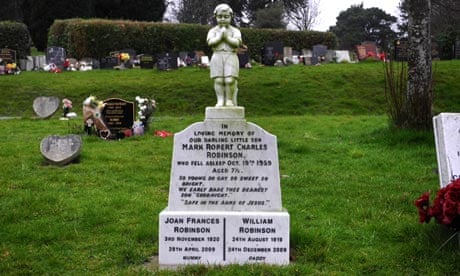
The grave of Mark Robert Robinson whose identity was stolen by spycop Bob Lambert. Branksome cemetery, Poole, Dorset
Lambert had a five-year relationship with a woman known as ‘Jacqui’. They had a son together, known as ‘TBS’. Jacqui gave evidence to the Inquiry on 28 November 2024.
Lambert had ended his deployment as ‘Bob Robinson’ – an identity stolen from a dead child – by having his flat raided by police.
They were supposedly looking for him following his involvement with the Debenhams incendiary devices, which had already seen Andrew Clarke and Geoff Sheppard go to jail. This gave ‘Bob Robinson’ the pretext to permanently flee the country.
Two of the women he deceived into relationships, Belinda Harvey and Jacqui, subsequently received letters from him sent from Spain. In reality he was back with his wife and family, and working at Scotland Yard.
When Jacqui and her new partner wanted to adopt TBS, they had to try to secure the agreement of the biological father ‘Bob Robinson’. However, he didn’t exist.
Social services asked after him at Lambert’s final undercover address at Seaton Point on the Nightingale Estate in Hackney. A Mrs Moseley said she’d shared the flat with ‘Robinson’ and that his whereabouts were unknown. ‘Mrs Moseley’ said that Bob was unlikely to surface in the future because of his intense political involvement with animal liberation movement activities.
It seems the SDS had quite an elaborate set of long-term measures in place to ensure that Jacqui and Belinda continued to believe in the fiction of Lambert’s undercover persona. It appears that ‘Mrs Moseley’ was part of this, another person who never existed getting involved in official proceedings about real lives.
It’s been suggested that using ‘Moseley’, the name of the British fascist leader, may have been an in-joke by the SDS.
HN109 was SDS manager for the final 15 months of Lambert’s undercover deployment, and for more than a year afterwards. Despite this he claims he doesn’t recall Lambert’s exit strategy or any of the arrangements being put in place for his exfiltration.
SPYCOP LAMBERT’S RELATIONSHIPS: BELINDA HARVEY
It is noted that by this time Lambert had begun his relationship with Belinda Harvey (who gave evidence on 26 November 2024) and was cohabitating with her.
Harvey’s witness statement [UCCPI000003701] describes their flat being raided:
‘In mid-November 1988 I went to Seaton Point after work as I often did, and found my old flatmate shaking and terrified. She told me that the flat had been raided by Special Branch officers who said they were looking for Lambert.
She told me that during the raid one of the officers had picked up a pair of my shoes and asked her who they belonged to, and that she had given them my first but not last name.’
HN109 says he may have been aware of the raid at the time:
‘I’ve got a feeling that I knew.’
He can’t remember being involved in the organisation of it in any way, and neither can he remember who was. He says SDS would not have had the capability to organise such a raid itself.

Spycop Bob Lambert undercover with Belinda Harvey, one of the women he deceived into a relationship
Asked if it was Special Branch or Anti-Terrorist Squad officers who would have carried it out, he apparently doesn’t know, but wonders if it was a Special Branch unit which was embedded in Anti-Terrorist Squad for liaison purposes.
He accepts that, given that one of the raiding officers was able to talk to a housemate of Harvey’s about a specific anarchist philosophy, that it was probably Special Branch officers, but he would not be more concrete than that.
Despite officers asking about Harvey’s shoes and being told her name, HN109 still insists that the first he heard about the relationship was from the newspapers years later after the scandal broke. Going further, he maintains that he never had any suspicions that any undercovers were ever having any sexual relationships.
We are then shown an extract from a statement to Operation Herne by one of the undercovers that HN109 managed, HN25 ‘Kevin Douglas’:
‘There was a regular occurrence in respect of sleeping with women. It wasn’t regarded as wrong and at the time the person would have to undertake a dynamic risk assessment.
I feel sorry for the woman Bob slept with who was not a target as such [Belinda Harvey]. The SMT [Senior Management Team] probably suspected these relationships took place and that it was not an issue.’
As one of the Senior Management Team, HN109 says this is not true.
Counsel then quotes from an apology by the Metropolitan Police:
‘Such conduct was a gross violation of the women’s privacy and human rights. It was abusive, deceitful, manipulative and wrong.’
HN109 says he agrees with it.
He is asked whether, given these abuses took place on his watch, he should have known they were happening. He replies with his characteristic lack of conviction and responsibility:
‘I think with hindsight, possibly.’
SPYCOP JOHN DINES’S RELATIONSHIP: HELEN STEEL
The Inquiry moved on to discuss HN5 John Dines, specifically the fact that he deceived Helen Steel into a long-term intimate relationship. HN109 was Dines’s manager for the majority of his undercover deployment.
HN109 is asked about comments made to Operation Herne by Detective Chief Inspector HN51 Martin Gray that Helen Steel was Dines’ ‘mucker’. It was recorded that they were inseparable.
HN109 said he didn’t realise at the time, but the description sounds ‘dangerously close’ for an SDS officer. Of course, he says he likes to think he would have investigated further had he known, which he somehow didn’t.
A report by Dines dated 20 February 1990 – so while HN109 was his manager – describes the sex lives of some of his targets, including Helen Steel. Once again, HN109 applies the standards he wants us to believe he had, but leaves us with the question of why he didn’t apply them at the time:
‘I’d like to think I would ask some questions about it, about the relationship.’
Counsel points out that HN109 has just told us he is certain he warned Dines off sexual relations. He is asked why he never mentioned that in his written statement. HN109 says he doesn’t know.
He then attempts to explain:
‘So it would have been informal. And I mean I didn’t mention, I don’t think, in my witness statement that on my lips – when necessary at meetings, or at joint meetings or just meeting with individuals – on my lips would be things like sexual encounters, not getting over-involved in organisations, and agent provocateur.
I mean those are the top three. They were always there so I just accepted that as being part of me and part of my communication with them. I didn’t see it as over-exceptional.’
It is very odd for someone who had no inkling that any of his officers were ever involved in sexual relationships to be constantly warning them not to do it. It’s equally peculiar that Lambert and Dines’s relationships were well known to many in the SDS but this knowledge somehow eluded HN109.
Asked about how he feels about it now, he says he has given it a lot of thought, and he thinks it’s ‘horrific’, and that it’s dreadful the Metropolitan Police has had to answer these questions:
‘when these individuals have let the system down so badly, with very little consideration of loyalty or trust.’
And does he take any responsibility for the likes of Lambert and Dines?
‘Yes, I do. But I only do retrospectively having made the decision to keep them on and trusting them at that point, and then later discovering that I was wrong’.
The Scutt Affair and the Cabal
We then come to the strange story of HN95 Stefan Scutt ‘Stefan Wesalowski’, the spycop who deceived his colleagues and left in disgrace.
The details of this undercover were also covered in the Tranche 2 Phase 1 hearings of July 2024, and in the evidence of Eric Docker.
Scutt infiltrated the Socialist Workers Party in 1985-88. In a complex story, HN109 and Docker became suspicious of Scutt’s output and started to question him. Relationships between Scutt and management deteriorated, particularly between him and HN109.
A group of Special Branch officers including Lambert and Dines were protective of Scutt. However, Scutt was nonetheless told to bring his undercover deployment to a swift end, something he was very unhappy about. He vanished.
Some time later, police in York discovered him in a park and, in custody, found documents that revealed his SDS role. All this caused a headache for the SDS. Scutt eventually left the police on medical grounds. All this occurred fairly early on in HN109’s tenure as a manager.
OFF TO A BAD START
HN109 says that within a fortnight of arriving at the SDS, Scutt had tried to flatter the him, offering him a gift of a bottle of whisky in a presentation box. Since he didn’t know Scutt at this point, HN109 felt he was being bought off, which concerned him.
HN109’s final impression of Scutt was overwhelmingly negative. At the time, he thought Scutt was doing well as an undercover, or at least that is what the SDS managers were telling MI5 [UCPI0000029287].
Within a few weeks, HN109 started to note that Scutt delivered less frequent reports and they were of a lower standard with a paucity of information. HN109 spoke to him about this in a friendly conversation, probably in early 1988.
However, as Docker had been managing the undercovers for some time already, HN109 was mindful of stepping on his toes. That said, he asserts that he’d have been keen to know why quality had dropped off.
HN25 ‘Kevin Douglas’ mentioned to HN109 that Scutt had told him he had a Special Forces background, and seemed enamoured of Scutt. HN109 was bothered by this; he thought there was a naivety to ‘Douglas’, but also that it seemed unlikely that Scutt had been in Special Forces.
This, along with concerns about Scutt’s reporting, prompted HN109 to check out Scutt’s military record through a Special Branch contact. He did this because he was worried Scutt was being disingenuous in what he was telling new undercovers, but also because it might reveal him as unreliable and indicate what else he might be lying about. It turned out that Scutt had a period of service in the Royal Army Medical Corps.
DODGY ACCOMMODATION
As noted earlier, Scutt had commented adversely to Docker regarding HN109’s checking into accommodation addresses. This made HN109 suspicious and he maintained a casual observation of Scutt’s cover address at 18 Walford Road, N16. It probably followed a comment by Scutt along the lines of him staying at that address.
For HN109, this was separate from the other concerns about cover accommodation, and all to do with Scutt. At one point he visited the address and asked for Scutt by his cover name. The caretaker said there was no record of him being there.
HN109 felt there was sufficient evidence to conclude Scutt had been falsifying his rent books and claiming those expenses fraudulently. It would have been an extremely serious crime for a serving police officer to be committing fraud. HN109 put this directly to Scutt, probably in March 1988. Scutt simply didn’t give the manager a response.
HN109 prepared a disciplinary report. However, this was done in secret, which is why, at the time, Scutt’s work was described to MI5 in positive terms. The issue wasn’t raised with Docker until the complaint was finished. HN109 says he wanted to keep Docker insulated from any potential criticism on how the investigation was conducted.
HN109 concluded that he had no confidence in Scutt being the right person to be undercover, something Docker supported him in. It was thought that the way to have Scutt discharged from the SDS was through the officer’s personal appraisal, the Annual Qualification Review (AQR). This was something they could present to more senior managers and so set the wheels in motion to have him transferred to another squad.
In the April 1988 AQR [MPS-0740925], HN109 describes Scutt as ‘working on a minimum requirement level’ below the standards his role required and as having ‘exhibited a divisive side to his character’. It was only when he started questioning Scutt’s fitness as an undercover that he paid closer attention to the intelligence Scutt had provided on the Socialist Workers Party and started finding issues with it.
Though not picked up in the hearing, this is a sharp counterpoint to what HN109 said previously about reporting. He described having to completely trust the undercovers, that there was no real corroboration or scrutiny of what was being provided, that undercovers could simply be relied on because, well, they were police officers.
By ‘divisive’, HN109 meant Scutt’s arrogance and having a superior approach; he exhibited a belief in having authority and status above his grade and capabilities. Also, though HN109 never specifically asked others on the SDS, he says it was clear to him that some there disliked Scutt.
Counsel asks why there is no mention in the AQR of HN109’s concerns about Scutt’s honesty or fraudulent rent claims. HN109 says he would have spoken to Docker and perhaps HN84 Chief Superintendent Ray Parker, the head of S Squad, about this, before making the AQR. It was decided that the two matters should be handled separately – ‘deal with the police element first’ – and the criminal or dishonest aspect afterwards. Disciplinary proceedings would have been considered.
He also sought the advice of another former S Squad and SDS officer, HN1668 Les Willingale, then on C Squad and whom he considered a mentor, before speaking to SDS line manager Ray Parker.
In a memo to Parker dated 20 April 1988 [MPS-0740927], the day after the damning AQR, Docker supports the view that Scutt is unsuitable for the SDS. Docker targets Scutt’s manipulative character which, Docker says, is used against colleagues and managers in that squad. There is focus by both HN109 and Docker on Scutt’s lack of self-motivation in relation to his work.
HN109 says he did talk to Scutt about the paucity of his intelligence, and notes it would have been a significant move to do that. However, the quality of his work is not addressed in the negative part of the AQR.
SACKING SCUTT
On 19 April 1988, Docker and HN109 presented Scutt with his AQR at an SDS safe house. Scutt was told they were recommending his immediate withdrawal from undercover work. It is clear Scutt blamed HN109 for this.
Scutt was given ten days to leave the field, after two and a half years of service. This is in stark contrast to other undercovers. Spycops often laid out plans for months or even years to ensure their excuse for leaving did not arouse suspicion among the people they spied on, as well as allowing the officer a period of psychological preparation and adjustment.
HN109 agrees that this is a shorter time than usual but this was not normal circumstances and Scutt had been found unsuitable for the job.
‘My view at the time and I would still say it now, is that it would have been less damaging pulling him off straight away than leaving him on.’
It is put to HN109 that such a rapid withdrawal for an officer whose cover hadn’t been blown would be humiliating and shameful for Scutt. The manager accepts it could be interpreted as that. He says he did think about how it would have an impact on Scutt’s emotional wellbeing but:
‘He was far too manipulative and conniving, as far as I was concerned, to leave him longer. It would have been unpredictable what would have happened.’
HN109 says he did not see any indications there was anything wrong with Scutt in terms of welfare. In any case, the risk to the SDS outweighed Scutt’s upset. He also thought that, prior to being presented with the AQR, Scutt had the impression something like this was being planned. That was why he was not shocked at the meeting in April.
Scutt’s words inferred that he believed HN109 was behind his removal, and gives the impression he thought HN109 had a vendetta against him. Though he accepts he was ‘pretty well solely responsible for it’, HN109 had Docker’s support, and he rejects characterising it as a vendetta. Rather, looking at Scutt’s character, he says Scutt describing it as such was a form of defence, trying to make the decision seem unfair.
S SQUAD BACKLASH
We are next drawn to the words of HN42 Superintendent Tony Evans, the deputy to Ray Parker in S Squad (the division of Special Branch that provided support to covert police operations).
In one document [MPS-0740925], Evans says he spoke to Scutt after the AQR had been given. He was ambivalent about HN109’s conclusions and spoke to him about it directly:
‘in the hope that it might have revealed other factors not reflected in his comments.’
HN109 recounted the meeting. Evans had phoned, asking to meet at Barons Court Station, which he had agreed to. It was the first time the two men spoke about the issue. HN109 recalls Evans being angry, defending Scutt and challenging the AQR, repeatedly asking what was really behind such a negative review.
HN109 says he held his ground, sticking to what was said in the AQR. The meeting finished with Evans walking off, saying HN109 should withdraw the review. There was no further contact between them on the topic. It is not explained why Evans wanted a one-on-one meeting away from the Special Branch offices.
Counsel asks HN109 why he did not tell Evans his concerns about Scutt’s dishonesty regarding expenses for the cover accommodation. HN109 admits Evans had a sense there was more going on. However, he had already told Chief Superintendent Parker about it. In particular, HN109 did not want the SDS team to know he had visited Scutt’s supposed cover address.
Later, when Evans was Chief Superintendent of C Squad (which monitors political groups and was a key ‘customer’ of SDS intelligence), he told MI5 he had known Scutt well and disagreed with the judgement of others, saying Scutt would never have betrayed his work.
After the SDS, HN109 would go on to serve under Evans at C Squad; he noted the previously good relationship he had with Evans, which had involved lots of laughter, but said that stopped as Evans cooled towards him. HN109 doesn’t think it actually caused problems though.
We’re shown a memo from Parker about the situation [MPS-0740892]. In it, he says that Docker and HN109 believed the situation needed immediate action. Docker had initially thought ten days was sufficient for withdrawal, but on subsequent reflection it was considered too short.
Parker said that despite Scutt’s sense of grievance, it was all his own fault for having taken:
‘what seems to have been a deliberately adopted stance to test the strength of management.
SDS is not a unit where such posturing can be tolerated and the punishment for such foolhardiness has to be, of necessity, to be administered quickly and, unfortunately, severe in its degree’.
Asked why Parker didn’t reference Scutt’s dishonesty, HN109 reiterates that he had told Parker about it in person.
Attention is drawn to Evan’s conclusion that the issue boiled down to a clash of personalities, something supported by one of the then-back office sergeants, HN61 Chris Hyde.
THE CABAL THREATEN THEIR BOSS

Spycop Bob Lambert (right) undercover at protest against dairy firm Unigate, 1980s
One of the most fascinating aspects of HN109’s written evidence is the reference to a cabal of undercovers (a term he uses to describe them), which included HN10 Bob Lambert, HN5 John Dines and HN8, as well as other officers over whom there is a restriction on mentioning.
Given the previous discussion of how Lambert and Dines dominated the safe house space, it is worth placing what follows in that context: their acting as self-appointed leaders of the undercovers, despite their own lack of morality. It is also after Lambert’s apparent success in the Debenhams arrests, when he was riding high in the squad.
HN109 says that Scutt’s leaving the unit was announced without ceremony at a safe house meeting. No details of what had been discovered were given to those present. Scutt was not there. HN109 thought it generated more surprise than ill-feeling among the undercovers at that point.
Lambert told HN109 he wanted to meet up, but was vague on the reason why. HN109 agreed, partly guessing what it was about, and thought it was just going to be a one-to-one meeting.
When he attended the pub in West Kensington near one of the SDS safe houses, HN8 and Dines were there along with Lambert. Scutt himself wasn’t present. HN109 offered to buy them a drink, which Lambert came to help with. HN109 described how, as they were returning to the table:
‘He touched my left-hand side and when I turned round he nudged me back towards the pillar. It wasn’t violent but it was positive. And he said to me something along the lines of, “If you leave Stefan we’ll leave you”…
He was giving me a message. And he looked upset or angry.’
After this, they continued to the table and chatted with the other undercovers, extending the time there. HN109 notes that Lambert used the same or similar words as Superintendent Tony Evans had done; what was behind the issue with Scutt, what else was there on him.
HN109 stuck to the same line, focusing on the AQR. All three undercovers made the point to him that Scutt should be given longer to withdraw. HN109 then left. The whole thing lasted ten to fifteen minutes.
HN109 reported it to Ray Parker. It’s very likely that he would have told Docker as well, though he doesn’t recall specifically doing it – it’s not something he would have kept from his boss who ought to be in the loop. Docker told the Inquiry he didn’t know anything about this, which surprises HN109. However, Counsel notes that Docker was possibly away on a course.
Parker was supportive of HN109, offering to also withdraw the undercovers in the pub, which indicates the seriousness of the incident. HN109 said he argued they should stay as the SDS was in a bad state because of what had happened with Scutt and he didn’t want to disturb or upset them further. He wanted to focus on keeping them as a cohesive team.
However, he was bothered by the incident and that they’d been asking if there was something else behind his giving Scutt such a bad review. He wondered if there was something else that had yet to turn up relating to those officers, that they too had something they might be hiding.
However, this was only an incidental thought and they all appeared to be good friends with Scutt. He says he had no evidence to suspect them of anything specific and was not tempted to look into their activities as he had with Scutt.
Counsel asked why he was not concerned about Lambert’s willingness to assault and threaten a senior officer. HN109 waffles, saying there was no good reason to look at them, and at the time there was a lot of pressure. It felt manageable because he had no significant evidence to the contrary. He stands by his decisions and says he was not frightened by the situation.
He is reminded about Lambert and Dines’ sexual relationships and asks if he regrets not having them removed from the unit at that point:
‘it’s probably the most regretful phase of my work.’
Counsel presses, asking why he feels that way. But HN109, now emotional, asks for a break.
SCUTT VANISHES
On 8 June 1988, Stefan Scutt vanished. Although it was some time after Scutt was told his undercover work had to come to an end, he had secured several extensions and was still deployed.
A memo from HN109 to Chief Superintendent Ray Parker [MPS-0740923] notes that Scutt was due to terminate his tour of duty on 10 June, but had failed to communicate with the SDS office on three pre-set times, his last contact being 6 June at 5pm. Nor had he spoken to any of his fellow undercovers. Detective Chief Inspector HN337, not then connected with the SDS, was appointed to investigate the disappearance.
HN109 is clear he thought that Scutt was attention-seeking and he had ‘minimal concern’ for the undercover’s mental state. He feels he had a measure of the man and still stands by what he said in the memo:
‘There is little doubt that the officer has been upset at his being withdrawn from the SDS and could be described as having exhibited signs of depression. In spite of this, however, DC Scutt has immense potential as far as deviousness is concerned.’
The ‘cabal’ of Lambert, Dines and others were willing to assist with the situation out of concern for Scutt. Lambert tracked down Scutt’s wife. HN109 saw this as a positive reaction from them. At this point Docker was still away on his course, but Parker was supportive through the whole matter.
Docker, on his return, was accepting of the situation. Scutt had visited him at his home address which had given Docker a new perspective. As a result, Docker fully supported the process that HN109 had started and was now completing.
SCUTT’S RISK TO THE SDS
On 12 June 1988, Scutt was found by police in York. He was sleeping rough with a copy of his AQR, leading to Special Branch being contacted. Following his discovery, Scutt was briefly admitted to the Metropolitan Police Service nursing home and subsequently discharged.
HN109 was glad Scutt had been found but was more concerned about what had happened between 8 and 12 June while he was missing, and whether the SDS was still secure.
An MI5 memo from a visit from HN109 on 15 June [UCPI0000024605] notes that following on from this and another fiasco the previous year (of which we aren’t given any details), the SDS are worried about their future, and that the Home Office (who directly funded the SDS and were given progress reports) had yet to be told about the issue.
HN109 says that’s an exaggeration but there was concern as the situation with Scutt was serious. The MI5 memo also notes that HN109 believes Scutt to be a conman who, having bluffed his way for a long time, is furious at becoming unstuck; and that he also assesses Scutt as a greedy man responsible for frauds.
He suspected that Scutt wanted an honourable medical discharge with a lump sum and enhanced pension. A question hung over what he would do if he was prosecuted.
Asked about why he thought this at the time, HN109 calls Scutt a chameleon, changing to get the best out of the new circumstances. HN109 was unaware that, around that time, another SDS undercover had also received an honourable medical discharge with lump sum and pension.
After Scutt was found, other transgressions came to light, such as coming to the attention of Norfolk police in his cover name ‘Stefan Wesolowski’, telling criminal contacts that he worked undercover for MI5 [MPS-0740898].
HN109 says that at the time he felt elated as it proved his suspicions were well-founded and confirmed that he was right in his actions. He was disappointed that disciplinary proceedings or a prosecution were not forthcoming, as the police as an institution had been let down by Scutt’s actions.
In hindsight, he sees the pragmatic reasons for not following such a course; if Scutt has been subjected to such proceedings he may have exposed the existence of the SDS. However, HN109 says at the time he was blind to this, and was sure of what he wanted. But by that stage things were no longer in his hands.
Asked why he has changed in hindsight, he says he was blinkered and ‘a trifle immature’ in not being able to see the bigger picture as more senior officers could. If there was a good enough deal then they could get away with it without breaches to the SDS or Special Branch. For the SDS, operational security was always top priority, far above legality, morality or justice.
SDS AND MI5: DON’T TELL THE HOME OFFICE
Scutt was medically discharged from the police on 17 November 1988.
An MI5 memo of a meeting with HN109 and Martin Gray (who’d succeeded Docker) gives the final convulsion in the affair [UCPI000030663].

The Home Office directly funded the SDS from its inception until changes brought in after the Scutt debacle
It notes that Special Branch do not want it being brought to the attention of the Home Office. The SDS was reliant on the Home Office for annually renewing their funding. If the Home Office knew they might pull the plug on the unit. Instead, the SDS wanted to lie and pretend things like the Scutt affair never went on.
HN109 says he wasn’t aware of any of this, or that the issue with the Home Office had surfaced with MI5.
MI5 were one of the main recipients of SDS reports, and sometimes gave the unit specific requests to spy on certain groups or individuals. They also held frequent meetings with SDS managers, and regarded the SDS as their footsoldiers.
In December 1988, the Scutt affair was still a point of discussion within MI5. A briefing was prepared for the Deputy Director General [UCPI0000024613], where it was maintained that MI5 would not say anything to the Home Office about the SDS’ internal difficulties in order to prevent the squad being shut down.
It’s quite extraordinary that the police and MI5 would collude to deceive their funders the Home Office for fear that the truth would be unacceptable. It’s a lot like the way individual spycops lied and exaggerated in their reports, but magnified up to an institutional level.
Though the MI5 briefing clearly stems from meeting HN109 and Martin Gray, HN109 denies that the SDS would have asked MI5 not to tell the Home Office. He says they didn’t have the power to make such a request. He adds that he saw it as an internal police disciplinary matter rather than something for the Home Office to be concerned with.
It is pointed out that six months later, in June 1989, it was decided that the SDS no longer had to seek annual authorisation from the Home Office to continue. Instead, it would be funded from the normal police budget and thus exempt from external scrutiny. The implication being that it might have been quite different had the Home Office known of the Scutt affair.
HN109 declares himself totally unaware of this major decision, even though he was still in post as an SDS manager until April 1990.
CHANGES AFTER SCUTT
Following the Scutt affair, HN109 was worried about security. The SDS stopped using the safe houses from Scutt’s time, and had the twice-weekly SDS meetings at HN109’s own house while new safe houses were found.
HN109 acknowledges there was a shock to the unit, and the uncertainty took a while to settle down. Things got better but HN109 acknowledged he was ‘never going to be anyone’s best friend’. People were probably nervous because they didn’t have the full picture.
In his evidence to the Inquiry, HN56 ‘Alan Nicholson’ said that before he was deployed he had a meeting with another undercover who wanted to reassure him about the unit because of the residual ill-feeling.
‘Nicholson’ also recounted an incident in a pub after one of the biweekly safe house meetings, where an angry Martin Gray had to tell HN109 to stop going on about Scutt.
HN109 says he does not recall this, but accepts he and Gray had differences – albeit which did not affect their managerial relationship. He thought that Gray identified more with the undercovers and was more in favour of narrowing the differences between them and the managers. Gray also took a friendlier approach and was less willing to engage in confrontation.
In his witness statement, HN109 says that with Gray in charge he was less able to pursue and challenge questionable behaviour from Lambert and Dines. Asked about this at the hearing, he says can’t remember what he meant about what that behaviour was, but he may have been bothered by the closeness the pair had.
At the very end of his testimony he is asked about this by his own barrister. HN109 says when he first joined the SDS as a manager he was reassured they were close to their targets but there were no close relationships, which was fine, but:
‘I sometimes got the impression that the intelligence was so good that maybe they were closer than I would have liked.’
But he says as he had nothing specific to look into and he didn’t feel disturbed enough to investigate further – yet another thing he says he regrets in hindsight.
When he first read about the spycops scandal in newspapers he felt disgusted:
‘I felt as if I hadn’t done my job right. I felt for the lassies involved. And I think the betrayal, [of] loyalty.’
With that, the hearing finished.
The Inquiry’s Chair, Sir John Mitting, thanked HN109 for:
‘the thoughtful and illuminating evidence that you have given to me…
It has been of the greatest assistance to me. If all the witnesses that I had heard had been of the same calibre my task could be a great deal easier’.
It was a jarring comment when HN109’s live evidence had contradicted his written statements and itself, and he was clearly being dishonest in trying to deflect blame from the undercovers he managed and from himself.
Was Mitting just being overly polite, or is he genuinely so gullible and/or biased towards police officers that he’s unable to spot the glaring problems with what he’d just heard?