
UCPI Daily Report, 17 Oct 2025: ‘Sara’ evidence
Tranche 3 Phase 1, Day 4
17 October 2025

Spycop James Thomson, undercover September 2001.
INTRODUCTION
The first live evidence hearing of the Undercover Policing Inquiry’s ‘Tranche 3’ hearings took place on 17 October 2025 at the International Dispute Resolution Centre in London. ‘Sara’ (not her real name) gave evidence remotely and in order to protest her privacy the live stream was audio-only.
The Inquiry’s page for the day has the audio, a transcript, and links to many of the documents referred to.
Sara has also provided the Inquiry with a written witness statement [UCPI0000038210].
Sara was deceived into an intimate relationship by undercover officer HN16 James Thomson, who used the fictional cover name ‘James Straven’ and also stole the identity of a deceased child, Kevin Crossland.
The Undercover Policing Inquiry (UCPI) is an independent, judge-led inquiry into undercover policing in England and Wales. Its main focus is the activity of two units who deployed long-term undercover officers into a variety of political groups: the Special Demonstration Squad (SDS, 1968-2008) and the National Public Order Intelligence Unit (NPOIU, 1999-2011). Spycops from these units lived as activists for years at a time, spying on more than 1,000 groups.
This hearing was part of the Inquiry’s ‘Tranche 3 Phase 1’, which is examining the final 15 years of the Special Demonstration Squad, 1993-2008.
Sara was questioned for the Inquiry by Daisy Monahan, who referred to Thomson by his cover name, ‘James Straven’ for the first hour or so. The SDS created codenames for their undercovers in this period, and various reports from the time refer to him as ‘Magenta Triangle’. However, we will be using his real name throughout: James Thomson.
SARA’S BACKGROUND
Sara started as an animal rights activist giving out leaflets in the late 1990s, and she became involved in Croydon hunt saboteurs in 1998. She volunteered at the same animal hospital as ‘Wendy’ who Thomson also deceived into an intimate relationship, and who has also given evidence to the Inquiry.
In his written witness statement to the Inquiry [UCPI0000035553], Thomson describes Sara as:
‘an occasional hunt sab interested in animal rights but not an extremist.’
Monahan began by questioning Sara about the hunt sab group – how did she get involved? What did they do? The Inquiry appears to struggle with the voluntary and ad-hoc nature of so much of the activism targeted by the spycops.

Spycop James Thomson
There was no recruitment process: people would just turn up and get involved. Sara explained that there was also a social scene.
They would all go to the pub together after protesting at a hunt, and the Croydon hunt sabs were a close knit group. She first met Thomson at one of those trips to the pub.
Sara told the Inquiry that she only took part in about 15 hunt sab actions, and she mostly did map reading in the van, because she wasn’t physically fit enough to keep up in the fields.
She said she stopped sabbing towards the end of 2000, before she left the country to live abroad.
EXAGGERATION AND LIES
James Thomson has described Sara as someone who was ‘prepared to risk arrest’ but not ‘fully committed to the violent struggle’ and not part of ‘any inner clique’.
His erroneous descriptions of rigid hierarchy and ready violence echo those made by other spycops. It may be due to a desire to seem like they were involved in activity that justified police interest.
Alternatively, it may be that because the police are an institution based on formal power structures imposed with the continual threat of violence, they simply project it on to everyone else.
Sara rejected the suggestion that an inner clique existed, or that anyone in the group was violent. Sara pointed out that hunt sabs were often violently attacked, and said that there was:
‘verbal shouting on either side, from us or the hunt.’
Monahan asked Sara a lot of questions about the group and what their actions were like, despite it being clear that she wasn’t actually present at most of the events she was being asked about.
For example, she never took part in any ‘home visits’ to hunt supporters (although Thomson says she did) so she said she could only imagine what they might have been like, and that people might have been ‘shouting abuse’. She never heard about anyone damaging property.
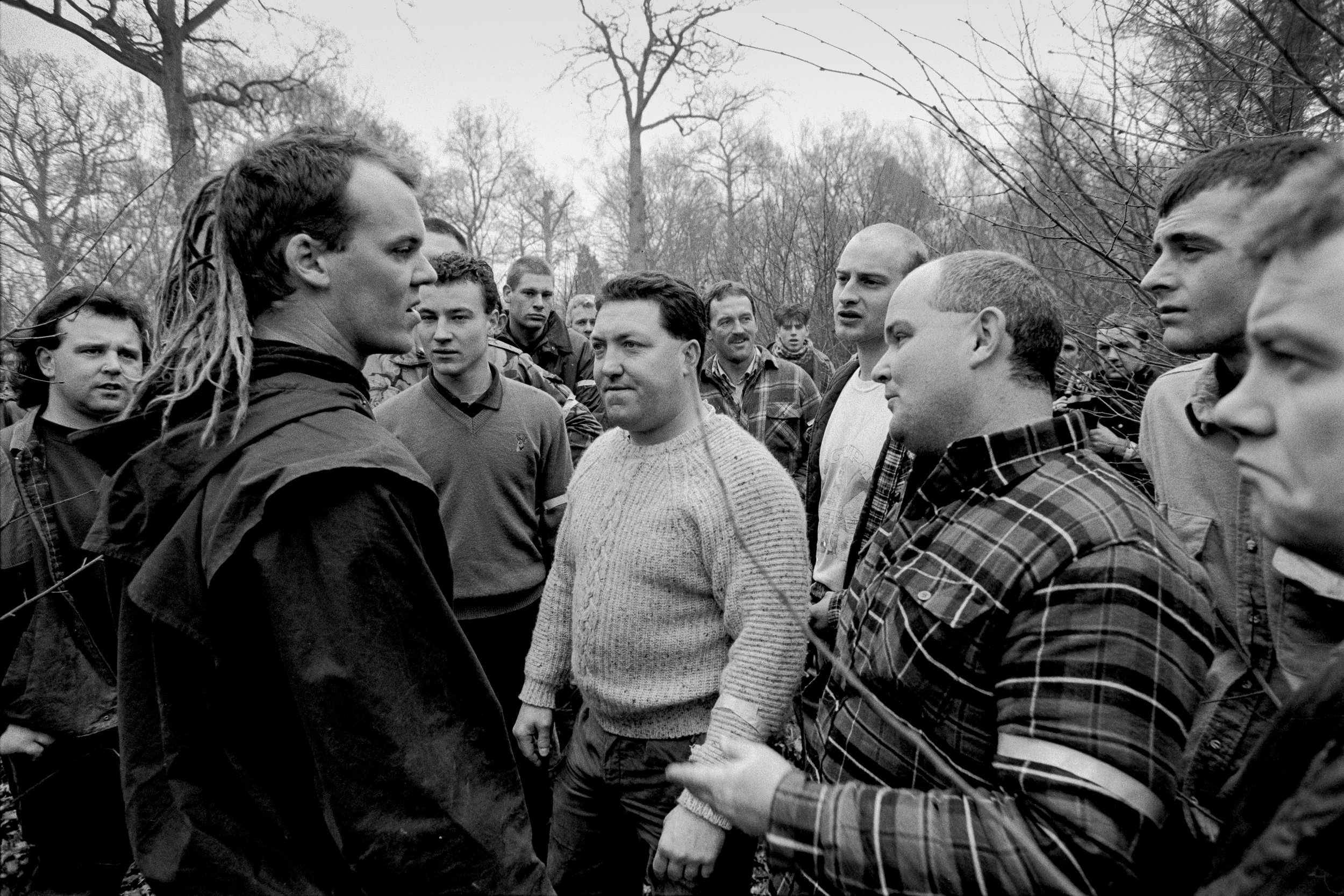
Hunt saboteurs and hunt supporters face to face. Pic: Andrew Testa
Looking at the secret police reports of the time, there is relatively little about Sara, and what there is appears to be inaccurate.
The first report highlighted by Monahan [MPS-0001923], dated 29 March 1999, mentions Sara’s work at an animal sanctuary, describing her as a ‘nurse’.
She says she wasn’t a nurse, she was an unqualified assistant. There are also two reports (including MPS-0745590, dated 8 September 1999) which claim that she’d sold her car to a hunt sab known as ‘L1’, and Sara says this isn’t true either.
Sara left the UK in 2001. She sold her flat before doing so, and says Thomson was aware of this.
However, the SDS management seem to have been told that she was renting the flat out and planned to return to it – this is detailed in an Appendix to their plan for ending his deployment,‘Magenta Triangle Extraction’ [MPS-0007389].
The same document also refers to her as a ‘one-time girlfriend’ of L1. She retorts that this was ‘absolute rubbish’. They were friends, but she was never his girlfriend.
Contrary to what Thomson said in one of his witness statements, she doesn’t believe Wendy had a sexual relationship with L1 either. This is all incredibly personal information of no obvious policing value, that the police have kept on file for almost thirty years, and they didn’t even get it right.
The SDS managers were aware that Thomson’s ex-wife and three children lived in Sutton, very close to Sara’s flat. The risk of a chance encounter is mentioned in a much earlier File Note about Thomson’s ‘extraction’ dated July 2000 [MPS-0749475], which suggests that HN58 (Thomson’s boss, a Detective Chief Inspector) was planning to research Sara’s ‘route to work etc’.
We then hear about a debrief written by Thomson after his undercover deployment was over, in which he states:
‘Due to circumstances beyond anyone’s control a peripheral member of my target group moved in around the corner from my ex-wife and children, who it had been my habit to visit regularly.
After I initially reported this I was informed that S squad would be tasked to follow the hood in question [redacted] so that we could assess the threat accurately. This was never done and the ‘follow’ was eventually performed by an ex-member of the branch.’
Sara was not the only one of Thomson’s targets to live or work in Sutton, so the Inquiry is not yet sure if she was the person trailed by a former Special Branch manager at Thomson’s behest.
She made the point:
‘The risk that he took in the first place of beginning a relationship with me when he knew that I lived two streets away from his ex and his children. That was a massive huge risk that was taken that needn’t have happened.’
In his witness statement, Thomson notes:
‘I have been referred to page 4 of what is titled ‘Magenta Triangle extraction’ … which refers to the threat posed by the proximity of “Sara” to where my “children’s mother and step-father now reside”. I am asked why, bearing in mind this “threat” did I enter into a sexual relationship with “Sara”. I can only say through stupidity.’
CROYDON HUNT SABS
Monahan then moved on, to ask Sara about Thomson’s involvement in the Croydon hunt sabs.
Sara agrees that Thomson was already ‘well-established’ in the group when she got involved, saying ‘it was clear that he had been there for a while’. She recalls that everyone knew him and liked him, and he often lent out his car.

Spycop James Thomson
Thomson has claimed that he was part of the ‘second tier’ of the group but not the core. He’s said that he became ‘embedded’ in the group, and ‘included in their other protest activity’, as a result of helping with planning, organisation and logistics.
During her questioning, Monahan drew heavily on the work done by the Undercover Research Group, whose profile of Thomson mentions the group’s nicknames for him: ‘Posh Sab’ and ‘James Blond’ (Thomson has denied being aware of these nicknames).
Sara says she called him ‘James Blond’ to his face, so he definitely knew, but didn’t seem bothered about the name. She thinks it the name was because of his hair, not because anyone suspected him of being a spy.
According to the profile Thomson was considered a ‘strong fighter’, who didn’t shy away when the group was attacked by the police or hunt supporters.
Sara agreed that he had that reputation, and confirmed that he’d trained in some sort of martial art.
She was then asked a series of questions about her experiences of public disorder, and she recalled ‘scuffles’ and shouting, and instances of terrier men pushing sabs around, hunters using their whips to hurt sabs.
In November 1998, Thomson himself was attacked by hunt supporters armed with golf clubs and bats, who beat him around the head and body. Monahan produced an SDS File Note about this incident [MPS-0001577], and Thomson taking time off due to his injuries.
‘Wendy’ was attacked by the group too, and has described this in her written witness statement [UCPI0000038208]. However, Sara doesn’t remember this incident, and wasn’t there at the time.
We also heard about another report filed by Thomson in November 1998. In it he claims that the Croydon hunt sab group were planning to physically attack a fascist at his home.
Sara was involved in the group by this time, but says she didn’t know about this, and it doesn’t sound like the sort of thing they would do. She never saw the hunt sabs committing acts of violence, and doesn’t think that they ever carried weapons.
Thomson has made a number of claims about the group’s involvement in ‘criminal activity’ and public disorder. Sara doesn’t agree with his claim that they had ‘a broad anarchic agenda’.
She says some of them went on marches and protests for human rights as well as animal rights. She only went to one demo at Hillgrove (a farm where cats were bred for vivisection, which closed in August 1999 due to campaigning). Thomson told her that he was going to take part in some ‘home visits’, but didn’t share details of these with her.
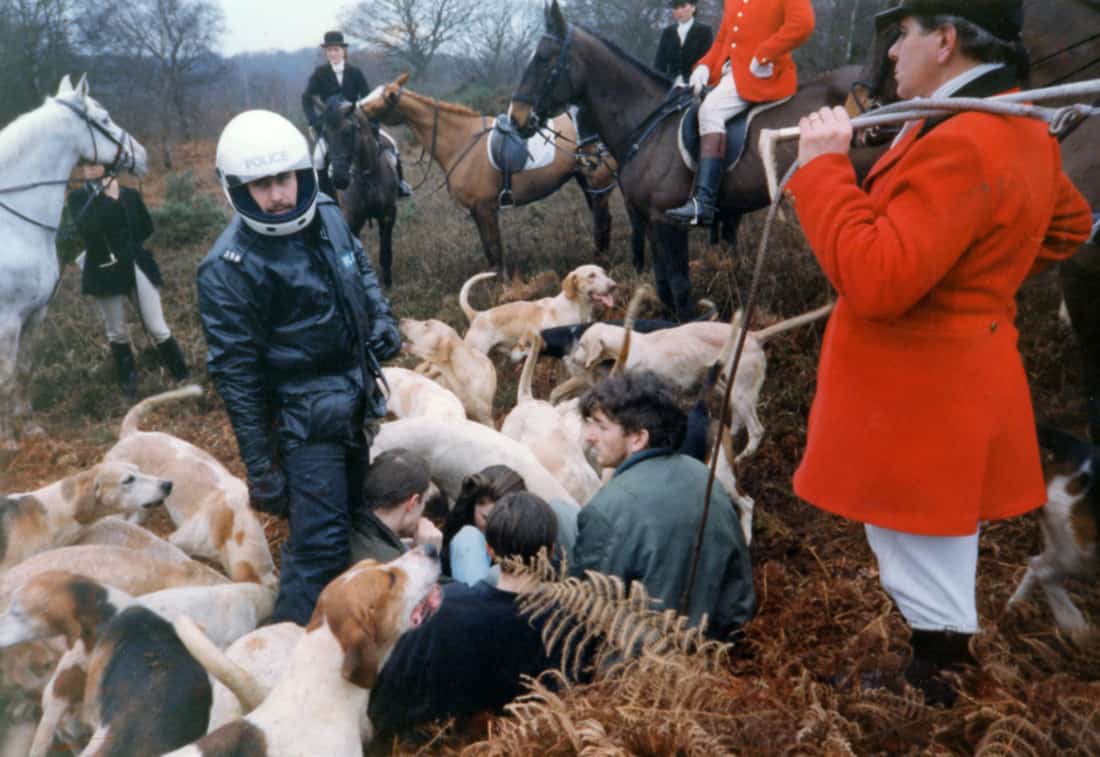
Saboteurs from the New Forest and Winchester protect a fox earth from the New Forest Foxhounds
On 1 September 2000 another Croydon hunt sab, ‘L4’, was run over by a member of the Old Surrey and Burstow hunt in a 4-wheel-drive vehicle, and very nearly killed.
His injuries were so severe that he spent months in hospital, regularly visited by Thomson, who pretended to be a good friend.
In his report of the incident, Thomson wrote about the anger felt by the hunt sabs who witnessed this deliberate attack, and claimed that there was immediate talk of ‘reprisals’.
Sara was not there that day, but remembered how upset and outraged everyone was. In her witness statement she wrote about going along to a protest at the hunt’s kennels after this incident, but leaving early because of the atmosphere. There were very few police there, but 36 animal rights activists were arrested afterwards.
OPERATION LIME
Questioning then moved on to Sara’s holiday with Thomson in Bordeaux in January 2001. This was a fairly spontaneous, last-minute trip, proposed by Thomson, supposedly because he wanted to research a business venture involving golf carts, although as far as Sara was concerned it was ‘just a jolly’, a nice little break with friends.
Thomson and another sab, known in the Inquiry as ‘L3’, drove there together. Sara flew down to meet them a few days later.
Here, Monahan read from Sara’s witness statement:
‘He arrived at Bordeaux Airport to collect me in a hire car, saying his Land Rover had been stolen in Marseille.’
He didn’t seem particularly bothered about the loss of this vehicle and everything inside it. Sara doesn’t remember Thomson saying anything about looking for it, or reporting the theft.
Unsurprisingly Sara doesn’t remember much in the way of detail about what appeared to her to be an innocuous trip to France 25 years ago:
‘Nothing stands out… I can remember we had a walk around town, went for coffee and lunch and things like that, and we went to the beach at one point for a walk. And that’s all I can remember, really. I think we went to a… whether it was an Indian or vegetarian restaurant or something we found while we were there. That’s all I can really remember.’
However, documentary evidence reveals that this ‘holiday’ was in fact ‘Operation Lime’. The ‘theft’ of the Land Rover was engineered by Thomson’s police handlers, ostensibly to disrupt the procurement of a firearm in Marseille, for £700, by ‘L3’, who allegedly had criminal contacts in France. The gun was supposedly in the vehicle when it was ‘stolen’.
Q. Were you aware at any point of any what seemed to be secretive conversations between the two of them, of them nipping off for private conversations?
A. Not that I can recall…Q. Just for the avoidance of doubt, just to be absolutely clear on your evidence, you have no recollection on that trip of anything being said about a firearm having been obtained in Marseille?
A. No. No, not at all.
Q. Nothing about the firearm being in the vehicle?
A. Nothing, no.
We heard from David Barr KC, Counsel to the Inquiry, during Opening Statements that even at this time, SDS managers were suspicious that this ‘plot’ might in fact have been a self-aggrandising tale made up by Thomson, planting a gun he had in order to make it seem like the animal rights activists were trying to buy one.
There is evidence that Thomson owned a firearm which he kept in a ‘deposit box’ in France, and Barr has made clear that the Inquiry will be investigating whether there was ‘a genuine plot which DS Thomson’s intelligence and actions thwarted, or was it all a deception on his part?’
Sara, who was present on the trip, clearly had no notion that there was any kind of plot involved.
![Police photograph of the gun found in James Thomson's car, January 2001 [MPS-0004963]](https://campaignopposingpolicesurveillance.com/wp-content/uploads/2025/11/L3-gun-MPS-0004963-scaled.jpg)
Police photograph of the gun found in James Thomson’s car, January 2001 [MPS-0004963]
Monahan then moved on to ask ‘Sara’ about the things she is really here to give evidence about: the deceitful sexual relationship that James Thomson engineered with her.
Sara met Thomson in autumn 1998. She was in her early 30s at the time, and remembered:
‘We made each other laugh. I think we just had a lot… we just connected.’
She was interested in him, and discussed the idea with friends. At some point he called her, and arranged a dinner date at a vegetarian restaurant in Croydon. It went really well, and he called her almost immediately after to invite her on a day trip to France. It was clearly the start of something. They went to Calais and bought wine and cheese (she wasn’t vegan at this point).
Sara describes the relationship as affectionate, but quite chaste, for the first few weeks. They would spend the night together, but not have sex:
‘I know he was reticent that is true, at the beginning… he was holding back and wanted to wait…’
Q: Even though you weren’t having full sex with him, did you during this period of time consider yourself to be in a fully committed monogamous relationship?
‘From my point of view, yes, we were in a relationship at that point… Just the intimacy between us. I don’t mean just physically I mean in general, the connection that we had with each other.’
Like other officers, Thomson lied to Sara about his age, claiming to 33, five years younger than he really was.
Sara was specifically asked about this, as Thomson had told ‘Ellie’, a substantially younger woman he deceived into a relationship, that Sara had corrected his claim to be 33 and reminded him he was actually 36 (Ellie has also given evidence to the Inquiry).
Sara is certain this never happened:
‘No, because my understanding until I found out the truth was that he was two years younger than me, three years younger than me, I can’t remember exactly now, but he was younger than me. That would have made him older than me, so that wouldn’t have happened.’
In fact, he was neither 33 or 36 when he began his relationship with Ellie, but 37.
Thomson told Sara he was a location manager and scout for TV and films, and that meant he travelled a lot for work.
He also told her he had three children with an ex-partner, and made it clear that he was a devoted father; they were his priority.
Thomson claimed that his ex had tricked him into having the first child, and Sara says she found it odd that he had gone on to have two more children with the same woman if she had tricked him into having the first.
Not long after they became close, they did start having sex, and the relationship became more intense. They would see each other two or three times a week, generally at her house.
SOMETHING ISN’T RIGHT
Sara only stayed at Thomson’s place once. Her description is very similar to those given by numerous women deceived into relationships by other spycops:
‘It was totally not his style and it didn’t look lived in… it didn’t look like anybody lived there. I found it quite strange and I thought it was because he was travelling so much that it was just a touchdown base.’
Sara described the relationship:
‘I felt like I had met somebody who really got me, and who got my life on all levels, especially the spiritual aspect of my life that was happening, getting deeper at that time. We had a lot of fun together.
And there was just a connection… it felt for me like a soul connection, that’s the only way I can describe it, like somebody I had known a lot longer than I actually did, on some level. It was not just on the physical mental plane, there was something else for me going on there.’
They never had any rows or conflicts. She introduced him to her parents as her boyfriend. During a trip to the town of Glastonbury in the summer of 1999, he told her he loved her. She adored him.
‘It was a mutual thing for me, we just really enjoyed each other’s company and I was always over the moon to see him.’
Nevertheless, in her written statement Sara described being cautious:
‘His life was very compartmentalised. Something didn’t sit quite right. It was as if there was a part of him that was kept at bay.’
He met her friends. But she never met any of his, nor his family.
The mixed messages Sara received took up a lot of mental energy and were ultimately quite damaging to her:
‘I was very preoccupied with this, so much so that there were nights when I could not sleep and running it over in my mind and writing in my journal about it. However, I was totally in love with him and just thought that was how he was and that he was a very private person.’
She described one odd incident when he was away and she asked him for an address. She tried to send him flowers but the delivery failed. The address was a B&B and there was no James Straven known at that address.
However, he made up a complicated story about it being owned by his family and the staff not knowing he was there, and she gave him the benefit of the doubt. With hindsight she says she would always find a benign justification for the way he was behaving.
UNDERSTATEMENT AND LIES
Thomson has made several statements to the Inquiry, with differing accounts of his relationship with Sara. In his second witness statement [UCPI00000352], dated 17 April 2018, he claimed:
‘We had a brief sexual relationship over a few weeks.’
Monahan observed that ‘he’s very vague about the duration of your relationship’ and in his 2023 witness statement he says:
‘I cannot remember how long the sexual relationship lasted. We were good friends until she moved abroad.’
Sara testified that the sexual relationship had in fact lasted over a year.
It ended after Thomson had disappeared for around two weeks, during Christmas 1999:
‘At that time of year, it’s a time where, you know, intimacy can deepen or just you know you would expect to be hanging out a little bit with the person you’re in love with.
And usually if he’d gone away, if he was away with his kids or if he was away on a work assignment, I would know about it and roughly how long he would be and we were always in touch when he was away.
So the fact that he just totally disappeared, I got quite concerned about it as well, like, what’s happened to him?’
After two weeks of unexpected silence she was upset and confused, and for the first time ever, challenged him about his behaviour. His response was to show up at her house, hand-deliver a letter and leave her alone to read it.
ENDING IT
In her witness statement, Sara recalls Thomson’s stories in the letter:
‘He had difficulties maintaining intimate relationships for long periods of time due to traumatic childhood experiences. He said that when he had been at boarding school his best friend had been raped by the headmaster and had subsequently committed suicide…
He also said that his first sexual relationship had been with a 35-year old teacher from his school and that this had impacted him significantly.’
He returned to talk to her once she’d read it. He said that the trauma made sexual relationships very difficult for him.
Monahan asked Sara about her reactions to this letter, which were obviously complex. She spoke of compassion, empathy, but also some confrontation about why he had put her in that position:
‘I think there was that lot of mixed emotion going on there, because I think there was something that clicked about, “ah that makes sense”, to why he had been behaving like he had.
There was also, sure, some disappointment but there was that lot of hope also because that wasn’t the main part of our relationship.’
However Sara also pointed out:
‘That whole story was that all pre-planned so that it all made sense all the way down the line. All the jigsaw puzzle bits being put together way in advance of all of this happening.’
This degree of premeditated manipulation was not exclusive to Thomson, many spycops had elaborate stories of childhood abuse and trauma as part of the reasons why they could not continue being with people they deceived. They gave no consideration to the horrendous impacts this had.
Sara explained how Thomson asked told her not to tell anyone about the letter:
‘I have to say at this point that I did talk to people about that letter because it was necessary for me because the adjustment from going from that type of relationship to this…
One of the reasons for me that finding out [that he was a spycop] was such a relief, because I had so much guilt over that for years and I want to make it absolutely clear at this point that these relationships did not just affect us during the relationship…
Q. If this doesn’t seem like a silly question, but what was your understanding at the time of why he was asking you to keep the contents of the letter secret?
A. Probably because of… it’s not something he would have wanted widely known, that he had problems around sex.
Q. And because it was private information about painful past experiences?
A. Yes.
Q. Thinking about it now, “Sara”, do you have a view on why you think he swore you to secrecy, now you know the truth?
A. Because of the contents of that letter are outrageous. It’s an outrageous thing to have told me if that is not true. And maybe some part of him knew that it would come out at some point.
I don’t know. Maybe he wanted to have other sexual relationships and that wouldn’t have made sense. I don’t know…
Q. Again, at the risk of stating the obvious but now that you know that it was all fabricated, what is your feeling about this letter?
A. I don’t really have the words… I think you can understand how disgusted and outrageous it was to have written what he did and to put me under that sort of pressure, and a pressure that has lasted over 20 years of my life.’
In his witness statement Thomson claims:
‘The sexual relationship ended through mutual agreement. I realised it was getting serious and I recognised the difficulties that would cause for both of us.’
However Sara was adamant that there was no ‘mutual agreement’, saying:
‘It was definitely on his request that the sexual relationship ended.’
The sexual element of their relationship was over, but in the letter Thomson had written that he still wanted to spend time with Sara, and seems to have continued acting as if she was his girlfriend. She says:
‘For me, sex or no sex, it was still a very intimate and exclusive relationship.’
STAYING CLOSE
He admitted to her that he wouldn’t be happy about her getting together with someone else. They were still very close, in regular contact and emotionally intimate. He travelled to India to join her on holiday in Goa, where they shared a room. He bought her a birthday present.
Sara described her feelings about this new relationship status in her written statement:
‘After this, we continued to spend much time together for several months, although we were no longer having sex with each other. For me, it was possible to make the shift to a non-sexual relationship because our connection was so strong on so many levels.
We still delighted in each other’s company and, of course, the continued close relationship meant that I held on to a hope that he would change his mind with time or that we could somehow work it out. It was on my mind all the time.’
‘James Straven’ had been to Goa before – he’d gone there with some other hunt sabs back in 1999. That little jolly was authorised by the SDS. His handler, Sergeant Greaney, justified it in a document [MPS-0527635] claiming:
‘This trip offers him the greatest opportunity yet to bridge the final barriers and gain total acceptance into the inner sanctum and all the advantages that will entail.
In a neutral environment, away from the paranoid fears of police/state interference, it is probable that he will become privy to the past actions, present plans and future intentions of L2 and L1.’
However, it seems there was no such authorisation for the week he spent there with Sara. Asked why she thought he went, Sara replied:
‘I would say it was pleasure… we went to the beach, we travelled a bit. Yes, it was just like a fun time.’
Sara moved abroad in March 2001. Soon after she left she discovered that Thomson had started seeing ‘Ellie’.
‘Q. How did you feel when you found that out?
A. Shattered, if I am really honest. Confused, completely and utterly confused… in my mind it was like, if we were that close and it was a sexual thing that stopped the relationship, why wouldn’t he have carried on just seeing me? Why was he starting a relationship that I knew to be sexual with somebody else?…
And I also had deep concern for the fact that he was going to take somebody else down the path that he had taken me…
I emailed him about that and was like, “What the hell are you doing? It’s not fair if you are about to start down the same pathway as you did with me”.
So it caused a lot of confusion and a lot of angst… He didn’t reply and I never heard from him again.’
Sara also recounted an incident where Thomson found out about a casual relationship she had with another man months after Thomson had ended the physical relationship with her. In her written statement she describes how Thomson reacted:
‘He wrote to me when I had moved abroad and asked why I had shared a room with him in January 2000 on the Goa trip if I was seeing someone else. I was not seeing this man when I went away with him in 2000, James had the dates wrong.
In this email he basically questioned my morals, which now I know the truth I find abhorrent.’
Monahan goes even further to say that it sounds like Thomson was gaslighting Sara.
IMPACT
Sara was plagued by distressing and disturbing dreams about Thomson, long before she discovered he was an undercover officer.
Around 2013 she ended up ceremoniously burning all her journals, lots of photographs of him, the letter he’d written (in which he claimed to be a victim of sexual abuse) and anything else which related to him, in order to get him out of her system.
She eloquently explained to the Inquiry:
‘These relationships did not just affect us during the relationship and from the date we found out, that it has been ongoing in that period in between.’
It never occurred to her at the time that he was an undercover police officer. After the news broke about HN26 ‘Christine Green’, who also infiltrated hunt sab groups, somebody suggested to her that he might have been one too.
However Sara didn’t take this possibility seriously, saying ‘it sounded too far-fetched’. In the absence of concrete proof, she refused to believe it.
‘I didn’t really take it on board… It was to do with not just his closeness to me, but other people in our group as well. The fact that he was such an integrated part of our group.
And for me at that time it was, like, having had the letter about all his sexual difficulties and the abuse and everything else, it was like, well, that happens to people, and that could be why he compartmentalised sides of his life, it was a way of coping with what had happened. So for me it was like that could be completely plausible.’
The Inquiry contacted Sara for the first time in August 2018, and told her that Thomson had been an undercover police officer. She says she was shocked, angry and confused, but also relieved to realise that she wasn’t paranoid:
‘Well, you know, after years of confusion and trying to work out… it is like layers of an onion coming off, you know. It takes time to make that switch from what was to what is, it’s not overnight.
I would say it took months, years, whatever, it is still ongoing in some ways…
The psyche knows when something is off. It’s a subconscious thing. And I think there were times, you know when I burnt those journals it is like, am I nuts, why can’t I move on from this? Because it didn’t make sense. So I used to question my own like feelings and stuff around it.
I did feel crazy at times. So in a way there was a relief in finally knowing that there was a good reason why I felt like that.’
However, Sara was also very scared that she would bump into Thomson, or that he would turn up and threaten her into silence. The discovery has had a lasting impact on her:
‘It changed my behaviour. It changed my feeling of safety completely and until I moved a year ago, if ever anything disappeared in my house that I couldn’t find, my response was always “who’s been in my house?” And that is a really hard thing to live with. And something happens you just get used to it. It becomes a new norm.
And it is only when I have looked back that I realise how much of an impact that is… it’s completely and utterly annihilated any sense of trust. It’s annihilated my trust in the state, in the police, I don’t know where I would go if something happened to me…
It affected my mental health. It affected my concentration and ability to relax and that is ongoing to this day. That has never returned to the level that it was at before. And I just feel like my life has been invaded again and again and again.’
ABUSE AS TRADECRAFT
Monahan read out the now-infamous advice of HN2 Andy Coles that appears in the SDS’s ‘Tradecraft Manual’ [MPS-0527597]:
‘If you have no other option but to become involved with a weary you should try to have fleeting disastrous relationships with individuals who are not important to your sources of information.’
Sara said she found it ‘utterly misogynistic and outrageous’.
Monahan went on to explain about the SDS’s mentoring scheme. Thomson’s mentor was HN1 ‘Matt Rayner’, another officer who is now known to have deceived a woman, Denise Fuller, into a sexual relationship. (The Inquiry has granted him anonymity over his real name, despite the their earlier promises not to do so for such men).
HN1 ‘Matt Rayner’ also mentored HN14 Jim Boyling, who had three or four sexual relationships during his deployment.
In his witness statement to the Inquiry (which the Inquiry has not yet published), Boyling says that HN1 was ‘candid’ about the benefits of entering into relationships:
‘I remember him saying words to the effect that as an undercover you were never going to break through the glass ceiling of acceptance, you were never going to get the acceptance of the inner circle unless they had confidence in you and this would not be forthcoming if you were perceived to be a single man living alone. Confidence could come from seeing you in a relationship with a fellow activist.’
The Inquiry has seen evidence that HN1 ‘Matt Rayner’ knew about Boyling’s relationships, and was also aware of Thomson’s. He reported this to an SDS Inspector, HN53, in May 2002.
By then though, Thomson’s time in the field had been brought to an ignominious end. SDS managers carried out an investigation into his activities and concluded that as well as failing to deliver a decent amount of credible intelligence, he had committed a host of other disciplinary breaches, some of them criminal.
These included disobeying his managers, travelling abroad in defiance of orders, making fraudulent expenses claims, the misuse of unauthorised false identities and last but not least, some extremely shoddy tradecraft.
Following an interview in September 2002, Detective Chief Superintendent Colin Black noted in a document [MPS-0722289] that:
‘It is clear that he has entered into relationships during the course of his work which are inappropriate.’

After his SDS deployment ended, James Thomson became a VIP protection officer. He is photographed here (centre, Barbour jacket, looking at camera) with Tony Blair, Dublin, September 2010
CULTURE OF IMPUNITY
Thomson was never formally disciplined, or prosecuted, for his behaviour. The managers knew that taking action against errant officers would risk them becoming disgruntled and making the unit’s existence public.
Learning about all this now for the first time, Sara reacted:
‘For me it is just unbelievable that there was no consideration for the impact that would have on us whatsoever. There was no consideration given to their wives and partners…
[It was known] that he was having a relationship, though it was decided not to be divulged to us to protect the SDS. So for 17 years of my life earlier I could have known that and been saved quite a lot of distress…
But it seems that there is no importance given to the impact on us, whatsoever, in any of this, and I find that abhorrent and shocking.’
After Monahan had finished, Sara’s own barrister, Charlotte Kilroy KC, asked her if there was anything she wanted to add. She made a point about undercover policing today:
‘Shortly after the Sarah Everard case [a woman raped and killed by a Met officer] and there was talk about the Metropolitan Police putting undercover – I can’t even say this – they were going to put undercover officers in nightclubs to protect women.
And for me, I am like, really, please do not put those men in charge of our safety. Ever. And I just want to be clear on that. I found that so shocking, after what they have done to put them in charge of women’s safety anywhere is unthinkable.’
Sara ended with a plea on behalf of other women:
‘It has been a journey, you know, of recovery. And I thought I was getting there, but I see from today that the impact is still there, how deeply impacted my life has been…
And I am standing here for other women, and I wouldn’t be here for any other reason and please do not allow this to happen again.’
The Chair of the Inquiry, Sir John Mitting, thanked Sara for giving evidence, recognising that it has plainly been a very difficult process:
‘As I am sure you know, I am not in charge of policing and although I can make my own views clear to those who are, all I can do, like you, is to hope that your views and mine will be paid heed to.’