UCPI Daily Report, 12 Nov 2025: ‘Lewis’ evidence
Tranche 3 Phase 1, Day 13
12 November 2025

Special Demonstration Squad officer Peter Francis, who9 spied on Lewis and Youth Against Racism in Europe
INTRODUCTION
The testimony of ‘Lewis’ to the Undercover Policing Inquiry took place on Wednesday 12 November 2025.
It offered one of the clearest illustrations yet of political policing based on Metropolitan Police paranoia, faulty intelligence, and institutional suspicion producing years of unwarranted surveillance.
Lewis was a student organiser at Kingsway College, in the early 1990s. His leadership of the Kingsway College Anti-Fascist Group (KAFG) and involvement in Youth Against Racism in Europe (YRE) led to him being secretly targeted in 1993 by Special Demonstration Squad officer HN43 Peter Francis ‘Peter Black’ / Peter Johnson’ / ‘Peter Daley’.
What emerged from Lewis’s account was the deeply ordinary, democratic nature of the anti-fascist organising he led, and the extraordinary levels of distortion in secret police reports that transformed a small, youthful, non-violent student group into a supposed ‘violent anti-fascist alliance’.
The story is less about genuine threat and more about police paranoia, misreads, bureaucratic exaggeration and the willingness of the Special Demonstration Squad to treat left-wing youth campaigning as subversion.

Don Ramble, who questioned Lewis for the Inquiry
The Undercover Policing Inquiry (UCPI) is an independent, judge-led inquiry into undercover policing in England and Wales. Its main focus is the activity of two units who deployed long-term undercover officers into a variety of political groups: the Special Demonstration Squad (SDS, 1968-2008) and the National Public Order Intelligence Unit (NPOIU, 1999-2011). Spycops from these units lived as activists for years at a time, spying on more than 1,000 groups.
Lewis values his privacy and has been granted a high level of anonymity at the Inquiry. His evidence was not video or audio recorded, and was only available to those in the room at the time, and from a transcript published later. A more detailed examination of the events he describes and the SDS reports on them can be found in our reports of the hearings for his contemporaries such as Lois Austin, Dan Gillman, Alex Owolade and Hannah Sell.
Lewis’s questioning was part of the Inquiry’s Tranche 3, examining the final 15 years of the Special Demonstration Squad, 1993-2008. Lewis has given the Inquiry a written witness statement.
He was questioned for the Inquiry by Don Ramble.
YOUTHFUL ANTI-FASCISTS MISCAST AS A MENACE
The Kingsway College Anti-Fascist Group was, at its core, a student-run contingent of teenagers and young adults determined to oppose the British National Party and racist violence in early-1990s London.
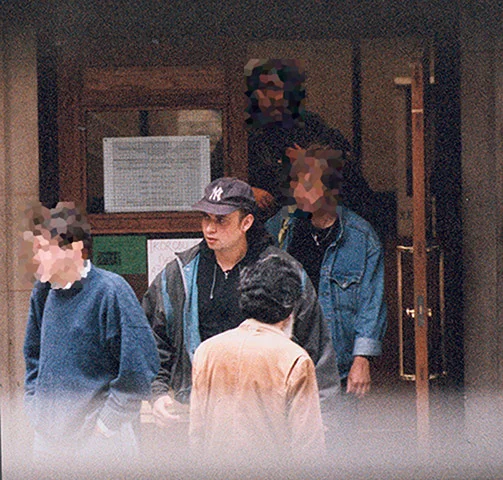
Spycop Peter Francis in a Special Branch surveillance photo of an activist event at Conway Hall, London, in the mid 1990s
Members were mostly between 16 and 25. They travelled together to demonstrations, marched behind their own banner, and maintained internal discipline through their own stewards.
According to Lewis, KAFG’s ethos was unambiguous: they avoided violence, never masked up, and attempted to calm anyone who tried to behave aggressively within their section.
Their stewarding tactics at large mobilisations, including the huge high-profile 1993 Welling demonstration against the British National Party (BNP), involved firstly protecting their young members, and then linking arms to stop panic when police charged, in order to protect the demonstration. They believed in mass mobilisation, good stewarding, self-defence, but not initiating confrontation.
Yet early SDS documents, prepared before Francis even infiltrated the group, cast this modest college-based contingent as the spearhead of a new violent bloc inside YRE.
The SDS mistakenly identified Lewis as having led a ‘charge’ on BNP paper sellers at Brick Lane in East London, an event at which he stated categorically he attended but did not ‘lead the charge’ as reported. Yet that single error snowballed into a formal targeting decision, and undercover officer HN43 Peter Francis was deployed to spy on him.
YOUTH AGAINST RACISM IN EUROPE:
BROAD, DEMOCRATIC AND ORGANISED
Youth Against Racism in Europe (YRE), another of Francis’s targets, appears in the Inquiry testimony as a broad, multi-racial, youth-led coalition active in Hackney, Tower Hamlets, and across the UK and Europe. It was not a clandestine outfit but a public, campaigning organisation that held meetings, organised demonstrations and stewarded marches in a disciplined manner, and had over 20,000 members.

Youth Against Racism in Europe protest
While some in its leadership were members of Militant Labour (now called the Socialist Party), Lewis said that, contrary to what Francis and other spycops reported to their manager, YRE cannot meaningfully be described as a Militant ‘front’. Lewis himself was from a rival political tendency, yet became a leading organiser within local YRE branches simply by virtue of commitment and activity.
YRE and KAFG often collaborated. At the Unity Demonstration in Welling (organised jointly by YRE, Anti-Nazi League, and the Indian Workers Association), YRE stewards linked arms with students from Kingsway on the front lines of the march.
A later TV documentary would sensationalise claims about an ‘away team’ within YRE who were bent on provoking violence, but Lewis clarifies that the term only appeared around a single Brick Lane protest and did not represent YRE policy or culture.
The organisation neither planned nor advocated violence and, in Lewis’s words, ‘posed no real threat to the state whatsoever’.
Yet Francis, in his retrospective justifications, framed groups like YRE as potential subversives, assertions that Lewis flatly rejects.
BRICK LANE: PUBLIC ORGANISING, POLICE MISINTERPRETATION
The BNP held regular paper sales in the multicultural Brick Lane in East London. One particular protest there forms the crux of why Lewis believed he was targeted.
In 1993, alongside YRE and Militant Labour, Lewis co-organised a mass mobilisation designed simply to occupy the BNP’s pitch before they arrived. This was a standard and openly advertised tactic. Lewis’s mobile number was even printed on fly posters.
According to his evidence, this innocuous fact, being publicly identifiable as an organiser, appears to have been misread by Special Branch and SDS officers as evidence of militancy or leadership of a violent faction.
When undercover officer HN78 Trevor Morris falsely associated Lewis with a supposed ‘charge’ on BNP supporters, an entire mythology grew around him: he was inflated into a dangerous ringleader.
Lewis dismissed all these claims as fiction. There had been no casualties, no charges, no plots, just bad, invented intelligence, later laundered into a justification for intrusive surveillance.
WELLING: DISCIPLINE, NOT DISORDER

Protest against the British National Party, Welling, 16 October 1993
Lewis gave evidence on the Welling Unity Demonstration. The 16 October 1993 anti-fascist mobilisation was one of the largest in a generation.
Lewis describes KAFG’s contingent as disciplined and defensive: linking arms against police charges, wearing hard hats only to protect against baton strikes.
He completely rejected the idea that demonstrators wore masks or carried improvised weapons.
Lewis stated that Peter Francis’s reporting on Welling blends fragments of truth with exaggeration. He correctly notes a post-demonstration meeting held to review stewarding, but attributes to Lewis comments and intentions that Lewis contests or considers distorted.
The suggestion that KAFG or YRE intended to break through police lines or take control of far-right premises is, in Lewis’s view, wholly inaccurate.
TARGETING DECISION BUILT ON FICTION
In his evidence Lewis highlighted how he only discovered the truth about the level of surveillance years later, when a journalist sent him an article written by Peter Francis portraying him as the ‘most dangerous man in London’.
Lewis did not even recognise himself in the description. The SDS, he says, built its entire rationale for targeting him on false premises.
The impact on him was twofold:
1. Personal shock: that radical student activism could be misread as violent extremism.
2. Political concern: that police narratives were not rooted in reality but in stereotype, assumption, imagination and paranoia.
Peter Francis’ later claims that the groups intended to overthrow parliamentary democracy – the standard spycop justification for their infiltrations – are dismissed out of hand. Lewis argues that neither KAFG, YRE, nor related groups had anything like that intention or capability. The SDS, he suggests, simply projected its own fears onto radical youth activism.
THE SDS: PARANOIA AND FANTASY
As Lewis made clear, the evidence was not merely a personal narrative, but a case study in systemic failure:
- False intelligence transformed a student organiser into a supposed extremist.
- Political prejudice against left-wing youth activism blurred distinctions between peaceful protest and subversion.
- Undercover policing powers being deployed not to prevent crime but to monitor legitimate anti-racist organising.
- Official reports exaggerated, sensationalised, or outright invented threats.
Thirty years later these failings will strike a chord, particularly with student activist groups being targeted by the Prevent programme today.
The Kingsway Anti-Fascist Group and Youth Against Racism in Europe appear from Lewis’s testimony to have been lively, disciplined, democratic youth groups confronting racism and fascism in their communities. The dangers attributed to them existed not in reality but only in the imagination of the state.
And at the heart of it, as a young organiser, Lewis found himself monitored, infiltrated and categorised as a menace, all on the basis of a catalogue of mistakes and lies.