
UCPI – Daily Report: 14 January 2025 – Liz (Denise) Fuller
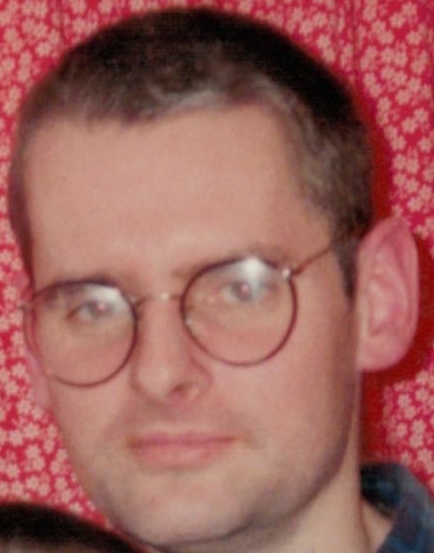
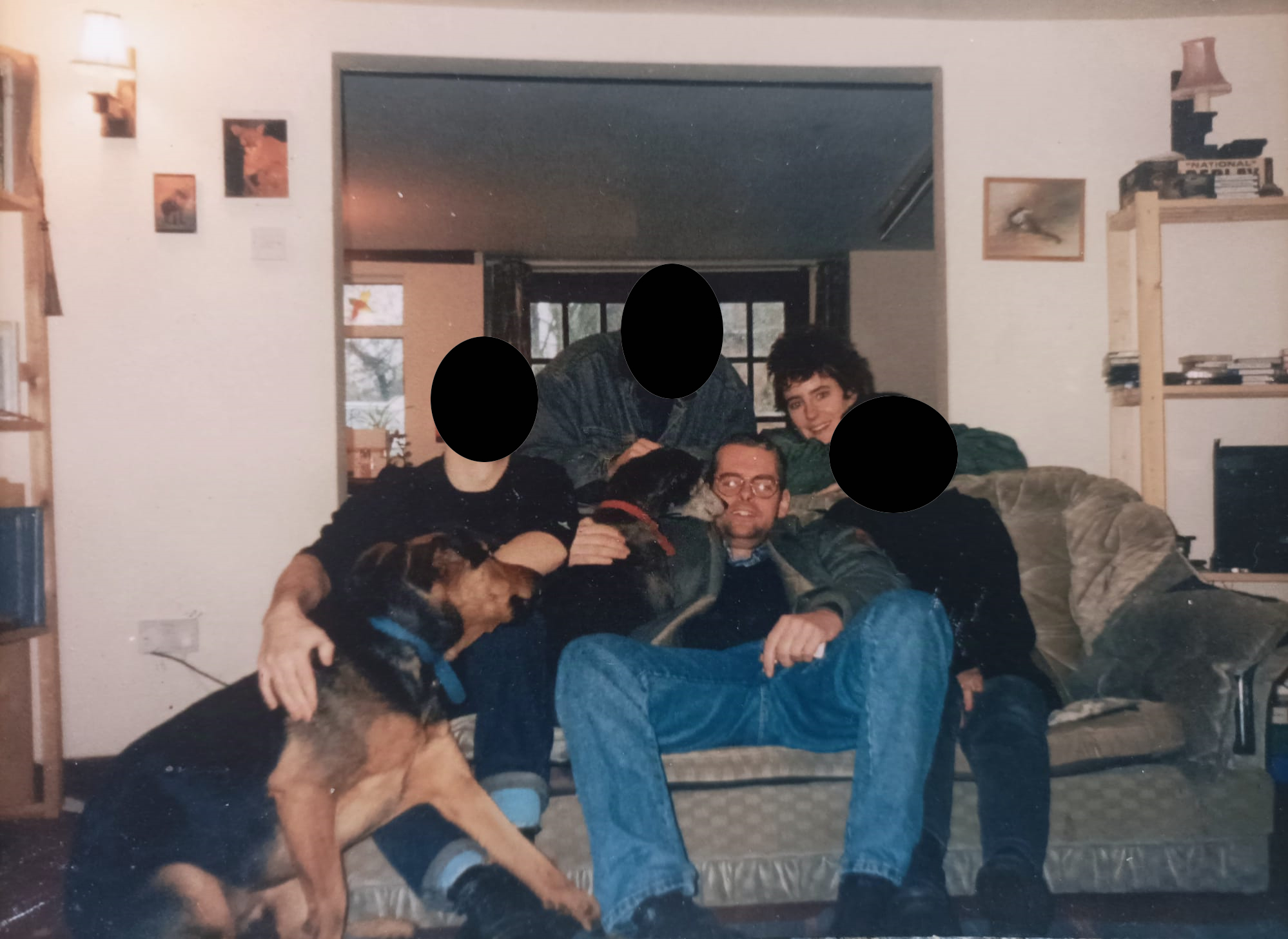
Spycop HN1 ‘Matt Rayner’ while undercover, February 1994
Liz Fuller (known as Denise Fuller to the Undercover Policing Inquiry) was an animal rights activist in London in the early 1990s. She was deceived into a relationship by Special Demonstration Squad officer HN1 ‘Matt Rayner’.
Despite the Inquiry’s earlier assurances that women deceived into relationships by spycops will be given the fullest possible account, including their abuser’s real name, they have broken their promise. We only know HN1’s cover name, ‘Matt Rayner’, which he stole from a boy who died of leukaemia.
We’ve already heard heartbreaking evidence from Kaden Blake, the real Matthew Rayner’s sister. His family also deserves the full truth and to see the man who stole their boy’s identity held to account.
The Inquiry won’t even say why it won’t publish HN1’s real name. The most obvious reason is that he currently has some role that would be adversely affected if people knew the truth about who he really is. Which is all the more reason for his name to be made public.
Liz Fuller and the Rayner family have done nothing wrong. HN1 has, yet is being protected from scrutiny and accountability. People who know him now continue to remain unaware of his abuses, which leaves them vulnerable to more.
Liz Fuller gave evidence to the Undercover Policing Inquiry on Tuesday 14 January 2025. Rachel Naylor asked questions on behalf of the Inquiry.
Liz’s Early Activism
Fuller explains that she became a vegetarian as a teenager, then saw an advert for London Boots Action Group (LBAG) in ‘Time Out’ magazine, and first went along to a meeting of the group in 1991 or 1992.
She spent her Sundays handing out leaflets outside Boots’ chemists shops (usually in Camden) informing the public about the company’s involvement in vivisection. She attended other animal rights demos and marches, and sometimes went hunt sabbing.
She started a university course in 1994. She explains that between her course and work, she didn’t have as much time for protests, and so was less involved with LBAG and the other groups.
‘I probably became less ardent and a less frequent attender’
She always demonstrated non-violently. She says they recognised that the Boots staff were retail workers, so didn’t harass them in any way.
Fuller is asked about non-violence. She provides a very clear definition, and explains that for her this went beyond not hitting people. It included not touching them at all, not throwing things and not calling anyone rude names.
It was peaceful protest. Fuller says she had no problem with economic sabotage (smashing windows and other forms of criminal damage) and forms of action that would potentially increase a company’s insurance premiums and affect the profits of those who abused animals.
Fuller attended LBAG’s meetings. These were open and publicised. They tried to educate the public about what Boots did, but never prevented people from entering the stores. Fuller tells an anecdote of leafleting someone going into Boots who said ‘I just need a bottle of Calpol for my child’ and she replied ‘go and get it!’.
She remembers going to Boots HQ in Nottingham once, but doesn’t remember any demos at people’s houses.
‘We were a legal protest group, we didn’t have any need for security measures as such’.
She thinks people within LBAG may well have supported what the Animal Liberation Front (ALF) did, but doesn’t know of anyone who was an ‘ALF activist’ as such.
She remembers ‘Andy Van’ (spycop HN2 Andy Coles ‘Andy Davey’). She didn’t like him much. She says she found him ‘a bit arrogant, and condescending’ so didn’t engage much with him. She only recalls one conversation with him, about geranium oil.
She knows ‘Jessica’, who Coles deceived into a relationship while undercover, but didn’t know her very well in those days. She didn’t know who ‘Jessica’ was having a relationship with.
Trusting the Spycop
Fuller confirms that HN1 was treasurer of LBAG, a position of trust in the group.

Matthew Rayner, whose identity was stolen by spycop HN1, in his father’s arms
This is a pattern we’ve seen emerge during the Inquiry. Spycops often took formal positions in the groups they infiltrated, and treasurer was a very common one. It tended to give the spycop people’s bank details to report, and was also a practical rather than political role so didn’t need any grounding in the ethos of the group.
Naylor asks Fuller how involved she was in London Animal Action. She says not very, she went to a few meetings.
She went along to monthly protests at Leyden Street slaughterhouse. She says they were ‘pretty chaotic’ and rowdy. There was lots of shouting. The slaughtermen threatened her with a knife, and the police told her she deserved it. She remembers that HN1 was quite vocal, but doesn’t remember if he liberated any chickens.
Asked about the organiser, an activist called ‘George’, she recalls that he was ‘erratic’ and ‘unstable’, yet also ‘kind’ and ‘forgiving’.
Naylor asks her if she remembers a group called ‘Anarchists for Animals’? Fuller doesn’t seem to. Naylor explains that this was supposedly organised by ‘George’: ‘That’s probably why it didn’t last very long’ says Fuller. Then she asks not to talk about Leyton Street Slaughterhouse any more, and questions move on.
What about ‘London Animal Protection League’? Fuller thinks they might have gone sabbing anglers. She adds that it may well have been quite short-lived. She went along because she had some sympathy for ‘George’.
Hunt Saboteurs
Fuller says she was never part of a hunt saboteur group, but occasionally went along.
‘I wasn’t very good at it!’
She describes the usual tactics used by the hunt sabs: spraying citronella to cover the scent of a fox’s trail, running, blowing hunting horns to distract hounds, etc, and talks about how good some of the other sabs were. She would just follow their lead.
She remembers the terriermen would start violence with sabs: they were ‘nasty pieces of work, they were best avoided’.
This is a sentiment echoed by HN2 Andy Coles when, at the end of his deployment, he rewrote the Special Demonstration Squad’s Tradecraft Manual [MPS-0527597]:
‘I know that in the future I will have nothing but contempt for fox hunters and in particular their terriermen.’
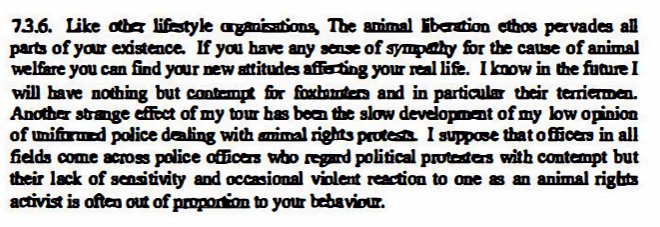
Spycop HN2 Andy Coles describing his contempt for foxhunters and uniformed police in the SDS Tradecraft Manual, 1993
Six months after his deployment ended, Coles had a debrief [MPS-0743479] in which he was asked about his concerns and fears, to which he replied:
‘I feared serious assault from terriermen or being shot by irate farmers more than anything else during my tour.’
In his evidence to the Inquiry in December 2024, Coles reaffirmed that fact.
Fuller explains she went sabbing with HN1 and suggests that he was well suited to infiltrating hunt sab groups because he was physically fit and good at running (very useful for sabbing). Fuller is asked about ‘Walter’‘s comment that HN1 was the most keen to get involved in confrontation. She says that sounds right.
LBAG’s main focus was on vivisection (animal testing) and there were other anti-vivisection groups based in other parts of the country.
Asked about her involvement in animal liberation, Fuller points out that this is meant to be an inquiry into the police’s conduct, not hers, she says she isn’t going to answer that question and we move on.
The Spycop Comes Closer
We see a report written by HN1, dated January 1993. which describes Fuller and says she is ‘probably’ involved in direct action. She scoffs at the use of ‘probably’, pointing out that she and HN1 were doing the same things together.
The report includes huge amounts of personal details about Fuller: her appearance, associates and so on. She points out it is unnecessary and unbelievable that they reported on her O-levels, or her parents’ names and salaries:
‘I find it really intrusive’.
She says she and Claire Hildreth never had any serious intention of moving in to a flat together; they didn’t go and look at any flats, despite what it says in one report.
She says she and ‘Matt’ became friendly in 1992, after she’d joined LBAG. She is asked if she can remember when she first met him. She says it’s difficult:
‘it’s such a long time ago’.
She thinks he initiated a conversation with her outside Boots, and says it was ‘a pleasant interaction’. He said that they met up for coffee and he began giving her lifts home after meetings.
Naylor asks if this was normal. Fuller says she met other male activists for coffee. He came round to her house uninvited, but she didn’t mind him being there. She says she started enjoying the company of ‘Matt’.
She moved out of her home in Burnt Oak and into a squat in Tottenham in 1993. After that the relationship became intimate.
She never felt like she knew a lot about HN1’s background. But it didn’t matter to her, he painted a picture of it all being very dull. Once they were in a relationship he would tell her things about his childhood and how he wasn’t close to his parents. She says it wasn’t unusual for an animal rights activist not to be close to their families – they were often seen as ‘weird’ for being vegan.
Unlike other spycops, he didn’t describe a particularly traumatic childhood. He knew how to play the piano. She says he seemed to be ‘very stable’ and ‘somebody you could depend on’.
She recalls how suspicious ‘George’ was but ‘he was a crackpot’. She says ‘George’ was very suspicious of everyone, and had a ‘very vivid imagination’. She recalls that he often said he was convinced that ‘Matt’ was a cop, and on one occasion even asked her to search Matt’s room. However she refused to do this for him, and told him she didn’t agree with his theory. She didn’t take his, or other people’s, suspicions seriously.
She goes on to say that ‘George’ has since told her that ‘Matt’ openly admitted to him that he was an undercover police officer, and told him to go ahead and tell anyone he wanted, as nobody would ever believe him, and he should get out of animal rights because no one liked him.
Fuller believes that HN1 found it easier to target her once ‘George’ was in prison, and therefore out of the way.
Tactical Friendships
She reckons HN1 probably ‘knew exactly what he was doing’ when he befriended Geoff Sheppard and as a result was taken ‘under his wing’ to some extent. Because Sheppard was ‘so well trusted’ and widely respected, activists would assume that HN1 could also be trusted.
It’s a similar tactic to the one employed by some of the spycops who formed deceitful sexual relationships. They deliberately targeted established, well-loved, activist women so that everyone in that woman’s social group would be more accepting and positive about them.
Fuller hopes that HN1’s relationship with her didn’t have the effect of allaying people’s suspicions of him (and she doubts that it would have, on its own).
However she can see how he may well have deliberately chosen the activists that he befriended (people like Paul Gravett, Claire Hildreth, and Geoff Sheppard, as well as herself) and this may have had a cumulative effect.
Fuller would never have entered into a relationship with HN1 had she ever suspected him to be an undercover police officer. She did not give informed consent.
There was a ‘closed’ (i.e. secret) session after the morning break and then we heard more about Fuller’s personal relationship with HN1.
Intimate Relationship Begins
We were shown a report by HN1, dated 18 May 1993, about Fuller moving house to live with two other people. She says HN1 helped her move.
He knew that she was having problems with someone at her old house. He brought his van round and helped her load her stuff into it. He came round soon after this to hang out with her and her new housemates, they had a few drinks.

Spycop HN1 ‘Matt Rayner’ at a summer party in London, 30 July 1995
Fuller says that was the evening when HN1 started a sexual relationship with her. She rejects his version of what was said.
She remembers sitting on his lap, ‘cuddled up on the sofa’. He ended up staying with her that night, and their relationship became sexual. She said it ‘naturally evolved’ and there wasn’t necessarily a conversation. She thinks she probably invited him to stay as it was her house. She had to ask her housemate for some condoms.
We are shown HN1’s witness statement, and what he says in it about the evening when he first had sex with Fuller. She rejects it and calls it rude.
HN1 claims he dropped her off after a meeting, there was a conversation, and that he ‘responded positively’ when she ‘made the first move’. He says he doesn’t remember if he stayed over that night, but admits that they did start having sex soon after that evening.
Fuller says that is not true: he had come round to spend the evening with her and her housemates. She is definite that they had sex that night, not at some later time. She rejects his claim that she made the first move, and says there is no way. She talks about how she held him in high regard at the time and had low self esteem. He was always ‘quite flirtatious’ and even flirted with her friends, and she wasn’t like that.
HN1 says that he told his manager, Bob Lambert, about Fuller’s ‘initial overture’. Lambert told him this was a ‘test’, and ‘there was only one way to pass it’. Fuller is baffled by this characterisation.
HN1 has stated that the relationship didn’t begin until ‘the second half of 1993’. Fuller is very confident that the relationship started in mid-May, about a week after she moved house.
He stayed over 3 or 4 times a week, according to her. He claims he only stayed with her once a week.
Fuller points out that she even had keys to his (cover) flat and sometimes went there when he was out. She confirms that they always used condoms, and doesn’t remember any discussions about them not being vegan.
This last point is relevant because part of HN2 Andy Coles’s elaborate denials of having a sexual relationship with ‘Jessica’ is his ridiculous assertion that they were both keen to have a relationship but because condoms weren’t vegan they had no sexual activity at all. Some of the most popular brands of condoms used a lubricant containing casein, a protein derived from cows’ milk. However, there were other readily available brands at the time which were vegan. Andy Coles is a liar.
The Relationship Settles In
Fuller believed her and HN1’s relationship to be monogamous. She only had one open relationship in her life, and this was something consciously agreed with that person.
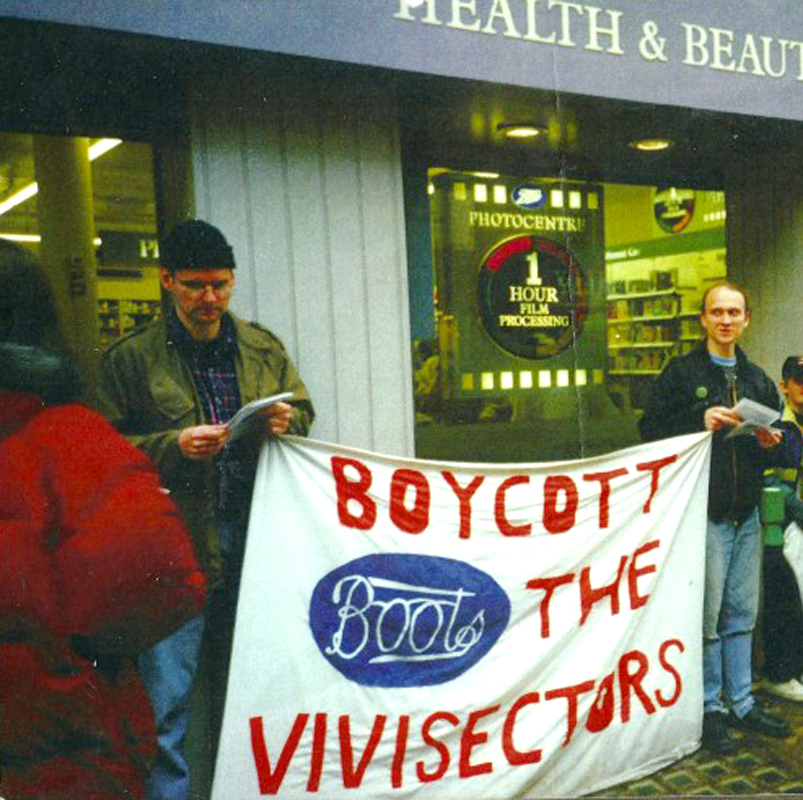
Spycop HN1 ‘Matt Rayner’ (left) with Paul Gravett, leafleting outside a branch of Boots
They sometimes stayed together at his place in West London. She says it was ‘nicer’ than hers. Sometimes she had to go home to feed her cat, but on other occasions it was more convenient to go back to his.
She says that there was a time in the summer of 1994 when she didn’t have her own home, when she lived at his for a few weeks. They hadn’t agreed to live together so this was only a short term arrangement while she looked for a new home.
HN1 went away to France, supposedly ‘for work’, for a week in 1993, and she stayed at his place for this time, again because she thought it was nicer than hers.
She says he was often away. She thought he was moving musical instruments across the country, and she never questioned it at the time. Her granddad worked as a long distance lorry driver, so it didn’t seem that odd to her.
She recalls that he had a pager and she would contact him using that. He sometimes called her when she was at work (in a hospital). She says neither of them was overly ‘flowery’ or romantic, but they checked in on each other.
They went for walks on Hampstead Heath together. They went to the theatre and the cinema (‘he liked Ken Loach’). She bought him gifts – for example for his birthday – she recalls a copy of van Gogh’s Sunflowers painting. He met her brother once.
She says they didn’t discuss their future together, and they didn’t ever go on holiday together. However, apart from being flirtatious with other women, he was ‘good company’, ‘attentive’; he seemed to be ‘kind’, ‘trustworthy’ and ‘quite solid, reliable, dependable and easy-going’. He sometimes picked her up after her late shifts at work.
She doesn’t think they ever said ‘I love you’ to each other but she felt a ‘close emotional bond’ with him – she says he’d be the first person she’d tell about things.
Their relationship wasn’t a secret at all. Asked specifically whether HN1’s contemporaries HN2 Andy Coles and HN26 ‘Christine Green’ knew about it, she can’t be certain. However, people in the movement knew about it. Anyone involved in their activist circles, spycop or otherwise, would have been aware.
Direct Action
Fuller said that due to her relationship with HN1, she did a great deal more activism than she would have done otherwise. It was often him who suggested doing things. She didn’t need much persuasion though.
She is asked what kind of things she did with him. She says she wasn’t involved in the Grand National protests at all (HN1 drove a van-load of activists to the 1993 Grand National, enabling the only instance of the race being abandoned).
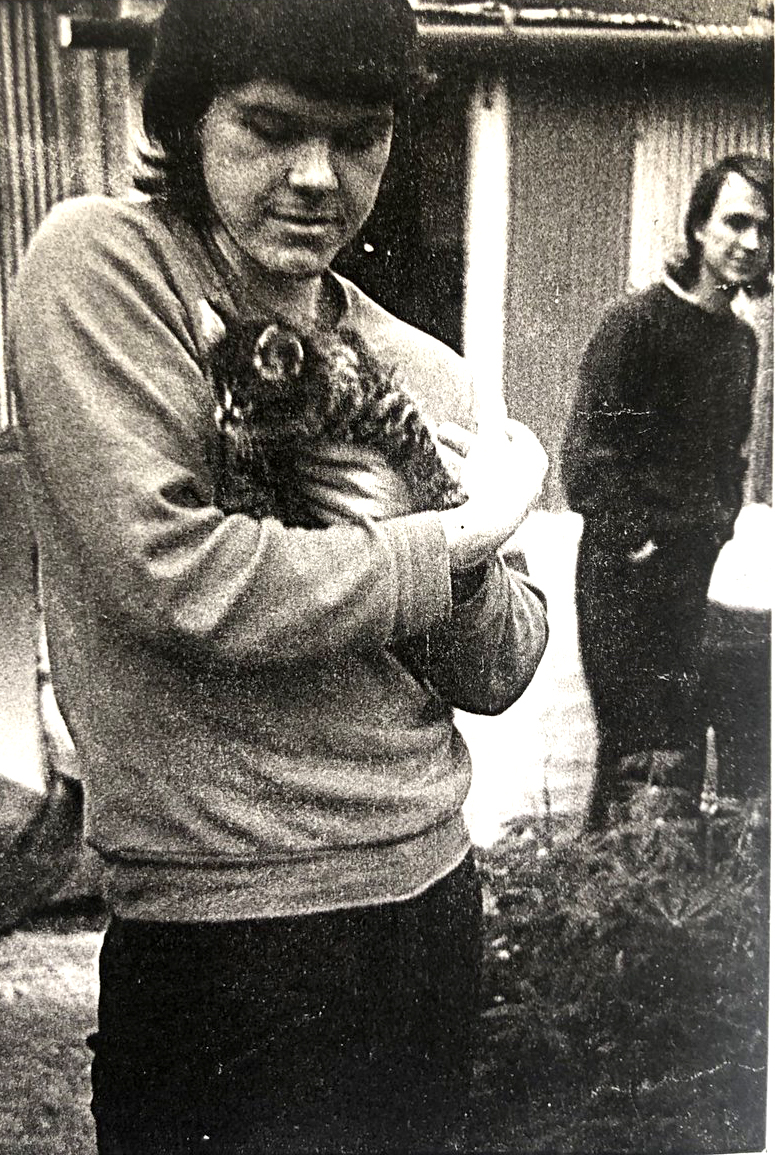
Geoff Sheppard (left) and Paul Gravett in the 1980s
She got to know Geoff Sheppard in 1991-92. They were arrested together for causing an obstruction outside Boots. She always found him to be very guarded, but it seemed to her that HN1 was close to Geoff and persuaded him to do things he had previously said he wouldn’t. Sheppard was quite quiet, but they got closer as they got to know each other better. She later went out with him for about six months, so got to know him fairly well.
She says Sheppard was a very determined single-minded person who wasn’t easily swayed by others. HN1 was one of the few people who seemed to be able to persuade him to do things.
HN1 has said in a statement (in 2015) that he ‘was in Sheppard’s shadow’ and acted as his ‘acolyte’, a follower rather than encourager. Fuller rejects this idea. She says it was ‘far more reciprocal’ than that, and she didn’t consider HN1 to be in Sheppard’s shadow at all.
She remembers that Sheppard was very clear that he intended to stick to legal activities. He didn’t want to go back to prison, but HN1 encouraged him to break the law. She says this manipulation was subtle and she didn’t see it at the time, but understands it better now.
The Inquiry has heard that between 1993 and 1995, HN1 was part of a group of four people who carried out criminal damage actions together. Fuller is shown the names (which are under redactions in HN1’s report from the time). She rejects the idea that these people were gathered together by Geoff Sheppard, and says it was all HN1’s plan.
Fuller didn’t realise that HN1 was also carrying out similar actions with other groups of activists, until she met another activist on the tube, who told her he was also doing direct action with HN1. Shocked by this, she asked HN1 about it. He denied it, and claimed that all he’d done was help them out a few times with lifts in his van.
Fuller’s written statement is shown again. It says that she saw HN1 break windows, break into Boots in Stamford Hill and cover it in red paint, and break butchers’ shop windows. She says he loved taking direct action:
‘He really got a buzz from this. It was almost as if he was on drugs – dilated pupils, great big smile.’
Fuller talks about how jubilant he was after smashing the glass doors of a Boots shop and throwing red paint over the cash register. This is something that HN1 has denied doing. Fuller says she is ‘100%’ sure that he did this.
She says he often went out at night to break windows, usually with a brick. She witnessed him doing this multiple times, but when asked to estimate how many she says it was too long ago to be specific. She says it was ‘sporadic’ and she can’t honestly remember.
HN1 had admitted to a number of occasions when he was part of a group who carried out some form of damage – at the Institute of Psychiatry and some other hospital buildings. Fuller has some memories of one such action, at a ‘fancy’ building.
HN1 claims that he drove for protests but not for direct action. Fuller says he’s lying. He was a very good driver, and she assumes now that he had done an advanced driving course. Sometimes he just drove to do direct action, but he also loved to get involved in the action himself. In her statement, Fuller has said that he often came up with ideas of things they could do, things that other people didn’t think of.
She is very, very clear: HN1 was the driving force behind a criminal damage direct action campaign. He selected targets, drove other activists and took part himself. And he absolutely loved it. She talks about numerous acts of criminal damage that HN1 took great glee in participating in. There are so many incidences that she can’t remember the details of them all.
Fuller is asked if she considered these incidents of criminal damage to be ‘ALF actions’. She points out that they didn’t entail the liberation of any animals, but did result in economic damage.
The Social Bonds
After this, the Inquiry went back into ‘closed’ hearing. When the open hearing recommenced, we heard that Fuller lived next door to Dave Morris for much of 1993. Morris was a London Greenpeace activist who was in the pre-trial phase of the McLibel case at the time, so was very much on the spycops’ radar.

The ‘McLibel Two’, Dave Morris & Helen Steel, outside a branch of McDonald’s
Fuller often babysat for Morris’ young son, and HN1 would turn up, ostensibly to see her. HN1 would sometimes be left alone downstairs while she put the child to bed or gave him a bath. All the McLibel papers were there.
She describes how HN1 was trusted by a number of ‘sensible, rational people’ and that in each case, their trusting him may have encouraged and reinforced other people’s trust in him.
Fuller is asked if her relationship with HN1 gave him increased access to Geoff Sheppard and Paul Gravett. She says she hopes it didn’t, but she feels terribly guilty about it; it keeps her awake at night.
She doesn’t feel guilty about any of the actions, but she does feel guilty about the time that Geoff Sheppard spent in prison.
Fuller is asked what HN1 might mean when he says he sat at a ‘top table’ in the pub? She says she doesn’t know – there was no ‘top table’ and they often swapped seats and tables. She thinks it must be a reference to sitting with Paul Gravett and Geoff Sheppard, two experienced activists. The spycops tended to project hierarchies and command structures on to the groups of people they spied on.
We see a report by HN1 from 21 June 1994 about Fuller. It includes lots of personal details about her appearance and claims she was very ‘anti police’ with a ‘volatile temper’. She takes issue with that, saying she wasn’t either. In her job in a hospital, she often worked alongside the police, and encountered some decent behaviour on their part.
If she had such a volatile temper, surely there would be instances mentioned in HN1’s reports? She asks where there is any evidence of her exhibiting any ‘volatile’ behaviour. There doesn’t appear to be any. The report was written after she had spent two weeks living with HN1.
Fuller says HN1’s statement admits he knew she wouldn’t have had sex with him if she had known he was a police officer. Coupled with his description of her as ‘very anti police’, she asks what this is about: was this ‘revenge sex’? She is very angry about it.
The Relationship Declines
Fuller was still seeing HN1 when she began her university course in 1994, but she saw a lot less of him after that as she was focused on her studies.
Spycop HN1 ‘Matt Rayner’ on a farewell visit to people he knew in northwest England with Claire Hildreth, 1996
She remembers that things ‘fizzled out’ between them and it didn’t seem worth the effort to continue seeing him.
She is absolutely certain that they were still together in December 1994, when she met up with him in a cafe and they had smashed avocado (not a common menu item in those days).
He gave her £50 that day. At the time she thought this was his personal money; she now assumes it was Metropolitan Police money.
Fuller says she ended the relationship in early 1995 because she started to develop feelings for someone she met in university.
HN1 says that they split up earlier. Fuller says that is absolute rubbish and a complete lie.
She recalls that he didn’t seem to take her seriously when she broke up with him, and tried to get back together (something he’s since denied doing). He phoned her several times.
Later he told her he was really depressed and was drinking wine from the bottle. He tried to rekindle it when they met in a bar.
She did feel a bit sorry for him, she knew what is was like to be depressed, but she couldn’t stay with him and it wasn’t enough to change her mind.
He seemed frustrated that she had broken up with him, he couldn’t understand it. She had to tell him she had met someone else. They were there less than an hour. She felt awful about it.
It does indeed seem to have had an effect on his ego. The other spycops tended to be the ones who left or otherwise ended things with their partners, after all.
Fuller then talks about why she finds guilt such a difficult emotion. She talks about a family tragedy and some unbearably horrific abuse that we will not repeat.
After that there is a break so Fuller can collect herself. The Inquiry’s Chair, Sir John Mitting, wants to ask a question of her lawyers. It relates to a matter from the closed session, but Mitting says HN1 needs to answer it in the open, so the issue needs addressing.
HN1 wrote to Geoff Sheppard – supposedly from Argentina – and we hear about one such letter, dated 14th February 1998. Naylor reads out a few excerpts, including:
‘I often imagine the good times that you, me, {xxx} and Liz used to have’
HN1 goes on to complain that Liz hasn’t written to him since he left London. He says he misses her and asks Geoff to say hello to her from him. Fuller doesn’t know of any other ‘Liz’ who he might be referring to here.
She points out that she was no longer in contact with him by then, two and a half years after she broke up with him! She didn’t even know he’d supposedly gone to France or Argentina. She wasn’t invited to his leaving party.
Sheppard has said that HN1 seemed to be ‘overplaying’ the relationship with Liz and she agrees with this.
‘He’s some kind of real fantasist, isn’t he?’
Fuller is asked about how she feels discovering that he maintained this fiction as late as 1998. She says he has a devious mind:
‘He should be a writer, he’s wasted in the police force.’
Please don’t give him ideas, Liz! We’ve already seen other former spycops’ creative writing attempts – HN85’s Roger Pearce’s novels and HN2 Andy Coles’s poetry are more than enough for this cursed subgenre.
With all we now know, we can see why a spycop would want to keep talking to Sheppard about Fuller, as it maintained the idea that they were all still close, bonded by their shared experience years earlier.
Finding the Truth
Fuller found out the truth about HN1 ‘Matt Rayner’ over ten years ago. She says she and Geoff Sheppard both knew about him being one of the spycops in around 2013. She is now well aware that by 1998 HN1, a married police officer, had had a child with his wife.
She talks about how she felt after discovering that he was one of the spycops:
‘It’s a horrible feeling, I can’t describe it to you’.
She has cried a lot, and felt exploited, angry and confused. She is still hurt. She feels degraded, and really disappointed. She says she hasn’t been able to trust anyone since.
She has written about the impact of the discovery in her witness statement. Asked if there’s anything else she wants to say about it today, she responds:
‘I feel used, abused, degraded.’
She sincerely hopes that her having a relationship with him didn’t make anyone else trust him, or have any effect on the McLibel case.
Fuller reflects on how the whole episode is all so totally negative. She used to think some of the relationship might have been real, and talks about lots of the good things she thought about that HN1 did for her and finds it hard to reconcile that man with who he really was.
She mentions the fact that nobody else has been allowed to see him giving evidence and asks the Inquiry that Paul Gravett be made an exception and be allowed to watch HN1 giving testimony to the Inquiry.
She wants to know why he picked her; why he tried to rekindle the relationship when he knew about her mental health; and why she was still being spied on when she wasn’t involved in activism any more.
She was spied on, had sex with someone against her knowledge and then he was rude and sarcastic about her, trivialising her mental state.
She wants a restorative justice meeting with HN1, but even if he agrees she expects she will just get a pack of lies.
She talks about the gross invasion of privacy of all the people around her too. She points out she never hurt anyone and yet she’s been abused while he’s been protected. She wants to know why he gets such anonymity.
Fuller wants to put her questions put to HN1 herself, but if she isn’t allowed, she wants the Inquiry to ask. She challenges the lies HN1 put in his reports. She wants to contest all these points.
At the end, Mitting thanked Liz Fuller for her evidence.