
UCPI – Daily Report: 26 November 2024 – Belinda Harvey

Spycop Bob Lambert with Belinda Harvey during their relationship, 1987 or 1988
Belinda Harvey was deceived into a long-term intimate relationship in the late 1980s by undercover officer HN10 Bob Lambert ‘Bob Robinson’.
She is one of the group of eight women who took the first legal action against the Metropolitan Police for spycops’ abuses.
She is also one of the five women who told their stories in the book and documentary series The Undercover Police Scandal: Love and Lies Exposed.
Belinda was questioned by the Undercover Policing Inquiry on Tuesday 26 November 2024.
Hearing Belinda’s evidence was a useful reminder that it wasn’t just ‘activists’ whose human rights were abused by the spycops.
Belinda’s background
She tells the story of being a young woman in London in the 1980s, a recent graduate starting out on her career, who met a man at a party and, in her words, ‘fell head over heels’ in love with him.
She is adamant that she was not an activist at all. She had opinions, and enjoyed talking about politics with her friends. She even went on a few Campaign for Nuclear Disarmament (CND) and anti-apartheid marches, but this kind of thing was not central to her life in the way that it was for many of the other Inquiry witnesses we’ve heard from.
Belinda came from a Northern working class family, and recalls how her life changed when she went to Lancaster University. This was where she first met people with different backgrounds and perspectives from her own.
She found it a stimulating time. She was interested by all the new and different ideas she encountered. She met vegetarians, and having learnt about factory farming, became a vegetarian herself.
She also came across the women’s liberation movement, and says of these women’s groups:
‘They were too radical for me. For instance they used to have parties where like men weren’t allowed, which is to me just, you know, anathema, why would I want to go to a party where there is no men?’
These remarks were greeted with amusement in the hearing room.
She threw herself into university life, with its lively social scene, and made lots of new friends. One of them was a politics student called Simon Turmaine, who became one of her best friends. They both enjoyed discussing political issues and the state of the world.
After graduating, she spent a year working in the United States, and then moved to London. She moved into a large shared house in Margery Park Road, in Stratford/ Forest Gate, with many of her friends from university. Simon was one of these housemates.
They were all working. Belinda was ambitious and focussed on her career. She’d got a job at the Central Electricity Board, and worked her way up a position in its payroll department. Her manager there promoted her and encouraged her to study to become a qualified accountant.
The Party
She was 24 years old when she met ‘Bob Robinson’ at a party in spring 1987. She recounted the chain of events that led to this meeting.

Bob Lambert and Belinda Harvey by a lake, 1987 or 1988
Simon invited her to come to the party with him. It was held at the house of someone they both knew from Lancaster, a woman who Simon was interested in. Belinda was a bit reluctant as it was a Monday night, and she had work the next day. However she was young and single, and enjoyed parties, so he managed to persuade her to go.
She and Simon had planned to catch the bus home, and as it got late, he went off to speak to the woman he was keen on, leaving Belinda alone for a while. She’d noticed a man looking over at her, and remembers thinking he had a ‘really nice smile’. She was pleased that Bob came over to talk to her, says he was ‘tall and good looking’, and also confident and charming. It was clear that they were interested in each other.
They fell into easy conversation – ‘no silences or anything like that’ – about music and political issues, and she says they had ‘real chemistry’ and rapport.
By this time she’d missed the last bus home, but rather than having to get a taxi, she and Simon were given a lift home by Bob. She sat in the front of the van with him. She remembers telling him her age, and finding out that he was 29, the same age as her big sister.
She is surprised to be told by the Inquiry’s lawyer that Lambert was actually 35 years old at this time (both his real age but also his ‘cover age’ used in his fake identity). She says she never realised there was such a big gap between them – adding that this ‘would have been a sort of red flag’.
She still has her diaries from this period, and knows that she wrote Bob’s birthday in one of them, but doesn’t remember them celebrating his 30th.
During that van journey he also told her that he was a vegan, which was still very unusual at the time.
‘I remember being quite taken aback. Because I didn’t really know anyone else who was a vegan.’
When he dropped her off they kissed, and arranged to see each other again soon. She doesn’t think he came in that night, but it was clear that this was potentially the start of an exciting new relationship, something she was very happy, and hopeful, about. She’d suffered heartbreak before this, and was very keen to find a life partner.
The Lies Begin
In his witness statement to the Inquiry, Lambert tells a different story, saying
‘That was the beginning of a friendship that developed into a sexual relationship subsequently’.
Belinda says it was
‘Never a friendship, no way.’
Lambert also claimed in his statement that he met Belinda ‘at a social gathering organised by the squatting community’.
She says ‘it didn’t look like a squat at all’; if it was, she had no idea. She remembers it being ‘quite nice’, and just like other large shared Victorian houses where people like her lived. She didn’t really know anyone at the house party apart from Simon, but says some of the people seemed to be a bit ‘alternative’, and Bob himself was ‘scruffily dressed’.
Lambert also claimed that she was ‘connected to his target group’, meaning London Greenpeace (LGP). He didn’t ask her if she was an activist during that first conversation.
She recalls that she and Simon discussed this before Simon’s death, trying to work out if the woman who held the party was maybe involved in animal rights or LGP, but could never be sure.
In his 2013 interviews with ‘Operation Herne’ (the police’s in-house investigation of the spycops units), Lambert went even further, claiming that when he first met Belinda,
‘She was, you know, perhaps unusual in she was squatting. It turned out she was squatting at a house around Stoke Newington/Hackney, and then she moved to another squat, so she was kind of an established member of that squatting scene.’
He refers to them as forming a ‘kind of anarchist squatting Animal Liberation Front supporting environment’.
She says this is absolutely not true. She lived in a house in Forest Gate, paying rent.
‘I had never even been to Stoke Newington at that time.’
She provided a letter from Bob as an exhibit [MPS-0737136] to ‘Operation Sparkler’ (another internal police inquiry, this time into the allegations of Lambert’s involvement in the use of incendiary devices):
It says ‘Tuesday evening’ at the top (i.e. the day after the party) and although he says ‘I’ll limp downstairs to the letterbox and post this card to you’, she remembers being told by Simon that it had been hand-delivered to the house the next day. She says she was ‘absolutely delighted’ to hear from Bob so soon.
Dinner Date in Stoke Newington

Bob Lambert’s first letter to Belinda Harvey
Lambert rang her up straight after this and they arranged to go out for dinner together. He took her to a Lebanese restaurant in Stoke Newington Church Street that served vegetarian and vegan food. She describes this dinner date as ‘wonderful’ in her statement, and says the evening was romantic; they held hands after leaving the restaurant. She paid for her half of the dinner, as being an independent woman was important to her.
He told her more about his activism during dinner – that he was involved in London Greenpeace (LGP) and explained how it was a bit different from the mainstream ‘Greenpeace’, an organisation which, like CND, she felt broadly supportive of.
Asked by the Inquiry if he’d said he supported the Animal Liberation Front, Belinda said she couldn’t remember. Did he tell you he was an anarchist? She thinks he might have said something about not voting. She had been brought up to believe strongly in the importance of voting, and thought the anarchist habit of not voting was ‘stupid, really’.
However, she wasn’t put off by his politics. She says she was ‘quite impressed’ that he had principles, but also she was ‘quite impressionable’. She sometimes felt guilty about not going to as many marches as she felt she should.
Belinda says ‘he kind of drip fed’ her information about what he did for a living; early on he mentioned sometimes driving someone else’s minicab; later on he told her about casual gardening jobs. According to him, campaigning for animal rights was the most important thing he did.
She talked about how her working class background meant that earning a decent salary was important to her; she didn’t have the middle-class luxury of parental support for an alternative lifestyle.
She didn’t tell him about her job at the electricity board (with its nuclear power stations) at first;
‘It was going so well that I didn’t really want to spoil it.’
She remembers feeling relieved when she finally told him and he didn’t seem to have a problem with it.
She suspected that he, like some of the students she’d met at Lancaster, was pretending to have less money and be more working class than he really was. ‘He seemed fairly middle class and well educated’ she recalls. In some ways, she thought he didn’t mean everything he said – ‘I thought a lot of it’s just bragging’ – and would grow out of it.
She agreed to go home with him, to his flat in Graham Road, Hackney. This was a bedsit above a barber’s shop. She was quite shocked by its grubbiness: ‘It wasn’t very nice’. She recalls a single mattress on the floor, a tiny kitchen shared with someone else, a geyser for hot water, filthy windows.
She says it didn’t match his persona; it seemed ‘poverty stricken’ but he didn’t. She tried not to let him see how shocked and horrified she was. She much preferred spending time at her own house, as it was so much nicer, so didn’t go to the bedsit very often.
McLibel Leaflets
She remembers seeing huge piles of ‘What’s Wrong with McDonald’s?’ leaflets there. She picked up one, and at first glance, thought it ‘a bit far-fetched and quite funny’.
After some research, she realised that it was generally truthful. However she didn’t think McDonald’s were intrinsically worse than any other multinational company.
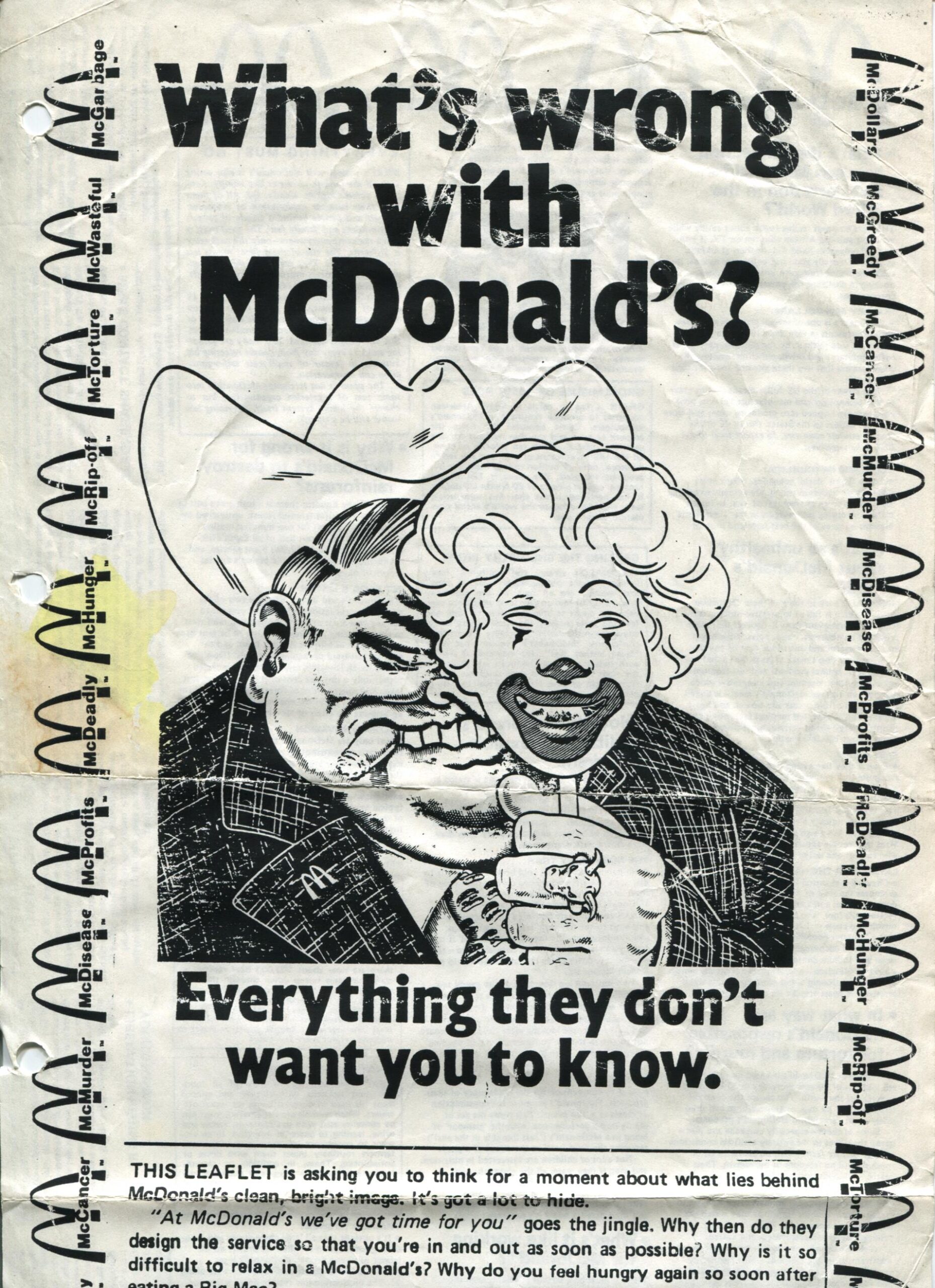
‘What’s Wrong With McDonalds?’ – the leaflet that caused the McLibel trial
He brought some of these leaflets round to her house and she says ‘everyone laughed at them and thought they were funny’. She has heard recently that there were different versions of this leaflet but only remembers that one.
Sometime that summer, whilst walking in the park with her, Bob ‘started laughing’ as he told her that he, along with one other person, had actually written it. She didn’t understand why he thought it was so ‘hilarious’ and he never explained. However she wasn’t surprised, or bothered.
McDonald’s were given copies of the leaflet and sued London Greenpeace for libel. It was the longest trial in English history (see the McLibel documentary for more). The fact of Lambert’s involvement, and of spycops infiltrating London Greenpeace, were kept secret from the court.
In her statement to the Inquiry, Belinda says was quite impressed by him writing the leaflet; at least he wasn’t a ‘shrinking violet’. Lambert also told Simon that he’d been responsible for writing them.
Belinda doesn’t remember him explicitly telling her not to tell people he’d written it, but got the impression that he didn’t want this info shared as it was meant to be a more collective effort and he wasn’t big headed.
Their Relationship
Belinda remembers Bob being very demonstrative, kind and loving. She remembers their relationship as ‘idyllic’, and Bob displaying a lot of empathy and emotional intelligence. He was always interested in her. He never disagreed with her. They never argued. She thought they were soulmates, ‘so well matched’, and that this feeling was mutual.
She now says in her statement that this seemingly ‘idyllic’ relationship gave her warped, completely unrealistic ideas about relationships, that nobody in future could possibly live up to. For years afterwards, she found herself comparing partners to Bob, who was ‘perfect’ in so many ways.
She is asked if she and Bob discussed contraception before becoming intimate. She told him she was using contraception; he never used condoms with her.
There was an incident that occurred early in their relationship in which Bob’s behaviour was not so perfect: he suddenly told her that he needed to have a serious conversation with her, and began insisting that she should be ‘faithful’ to him.
She recalls being surprised by this, because to her it went without saying (she spent so much of her time with him and had no intention of going with anyone else) but she was also offended, because he said he didn’t want to get HIV (the public awareness of which was growing at the time).
Bob told her about the relationship he’d had with the woman known at the Inquiry as ‘CTS’ – who was also much younger than him – and Belinda got the impression that he had ‘proper feelings for her’. That relationship ended when CTS went away to university, and supposedly they planted a tree together to mark its end. Belinda considered this a bit ‘soppy’.
Belinda gave Bob a key to her home, and he spent a lot of time there, four or five nights a week, sometimes disappearing in the evening – she thought he was off driving the cab.
He often hung out with Simon and chatted about politics, without Belinda always being there. Simon liked Bob, and thought he was interesting. She and Simon had a platonic ‘brother-sister relationship’.
Simon wasn’t so happy to come home one day and find Bob using their house to hold an activist meeting, without asking first. Belinda says she wasn’t as bothered about this as Simon and her other housemates, but recalls that there were a lot of people there, and she told Bob it couldn’t happen again.
Bob Meets Her Family
Belinda took Bob to Wales to meet her parents. She recalls that he looked a bit scruffy, and they were concerned to realise that he didn’t have stable employment. However, they accepted him, because it was clear that she really loved him.
‘My mum went out of her way to find vegan recipes for him. It was a joke’.
Belinda really wanted Bob to meet her granny, who was 99 years old and living in an old people’s home by the time, so took him there too.
‘It was really important to me that he met her and she met him, because I thought he was going to be my life partner and I wanted them to meet. You know, because I thought this was my future.’
She’s provided the Inquiry with some photos [UCPI0000037012], including one of Bob with her younger sister, who they stayed with. She got a good impression of Bob at first.
‘Then she said she didn’t really like Bob. Well she was the first person who has ever said that to me, but I should have listened. She said she thought he was a bit false and over jolly.’
There’s also a photo of Lambert at Glastonbury Festival in 1987.
She remembers him smoking roll-ups made with licorice papers, but never smoking weed around her. He told her he didn’t like the effect. He didn’t drink much either.
They also went to Cambridge Folk Festival together, in July 1988. She has some photos of them there with friends but she doesn’t like looking at these images – she recalls him doing something to her that weekend which she hadn’t consented to, and looking back she says:
‘I would almost say it was an assault, actually. I would put it that strongly’.
Bob’s Child with Jacqui
At some point, Bob told her that he had a young son – who’s now known to the Inquiry as ‘TBS’ – but felt guilty that he wasn’t a good dad. TBS lived with his mum, ‘Jacqui’.

Bob Lambert with Belinda Harvey’s younger sister, 1987 or 1988. They stayed at her house together several times.
Bob used to go and pick him and take him out for the day. Belinda recalls that he did this often, about three times a week, in the summer of 1987. He often brought TBS, a toddler at the time, to her house, so she spent a lot of time with them both.
The Inquiry say they understand that this level of contact between Bob, Jacqui and their son stopped around October of that year, and Belinda agrees that sounds about right.
She’s not sure whose decision that was, and is unwilling to speculate. By this time he told Belinda that Jacqui had met someone else. Belinda got the impression Bob thought this supposed new man would be a better father figure for TBS, so was ‘quite pleased’.
At the time he told Belinda and Simon that Jacqui had ‘tricked’ him into the pregnancy, and said ‘he wasn’t ready for another one’. She thinks he wanted to discourage her from any ideas of having a child with him herself. She is now aware that he is a ‘total liar’.
Evidence from Jacqui and others has established that Lambert maintained a sexual relationship with her while he was with Belinda.
He used to ask Belinda to wait around the corner from Jacqui’s house if she accompanied him to drop off or pick up TBS, telling her that Jacqui might ‘kick off’ if she saw her. At the time she interpreted this to mean that Jacqui wasn’t entirely comfortable with the idea of her son spending time with another woman.
She and Jacqui have since met. Jacqui says she didn’t know that Bob was with Belinda at all. Belinda says that Bob told her the relationship with Jacqui had ‘only lasted a couple of months’ adding that:
‘It never crossed my mind that they were still having a relationship, in a million years’.
Bob’s Bachelor Lifestyle
Bob also ‘drip fed’ her information about his involvement in direct action. By the time he did this, she was already ‘head over heels in love’ with him, and imagined they’d be together forever. She thinks he mentioned hunt sabbing first. He didn’t mention more serious stuff like criminal damage until later, in 1988.
She thought a lot of what he said as ‘bravado’, so didn’t take it too seriously at first. She recalls that he told her about breaking butchers’ windows, something she considered pointless ‘vandalism’. She got the impression that he was a bit uncomfortable, not really into it, and thought maybe this was something he did in order to impress his activist friends.
She had concerns but thought, or hoped, this was ‘just a phase’ that he would get over, with her help.
‘To me he hadn’t quite grown up yet. Some men are like that, they don’t grow up until they are quite old’.
He told her very little about his family. She got the impression that he didn’t really have one, that one of his parents had died and the other had dementia. There were always excuses or reasons why she couldn’t join him on visits to the care home where his relative (either his dad or his uncle; it wasn’t clear to her which) stayed.
‘I should have been more inquisitive than I was’
She just accepted what he told her, and felt sorry for him. She thought he’d just ‘gone down the wrong path’ and that she could help him sort his life out.
Bob Working Away
Bob claimed to have a casual (and dodgy) arrangement to drive his mate Terry’s minicab sometimes, when Terry wasn’t using it himself, usually at night.
He told her that he wasn’t supposed to be driving it, and if he was ever stopped he would have to pretend to be its licensed owner.

Final page of a letter from Bob Lambert to Belinda Harvey with his map of their significant places
As well as claiming to tout for trade illegally at Heathrow airport, he once told her that he had to go to court, as ‘Terry’, for a case which resulted in a fine (centred on the police stopping him in the cab one day and finding a load of stolen hairdryers in the boot).
It’s unclear how much of this story was true, and why he told her all this. But, as someone who did get prosecuted under a false identity as ‘Bob Robinson’, he had plenty of material to draw this anecdote from.
He also pretended to do gardening and landscaping work, and sometimes these jobs entailed working in other parts of the country. He once sent Belinda a letter [MPS-0737136] from Kings Lynn in Norfolk. His excuse for not phoning was that he’d left her number behind.
The letter included a hand-drawn map of London, with various places highlighted, including the Hammersmith Odeon. Belinda recalls that they went to see lots of live music together; she kept all the ticket stubs. The September 1987 gig referred to on the map was REM, one of her favourite bands at the time.
She really missed him while he was away, and loved receiving this letter, with its in-jokes and pictures, as she thought it showed how much he cared about her.
She missed him the next time he went away, this time for weeks, in the spring of 1988. He told people that he had a job planting trees by the motorway in Cambridgeshire. He sent a chatty letter to fellow London Greenpeace activist Helen Steel at this time, [UCPI0000037425] claiming to be in Ely.
There was one ‘work trip’ which lasted longer – at least a month – in the summer of 1988. Belinda thinks he might have phoned her this time (she doesn’t have any letters from this period). She completely trusted him.
‘I never, ever disbelieved anything he said.’
She found out since that Lambert went away on holiday with his real family on this occasion. She felt
‘So betrayed, just so naive, so stupid and naive’.
How Belinda Feels Now
She says ‘it’s unfathomable’ that he was being paid to work while he was spending time with her. She was utterly shocked that her taxes were being used by the police for this.
She still struggles to understand it now. The personal betrayal ‘is bad enough in itself’ she says, but she recalls that when she first found out who he’d really been she still thought there was some genuine feelings on his part:
‘At first we all thought, well, they did love us really, it was a genuine relationship. You know, it was genuine, they must, they loved, we loved each other. You know, for all of us it was very special relationships and then it was kind of a gradual realisation.’
Like the other women, she has since realised just how cruel and manipulative these men were. It’s only recently that she’s started to understand just how bad Lambert’s behaviour was.
‘I didn’t fully realise what he was capable of and how bad it was, to be honest. And even until just a couple of years ago I still thought there was some genuineness in the relationship’
Bob Amongst the Activists
She didn’t usually go to meetings with him, but did witness how Bob behaved in the company of activists. She saw how influential he was, especially with the younger ones.
‘You got the feeling people looked up to him and wanted to impress him’.
He was personable, articulate and ‘very confident’. He laughed and smiled a lot. She witnessed people ‘hanging on to his every word’ in social situations, and treating him as a ‘leader’.

Spycop Bob Lambert (right) at protest against dairy firm Unigate, 1980s.
It appears that Bob was keen to portray Belinda as an ‘activist’. In his Operation Herne interviews in 2013, he claimed she attended animal rights meetings with him.
She says he was always trying to persuade her to attend London Greenpeace (LGP) meetings, and there was one time when he essentially tricked into one. It was already underway, she only stayed out out of politeness, and she thinks she was there for less than half an hour. This was more than long enough for her!
He mentioned her in some of his reports, and we saw one example [MPS-0740045], about a big animal rights meeting at Manchester University in September 1987. This was held by the Federation of Local Animal Rights Groups, and as well as this Saturday meeting, there was some kind of party.
Belinda says she had very little interest in the animal rights movement – considering it a ‘waste of time’ – but remembers going to Manchester with him once. She thinks he might have been going to speak at a meeting, and she might have gone along to be supportive, but doesn’t remember what was said at it, or if she was even there.
In his report, Lambert said that local activists hosted the people who’d come from elsewhere, and there were opportunities for ‘experienced animal rights extremists’ to conspire. Belinda remembers the party, but no mention of the Animal Liberation Front or anything like that.
She had an old school friend who lived in Manchester, and thinks she spent time with her that weekend. She and Bob probably both stayed at hers.
She tells us that she also went out once with a hunt sab group, but spent the entire day in the Land Rover and didn’t do any sabbing. She remembers it as ‘social event’ and her motivations for this:
‘I wanted to impress Bob, to be honest’.
What She Knew about Debenhams
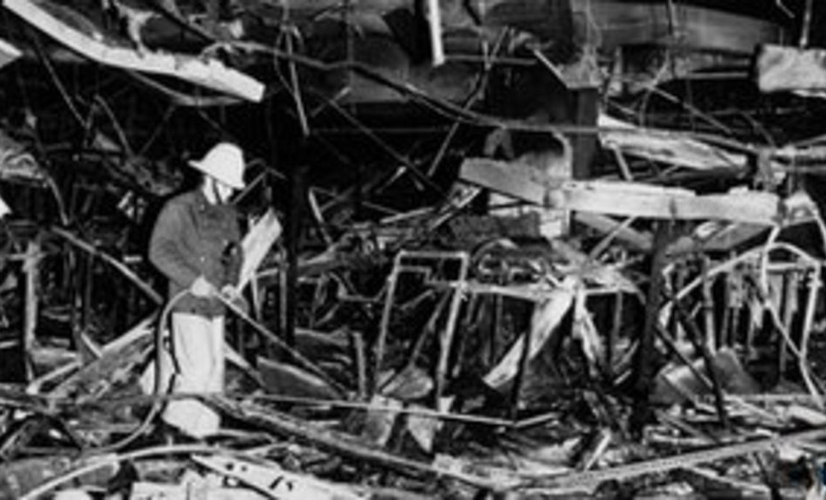
Firefighter in the wreckage of Debenhams Luton store after an incendiary device was placed by Bob Lambert’s Animal Liberation Front cell, 1987
One of the most serious elements of Lambert’s deployment was his role in an Animal Liberation Front cell. The group placed timed incendiary devices in Debenhams department stores that sold fur.
Belinda says that Lambert told her about the planned action at Debenhams stores about a month beforehand.
Bob explained to her that people he knew had managed to manufacture an incendiary device, and went on to tell her what their plans were, along the names of the other people involved in the ‘cell’. She says she didn’t really know Geoff Sheppard and Andrew Clarke.
She did know Paul Gravett, as Bob had introduced them to each other. However Bob gave her the impression at some point that Paul had been involved in the initial stages, and then had ‘dropped out’ or become less involved. There was something about Paul possibly being a police informer, but Belinda can’t remember exactly what was said about this. She thought there were three of them: Bob, Geoff and Andrew.
She knew that they planned to target four branches of Debenhams, and place one device in each, probably inside the sofas in their fur departments. She was told that these devices would be set off, but thought ‘they weren’t designed to set on fire, they were designed to let off smoke’ and this would set off the sprinklers, damaging the fur coats and rendering them unsellable.
His story was consistent every time he talked about it over the course of that month.
‘I have tried to dissuade him and he’s insisted that it was only going to let off smoke… the whole point was to set off the sprinklers, not start a fire’.
To her it sounded dangerous and she worried that somebody might get hurt. She remembers asking about this, and if there were security guards. Bob was ‘very insistent’ that there was no chance of anything going wrong. She says she was worried about him, and encouraged him to talk to Simon about these plans too, but doesn’t know if he ever did.
‘I didn’t even want to hear about it, but he used to talk about it a lot.’
He told her a lot of detail, far more than she wanted to know, and even showed her sheets with instructions of how these devices were made. She didn’t approve of the idea at all, but at the time thought that his over-sharing was a sign that he really loved her.
She remembers him saying ‘I’m in it too deep’, and now wonders if he was secretly hoping that she would try harder to dissuade him, or report her concerns to someone else. She says she would never have broken his confidence, because she loved him and was a loyal person. She didn’t even talk to her best friend Simon about it.
Bob told her not to let on to Geoff or Andrew that she knew anything about the trio’s plans, saying that they’d be annoyed if they found out that Bob had spilled the beans.
She didn’t know exactly when they planned to do it, but recalls that late one Friday night, as she was getting into bed, Bob suddenly announced that he was going off to meet the other two in a park, and ‘do this thing’. He put on his coat and left her house.
She was shocked, upset and worried. She didn’t sleep well that night, and listened to the radio to see if it came on the news.
The devices were actually planted while the stores were open, on the Saturday afternoon. She still wasn’t sure if anything had actually happened. She didn’t try to contact Bob, and didn’t see him again until almost a week later.
After the Fire
After this weekend, he seemed to be his normal self, but they didn’t talk much about what had taken place.
‘He talked about it more before than he did after.’
Belinda never saw any news reports, so had doubts about whether or not it even happened. It was only when the trial started at the Old Bailey that she realised the action had definitely gone ahead.
At some point Lambert told her that one of the devices hadn’t gone off as it was meant to. She didn’t want to know who had planted the devices in which store. He never mentioned any ‘spare device’.
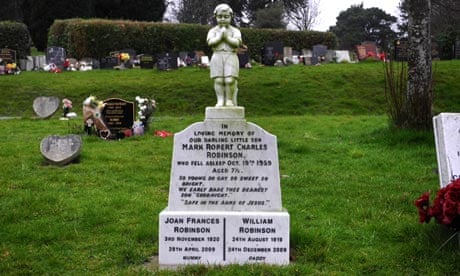
The grave of Mark Robert Robinson whose identity was stolen by spycop Bob Lambert for his undercover persona. Branksome cemetery, Poole, Dorset.
Lambert didn’t tell her that the Luton store had burnt down because the sprinkler system wasn’t working. This is something she only found out about many years later, after finding out that he had been a police officer.
Geoff and Andrew were arrested on 9 September 1987. Belinda remembers Bob telling her about this at a concert (probably the REM gig on the 12 September).
Lambert’s bedsit in Graham Road was also ‘raided’ by the police around this time, to make it look like he was under suspicion (and not an officer himself). Belinda doesn’t remember knowing about the raid.
It is obvious that Belinda found it hard to believe that Bob was serious about using incendiary devices, and that she still feels shame and guilt that she didn’t do more to stop him. She says ‘I’m not proud of it’ and ‘obviously it doesn’t reflect very well on me, at all’.
In his witness statement to the Inquiry, Lambert has denied any involvement in these actions, and denied any discussions of them with Belinda.
Bob’s Relationship with the Cell’s Other Members
In her witness statement Belinda has written about Bob ‘going dewy eyed when he talked about Geoff’.
She thought that he admired Geoff Sheppard, and they were very close friends. She assumed that after Geoff’s arrest, he felt a bit guilty that he hadn’t been imprisoned himself, adding ‘but he didn’t seem as bothered about Andrew for some reason’.
She hadn’t met these two men before their arrests, just heard their names a lot. They were held in police custody at first, and she recalls visiting them inside with Bob one night. She says they were on their way home from a gig (again, maybe the REM one?) when Bob suggested that they try to visit them.
She’d never been in a police station before, and can’t remember which one it was. They didn’t get to see Geoff, but got about five minutes with Andrew: this was the first time she met him. She remembers going with Bob to visit Geoff in prison later, taking vegan food and cigarettes to him. There was no legal discussion while she was there.
She found Bob’s interest in the trial ‘a bit intense’ and thought it was a bit strange of him to spend as much time at it.
Did he talk much about how the trial was going? Not to her, no. She can’t remember if she ever visited them in prison after they were convicted. But she does remember Lambert coming home from a visit acting ‘gloomy’. He was visiting as a friend, not as part of ALF Supporters Group.
Belinda’s Move to Seaton Point
Belinda’ s tenancy in Forest Gate came to an end. Bob told her that he had a friend called ‘Howard’, who lived in a flat in Seaton Point, on Hackney’s Nightingale estate, and suggested she move in there.
Bob was friends with both Howard and ‘Natalie’, who already lived there, and after Belinda moved in, he spent many evenings there. This wasn’t a squat; she paid a third of the rent, and bills.
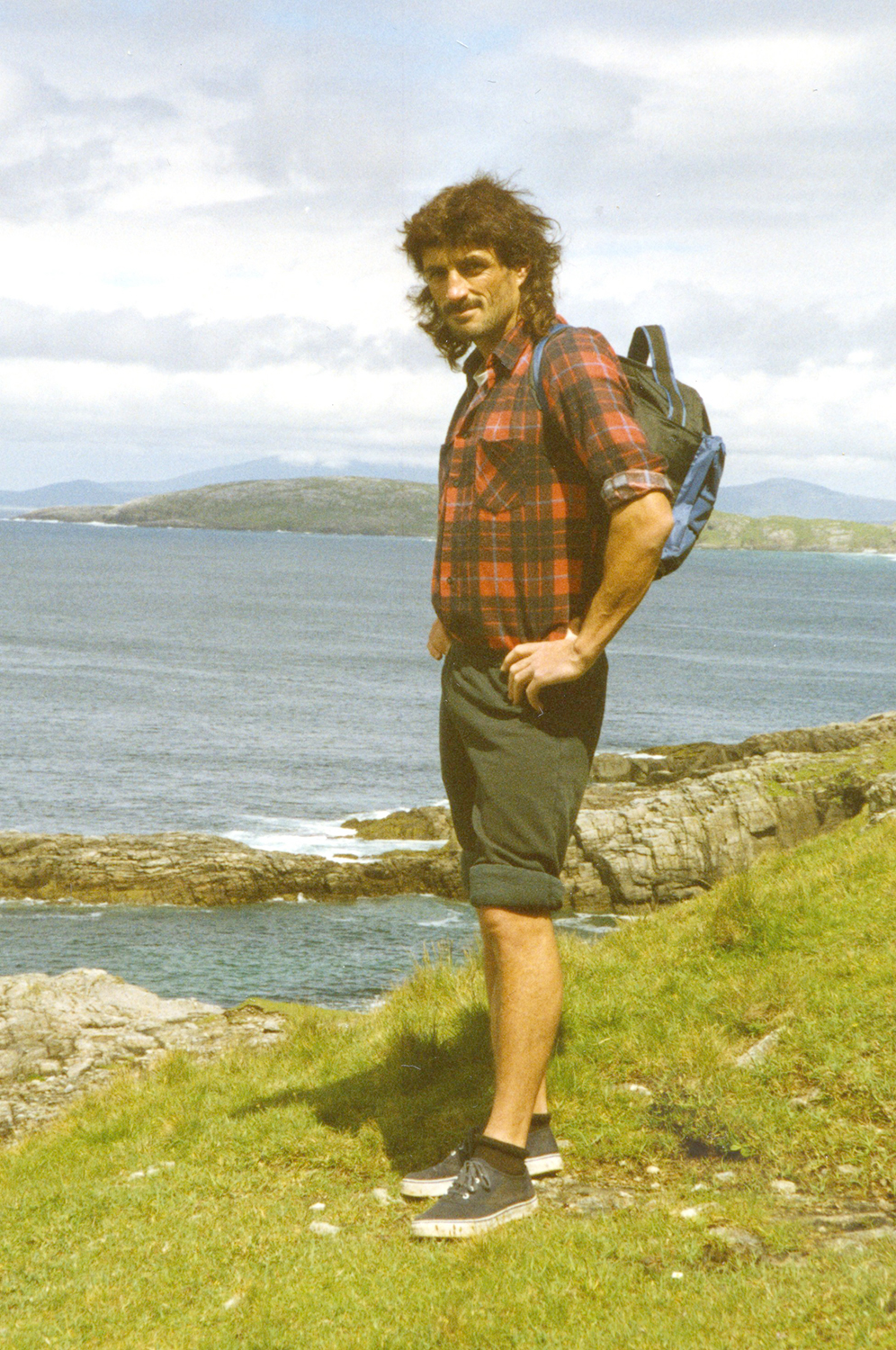
SDS officer HN5 John Dines ‘John Barker’, on holiday while undercover
Howard worked at Housmans bookshop, and is described in Lambert’s report as a ‘leading anarchist’.
Belinda disputes this, but admits she ‘doesn’t really know what an anarchist is’.
She knows Howard was connected to the Peace News collective through his work, and definitely knew anarchists. He was quite a private, secretive person. But she saw him most evenings and knows he wasn’t particularly active, wasn’t going out to meetings, etc.
‘Natalie North’ is another pseudonym (someone known as ‘Greta’ in the book ‘The Undercover Police Scandal: Love and Lies Exposed‘). Belinda found her strange and a bit ‘cold’, and recalls that she often walked around naked in the flat. Natalie got on well with Bob, ‘a bit too well in my opinion’, and Belinda says she never got to know her well.
By this time, Bob had introduced Belinda to many people in the squatting community, and she had friends in the estate and local area. They went to each others’ houses and she often went without Bob (as he was off ‘driving his taxi’).
She remembers meeting another spycops, HN5 John Dines ‘John Barker’, around this time (March 1988). She has a clear memory of him and Bob greeting each other extremely warmly, ‘like brothers’. Bob told her John was an old friend.
She liked John. She found him friendly and good company. They got on well. She was introduced as Bob’s girlfriend so she has no doubt that John knew about their relationship!
Belinda has her diary from June 1988, and was asked if she can explain something like looks like a phone message on one page [UCPI0000037014]. She recalls that it seemed to be very important at the time – it was someone she didn’t know asking that ‘Bob or friend John’ call him back ‘urgently’.
Bob Moves in with Her
Bob moved into the flat in Seaton Point with her in the spring of 1988, maybe May. Belinda had suggested living together a few months earlier but he hadn’t wanted to. She didn’t know why he suddenly changed his mind but was ‘delighted’ when he did.
She helped him move his stuff from Graham Road to the flat. Again, he had a key. She can’t remember if he contributed towards the rent and bills.
There’s also a diary entry from May 1988 [UCPI0000037011], supposedly written the week he was due to move in, in which Belinda wrote about a ‘nagging feeling that Bob is not good for me’. She had doubts about ‘the stuff he was up to’ and was worried that he’d get into trouble.
She added a note addressed to Bob to her journal entry. Did she think he read it? Yes, she certainly thought he might. She used to leave it lying around in their bedroom, and he sometimes wrote things in it.
In his witness statement to the Inquiry, Lambert denies ever living with Belinda. However, in early 1988 (the Inquiry thinks late March), he sent a letter [UCPI0000037262] to Paul Gravett, supposedly from Ely in Cambridgeshire, saying ‘I moved out of Graham Road when I started this job’, and explaining that he was sleeping in his van Monday toThursday, and spending weekends in the flat at Seaton Point.
Bob’s Exfiltration
In October 1988, Bob went to visit Geoff Sheppard in prison, and when he came back he wasn’t his usual ‘jolly’ self.
The next day, he told her that he was in trouble with the police so would have to leave at some point. She doesn’t remember what exactly he said, but she was ‘extremely distraught and upset’ about the idea of him leaving, and them not being together. He acted ‘regretful’, and said he would need to keep a low profile, and that he would need to go abroad.
He gave her the impression that he had to leave Seaton Point as the police might raid the flat, looking for him. He said he didn’t want her ‘getting mixed up in it’, and suggested that she move out, at least for a while.
She doesn’t know what Bob told Natalie and Howard at this time. He rang one of Belinda’s (non-activist) squatting friends, who promptly came round and offered her a room in their house in Sach Road. She thought this would just be a temporary move, so left lots of her stuff in Seaton Point.
In November, less than a fortnight after she’d moved out, she went back to the flat after work and learnt that Special Branch had just raided. She doesn’t know how they got in, but it didn’t look as if the door had been broken down, so thinks Natalie had let them in.
The place wasn’t in excessive disarray and she got the impression they were looking for Bob rather than doing a full search. Natalie told the police she didn’t know where Bob was.
Belinda was shocked to discover that they had been through the room that she and Bob had shared, and come across her shoes in it, and then found out her first name. She remembers how scared she was of the police. She worried that she’d be blacklisted and this would affect her career.
She didn’t have a way of contacting Bob, so went back to the Sach Road squat. She thinks she went back to Seaton Point after this to collect all her stuff. She didn’t stay in touch with Natalie, but saw Howard around for the next few years.
Bob ‘in Hiding’
Belinda doesn’t know what Bob told his activist friends in November 1988 about going on the run – if he mentioned going to Spain or not. He stopped seeing them but continued seeing her through December and into January 1989.
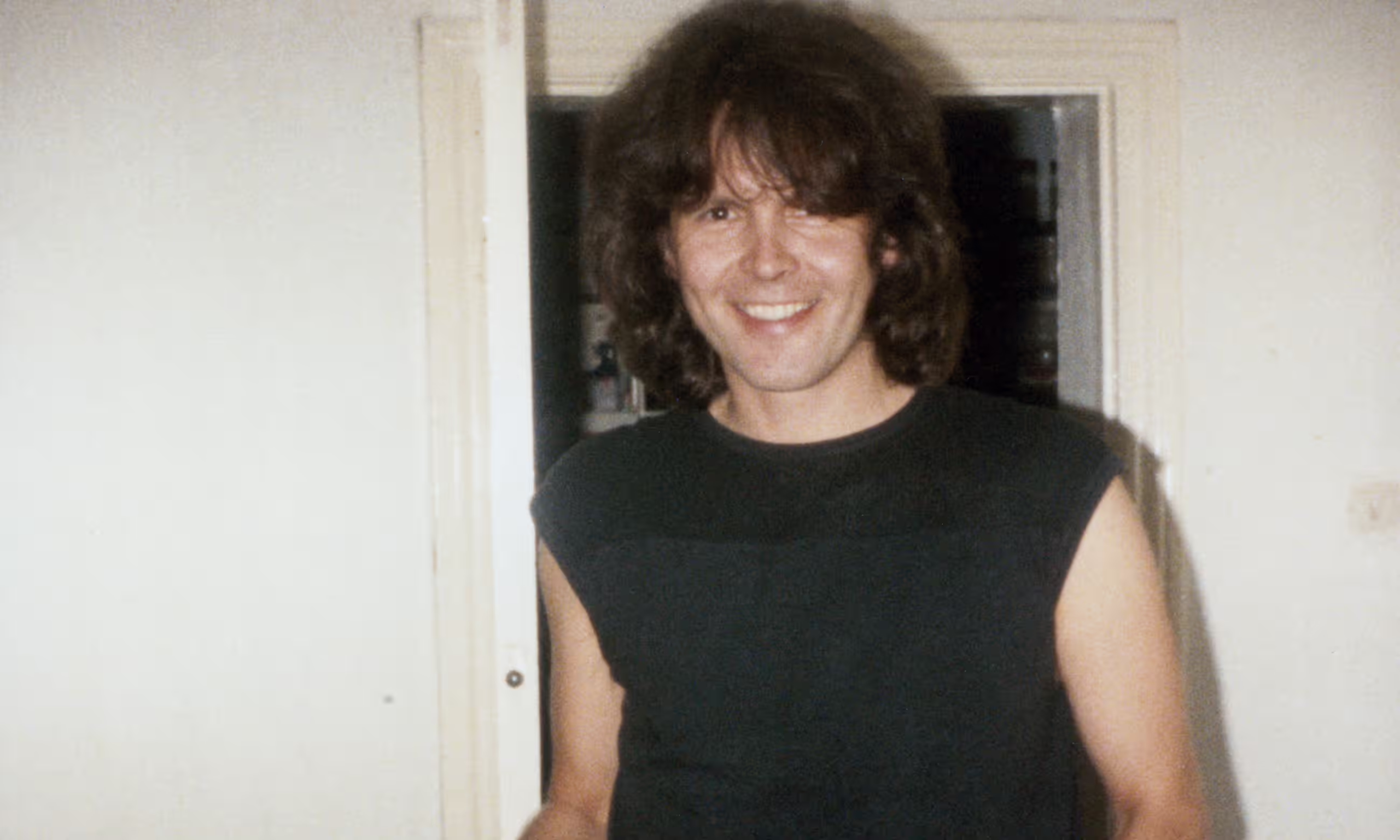
Spycop Bob Lambert whilst undercover, 1987 or 1988
He wrote her another letter about a week after the ‘raid’, supposedly from ‘Graham Road’. This was the first she heard from him after it. It was unclear how he was back in the same bedsit that he’d lived in before. She thought he had left it behind – she has helped him move his stuff – so was a bit surprised. She agrees that it seems strange, as surely the police would have looked there for him too? (They’d done a ‘raid’ there in 1987).
In the letter [MPS-0737136] Bob says he hopes she’s not ‘as dazed and confused’ as him, tells her he loes her and asks her for Simon’s phone number. She thinks she must’ve dropped it round, and might well have driven there.
In his statement, Lambert claims not to know about the Seaton Point ‘raid’.
In late November she heard from Simon, who told her Bob was staying with him in Greenwich, where the police wouldn’t find him. She says Simon was as ‘law-abiding’ and career-orientated as her and didn’t want any trouble either, so wasn’t overjoyed to be housing a ‘fugitive’.
She went there a few times to see him, ‘a bit paranoid’ about being followed. She remembers being ‘angst-ridden’ but Bob being his normal self. She says he was very glad to see her and ‘just wanted to be intimate with me’.
The three of them went to Dorset, where Simon’s mum lived, around December 1988 but she can’t be sure of the exact dates. She describes it as being as passionate as ever. Lambert told her he couldn’t them not being together.
In her statement Belinda said something about Bob telling her the police were after him about ‘hundreds’ of unpaid parking tickets. She never saw him get a single ticket.
She says now that she knew deep down that it was more likely to be related to the Debenhams action, and probably said that because she felt so ‘ashamed and embarrassed’ about it.
Bob ‘on the Run’
Sometime in December, Bob told her that he was heading for Valencia. He mentioned going to see his brother there. She was devastated, and tried to persuade him to let her go with him.
She says she was prepared to give up everything in her life – even her family – in order to go with him. Looking back (and shaking her head in disbelief) she can’t believe she really thought like this.
She recalls getting lots of mixed messages from him when he was talking about going on the run to Spain – and him ‘eventually relenting’ and saying she could go with him. He then said no, he would go alone after all, suggesting she could follow later.
Their final farewell was in Finsbury Park in January 1988. She thought that he’d get in touch with her once he’d settled down in Spain. She didn’t hear from him, but had so much faith in him that in April she gave in her notice at work.
She began worrying that he wouldn’t send for her, but pushed these thoughts away. Then she received another, confusing, letter from him, in which he said it didn’t feel right for her to come to Spain.
In reality he was, of course, back living with his wife and children, working at Scotland Yard. Even then, after his deployment had ended, he made efforts to keep Belinda’s feelings for him alive. In the letter he’d arranged to be sent from Spain he told her he wanted:
‘to thank you with all my heart for being the kindest person in the world to me.’
She found it really hard to accept that he wasn’t coming back, and it was over. She remembers feeling devastated. She went to Bristol to stay with a kind friend.
Belinda also received a letter from her mother. Lambert was the cause of the only argument she ever had with her mum. She’d never kept secrets from her family before, but felt she couldn’t be totally honest with them about Bob and what he did.
Belinda’s Regrets

Belinda Harvey, 2024
Looking back over it all, Belinda see how Lambert changed the course of her life. She’s stated that some of her old friends were ‘alienated’ by Bob’s political views, and as a result she didn’t see as much of them.
She did make some new friends in the activist circles that he introduced her to, and remains friends with some of them today. She met lots of squatters, including a group of women who she ‘fell for’ as friends, becoming close with one of them in particular.
She’d started thinking about buying a flat. She began house-hunting that summer, having saved up enough for a deposit. By the time Bob came back from his month away, she’d put in an offer on a place and was very excited about the prospect of living there.
He ‘just didn’t like it’. He was so negative – pointing out that there was a fried chicken shop downstairs – that she ended up withdrawing her offer, as she was in love with him and had hoped they’d spend a lot of time together there. She really regrets this now.
She recalls that many of her squatting friends dressed in a ‘punky’ way and lived in a ‘different world’. Conscious that they were opposed to capitalism and house-buying, she changed her priorities.
She remembers talking about having children with Bob, as it was important to her. She was horrified when he told her that this wasn’t something he wanted. According to him, the political struggle was more important. She didn’t feel she could change his mind, and remembers ‘crying and crying’. He made her feel stupid for wanting these things.
In his statement, Lambert says there were no discussions about having children. Belinda is adamant that he’s lying.
‘Why would I make it up?’
She recalls him saying ‘you deserve better than me’ and suggesting that she should meet someone else to settle down with. He said he would come back sometime and look out for her in her new life (which actually made more sense once she’d learnt that he was a cop, as it would have been easier for him to find her).
She hoped that he would return, and for years imagined him turning up again.
As well as giving up her job, she decided not to pursue an accountancy qualification.
‘I didn’t think accountancy was a suitable profession for the partner of an activist, you know. It seemed a bit kind of capitalist and money oriented. Which was probably at odds with my friends who I was living with now and all these people. You know, all my new friends and Bob’s values, and I wanted to be the person he wanted me to be.’
She now wishes she’d done it.
She points out that Lambert had a house, a marriage, family, a career, and thanks to him she didn’t have any of those things. He completely changed the direction of her life.
‘I think I would have done a lot better in my life if I hadn’t met him’.
She feels that she was ‘groomed’ by him, ‘played with like a plaything’, and gets quite upset thinking about it all. She is aware that his deception has held her back in many ways.
She did meet someone else, and had a son in 1992. She then trained to become a midwife. She remained ignorant of Bob’s true identity for many years.
‘Beyond Comprehension’
She learnt about Lambert being a police officer from Helen Steel. It has taken many years for her to truly understand what had happened, and how Lambert used her, and she says every time she participates in this Inquiry she learns more about the way the spycops operated.
For example, just recently she discovered that Lambert spent a full year planning his departure. He knew that he would leave her at the end of it. By continuing with the relationship, he caused a lot more damage than he would otherwise have done.
She was astonished to learn this, and thinks this pre-meditation makes his behaviour much worse:
‘It’s abuse, really, nothing short’
She points out that she is a member of the public, who the police are supposed to protect.
Lambert has said that his relationship with Belinda involved ‘genuine chemistry’ and wasn’t just about gathering information. She responds bitterly:
‘It’s not the same as caring about somebody’s wellbeing is it? He certainly had no integrity or consideration’.
The discovery has affected her self-esteem and her mental health. She knows that if she hadn’t been such a strong person this could have completely broken her. To this day, she doesn’t trust anyone apart from her sister and a very small group of close friends.
Lambert made two ‘apologies’ – one when he was interviewed on Channel 4 News in 2013 and one in his statement to the Inquiry.
Her retort:
‘Well it’s a bit late now isn’t it?’
She points out that if it wasn’t for this Inquiry she still wouldn’t know the truth, which ‘is still unfolding, as far as I concerned’.
‘What have I ever done to deserve this?’
Mitting looked towards Belinda and thanked her with some sincerity for her ‘valuable public service’.