
UCPI Daily Report, 4 Feb 2026: ‘GRD’ evidence
Tranche 3 Phase 2, Day 4
4 February 2026

J18: anti-capitalist protesters in the City of London on 18 June 1999 (Pic: Andrew Wiard)
On the afternoon of Wednesday 4 February 2026, the Undercover Policing Inquiry (UCPI) heard from a person known at the Inquiry as ‘GRD’. He was a hunt saboteur and London Greenpeace activist who was spied on by undercover officer HN14 Jim Boyling ‘Jim Sutton’ in the 1990s.
GRD has been granted core participant status at the Inquiry, and also a significant degree of anonymity. He is referred to only by the intials, and his evidence was broadcast audio-only, without his face being seen.

Don Ramble
The UCPI is an independent, judge-led inquiry into undercover policing in England and Wales. Its main focus is the activity of two units who deployed long-term undercover officers into a variety of political groups: the Special Demonstration Squad (SDS, 1968-2008) and the National Public Order Intelligence Unit (NPOIU, 1999-2011). Spycops from these units lived as activists for years at a time, spying on more than 1,000 groups.
GRD was questioned by Don Ramble as Counsel to the Inquiry.
GRD has produced a written statement for the Inquiry [UCPI0000037735], which was read into the evidence.
Additionally, he is a signatory to the Good Easter hunt sab group witness statement, a case that appears to be a miscarriage of justice due to spycop Jim Boyling’s involvement and his evidence being withheld from the subsequent court case.
However, GRD was not present for the events involving Boyling on that day, and Ramble made clear they would not be asking about that statement in this hearing.
In sharp contrast to Roger Geffen’s evidence earlier in the day, GRD’s answers were short and to the point. It was clear that he had little time for the Inquiry asking nonsense questions that sought to justify the deployment of undercover cops.
HUNT SABBING AND VIOLENCE
GRD first met SDS officer Jim Boyling with the East London hunt saboteurs in 1995 when they travelled together in a minibus. They really got to know each other on 17 February 1996 on a large sabotage of the Duke of Beaufort hunt, when they became separated from the rest of their group:
‘It was right at the beginning of the meet. And I don’t think either of us realised how many riders and supporters there were with this particular hunt.
So, we were holding the gate closed for a very long time and the whole field, as it’s referred to, kind of rode over us…
You get spat on, getting hit with whip and sworn at… And that’s the first time I kind of really had any real connection with him.’
GRD didn’t see Boyling again after that incident until more than a year later, in the summer of 1997. Nevertheless, Ramble asks him a series of questions about his activities while sabbing and any possible justifications for police spies targeting the hunt sabs.
GRD got involved in the Harlow hunt sabs in 1992. He started the North London hunt sab group a year or two later and remained involved until 2006. He is clear that the only violence he ever saw while sabbing was by hunters, hunt supporters and the police – especially in Essex:
‘We would generally not sab them. It was too dangerous, too risky…
It’s just too violent, you’d get your vehicle smashed up or the police operation would be so considerable that you’d all be arrested by midday.’
This was was exactly what happened on the day of the Good Easter arrests, 10 February 1996. GRD witnessed the arrest of a fellow core participant at the Inquiry, Brendan Mee, but not the arrests of Ben Leamy, Brendan Delaney and Simon Taylor who were with Boyling that day.

Spycop Jim Boyling whilst undercover in the 1990s
The Inquiry will need to ask Boyling about his role in those arrests and also his offer to act as a witness on behalf of the defendants whose lawyer was Keir Starmer, a name that just keeps coming up in the Inquiry files.
GRD is also asked about links between the hunt sabs and the Animal Liberation Front (ALF). The ALF was a clandestine group that broke into farms and laboratories, liberating animals and damaging property. They were seen by the police as the apex of the animal rights movement, and were portrayed as something akin to terrorists.
A document recording Boyling’s initial deployment into the East London hunt sabs said that he ‘will be following an essential and authentic route towards acceptance by ALF activists’.
The targeting strategy document for SDS officer HN16 James Thomson ‘James Straven’ [MPS-0526929], whose was deployed into hunt sabs slightly later, further refers to Boyling’s deployment as follows:
‘originally earmarked for long-term deployment in the ALF and he has provided first rate intelligence on violent hunt saboteurs based in East London and Essex and indeed valuable assistance to Operation GANT and SO-13 investigation into a series of crude ALF incendiaries in East London.’
GRD says that doesn’t make sense, he doesn’t know any sabs who associated with the ALF and the hunt sabs never used, or planned to use, incendiary devices. He rejects the idea that sending an officer to infiltrate the hunt sabs was justified.
MCLIBEL SUPPORT GROUP
In 1990, McDonald’s brought legal proceedings against London Greenpeace for the claims made in a factsheet titled ‘What’s Wrong With McDonald’s?’ that detailed the company’s appalling environmental, employment, animal welfare and marketing practices.
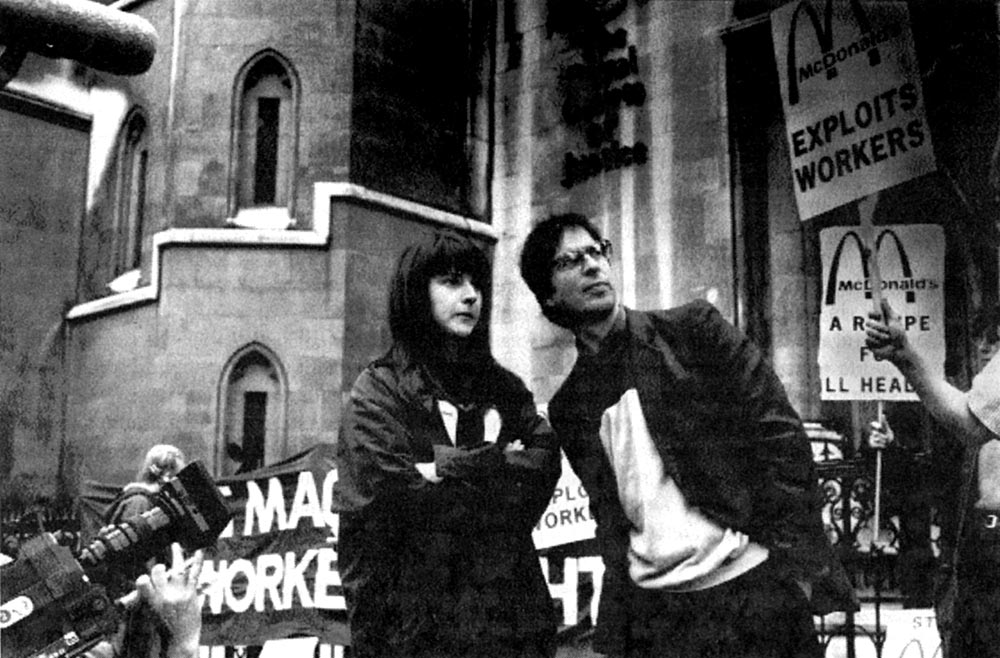
The McLibel 2, Helen Steel and Dave Morris, at the Royal Courts of Justice (Pic: Nick Cobbing)
The ensuing court case took seven years, with the defendants attracting huge support and backfiring badly on McDonald’s. It was revealed that McDonald’s had sent two separate lots of private detectives to infiltrate London Greenpeace who were unaware of one another.
The court did not learn that multiple SDS officers also infiltrated the group, and indeed the factsheet at the core of the court case was co-written by an SDS infiltrator, HN10 Bob Lambert ‘Bob Robinson’.
GRD first became involved in the McLibel support campaign in 1995 due to fellow hunt sabs being involved in the McSpotlight website. The McLibel Support Group office ended up being in GRD’s flat at one point. He says it was mostly a storage headache, as storing all the T-shirts and other merchandise took up space.
He met Boyling again while he was running a McLibel Support Campaign stall at the 1997 Glastonbury festival.
‘He was there with Reclaim The Streets and they were on the other side of the Green Futures Field… it had a lot of activism, eco-activism, and animal rights campaigns, veganism, vegetarianism…
Jim used to come over and hang out in the McLibel Support stall, tent as it was, for most of the days, from my memory.’
GRD hadn’t seen Boyling since they were attacked by hunters together in early 1996, but after Glastonbury they continued to bump into each other at squats and events around London.
The last time GRD saw Boyling was in a squat in December 1999. The intense experience they had together as hunt sabs meant that GRD considered Boyling a friend. He trusted him and they would socialise together.
GRD describes these encounters in his written statement:
‘We were a little bitchy about other activists and like to take the mickey out of them, but not to their face. We had a laugh together like mates.’
Looking back on this he finds it depressing and feels betrayed. He also points out that this piss-taking could be weaponised as a means of sowing division.
Boyling claims he had no inside knowledge of the McLibel matter, but GRD says that’s untrue. After Glastonbury 1997 he would have had access to all the materials which were often scattered around GRD’s flat:
‘I was uploading daily material onto the McSpotlight website… So I’d have stuff all over the place. I’d have correspondence, and I would have you know other stuff associated with the campaign.’
LONDON GREENPEACE
London Greenpeace (a small group unrelated to Greenpeace International) campaigned on a broad range of environmental and social justice issues. GRD describes himself as a key London Greenpeace activist and he ended up running the office, because he lived very nearby.
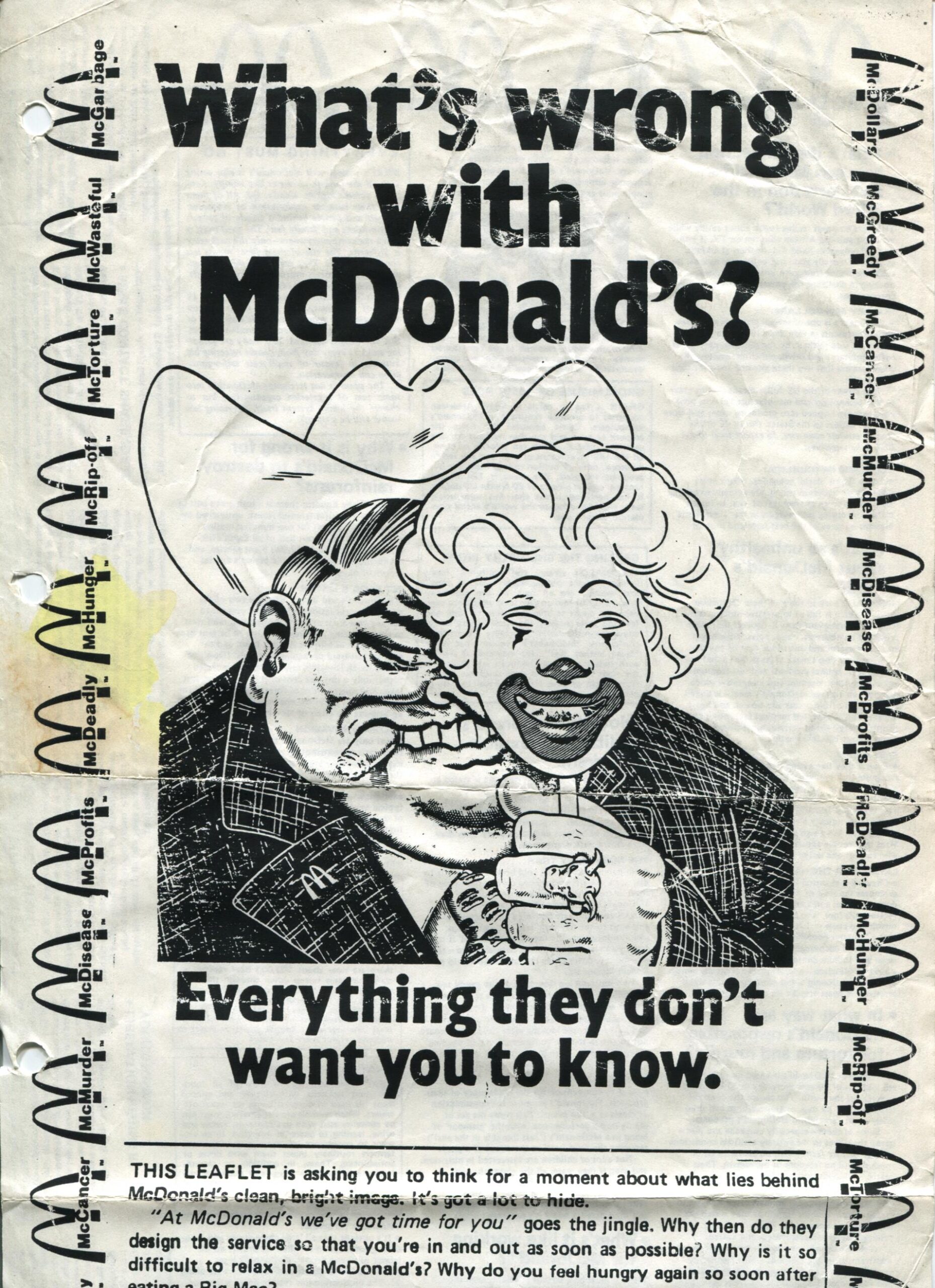
London Greenpeace’s ‘What’s Wrong With McDonalds?’ leaflet which triggered the longest trial in English history
We are shown an intelligence report by Boyling [MPS-040634] dated 31 October 1997, which refers to a meeting to ‘relaunch’ of London Greenpeace.
GRD says that Boyling would have been aware that London Greenpeace was restarting from the conversations they had at Glastonbury festival in 1997. The ‘source comment’ from Boyling on the report ironically notes that the relaunch will include all the old members ‘though presumably not the private detectives’.
This seems to be the only one of Boyling’s reports that references GRD, something he found surprising. He would have thought he’d be mentioned more, given his long-term involvement with Boyling.
EARTH FIRST! AND GENETIC MODIFICATION
In 1998 Jim Boyling and others gathered at GRD’s squat in King’s Cross to discuss the feasibility of liberating ‘Dolly’, the world’s first genetically modified sheep.
Looking back, GRD says he thinks Jim was trying to get him on board for future plans he might have had. In his reporting, Boyling describes GRD as a hunt sab organiser in North London, and a McLibel and occasional Earth First! activist.
GRD says only the first two are correct. He was also active in the Genetic Engineering Network (GEN) between 1997 and 2002. There was some crossover between GEN and Earth First! Nevertheless, his only connection to Earth First! was through things that Jim Boyling organised.
Around the same time as the meeting about Dolly the sheep, GRD recalls that Boyling asked him to drive Boyling to collect some Reclaim the Streets posters from the printers. When he got home his flat had been burgled. A camera and some two-way radios used for hunt sabbing were taken, along with some pictures, some cash, and GRD’s turntables.
‘There was only one person knew that I was going to be out all day, and that was Jim.’
Another action Boyling was involved in organising was the first ever destruction of a field of genetically modified crops in Ireland. Ramble tells GRD that the Inquiry is not interested in what happened in Ireland as it falls outside of the Inquiry’s Terms of Reference, which are limited to events in England and Wales. However, this is certainly an interesting and significant action nonetheless.
In his written statement to the Inquiry [UCPI0000036294], Boyling says he destroyed a genetically modified crop in Ireland when he had no other option than to participate or being exposed.
GRD says this is not true, and that the action in Ireland would not have happened if Boyling had not done the planning and logistics, both in the UK before travelling and in Ireland, pushing the group to do it.
GRD is very clear that Boyling would have found it very easy to back out of the genetics action, even once they were in Ireland. The UK group wasn’t even meant to carry out the action, and there were too many people in the van so it would have been easier, logistically, to have fewer people.
RECLAIM THE STREETS
Although GRD attended a great number of Reclaim The Streets (RTS) public events, he only attended two of the group’s meetings.
Boyling, in contrast, claims to have been involved in the core organising group. He insists he walked a fine line, as an undercover officer, taking part in meetings without suggesting or proposing any specific action. GRD says this is completely false and contradicts his experience of Boyling.

Leaflet promoting J18, the Carnival Against Capitalism in the City of London and around the world
Boyling approached GRD in 1999 and asked if he could hold an important meeting at GRD’s flat. It was about driving vehicles into the city of London for the J18 Carnival Against Capitalism to be held on 18 June 1999.
There were four people present, Boyling, GRD and two others, and Boyling set out his plan, which was to use cars to block two roads. This was entirely Boyling’s idea, and no one else in the meeting had been involved in coming up with it.
After the meeting they got in a vehicle and drove the routes the cars would take. Boyling encouraged them all to wear hi-vis jackets and walk the routes regularly to memorise them.
Boyling said he had purchased four cars and four pay-as-you-go-phones with enough credit for use on the day. He handed them all a phone.
The night before ‘J18’, each of the drivers stayed in new and unknown locations organised for them by Boyling in order to prevent police following them on the day. They were directed by Boyling to park the cars at specific car parks prior to driving them to the action.
On the day, GRD and another activist blocked the road by crashing the cars together at one end of the street, while Boyling and one other did the same at the other end of the street.
GRD is very clear he would have never been involved in the car action if he had not been approached by Boyling. He wasn’t really involved in Reclaim The Streets at the time. He says once he had completed his mission of crashing the cars, he spent the rest of J18 partying.

‘Let London Sprout’ – the Reclaim the Streets guerilla gardening event, Parliament Square, 1 May 2000
The Inquiry played footage of the J18 Carnival Against Capitalism, featuring the cars Boyling organised to block the road.
Ramble listed titbits of events that happened on the day, most of which GRD only heard about afterwards, and there were lots of happy memories for those of us in the public gallery.
Ramble then put it to GRD that is was justified to deploy Boyling into the groups organising J18. GRD replies that Boyling himself was integral to the organising of J18.
On 21 June 1999, Boyling filed a report titled ‘Debrief – Stop The City – June 18’ [MPS-0302210] which says the organisers were pleased with the outcome. GRD says he can’t say he was an organiser, but it was very good day.
It is very frustrating that none of the people who did organise the event have been asked to give oral evidence by the Inquiry.
‘JASON BISHOP’ AND MAYDAY 2000
GRD is also asked about another SDS officer, HN3 ‘Jason Bishop’, who was deployed 1998-2005.
GRD says he met him in the Reclaim the Streets office, and saw him around at RTS parties and activist events. Bishop also borrowed GRD’s van twice.
Most significantly, on 1 May 2000, Bishop was arrested in GRD’s van. He was stopped while transporting manure and seeds on his way to the Reclaim The Streets ‘guerrilla gardening’ event in Parliament Square.
The van was seized by police, and GRD describes getting it back:
‘I just packed my kit in it, loaded it up and then drove off to Hampshire… driving down the motorway, [the wheels] just felt odd and a bit weird…
The vehicle was in a very good condition when lent to HN3. It is possible the wheels were loosened during its time in the Met Police pound.
The experience left me distressed as I thought I was not going to be able to turn up for my first big event with the new lighting company… it was a very well maintained Mercedes panel van. It’s not usual for a considerable amount of the wheel nuts to be loose all at the same time.’
IMPACT
GRD says it was always Boyling who approached him to take part in actions, not the other way around, and he would have never suspected he was a cop.
He was shocked to hear that there was even a suggestion that ‘Jim Sutton’ had been an undercover officer. He didn’t believe it at first – activists can be paranoid – but it turns out they were right.
He had found Boyling convincing because of the human connection they had. He trusted him, and he feels set up and used. He has developed trust issues as a result, and he says it is difficult to put it into words. He feels cheated.
Asked if there is anything else he would like to tell the inquiry, GRD is characteristically succinct:
‘I’m alright, thanks.’
The Inquiry’s Chair, Sir John Mitting, thanked GRD for giving evidence and the hearing closed for the day.